
Developer and enterprise · private
How Vercel went to market
Vercel started as ZEIT, a one-command deploy tool, and open-sourced Next.js as the framework that fed it. Growth came from developers linking repositories and sharing preview links, with a free Hobby plan. It then added enterprise sales, partners, and marketplaces, launched v0 as an AI product-led front door, and now sells governance for apps and agents.
- Buyer:
- Developers, Mid-market, Enterprise
- Contract size:
- Mixed
- Checked:
- October 18, 2026
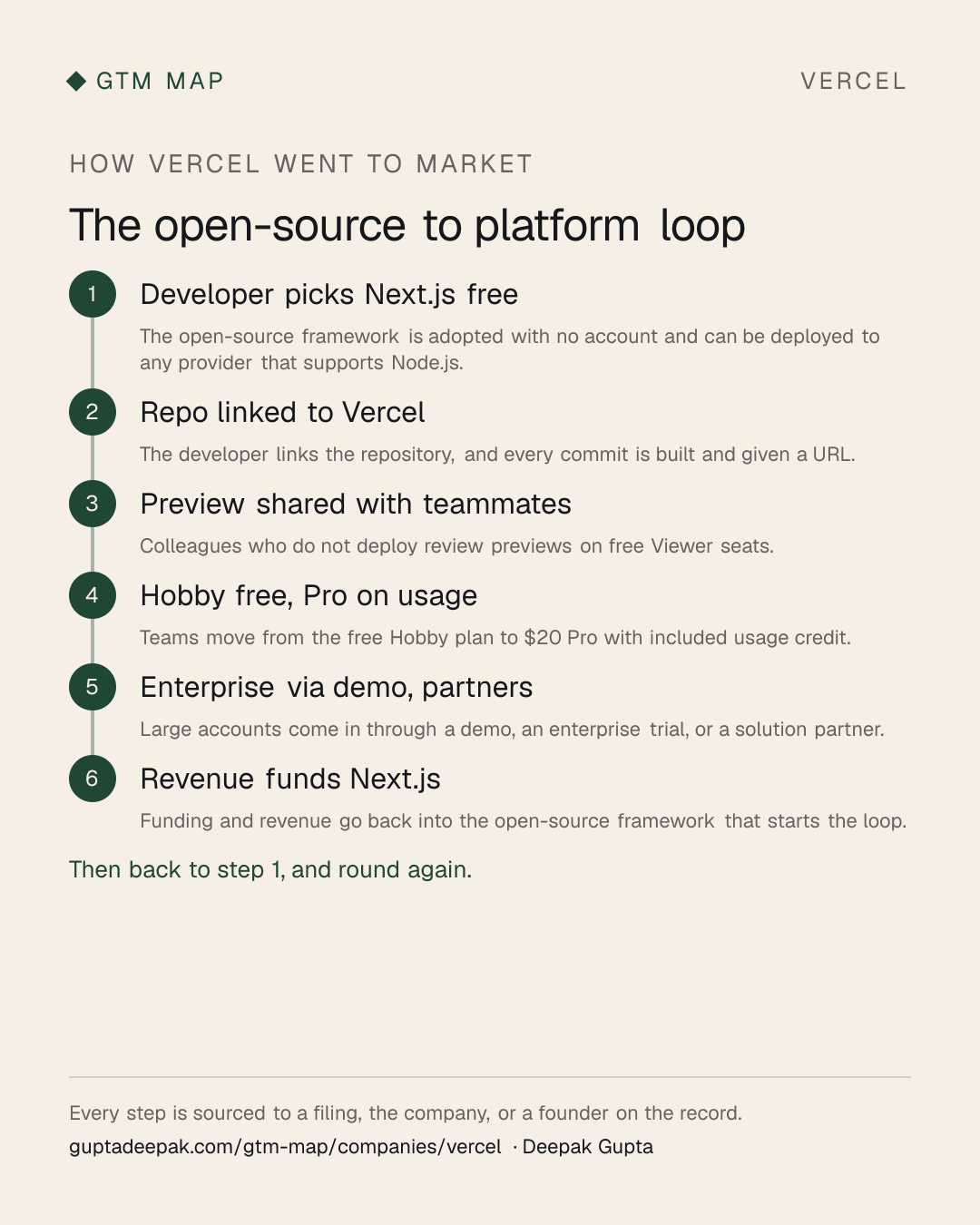
Developer picks Next.js free
The open-source framework is adopted with no account and can be deployed to any provider that supports Node.js.[35]
Repo linked to Vercel
The developer links the repository, and every commit is built and given a URL.[13]
Hobby free, Pro on usage
Teams move from the free Hobby plan to $20 Pro with included usage credit.[38]
Revenue funds Next.js
Funding and revenue go back into the open-source framework that starts the loop.[3]
Back to step 1, and round again
01The phases
PrimarySupportingTried, then dropped
2016 to 2019
Deploy tool plus an open-source framework
As ZEIT, the company sold a one-command deploy tool to solo developers and open-sourced Next.js, whose launch post ended with a deploy on ZEIT's own tool.
- Developer-led
The first product, now, put an app live with a single command, including SSL and routing, for solo developers. The company says developers loved it.[3]
- Open source
Next.js was open-sourced in October 2016 as a small framework for server-rendered React apps, and its launch post showed deployment with now as the final step. The company later called it the most notable of its open-source projects.[1],[3]
- Owned events
The first owned event was backendlessConf_, a remote conference in December 2019 that drew 3,888 registrations.[2]
- Developer-led
2020 to 2022
Vercel for frontend teams: free tier, Git integration, Next.js Conf
The rebrand to Vercel paired a free Hobby plan with zero-config deploys. Linking a repository became the way people met the platform, Next.js Conf became an annual event, and enterprise customers began to arrive without a sales team described in any source.
- Product-led
Setup took 15 seconds with zero-config deployments, the unlimited usage Hobby plan was free, and the company said anyone could set it up in a couple of clicks.[3]
- Developer-led
Developers link a repository and get a build and a URL on every commit. The CEO calls that Git integration a key unlock for growth and the way people get to know the platform.[13]
- Open source
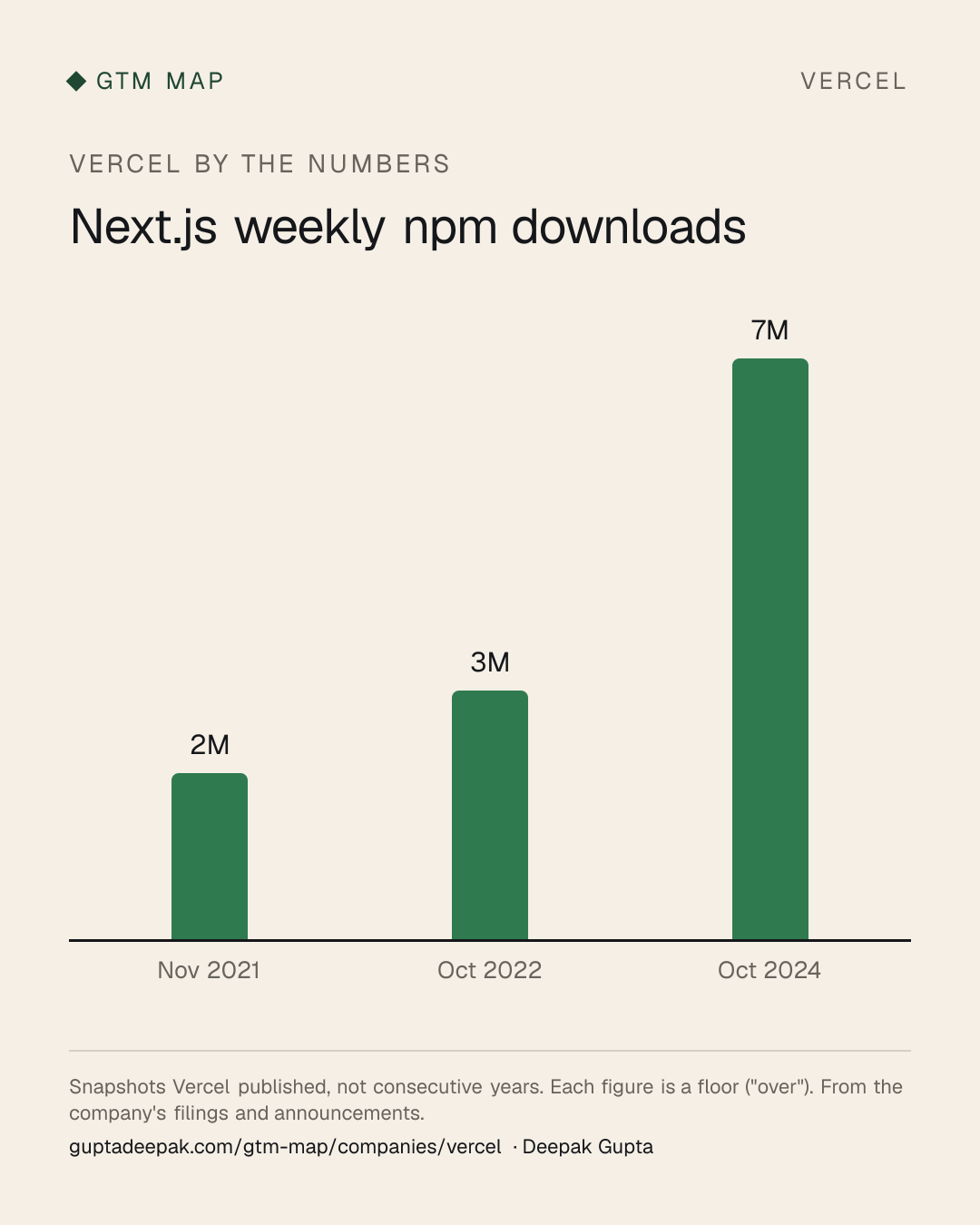
Funding was framed as money to keep investing in Next.js. By November 2021 Next.js had more than 1,800 contributors and over 2 million weekly installs.[3],[8]
- Owned events
Next.js Conf became an annual owned event with a CEO keynote and sponsors. A June 2021 Next.js community event with the Google Chrome team drew over 65,000 people.[5],[6],[9]
- Viral loop
Every deployment gets a Preview URL that teams share for review; Vercel cites Airbnb using them as its unit of collaboration. This shows non-developers seeing the product, not a measured conversion loop.[4],[13]
- Community
Vercel sponsored other frameworks and libraries, donated free accounts to hundreds of communities, and hired Svelte's creator to work on it full time with its governance unchanged.[7],[8]
- Product-led
2023 to 2024
Frontend Cloud for the enterprise: sales, partners, marketplaces
Self-serve stayed the entry path while enterprises bought through account teams, demos, and trials. Partners became half of sales, Vercel listed on AWS Marketplace, Pro moved to granular metering, and the company started calling its category the Frontend Cloud.
- Sales-assist
Hobby is free and Pro is $20 a month with a free trial, while enterprise customers have account teams and buy through a demo or an enterprise product trial.[38],[15],[39]
- Partner channel
By late 2024 one in two sales and project deliveries involved partners, with 70+ solution partners. The CEO says partners' sales engineers demo their back ends on Vercel, and the Vercel Marketplace resells integrated services with unified billing.[21],[13],[17],[18]
- Cloud marketplace
Vercel listed on AWS Marketplace in April 2023, pitching streamlined procurement and consolidated billing for AWS customers.[11]
- Usage pricing
Pro moved to paying for exactly what you use in granular increments, with Hobby still free. The CEO describes pricing as infrastructure metering combined with the collaboration value of the platform.[15],[13]
- Category creation
The CEO says early positioning should be relatable to what already exists, and that Vercel only later earned the right to try to define a category.[13]
- Owned events
Next.js Conf moved in person, with over 1,000 people in San Francisco and over 35 partner sponsors, and Vercel added its own product event, Ship, in New York.[20],[21],[16]
- Sales-assist
2023 to 2025
v0: an AI product-led front door
v0 went from a waitlist to free and paid plans, then team and enterprise plans, then an AI builder for everyone. Pricing moved to token-metered credits, and a referral bounty and ambassador program pushed it out.
- Product-led
v0 drew 100,000 waitlist registrations in three weeks and launched with a free plan and three paid plans. A Team plan at $30 per user per month followed, then the rename to v0.app, the AI builder for everyone.[12],[19],[27]
- Usage pricing
Usage moved from fixed message counts to input and output tokens converted to credits, with $5 of included credits a month on the free plan.[23]
- Referral program
The v0 Ambassador Program pays $10 for every Premium referral and $30 for every Team referral.[25]
- Community
Ambassadors get $100 in v0 credits a month and commit to creating and sharing content about v0 at least once a week.[25]
- Open source
The AI SDK repeated the Next.js pattern for AI apps, growing from 446,012 to 3,209,817 weekly downloads in a year. The CEO calls the open-source bet a powerful flywheel.[29]
- Product-led
2025 to now
AI Cloud and enterprise AI governance
Enterprise features moved into self-serve Pro, while a new COO and CRO built a Sales organization around governing apps and agents. Pricing became a flexible usage credit with execution-time compute billing, and Ship spread to five cities.
- Sales-assist
SAML SSO and HIPAA BAAs became available to everyone on Pro with no need to contact sales, while the enterprise tier and a new CRO focus on the largest companies.[28],[30],[39]
- Sales-led
A COO hired in 2025 leads go-to-market and a CRO hired in 2026 leads a global Sales team, selling a platform for shipping apps and agents behind a company's access and security boundaries. This shows structure and intent, not revenue mix.[22],[30],[33]
- Usage pricing
Pro replaced included allotments across 20+ products with a flexible usage balance starting at $20 of credit a month, and compute moved to Active CPU billing for execution time rather than wall time.[28],[24]
- Owned events
Ship went from over 1,200 people in New York in 2025 to London, Berlin, New York, Sydney, and San Francisco in 2026, with more than 2,700 at the San Francisco event.[24],[36]
- Open source
Next.js published a public Adapter API that Vercel's own adapter uses with no private hooks, and a quarterly program gives outside maintainers $3,600 in platform credits.[32],[34]
- Sales-assist
02The numbers
Show the data
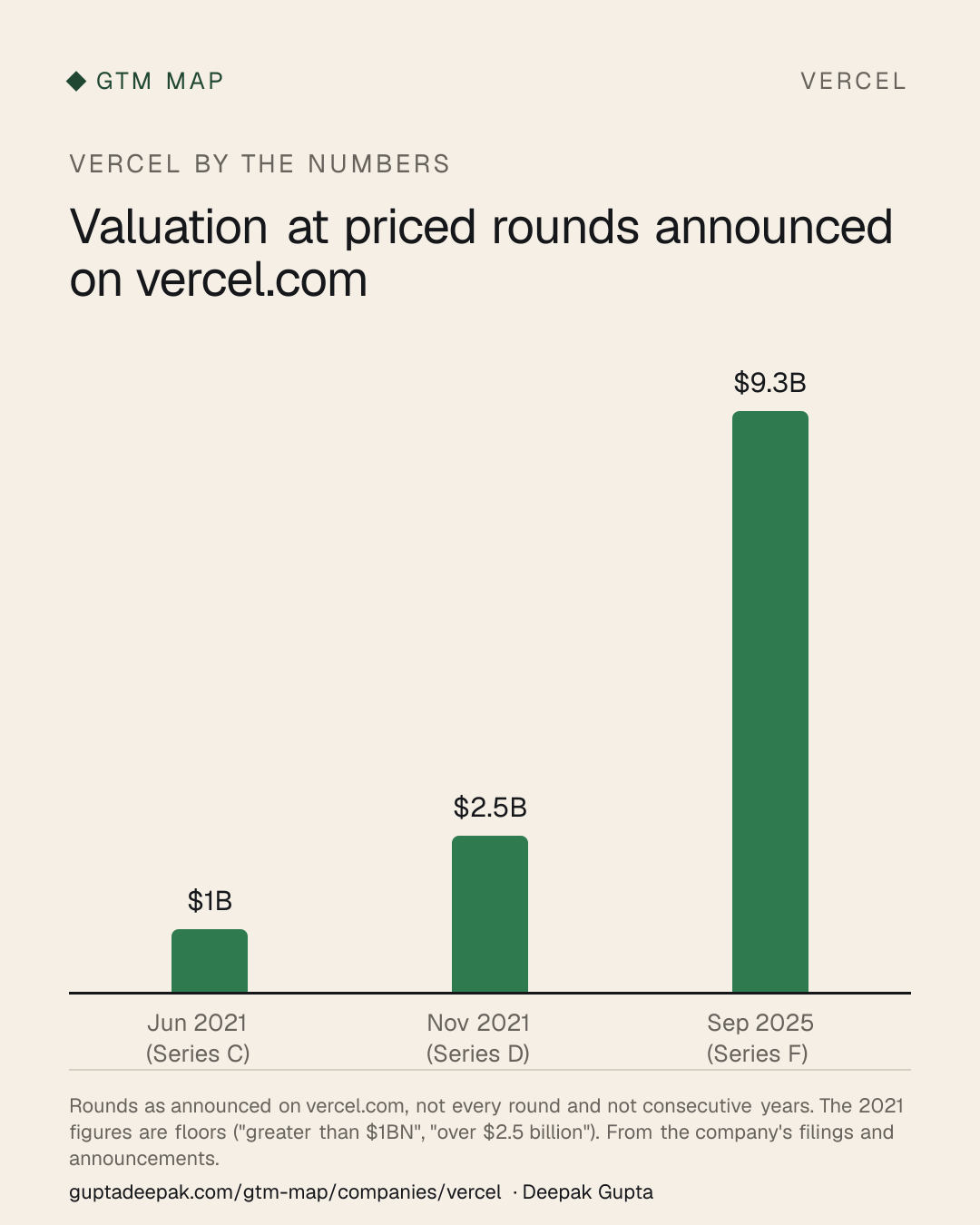
| Jun 2021 (Series C) | $1B | Company-stated |
|---|---|---|
| Nov 2021 (Series D) | $2.5B | Company-stated |
| Sep 2025 (Series F) | $9.3B | Company-stated |
| Metric | Value | As of | Basis |
|---|---|---|---|
| Frontend engineers and designers using its technology | 300,000+[3] | April 21, 2020 | Company-stated |
| Enterprise customer base | Tripled[5] | June 23, 2021 | Company-stated |
| Valuation (Series C, $102M raised) | Over $1B[5] | June 23, 2021 | Company-stated |
| Valuation (Series D, $150M raised, $313M total) | Over $2.5B[8] | November 23, 2021 | Company-stated |
| v0 waitlist registrations in three weeks | 100,000[12] | October 11, 2023 | Company-stated |
| Annual recurring revenue | $100M[41] | January 2024 | Reported |
| Next.js weekly downloads | Over 7 million[20] | October 25, 2024 | Company-stated |
| Sales and project deliveries done with partners | One in two[21] | November 15, 2024 | Company-stated |
| Weekly active domains | More than 4M[26] | August 7, 2025 | Company-stated |
| Paying teams with a lower or unchanged bill after the 2025 Pro change | Over 100,000[28] | September 9, 2025 | Company-stated |
| Valuation (Series F, $300M raised) | $9.3B[29] | September 30, 2025 | Company-stated |
| Next.js downloads in the prior 12 months | Over 500 million[29] | September 30, 2025 | Company-stated |
| People who have used v0 since general availability | More than 4 million[31] | February 3, 2026 | Company-stated |
| Revenue run rate | $340M[41] | February 2026 | Reported |
“Reported” figures come from trade press, not the company, and are shown with their date.
03Myth checks
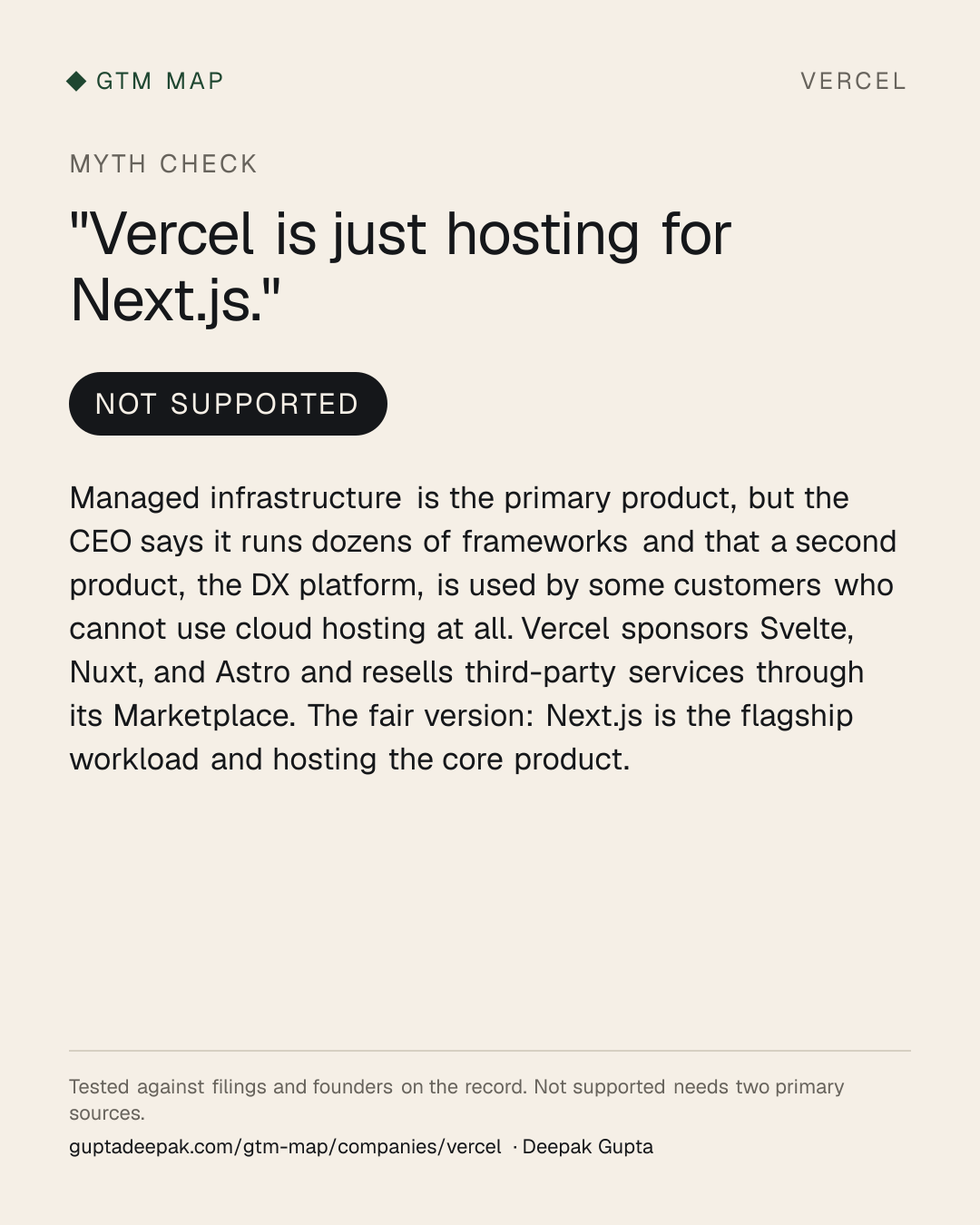
“Vercel is just hosting for Next.js.”
Not supportedManaged infrastructure is the primary product, but the CEO says it runs dozens of frameworks and that a second product, the DX platform, is used by some customers who cannot use cloud hosting at all. Vercel sponsors Svelte, Nuxt, and Astro and resells third-party services through its Marketplace. The fair version: Next.js is the flagship workload and hosting the core product.[13],[7],[8],[17]
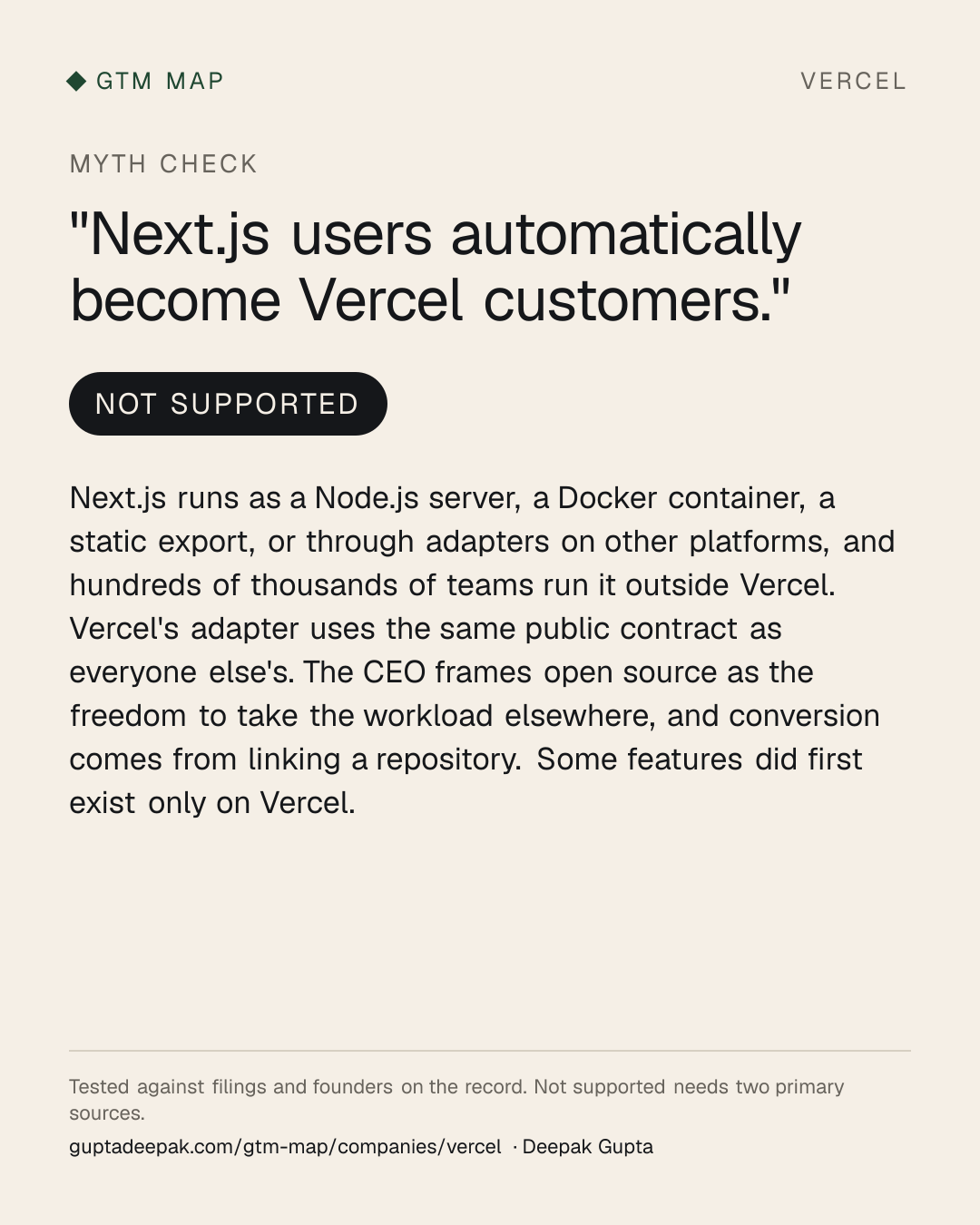
“Next.js users automatically become Vercel customers.”
Not supportedNext.js runs as a Node.js server, a Docker container, a static export, or through adapters on other platforms, and hundreds of thousands of teams run it outside Vercel. Vercel's adapter uses the same public contract as everyone else's. The CEO frames open source as the freedom to take the workload elsewhere, and conversion comes from linking a repository. Some features did first exist only on Vercel.[35],[32],[13],[14]
On the record
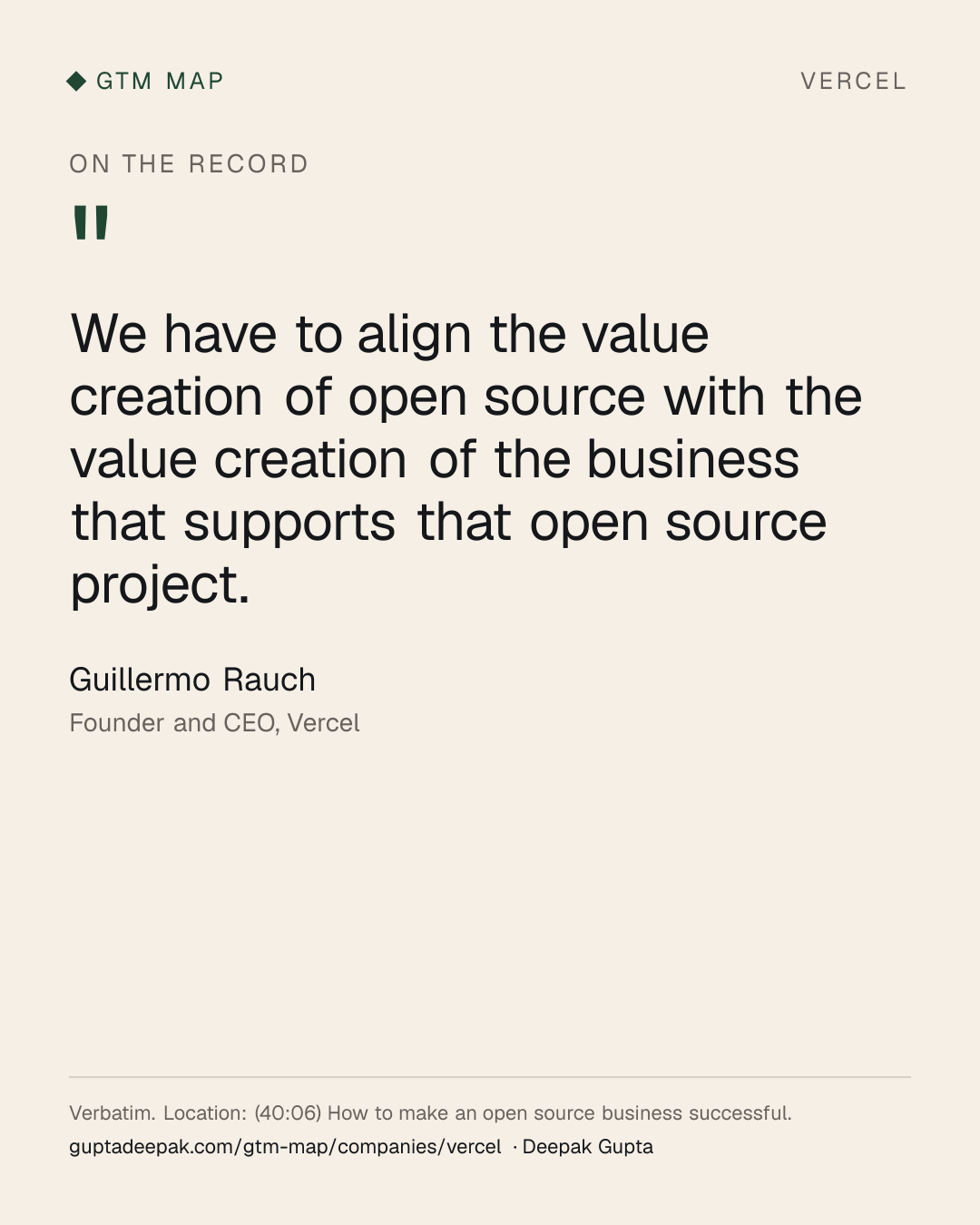
“We have to align the value creation of open source with the value creation of the business that supports that open source project.”
Guillermo Rauch, Founder and CEO, Vercel[13]
(40:06) How to make an open source business successful
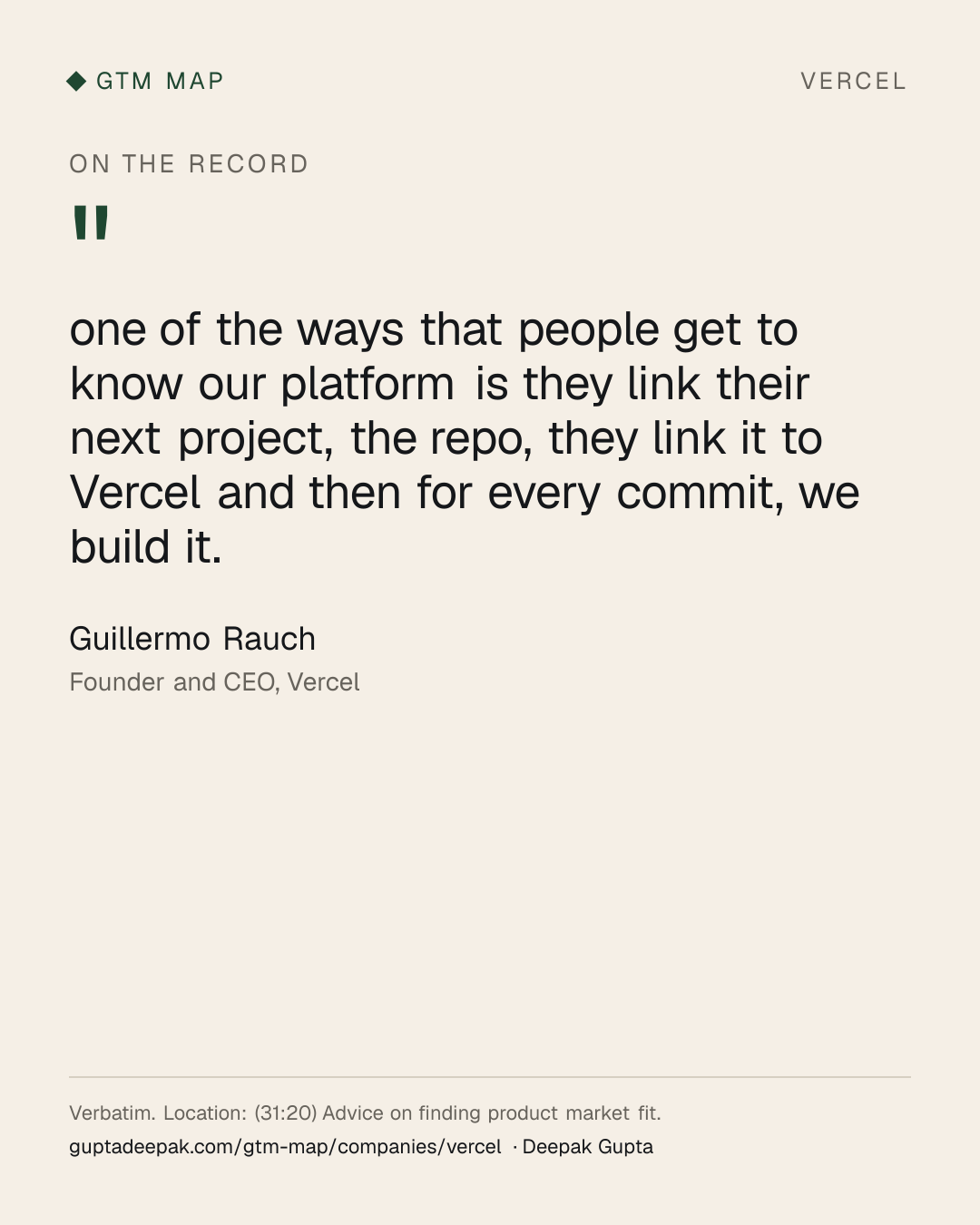
“one of the ways that people get to know our platform is they link their next project, the repo, they link it to Vercel and then for every commit, we build it.”
Guillermo Rauch, Founder and CEO, Vercel[13]
(31:20) Advice on finding product market fit
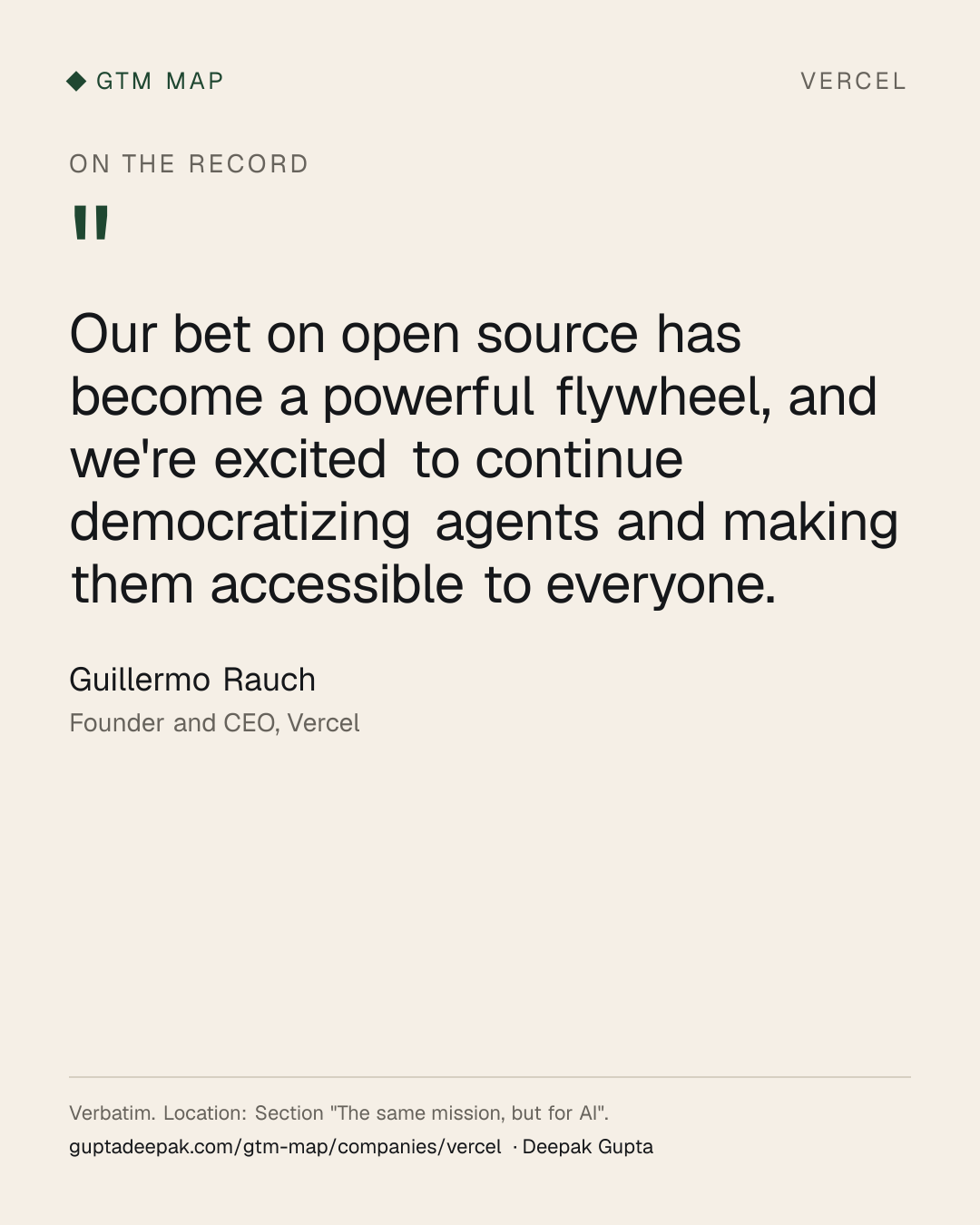
“Our bet on open source has become a powerful flywheel, and we're excited to continue democratizing agents and making them accessible to everyone.”
Guillermo Rauch, Founder and CEO, Vercel[29]
Section "The same mission, but for AI"
04What other companies can take from it
Give the framework away and charge for the operations it creates at scale.
Works when: The open-source project is easy on a laptop but hard to run globally, so teams in production face real ongoing work, and buyers value engineering time over infrastructure cost.
Backfires when: The project is trivial to self-host, so the hosted product looks like a markup, or the community comes to believe the framework is being bent toward the vendor's platform.
Based on: Deploy tool plus an open-source framework, Open source; Vercel for frontend teams: free tier, Git integration, Next.js Conf, Open source
Make the integration the acquisition channel.
Works when: The product attaches to a tool developers already use every day, such as Git hosting, and produces something shareable with non-developers on each use.
Backfires when: The output is private by nature, so nothing gets shared, or the host platform can copy the integration natively.
Based on: Vercel for frontend teams: free tier, Git integration, Next.js Conf, Developer-led; Vercel for frontend teams: free tier, Git integration, Next.js Conf, Viral loop
Push enterprise features down into self-serve and point sales at a new enterprise problem.
Works when: A large paying self-serve base already exists and the enterprise offer can be rebuilt around a new buying problem, such as AI governance, rather than SSO gating.
Backfires when: SSO and compliance gates are the main reason enterprises sign contracts, so removing them without a new enterprise story shrinks deal sizes.
Based on: AI Cloud and enterprise AI governance, Sales-assist; AI Cloud and enterprise AI governance, Sales-led
Launch an AI-native product for people who are not yet your users, and let its output land on your platform.
Works when: The core platform is where generated output naturally ends up, such as hosting and deployment, so the AI product feeds core usage.
Backfires when: The AI product's users never need the core platform, or AI-native rivals offer the same generation free and host it themselves.
Based on: v0: an AI product-led front door, Product-led; v0: an AI product-led front door, Usage pricing
05 · GTM Now
What changes in the AI era, and what to do now
Analysis by Deepak Gupta. This is opinion built on the sourced record above, not part of it.[29],[40],[37],[32],[24],[27],[31],[28],[33]
Still works
- Open-source framework adoption as the top of the funnel. Vercel says the biggest AI products use Next.js for their frontends, and the AI SDK repeated the pattern at over 3 million weekly downloads.
- Coding agents pick defaults from what is widely used and documented, which favours the most-downloaded framework (analysis).
Breaks
- The developer as the only entry user. The CEO says everybody can now create an app, and Vercel describes citizen developers building with AI coding tools.
- Framework fit as a moat. Vercel's adapter now uses the same public contract as other hosts, so the hosting decision rests on operations and price (analysis).
- Bundled pricing when AI workloads sit idle waiting on model calls, the reason Vercel gives for billing compute by execution time.
What replaces it
- v0 and coding agents as a new front door for people who do not write code.
- Execution-time compute and a flexible usage credit in place of bundled allotments.
- An enterprise sale built on governing every builder, agent, and app behind company access and security boundaries, rather than on SSO gating.
Apply it now
If you are
A seed to Series B developer-infrastructure company with an open-source project developers adopt for free and a hosted product with usage costs, selling to engineering teams under $10K a year at first
- Keep the open-source project fully usable without your platform and document the self-host path yourself, so hosting wins on operations, not lock-in.
- Build the deepest integration you can with the developer's Git or CI tool, and make every change produce a shareable link.
- Run a free tier with no card, then a low flat plan with included usage and granular overage, with spend alerts on by default.
- Host an annual conference for the open-source project, not the product, with partner sponsors.
You will know it works when: Share of new paid teams whose first event was linking a repository, and paid conversion among accounts whose preview links were opened by a non-deploying viewer.
Based on Vercel's Vercel for frontend teams: free tier, Git integration, Next.js Conf, Vercel for frontend teams: free tier, Git integration, Next.js Conf, Vercel for frontend teams: free tier, Git integration, Next.js Conf, Vercel for frontend teams: free tier, Git integration, Next.js Conf, Vercel for frontend teams: free tier, Git integration, Next.js Conf
If you are
A growth-stage platform with a large self-serve base, enterprise accounts arriving bottom-up, and AI tools letting non-developers in those accounts build software
- Move table-stakes enterprise features such as SSO and compliance documents into the self-serve paid plan.
- Reposition the enterprise tier around governing non-developer builders and agents: identity, data access, model and token budgets, and audit.
- Sign solution partners and give them co-selling support before scaling direct reps.
- List on the cloud marketplace your largest customers already buy through.
- Launch an AI builder that deploys onto your platform, with a free credit allowance and a referral bounty.
You will know it works when: Share of enterprise revenue from accounts that started on self-serve, and the number of non-developer builders per enterprise account.
Based on Vercel's AI Cloud and enterprise AI governance, AI Cloud and enterprise AI governance, Frontend Cloud for the enterprise: sales, partners, marketplaces, Frontend Cloud for the enterprise: sales, partners, marketplaces, v0: an AI product-led front door
Motions in this record
Share the visuals
Every card is drawn from the sourced record above and sized 1080 by 1350 for LinkedIn and X. Free to share with a link back to this page.
Sources
- [1]CompanyNext.js (ZEIT blog, read via an Internet Archive copy) (October 25, 2016)
- [2]CompanybackendlessConf_ 2019 (December 23, 2019)
- [3]CompanyZEIT is now Vercel (April 21, 2020)
- [4]Company$40M to Build the Next Web (December 16, 2020)
- [5]Company$102M to Continue Building the Next Web, Together (June 23, 2021)
- [6]CompanyAt Next.js Conf 2021, let's make the Web. Faster. (September 20, 2021)
- [7]CompanyVercel welcomes Rich Harris, creator of Svelte (November 11, 2021)
- [8]CompanyAnnouncing $150M to build the end-to-end platform for the modern Web (November 23, 2021)
- [9]CompanyAt Next.js Conf 2022, learn to build better and scale faster (September 2, 2022)
- [10]CompanyNext.js 13 (Next.js blog) (October 25, 2022)
- [11]CompanyPowering a serverless Web: Vercel joins AWS Marketplace (April 5, 2023)
- [12]CompanyAnnouncing v0: Generative UI (October 11, 2023)
- [13]Founder interviewHow Vercel found extreme product-market fit by focusing on simplification (First Round Review, In Depth podcast, transcript) (Guillermo Rauch, November 2, 2023, at (31:20) Advice on finding product market fit; (40:06) How to make an open source business successful; (44:54) Insights on product positioning and category creation; (48:52) Vercel's journey through becoming multi-product)
- [14]Founder interviewInterview: Vercel's Guillermo Rauch talks up AI-generated UI, unpacks Next.js relationship to React (DevClass, at AWS re:Invent) (Guillermo Rauch, December 1, 2023, at direct quotes in the article body, answering the "difficult to deploy anywhere but Vercel" complaint)
- [15]CompanyImproved infrastructure pricing (April 4, 2024)
- [16]CompanyVercel Ship 2024 recap (May 24, 2024)
- [17]CompanyIntroducing the Vercel Marketplace (August 28, 2024)
- [18]CompanyHow Supabase increased signups through the Vercel Marketplace (October 7, 2024)
- [19]Companyv0 plans for teams are here (October 15, 2024)
- [20]CompanyRecap: Next.js Conf 2024 (October 25, 2024)
- [21]CompanyAccelerating partner success: Vercel's new Partner Program benefits (November 15, 2024)
- [22]CompanyJeanne DeWitt Grosser joins Vercel as COO (March 13, 2025)
- [23]CompanyUpdated v0 pricing (May 13, 2025)
- [24]CompanyVercel Ship 2025 recap (June 26, 2025)
- [25]CompanyJoin the v0 Ambassador Program (July 29, 2025)
- [26]CompanyVercel named a Visionary in the 2025 Gartner Magic Quadrant for Cloud-Native Application Platforms (August 7, 2025)
- [27]Companyv0.dev is now v0.app (August 11, 2025)
- [28]CompanyA more flexible Pro plan for modern teams (September 9, 2025)
- [29]CompanyTowards the AI Cloud: Our Series F (September 30, 2025)
- [30]CompanyNick Bogaty joins Vercel as Chief Revenue Officer (January 13, 2026)
- [31]CompanyIntroducing the new v0 (February 3, 2026)
- [32]CompanyNext.js Across Platforms: Adapters, OpenNext, and Our Commitments (March 25, 2026)
- [33]CompanyVercel for Enterprise Apps and Agents (June 16, 2026)
- [34]CompanyVercel Open Source Program: Spring 2026 cohort (June 29, 2026)
- [35]CompanyDeploying (Next.js docs, last updated 2026-08-06) (August 6, 2026)
- [36]CompanyVercel Ship 2026 recap (October 15, 2026)
- [37]CompanyVercel for Enterprise (October 15, 2026)
- [38]CompanyVercel Pricing (undated)
- [39]CompanyVercel Enterprise (undated)
- [40]Founder interviewVercel CEO Guillermo Rauch signals IPO readiness as AI agents fuel revenue surge (TechCrunch, Rauch onstage at HumanX) (Guillermo Rauch, April 13, 2026, at direct quotes in the article body)
- [41]Trade pressVercel CEO Guillermo Rauch signals IPO readiness as AI agents fuel revenue surge (revenue figures, citing The Information and Forbes) (TechCrunch, April 13, 2026)
Every phase, motion, and myth verdict cites a filing, the company's own pages, or a founder speaking on the record. See the methodology.