
Developer and enterprise · public
How GitLab went to market
GitLab began as an open source project, then sold open core: free features for individual developers, paid tiers placed by who buys them. Developers brought it into companies, and an enterprise sales force and partners turned that usage into contracts. It later pruned its cheapest tier, tightened free limits, and added usage-priced AI credits to seats.
- Buyer:
- Developers, Mid-market, Enterprise
- Contract size:
- Mixed
- Checked:
- October 18, 2026
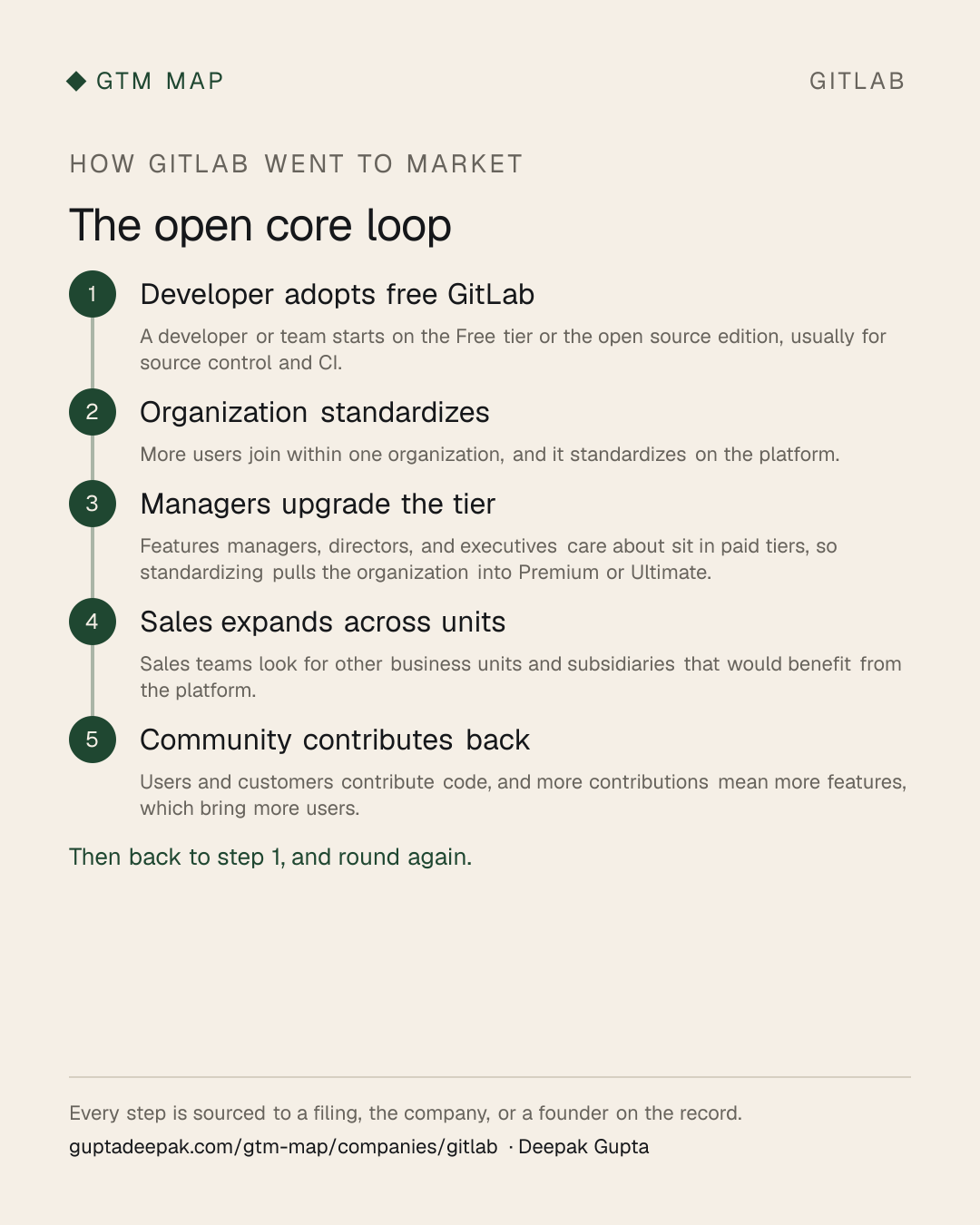
Developer adopts free GitLab
A developer or team starts on the Free tier or the open source edition, usually for source control and CI.[1]
Organization standardizes
More users join within one organization, and it standardizes on the platform.[1]
Managers upgrade the tier
Features managers, directors, and executives care about sit in paid tiers, so standardizing pulls the organization into Premium or Ultimate.[5]
Sales expands across units
Sales teams look for other business units and subsidiaries that would benefit from the platform.[1]
Community contributes back
Users and customers contribute code, and more contributions mean more features, which bring more users.[1]
Back to step 1, and round again
01The phases
PrimarySupportingTried, then dropped
2011 to 2015
Open source project and monetization experiments
GitLab started in 2011 as an open source project and became a company in 2014. Before open core, the founders tried donations, which reached $1,000 in the best month, then paid feature requests, then a support model, and dropped each one.
- Open source
Dmitriy Zaporozhets created GitLab in 2011, and the project absorbed more than 300 outside contributions in its first year. The company was founded in 2014.[1]
- Community
Contributors shaped the product itself: in 2015 a community member built a better CI runner that became the default, and he later joined the company.[1]
- Product-led
Hosted GitLab.com was the first bet on a business model. Sijbrandij says it was used mostly by small teams while large organizations self-hosted, so GitLab made GitLab.com free and monetized single-tenant installs instead.[9]
- Open source
2015 to 2019
Open core and buyer-based tiers
After Y Combinator in 2015, GitLab settled on open core and placed each feature in a tier by its likely buyer. Enterprise customers found the open source project on their own, and GitLab only began hiring sales development reps in 2016.
- Open source
A free open source Community Edition shipped alongside a proprietary Enterprise Edition. Features for individual contributors are open source; features for managers, directors, and executives go into paid tiers.[9],[10],[14]
- Developer-led
Asked how early enterprise customers found GitLab, Sijbrandij said they did no marketing or outbound: "They just found the open source project." He also said open source by itself is not enough without sales and marketing.[9]
- Product-led
Free GitLab.com proved a better indicator of enterprise purchase than open source downloads, because GitLab had the email addresses of hosted users and could reach out to them.[9]
- Brand narrative
Radical transparency as a public posture: an open company handbook, public strategy and OKRs, and open issue trackers even for finance and marketing, which Sijbrandij called a superpower.[9],[10]
- Land and expand
Large accounts began to appear: a first $100,000 ARR customer in 2017, the Ultimate tier at $99 per month in 2018, 20 such customers that year, and a first $1 million ARR customer in 2019.[1]
- Open source
2019 to 2021
Enterprise sales, partners, and the IPO
GitLab invested heavily in enterprise sales from 2019, built a dedicated enterprise team and a partner program in 2020, and went public in October 2021 at $77 a share, with sales and marketing spending above revenue along the way.
- Sales-led
Selling ran in three layers: self-service, high-velocity inside sales, and outbound enterprise sales for organizations over 2,000 employees. Enterprise customers were more than 60% of ARR in FY2021, and sales and marketing cost 122% of revenue in FY2020 and 101% in FY2021.[1],[3]
- Land and expand
The customer journey begins with developers and expands to senior executive buyers, with organizations moving into higher tiers such as Ultimate for security. Dollar-based net retention was 179% in FY2020 and 148% in FY2021.[1]
- Open source
The S-1 describes the free tier as targeted lead generation for paid customers and the large open source installed base as the source of paying customers.[1]
- Partner channel
An Alliances and Channels initiative launched in 2020, with AWS, Google Cloud, and national system integrators and resellers, then Atlassian and Red Hat in 2021.[1]
- Cloud marketplace
Google Cloud and AWS offer GitLab on their marketplaces, and the FY2024 10-K repeats this. No filing discloses marketplace revenue.[1],[4]
- Brand narrative
The S-1 presents all-remote work since inception and a public handbook of over 2,000 webpages as brand advantages with customers and recruits, strengthened by the shift to remote work during COVID-19.[1]
- Outbound
Marketing ran sales development and account-based marketing alongside digital demand generation, events, and content.[1]
- Owned events
GitLab hosts Commit, its annual user conference, plus Contribute for the community; both moved online during the pandemic.[1]
- Community
Contributors grew from more than 1,600 in January 2020 to more than 2,600 in July 2021, and the roadmap is public so the community can give feedback.[1]
- Sales-led
2021 to 2024
Pruning the cheap tier and the free ceiling
GitLab ended its lowest paid tier in January 2021, capped Free private groups on GitLab.com at 5 users from October 2022, and raised the Premium list price in April 2023, while enterprise sales kept growing large accounts.
- Land and expand
Starter and Bronze, 27% of FY2020 revenue, were ended for missing the company's hurdle rate, with customers moved to Free or Premium. Premium then rose from $19 to $29 per user per month, GitLab's first price increase in more than five years.[11],[1],[13]
- Product-led
Free kept 89% of the old Starter features, but Free private groups on GitLab.com were capped at 5 users. The stewardship promise against artificial limits covers the open source codebase, not the SaaS.[11],[12],[14]
- Community
Open source projects, education, and startups were exempted from the Free limits through community programs, which give qualifying projects Ultimate features.[12],[17],[18]
- Sales-led
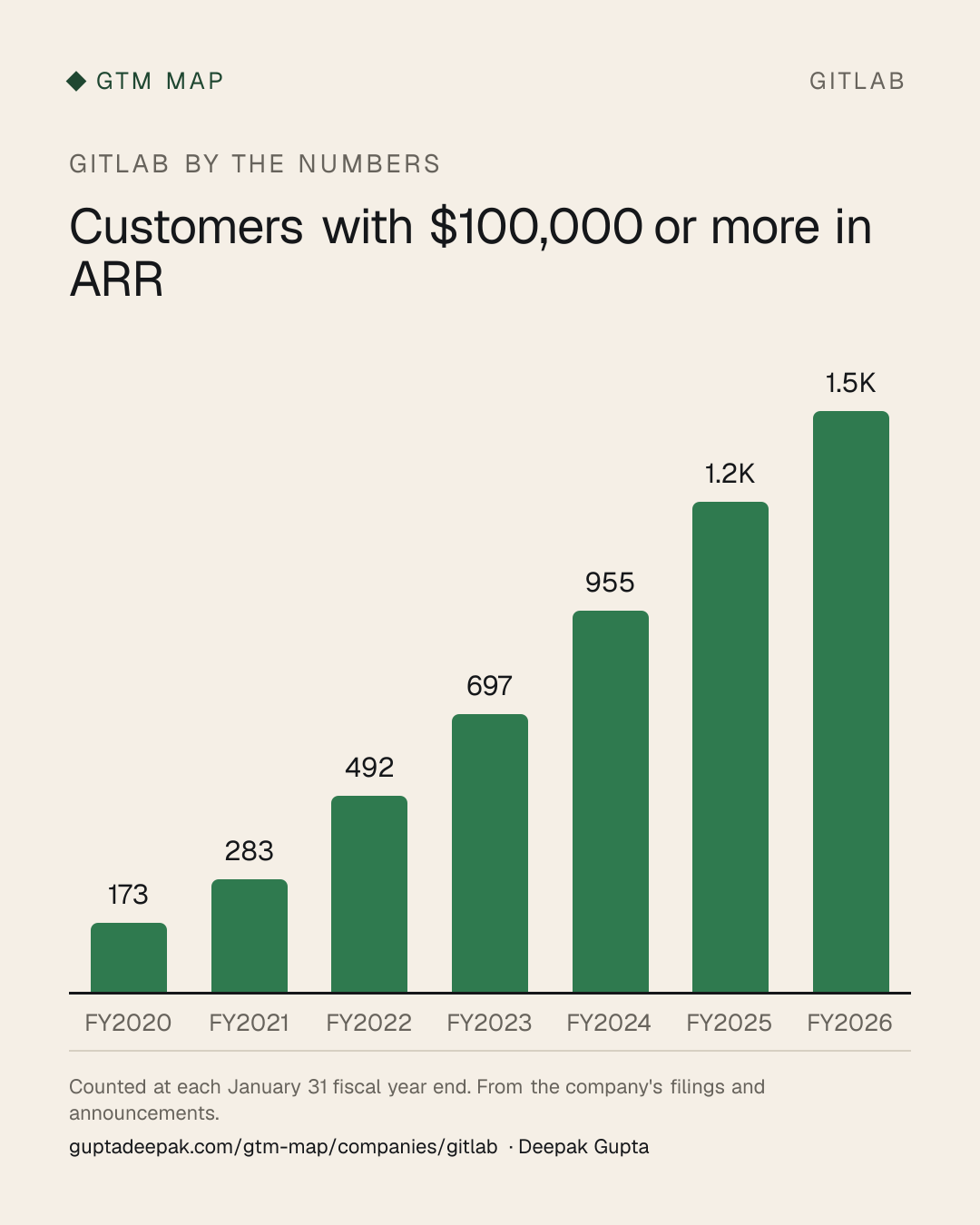
Enterprise sales investment continued, and customers above $100,000 ARR rose from 492 in FY2022 to 955 in FY2024.[3],[4]
- Land and expand
2024 to now
AI agents and hybrid pricing
Bill Staples succeeded co-founder Sid Sijbrandij as CEO in December 2024. GitLab now sells seats for the platform plus usage-based credits for AI agents to an enterprise and public sector base, while tightening Free limits further.
- Sales-led
Public sector and enterprise customers were more than 70% of ARR in FY2026, and the sales organization is structured by region and size with vertical teams for regulated industries.[5],[6]
- Usage pricing
Seat pricing covers the platform and usage-based GitLab Credits cover Duo Agent Platform capabilities. Premium and Ultimate include monthly credits, and GitLab Flex puts seats and credits under one annual commitment.[5],[16],[8]
- Land and expand
Expansion is now sold as users, tiers, and credits, while dollar-based net retention fell from 130% in FY2024 to 118% in FY2026 and 117% in the quarter to July 2026.[5],[8]
- Developer-led
The 10-K names two entry points: bottom-up adoption by developers and top-down buying by executives.[5]
- Product-led
Free is positioned for individual developers and trials. User limits apply to all remaining Free private namespaces from August 15, 2026, and Free accounts created after January 27, 2026 are limited to three top-level groups.[5],[12],[15]
- Open source
Open core is still the stated model, and users contributed more than 6,500 merge requests in calendar 2025.[5]
- Partner channel
Hyperscalers including Google Cloud and AWS, software vendors, global resellers, and system integrators complement direct sales.[5]
- Sales-led
02The numbers
Show the data
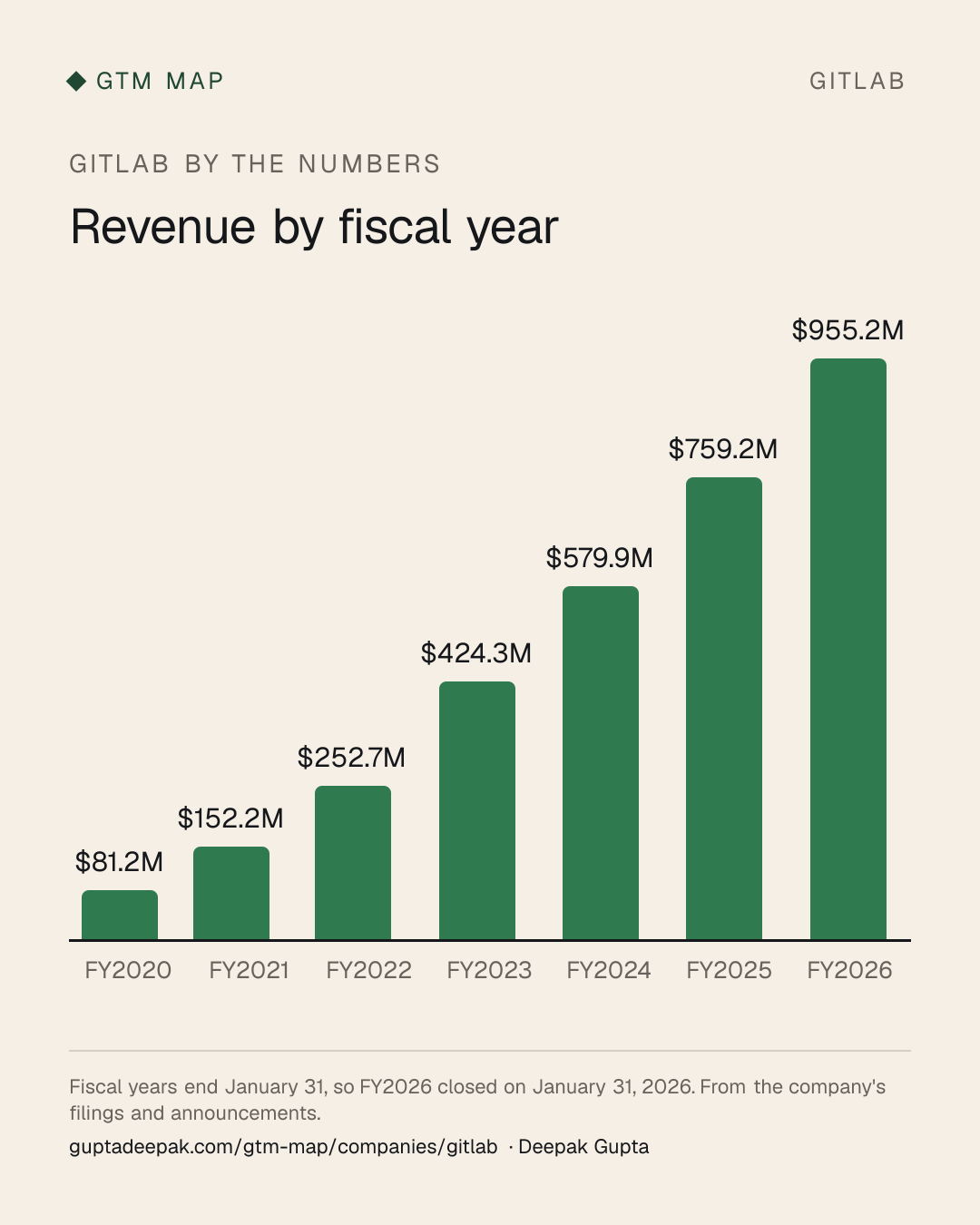
| FY2020 | $81.2M | From a filing |
|---|---|---|
| FY2021 | $152.2M | From a filing |
| FY2022 | $252.7M | From a filing |
| FY2023 | $424.3M | From a filing |
| FY2024 | $579.9M | From a filing |
| FY2025 | $759.2M | From a filing |
| FY2026 | $955.2M | From a filing |
| Metric | Value | As of | Basis |
|---|---|---|---|
| Revenue, FY2026 | $955.2M, up 26%[5] | January 31, 2026 | From a filing |
| ARR, FY2026 | Crossed $1B[7] | January 31, 2026 | Company-stated |
| Dollar-based net retention, FY2020, FY2021, July 2021 | 179%, 148%, 152%[1] | July 31, 2021 | From a filing |
| Dollar-based net retention, FY2024 to FY2026 | 130%, 123%, 118%[5] | January 31, 2026 | From a filing |
| Dollar-based gross retention, FY2020 and FY2021 | 97% each year[1] | January 31, 2021 | From a filing |
| Sales and marketing as a share of revenue, FY2020 to FY2022 | 122%, 101%, 76%[3] | January 31, 2022 | From a filing |
| Sales and marketing as a share of revenue, FY2024 to FY2026 | 61%, 51%, 46%[5] | January 31, 2026 | From a filing |
| Ultimate tier share of ARR, FY2020 to July 2021 | 17%, 26%, 29%[1] | July 31, 2021 | From a filing |
| SaaS share of ARR, FY2020 to FY2021 | 9% to 16%[1] | January 31, 2021 | From a filing |
| Paying customers and Base Customers (over $5K ARR), FY2021 | 15,310 paying, 2,745 Base[1] | January 31, 2021 | From a filing |
| Registered users and Base Customers, FY2026 | More than 50M users, 10,682 Base[5] | January 31, 2026 | From a filing |
| Customers above $1M ARR, FY2026 | 155, from 123[5] | January 31, 2026 | From a filing |
| IPO price and gross proceeds | $77.00 a share, $800.8M[2] | October 14, 2021 | From a filing |
| Latest quarter, Q2 FY2027 | $286.3M revenue, up 21%; 1,571 customers above $100K ARR; 117% net retention[8] | July 31, 2026 | From a filing |
“Reported” figures come from trade press, not the company, and are shown with their date.
03Myth checks
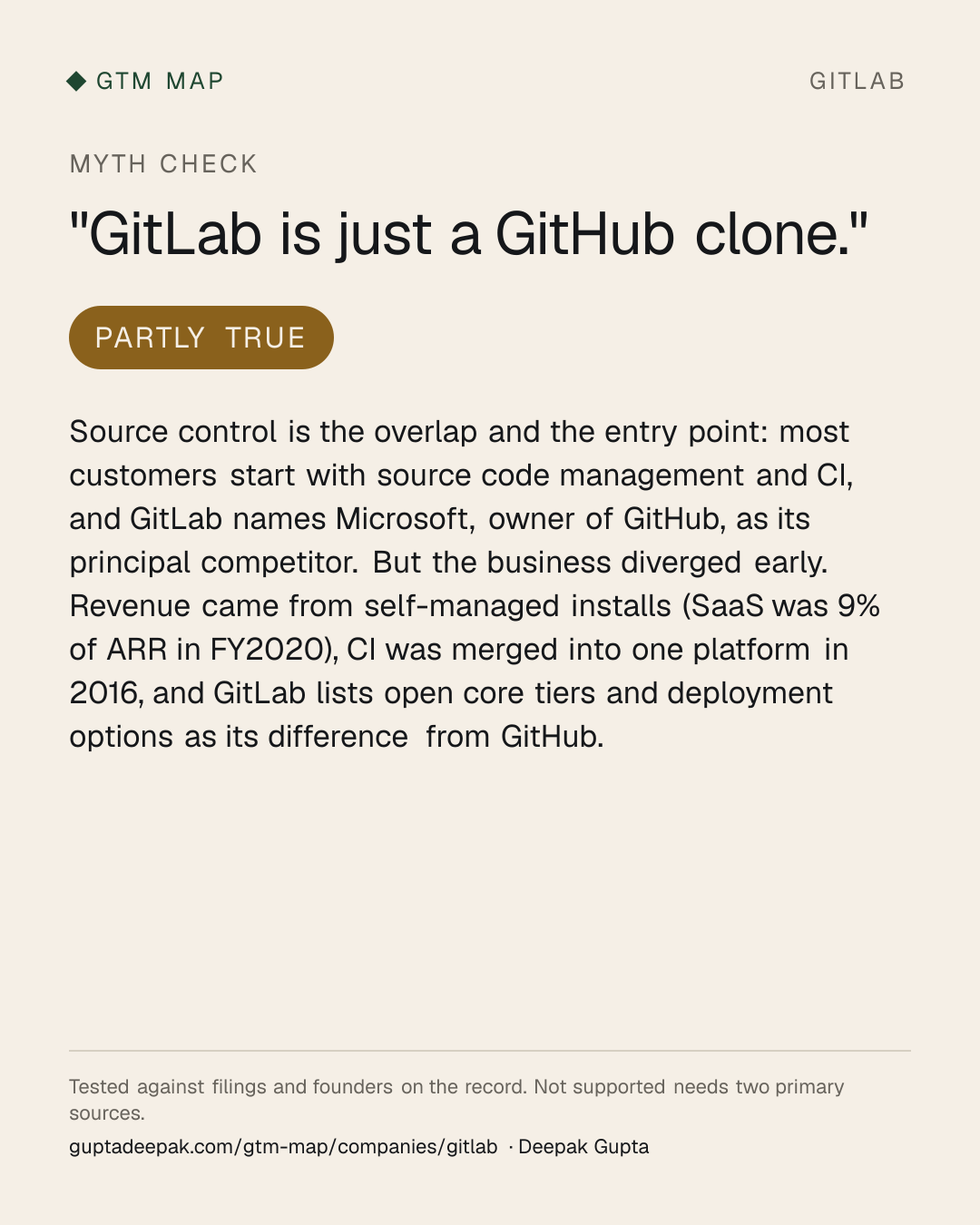
“GitLab is just a GitHub clone.”
Partly trueSource control is the overlap and the entry point: most customers start with source code management and CI, and GitLab names Microsoft, owner of GitHub, as its principal competitor. But the business diverged early. Revenue came from self-managed installs (SaaS was 9% of ARR in FY2020), CI was merged into one platform in 2016, and GitLab lists open core tiers and deployment options as its difference from GitHub.[1],[9],[5]
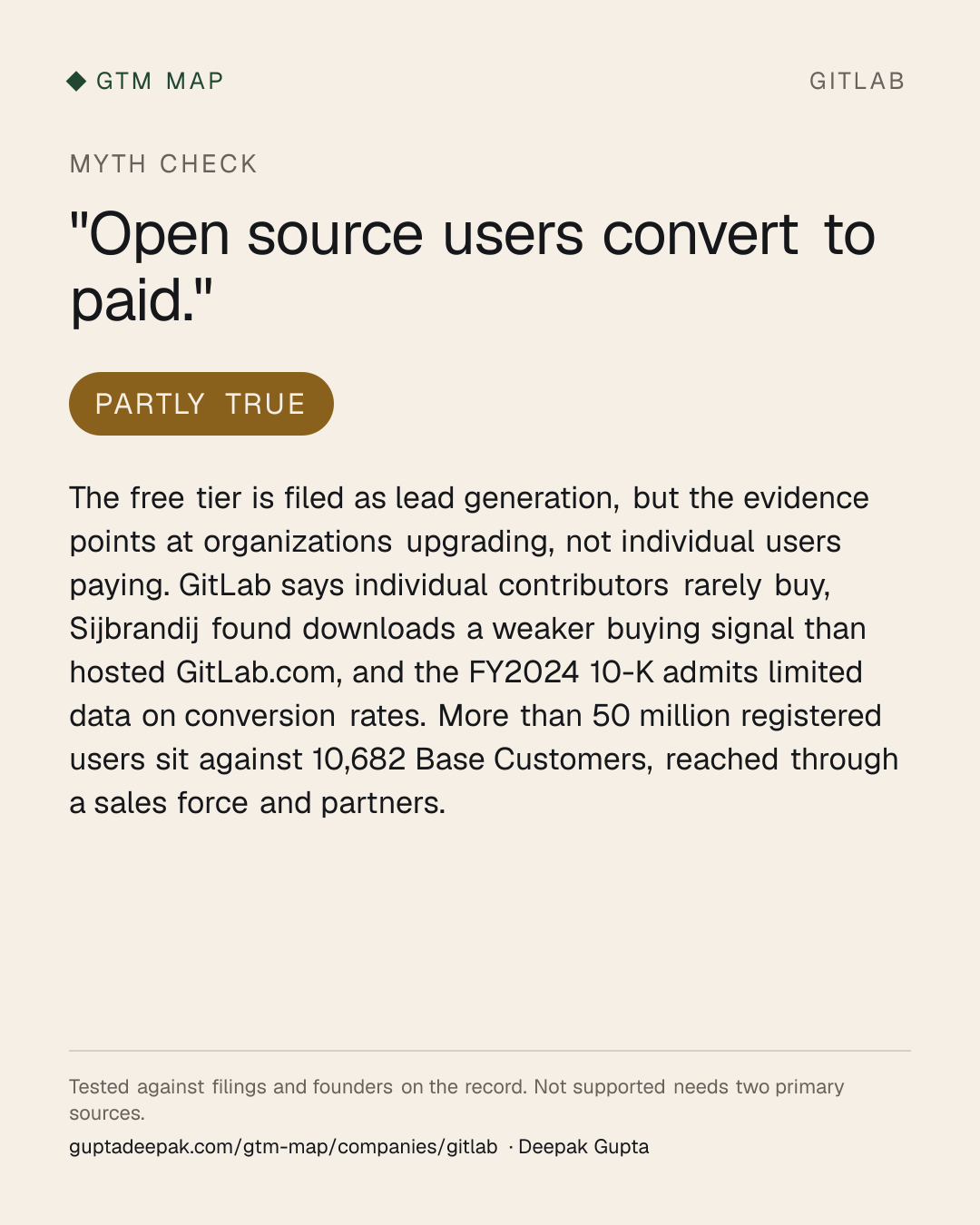
“Open source users convert to paid.”
Partly trueThe free tier is filed as lead generation, but the evidence points at organizations upgrading, not individual users paying. GitLab says individual contributors rarely buy, Sijbrandij found downloads a weaker buying signal than hosted GitLab.com, and the FY2024 10-K admits limited data on conversion rates. More than 50 million registered users sit against 10,682 Base Customers, reached through a sales force and partners.[1],[9],[4],[5]
On the record
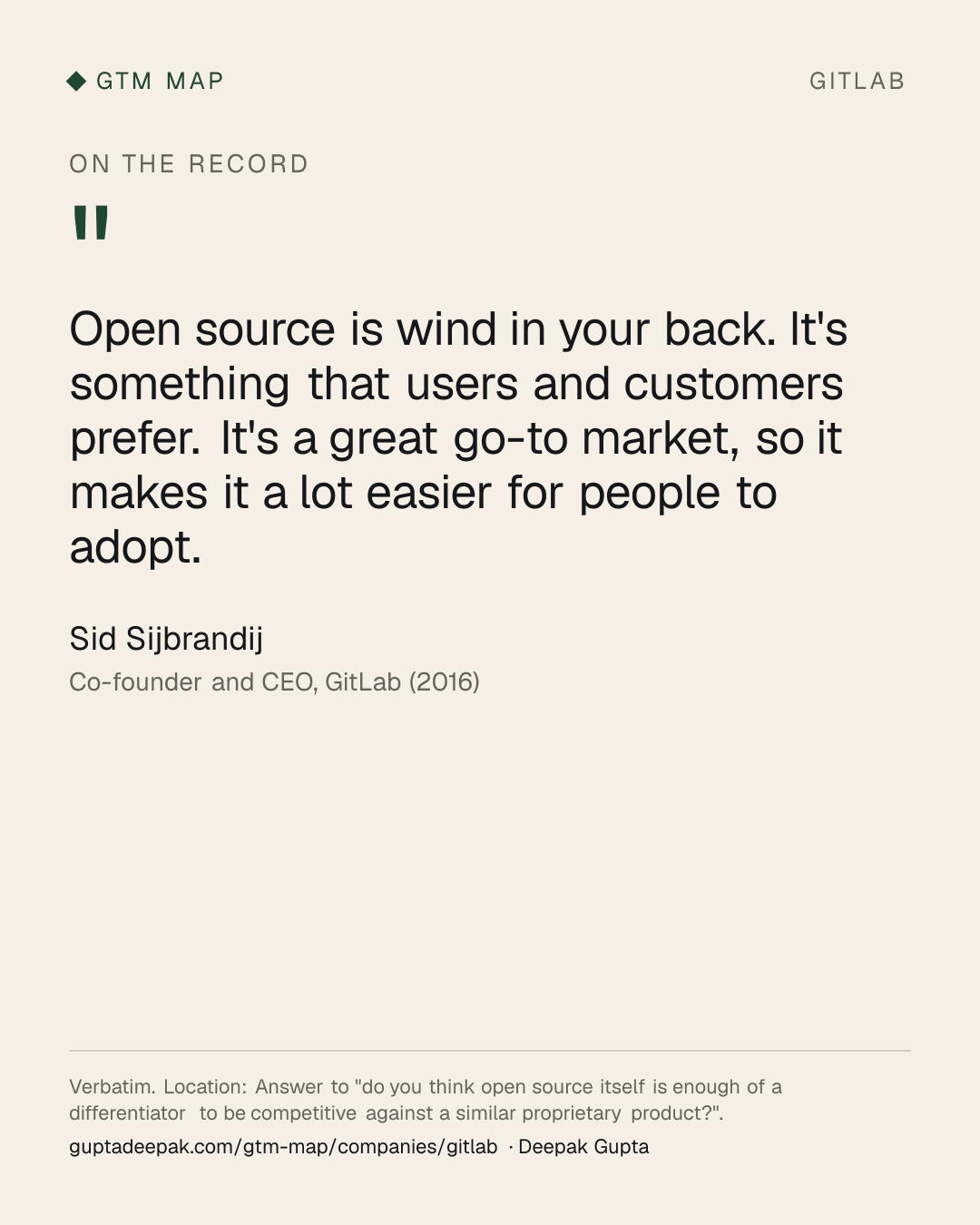
“Open source is wind in your back. It's something that users and customers prefer. It's a great go-to market, so it makes it a lot easier for people to adopt.”
Sid Sijbrandij, Co-founder and CEO, GitLab (2016)[9]
Answer to "do you think open source itself is enough of a differentiator to be competitive against a similar proprietary product?"
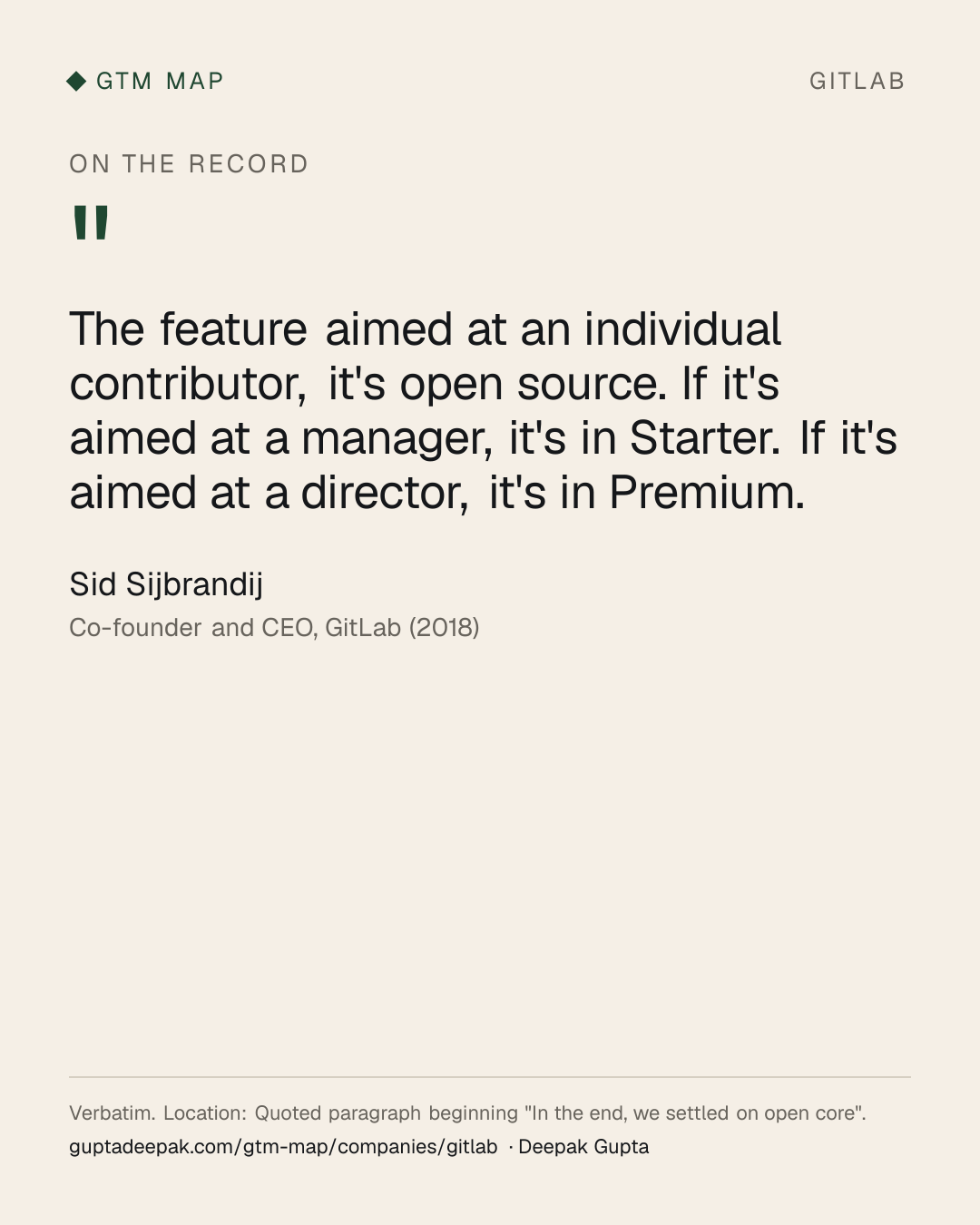
“The feature aimed at an individual contributor, it's open source. If it's aimed at a manager, it's in Starter. If it's aimed at a director, it's in Premium.”
Sid Sijbrandij, Co-founder and CEO, GitLab (2018)[10]
Quoted paragraph beginning "In the end, we settled on open core"
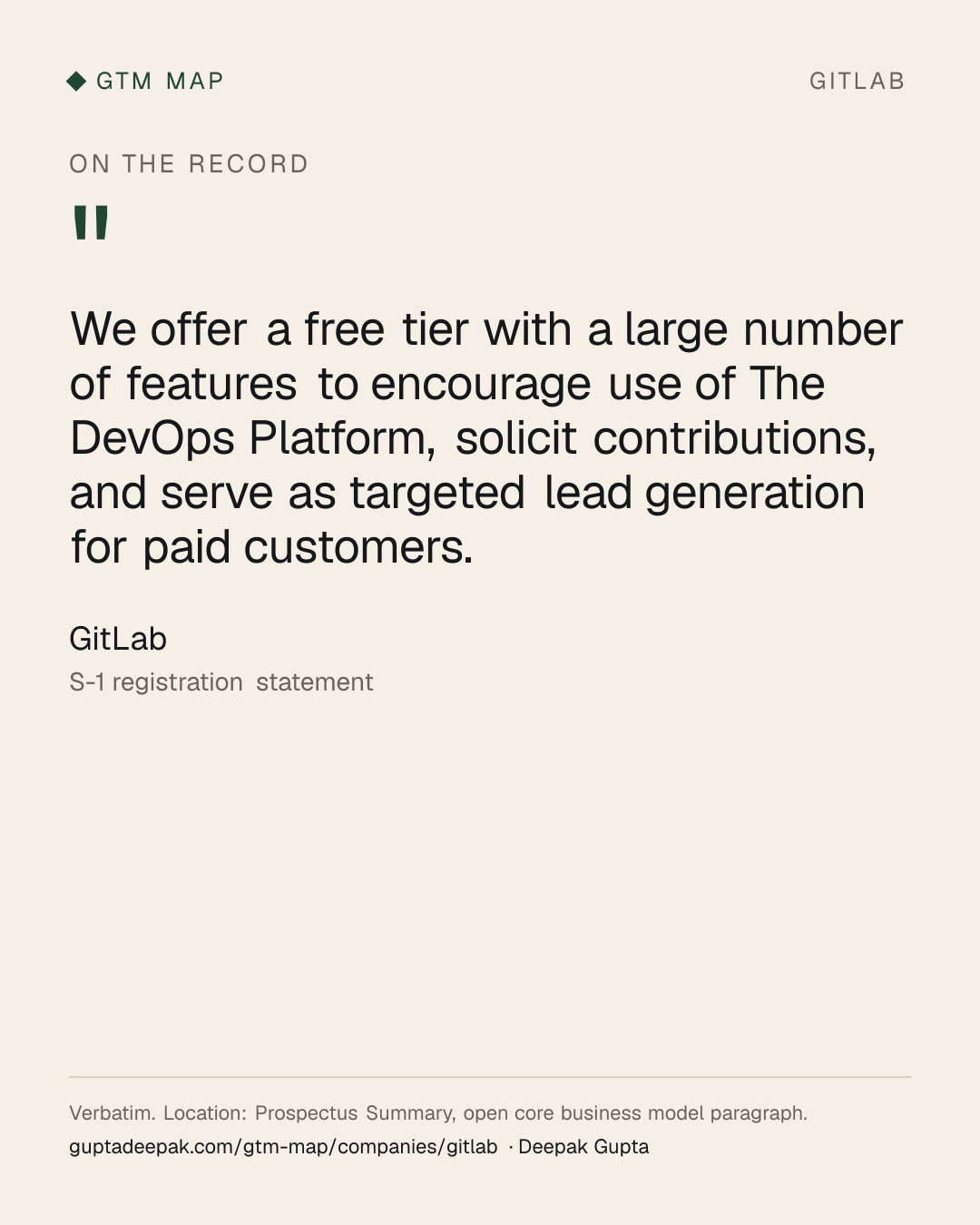
“We offer a free tier with a large number of features to encourage use of The DevOps Platform, solicit contributions, and serve as targeted lead generation for paid customers.”
GitLab, S-1 registration statement[1]
Prospectus Summary, open core business model paragraph
04What other companies can take from it
Tier features by who buys them, not by how advanced they are.
Works when: The product is used by individuals but bought by an organization with layered roles, so managers, security leads, and executives need governance, reporting, or policy features individuals do not.
Backfires when: Buyer and user are the same person, or the paid features are core to individual use, which makes the free tier feel crippled and invites forks.
Based on: Open core and buyer-based tiers, Open source; Enterprise sales, partners, and the IPO, Land and expand
Follow where the revenue is, even if it is not where the users are.
Works when: Enterprise buyers have data residency, security, or compliance reasons to self-host, and a free hosted tier can still serve as a lead source.
Backfires when: The market has already accepted multi-tenant SaaS, so a self-managed product adds support cost without a price premium.
Based on: Open source project and monetization experiments, Product-led; Open core and buyer-based tiers, Product-led
An open source funnel still needs a sales machine to turn usage into contracts.
Works when: Free usage spreads inside large organizations whose purchase decision sits with a CIO or security leader.
Backfires when: The users are mostly individuals and small teams with no route to an organization-wide purchase, so sales cost exceeds what the accounts are worth.
Based on: Open core and buyer-based tiers, Developer-led; Enterprise sales, partners, and the IPO, Sales-led
Prune the cheap tier and the free ceiling once the platform is broad enough.
Works when: The product has added enough value since the tier was set that the low tier undercuts the next one, and the free tier stays generous for individuals.
Backfires when: A credible free or cheaper rival is one click away for the affected users, or the community reads the change as breaking an open source promise. GitLab limited only the SaaS, not the open source codebase.
Based on: Pruning the cheap tier and the free ceiling, Land and expand; Pruning the cheap tier and the free ceiling, Product-led
05 · GTM Now
What changes in the AI era, and what to do now
Analysis by Deepak Gupta. This is opinion built on the sourced record above, not part of it.[5],[16],[8]
Still works
- Developer-first entry and open core. The FY2026 10-K still names bottom-up developer adoption as one of two entry points, and contributors added more than 6,500 merge requests in 2025.
- Deployment choice for regulated buyers. Self-managed options remain GitLab's stated difference from GitHub for security and compliance requirements.
Breaks
- Pure seat-based expansion. Net retention fell from 130% in FY2024 to 118% in FY2026; the filings do not attribute this to AI, and the link to agents doing more of the work is analysis.
- A free tier sized in users per group is a weaker gate when one user can run many agents (analysis).
What replaces it
- Hybrid pricing, which is GitLab's own move: seats for the platform, GitLab Credits for agent usage, credits included in Premium and Ultimate, and Flex as one annual commitment.
- In the agent era the buyer-based rule may become "who carries the risk of the agent's output", with governance, audit, and security features staying the paid line. This is analysis; GitLab does not state it.
Apply it now
If you are
A seed to Series B open source or open core developer tool, with individual developers as users and mid-market or enterprise organizations as the eventual buyer, at $10K to $100K a year
- Write down and publish the buyer-based rule (individual features free, manager and executive features paid), so the community knows what will never move behind a paywall.
- Offer a hosted free tier even if self-managed is the revenue line, because hosted users can be identified and contacted.
- Hire sales development early, as GitLab did in 2016, and route organizations with several active users to it.
- Put security, compliance, and audit features in the top tier and track that tier's share of ARR.
You will know it works when: The share of new paid organizations whose first contact was an identified free hosted user, and top-tier share of ARR (GitLab's filed path was 17% to 29% in about 18 months).
Based on GitLab's Open core and buyer-based tiers, Open core and buyer-based tiers, Enterprise sales, partners, and the IPO
If you are
A later-stage seat-priced developer platform seeing net retention drift down as customers adopt AI coding agents
- Keep the seat price for the human platform, and add a metered unit for agent work with a fixed allowance included in paid tiers, as GitLab Credits are.
- Offer one annual commitment that covers both seats and usage, so customers do not renegotiate every time the mix of people and agents shifts.
- Set free tier limits in units that still bind when one user runs many agents (groups, compute, credits), not only users.
- Report retention separately for customers using the metered AI unit, so its effect on expansion is visible.
You will know it works when: Net retention for customers using the metered unit versus those who do not, and the share of expansion ARR that comes from usage rather than seats.
Based on GitLab's AI agents and hybrid pricing, AI agents and hybrid pricing, AI agents and hybrid pricing
Motions in this record
Compare with every other company on the GTM matrix.
Share the visuals
Every card is drawn from the sourced record above and sized 1080 by 1350 for LinkedIn and X. Free to share with a link back to this page.
Sources
- [1]SEC filingGitLab Inc. Form S-1 (includes Letter From Our CEO by Sid Sijbrandij) (September 17, 2021)
- [2]SEC filingGitLab Inc. Prospectus (Form 424B4) (October 14, 2021)
- [3]SEC filingForm 10-K, fiscal year ended January 31, 2022 (April 8, 2022)
- [4]SEC filingForm 10-K, fiscal year ended January 31, 2024 (March 26, 2024)
- [5]SEC filingForm 10-K, fiscal year ended January 31, 2026 (March 17, 2026)
- [6]SEC filingForm 8-K, Item 5.02 (CEO resignation and Executive Chair appointment) (December 5, 2024)
- [7]EarningsGitLab Reports Fourth Quarter and Full Year Fiscal Year 2026 Financial Results (8-K exhibit) (March 3, 2026)
- [8]EarningsGitLab Reports Second Quarter Fiscal Year 2027 Financial Results (8-K exhibit) (September 1, 2026)
- [9]Founder interviewBuilding an open source company: Interview with GitLab's CEO (Q&A transcript) (Sid Sijbrandij, July 14, 2016, at answers on the business model, how customers found GitLab, the SaaS funnel, and whether open source is enough)
- [10]CompanyMonetizing open source ≠ an 'open source' company (November 9, 2018)
- [11]CompanyGitLab is moving to a three-tier product subscription model (Sid Sijbrandij) (January 26, 2021)
- [12]CompanyUpcoming changes to user limits on Free tier of GitLab SaaS (updated to 2026-06-18) (March 24, 2022)
- [14]CompanyOur stewardship of GitLab (handbook) (undated)
- [15]CompanyFree tier user and group limits (GitLab Docs) (undated)
- [16]CompanyGitLab pricing (undated)
- [17]CompanyGitLab for Open Source Program (undated)
- [18]CompanyGitLab for Startups (undated)
Every phase, motion, and myth verdict cites a filing, the company's own pages, or a founder speaking on the record. See the methodology.