
Product-led · public
How Dropbox went to market
Dropbox grew on a free plan, a sharing loop that pulled non-users in, and a two-sided storage referral, then converted users to paid and team plans in the product. Over 90% of revenue has come from self-serve in every filing, with only a small outbound sales team, and revenue has been roughly flat since 2023.
- Buyer:
- Prosumers, Small business, Mid-market, Enterprise
- Contract size:
- Under $1K a year
- Checked:
- October 18, 2026
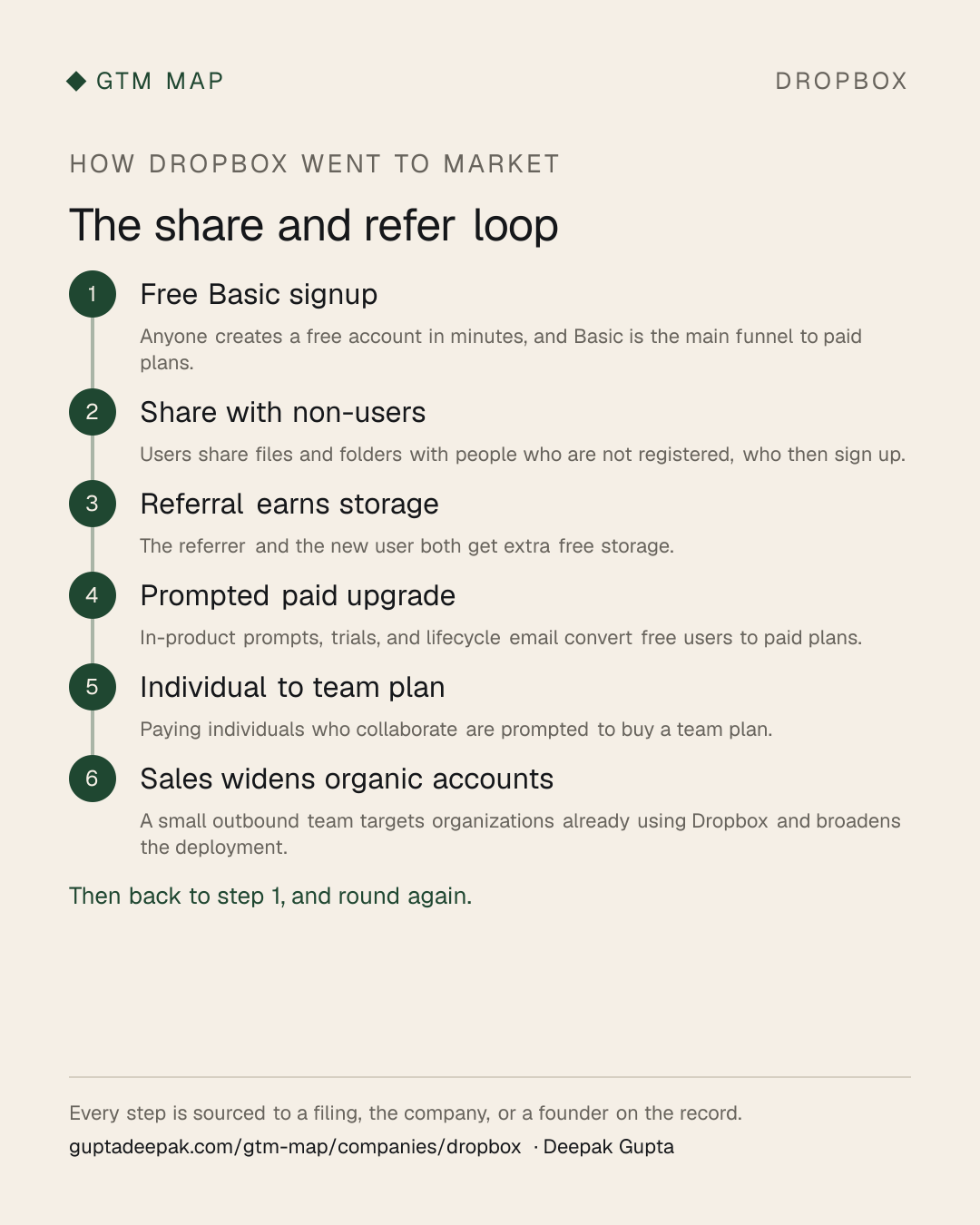
Free Basic signup
Anyone creates a free account in minutes, and Basic is the main funnel to paid plans.[1]
Share with non-users
Users share files and folders with people who are not registered, who then sign up.[1]
Referral earns storage
The referrer and the new user both get extra free storage.[11]
Prompted paid upgrade
In-product prompts, trials, and lifecycle email convert free users to paid plans.[1]
Individual to team plan
Paying individuals who collaborate are prompted to buy a team plan.[1]
Sales widens organic accounts
A small outbound team targets organizations already using Dropbox and broadens the deployment.[2]
Back to step 1, and round again
01The phases
PrimarySupportingTried, then dropped
2008 to 2010
Free sync, shared folders, two-sided referral
The free Basic plan and the paid Plus plan both launched in 2008, after a demo video took the beta waiting list from 5,000 to 75,000 overnight. Sharing and a storage referral did the rest, while paid search was tried and dropped.
- Product-led
Anyone can create a free account in minutes, and the free Basic plan is the main funnel to paid plans. Basic and the paid Plus plan both launched in 2008.[1]
- Referral program
A two-sided incentive gave both the person who referred and the person referred free storage. Houston says it was modeled on PayPal's referral bonus, and Ferdowsi says it doubled the growth rate overnight.[15],[1]
- Viral loop
Users share files and folders with people who are not registered, which pulls them into the product. Houston describes sharing and referral as one loop where every step of friction is worth removing.[1],[15]
- Paid acquisition
Early AdWords spend cost $500 to $1,000 to acquire a user who would pay about $100, so Houston says it was clear it would not work.[14]
- Product-led
2011 to 2015
Team plans on top of individual adoption
Dropbox for Teams launched in November 2011 with admin controls and central billing on top of the product people already used. Teams were bought by staff who already knew Dropbox, and the referral reward was doubled in 2012.
- Land and expand
Teams added admin controls, central billing, and phone support, priced at $795 a year for five users plus $125 per extra seat. The Golden State Warriors started with 15 licenses in 2013 and later requested 450.[9],[1]
- Product-led
Team purchases followed existing use: WBR bought 50 Dropbox Business licenses in 2015 because many employees were already familiar with the product.[1]
- Referral program
In 2012 the reward was doubled to 500 MB for both sides on free accounts, capped at 32 referrals, and 1 GB per referral on paid Pro accounts.[10]
- Land and expand
2015 to 2019
Focus on work, self-serve at scale, IPO
In 2015 Houston refocused the company on work and away from consumer products. By the 2018 S-1, over 90% of revenue came from self-serve channels, and the filing said Dropbox did not have a significant outbound sales force.
- Product-led
Over 90% of revenue came from self-serve channels, driven by in-product prompts, time-limited trials, email, and lifecycle marketing.[1]
- Viral loop
The S-1 calls its 500 million registered users its best salespeople and says millions of individuals sign up for Dropbox at work every year.[1]
- Land and expand
Individual subscribers who collaborate are prompted to buy team plans. In 2017 over 40% of new Dropbox Business teams included a former individual subscriber.[1]
- Sales-assist
A focused outbound sales effort targets organizations with existing organic adoption and works to widen the deployment. The S-1 says Dropbox does not have a significant outbound sales force, which kept sales and marketing spend efficient.[1],[2]
- Partner channel
A small share of users came through hardware makers that pre-install Dropbox, and more than 75% of Dropbox Business teams linked at least one third-party app.[1]
- Paid acquisition
Brand campaigns, lead generation, and third-party sales representative fees drove most of a $63.4M rise in sales and marketing spend in 2017.[1]
- Product-led
2020 to now
Multi-product, restructuring, and AI
Dropbox cut its workforce by about 16% in 2023 and about 20% in 2024, saying the core business had matured, and launched Dash for Business. Paying users fell in 2025, then grew for three straight quarters. In May 2026 Ashraf Alkarmi became co-CEO alongside Drew Houston.
- Product-led
The self-serve share of revenue stayed above 90% in every 10-K read through fiscal 2025, and new products such as Dash are presented as upgrade levers inside the same self-serve model.[3],[4],[5]
- Land and expand
Dash, an AI-powered universal search tool, is offered to teams at an additional cost, a second product sold to the same buyer.[5],[12]
- Sales-assist
Outbound sales stayed a targeted complement, and the 10-Ks still list the lack of a significant outbound sales force as a risk. After the October 2024 cut of about 20% of staff, the fiscal 2025 10-K blames reduced outbound activity for most of the paying user decline.[4],[5],[13]
- Paid acquisition
FormSwift, acquired in late 2022, carried heavy advertising spend. Dropbox cut that investment at the start of 2025, advertising spend fell $52.3M, and FormSwift is planned to wind down by the end of 2026.[4],[5],[6]
- Referral program
Referrals still run for individual plans, at 500 MB or 1 GB per referral plus 500 MB for the new user. Team accounts cannot send referrals, and sharing a folder does not count.[11]
- Partner channel
Hardware pre-install partnerships continue, and just over 1,000,000 developers have registered and built applications on the platform.[5]
- Product-led
02The numbers
Show the data
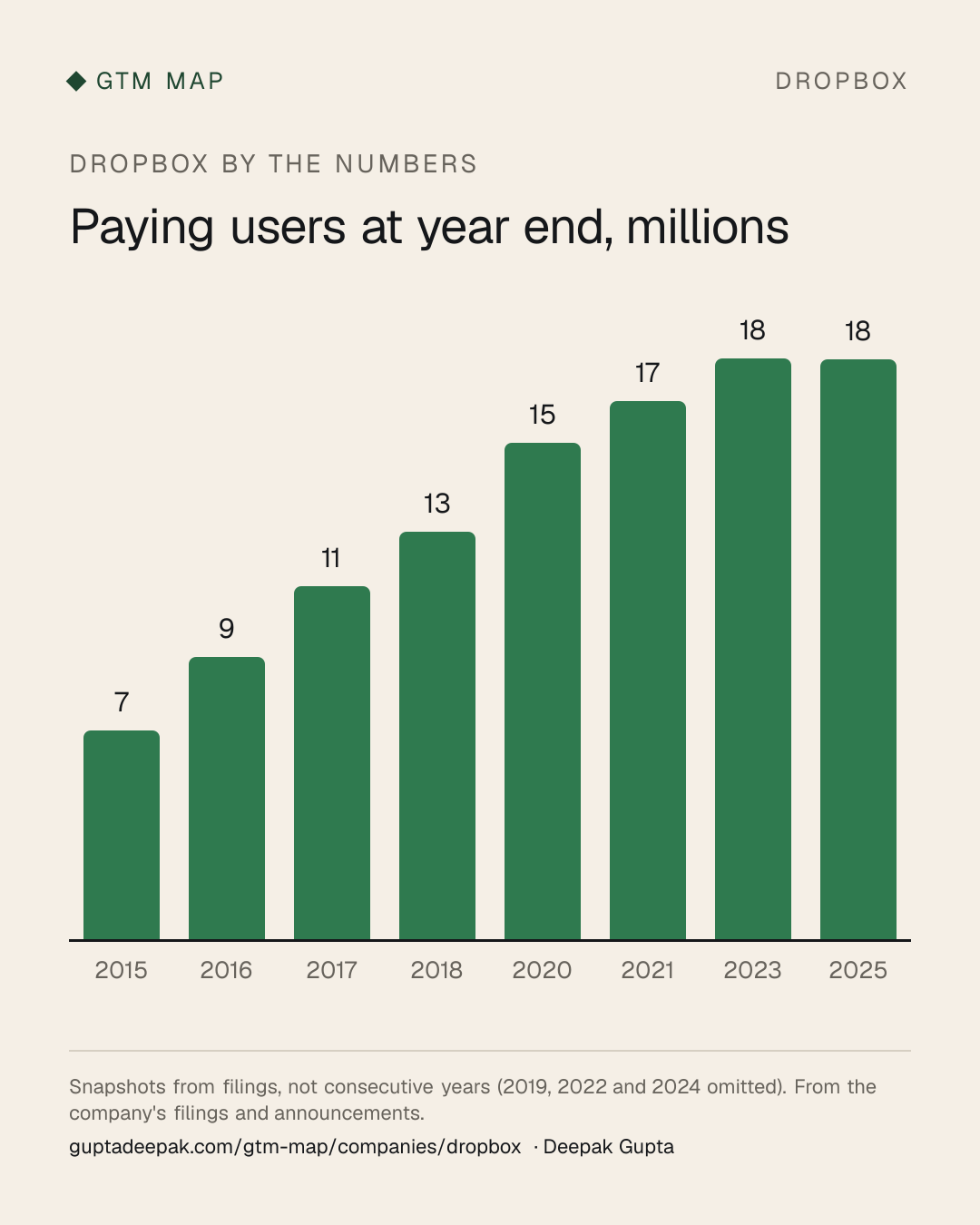
| 2015 | 7 | From a filing |
|---|---|---|
| 2016 | 9 | From a filing |
| 2017 | 11 | From a filing |
| 2018 | 13 | From a filing |
| 2020 | 15 | From a filing |
| 2021 | 17 | From a filing |
| 2023 | 18 | From a filing |
| 2025 | 18 | From a filing |
Show the data
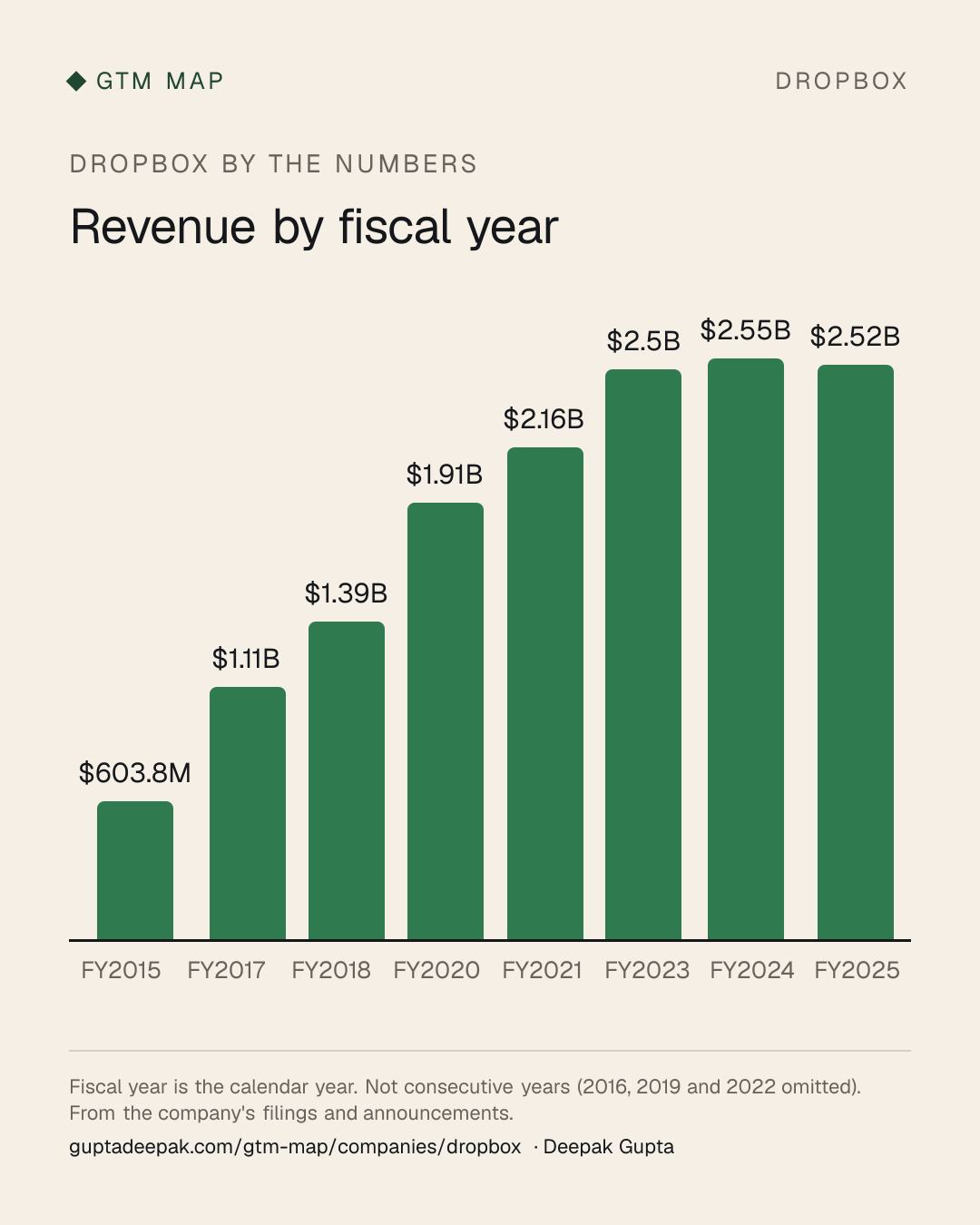
| FY2015 | $603.8M | From a filing |
|---|---|---|
| FY2017 | $1.11B | From a filing |
| FY2018 | $1.39B | From a filing |
| FY2020 | $1.91B | From a filing |
| FY2021 | $2.16B | From a filing |
| FY2023 | $2.5B | From a filing |
| FY2024 | $2.55B | From a filing |
| FY2025 | $2.52B | From a filing |
| Metric | Value | As of | Basis |
|---|---|---|---|
| Beta waiting list after the Digg demo video | 5,000 to 75,000 overnight[14] | March 2008 | Company-stated |
| Paying users, 2017 | 11.0M, from 6.5M in 2015[1] | December 31, 2017 | From a filing |
| Paying users who use Dropbox for work | About 80% (30% on team plans, about 50% on individual plans)[1] | December 31, 2017 | From a filing |
| Fortune 500 companies with paying users | 92%, and 56% with a paying team[1] | December 31, 2017 | From a filing |
| New teams with a former individual subscriber | Over 40%[1] | 2017 | From a filing |
| Free cash flow, 2017 | $305.0M, from negative $63.9M in 2015[1] | December 31, 2017 | From a filing |
| Self-serve share of revenue | Over 90%[5] | December 31, 2025 | From a filing |
| Paying Dropbox Business teams | About 575,000[5] | December 31, 2025 | From a filing |
| ARPU, 2025 | $138.91, from $111.91 in 2017[5] | December 31, 2025 | From a filing |
| Sales and marketing spend, 2025 | $369.9M, down 19.7%[5] | December 31, 2025 | From a filing |
| Revenue, fiscal 2025 | $2.521B, down 1.1%[6] | December 31, 2025 | From a filing |
| Paying users, Q2 2026 | 18.19M[7] | June 30, 2026 | From a filing |
| Total ARR, Q2 2026 | $2.566B, up 1.0%[7] | June 30, 2026 | From a filing |
| Registered users | More than 700M across about 180 countries[7] | August 6, 2026 | Company-stated |
“Reported” figures come from trade press, not the company, and are shown with their date.
03Myth checks
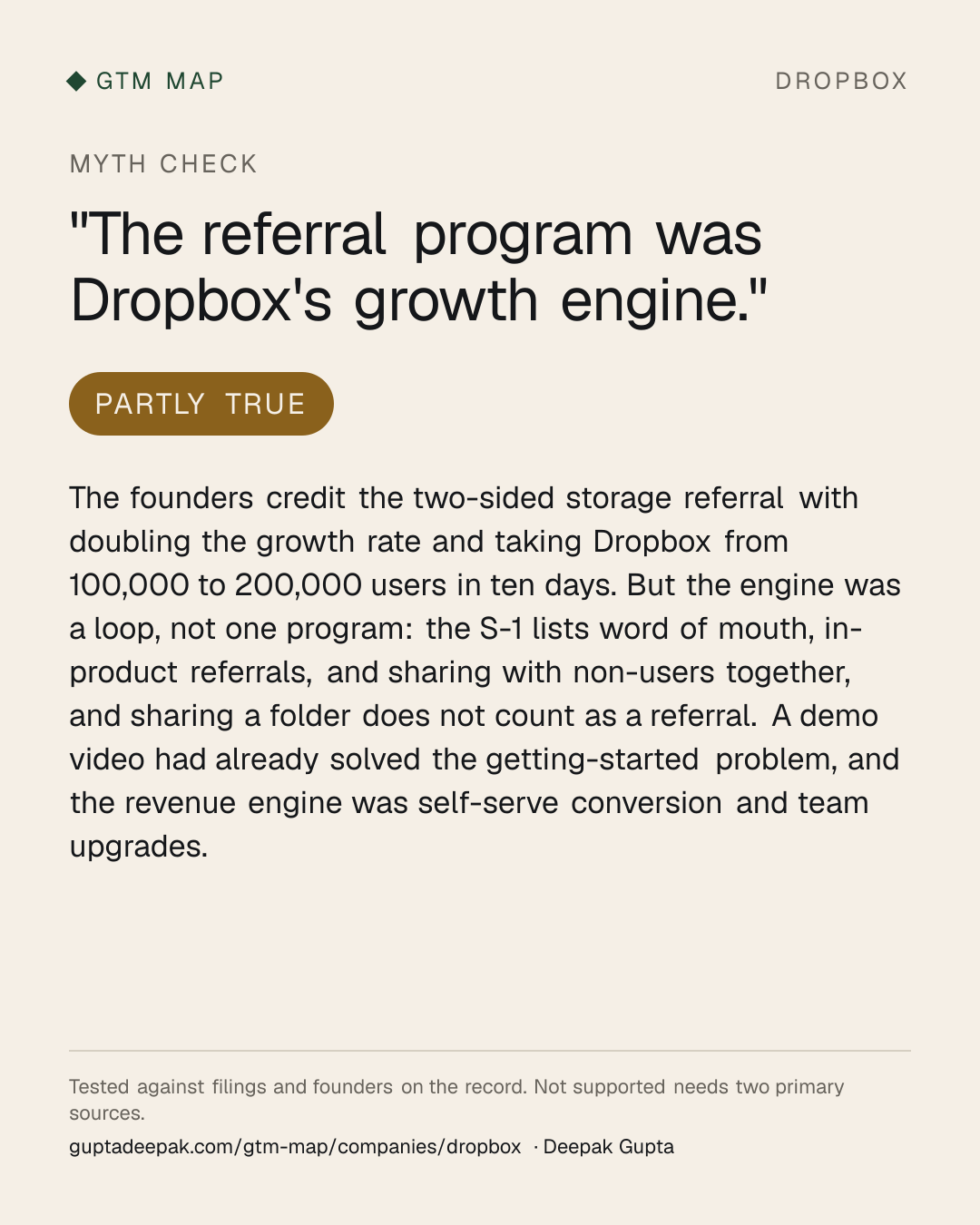
“The referral program was Dropbox's growth engine.”
Partly trueThe founders credit the two-sided storage referral with doubling the growth rate and taking Dropbox from 100,000 to 200,000 users in ten days. But the engine was a loop, not one program: the S-1 lists word of mouth, in-product referrals, and sharing with non-users together, and sharing a folder does not count as a referral. A demo video had already solved the getting-started problem, and the revenue engine was self-serve conversion and team upgrades.[15],[1],[11],[14]
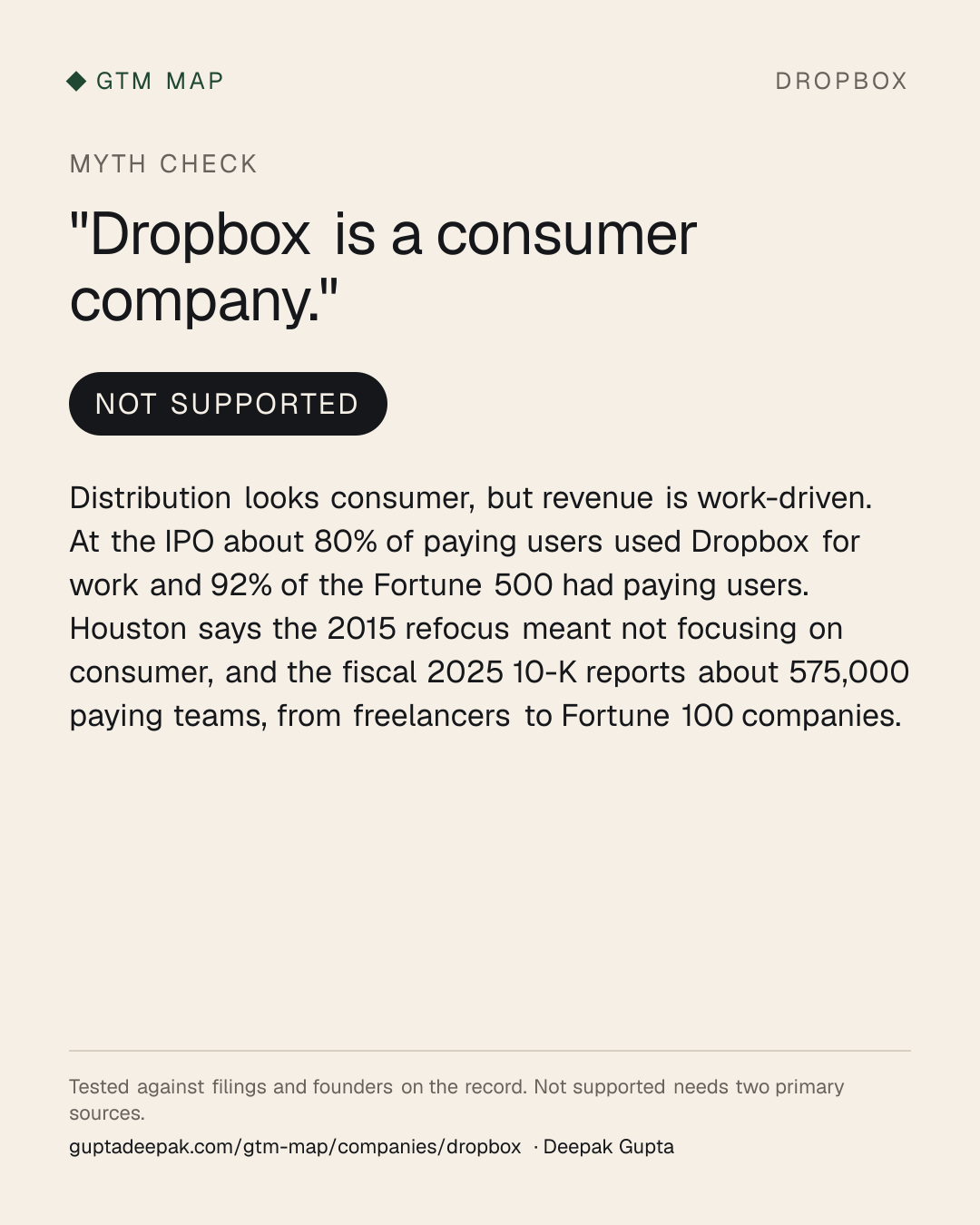
“Dropbox is a consumer company.”
Not supportedDistribution looks consumer, but revenue is work-driven. At the IPO about 80% of paying users used Dropbox for work and 92% of the Fortune 500 had paying users. Houston says the 2015 refocus meant not focusing on consumer, and the fiscal 2025 10-K reports about 575,000 paying teams, from freelancers to Fortune 100 companies.[1],[5],[15]
On the record
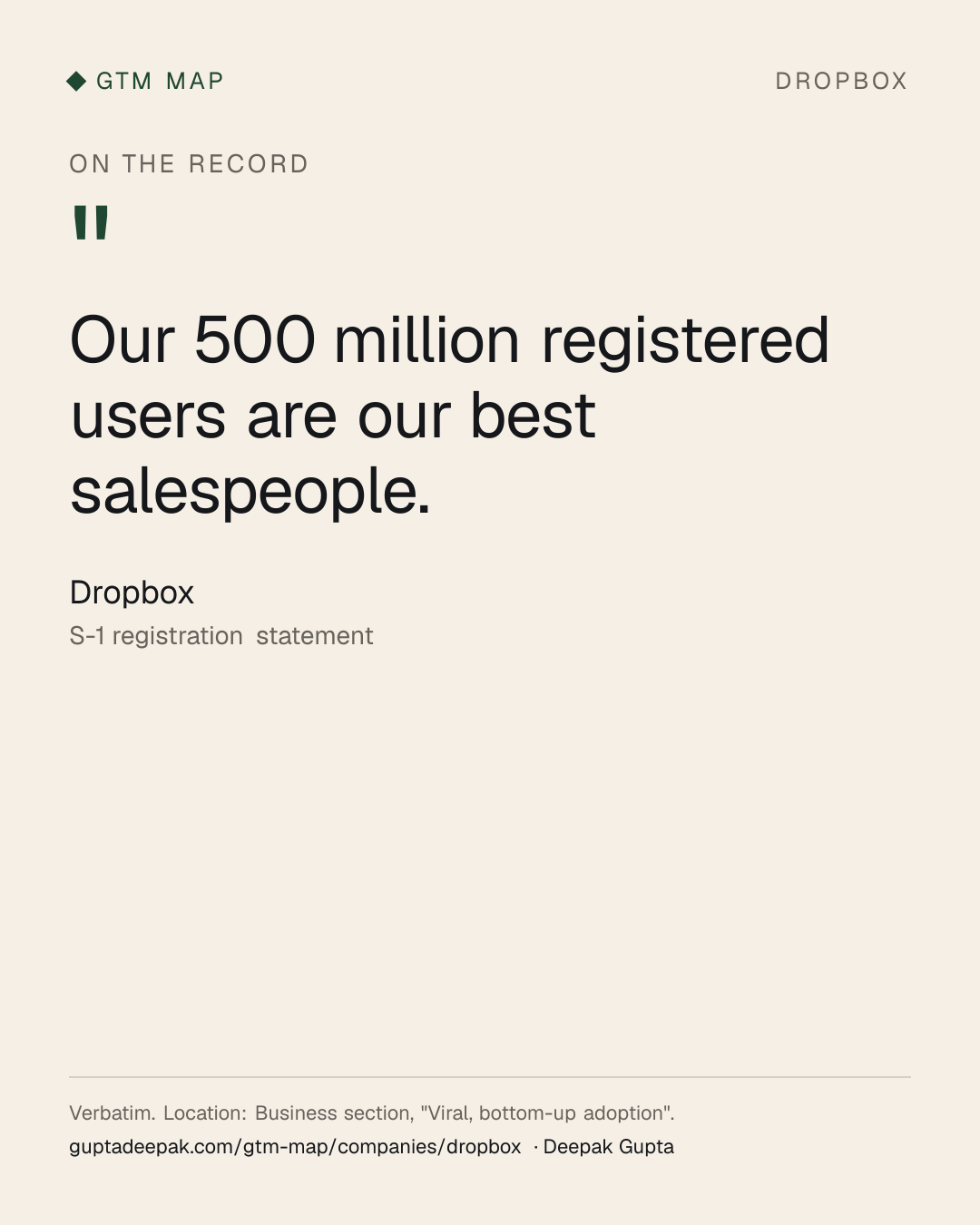
“Our 500 million registered users are our best salespeople.”
Dropbox, S-1 registration statement[1]
Business section, "Viral, bottom-up adoption"
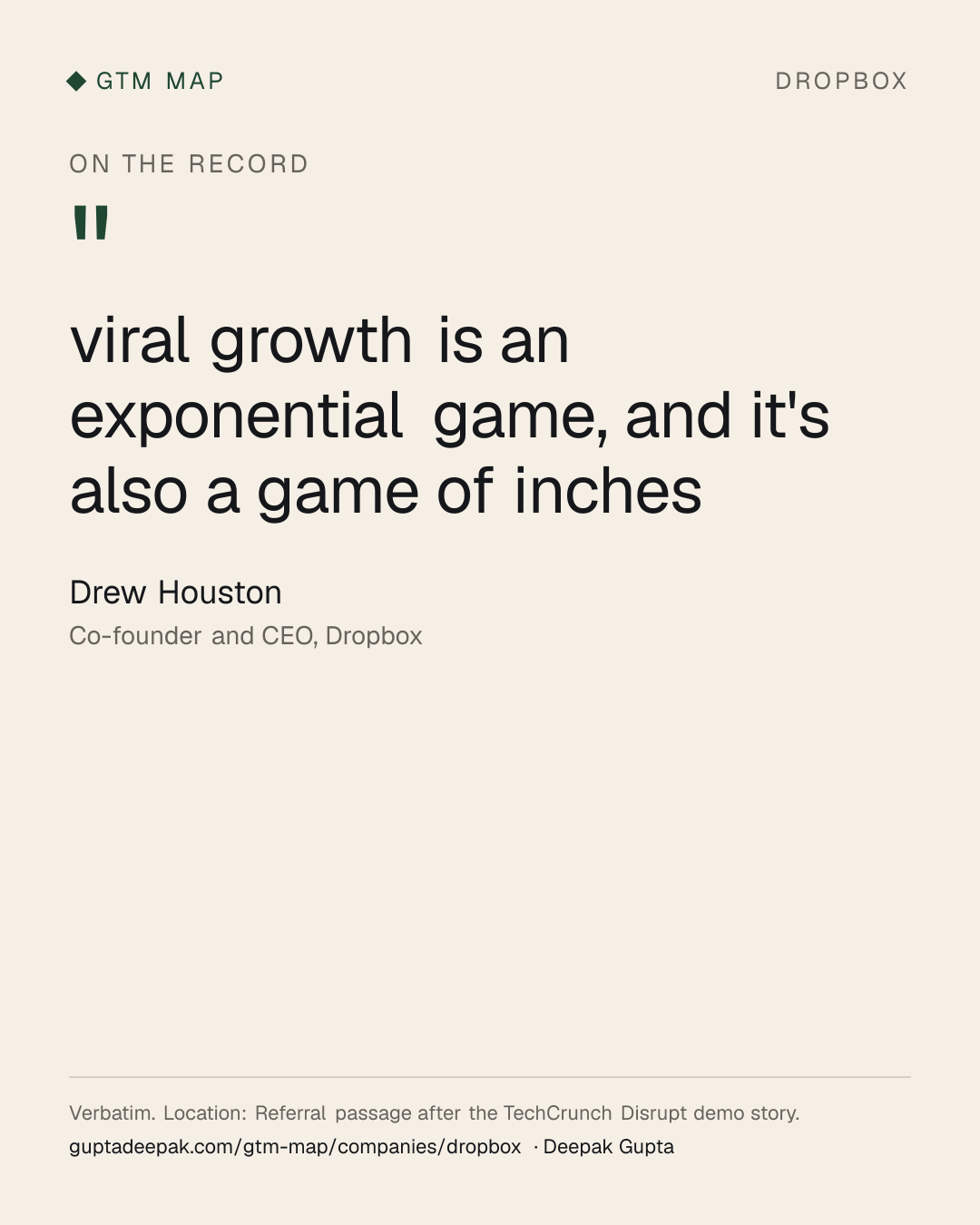
“viral growth is an exponential game, and it's also a game of inches”
Drew Houston, Co-founder and CEO, Dropbox[15]
Referral passage after the TechCrunch Disrupt demo story
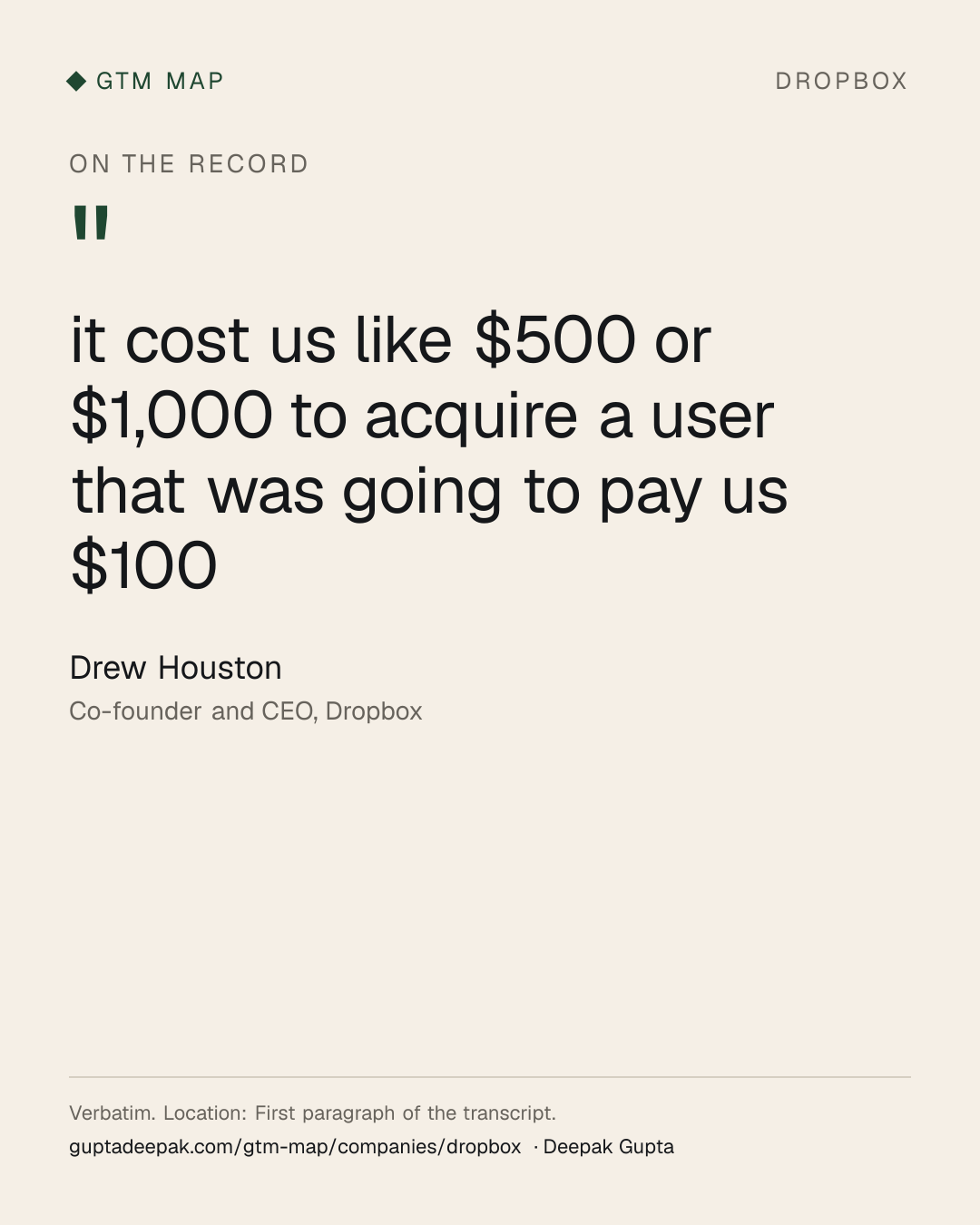
“it cost us like $500 or $1,000 to acquire a user that was going to pay us $100”
Drew Houston, Co-founder and CEO, Dropbox[14]
First paragraph of the transcript
04What other companies can take from it
Pay the referral reward in the product's own currency, on both sides.
Works when: The product has a cheap-to-give unit people value, such as storage, credits, or usage, whose marginal cost is low, and the new user is a likely future payer.
Backfires when: The reward is cash that attracts reward-seekers, the unit has a real marginal cost such as heavy AI inference, or the buyer is a company where individuals cannot take the reward. Dropbox blocks referrals from team accounts.
Based on: Free sync, shared folders, two-sided referral, Referral program; Multi-product, restructuring, and AI, Referral program
Paid search fails when nobody is searching for the category yet.
Works when: The category is new, existing search demand is low, and the price point is low.
Backfires when: Demand already exists as search queries with clear purchase intent and a higher contract value, so paid search can pay back.
Based on: Free sync, shared folders, two-sided referral, Paid acquisition; Multi-product, restructuring, and AI, Paid acquisition
Mine the individual base for team upgrades before hiring sellers.
Works when: Individuals use the product for work and share with colleagues, so usage data shows which companies are already inside.
Backfires when: IT or security blocks individual use, or the team value is weak so the base stays individual. Dropbox's own filings name continued pressure on its Teams plans.
Based on: Focus on work, self-serve at scale, IPO, Land and expand; Focus on work, self-serve at scale, IPO, Sales-assist
A self-serve engine that never builds a real sales force hits a ceiling when the core matures.
Works when: A horizontal product whose core use is commoditizing must grow through larger accounts or new products. Dropbox kept over 90% of revenue self-serve for a decade, had no significant outbound sales force, and lost paying users when it cut outbound activity.
Backfires when: The market is mostly individuals and small teams with no enterprise path, where a sales touch costs more than the account is worth.
Based on: Multi-product, restructuring, and AI, Product-led; Multi-product, restructuring, and AI, Sales-assist
05 · GTM Now
What changes in the AI era, and what to do now
Analysis by Deepak Gupta. This is opinion built on the sourced record above, not part of it.[5],[13],[7],[8]
Still works
- The share loop. A shared folder or link still exposes non-users with no ad spend, and Dropbox still reports over 90% of revenue from self-serve.
- In-product prompts to an installed base, a distribution channel that AI search does not intercept (analysis).
Breaks
- Storage as the upgrade trigger and the referral currency. Dropbox itself calls its core file sync and share business matured, and extra gigabytes are worth less when storage comes bundled with suites and phones (analysis).
- Search-ad demand for commodity tools, the FormSwift model, is exposed when AI answers replace clicks. That link is analysis, not a reason Dropbox filed.
What replaces it
- An AI add-on sold to existing teams at an additional cost, and AI built into the core product, which is Dropbox's own move under co-CEO Ashraf Alkarmi from May 2026.
- Referral rewards paid in usage credits, and shareable AI outputs as the new shared folder. Whether Dropbox measures this is not published (analysis).
Apply it now
If you are
A seed to Series A prosumer or small business tool under $1K a year, where users already share files, links, or workspaces with people outside their account
- Make the shared artifact viewable without signup, with one clear prompt to create an account that keeps a copy.
- Add a two-sided referral paid in your own unit, such as credits, storage, or usage, capped per user the way Dropbox capped it at 32 referrals.
- Remove friction step by step in the share and referral flow and measure yield at each step.
- Prompt individual payers who collaborate with others to move to a team plan.
You will know it works when: The share of new signups whose first touch was a shared link or referral, and the share of new team plans that include a former individual payer (Dropbox's filed figure was over 40%).
Based on Dropbox's Free sync, shared folders, two-sided referral, Free sync, shared folders, two-sided referral, Focus on work, self-serve at scale, IPO
If you are
A mature self-serve SaaS company with flat revenue, a large free base, and over 80% of revenue from self-serve
- Build a company-level view of free and paid usage and route accounts with many active users to a small sales-assist team.
- Launch the AI product as an add-on for existing teams first, sold in the product, before chasing new logos.
- Cut paid acquisition for side products that do not feed the core loop.
- Track whether cutting sales activity costs paying users, since Dropbox's fiscal 2025 10-K names that as a cause of its decline.
You will know it works when: Paying user growth back above zero, which Dropbox reported for three straight quarters by Q2 2026, and add-on attach rate among existing teams.
Based on Dropbox's Multi-product, restructuring, and AI, Multi-product, restructuring, and AI, Multi-product, restructuring, and AI
Motions in this record
Compare with every other company on the GTM matrix.
Share the visuals
Every card is drawn from the sourced record above and sized 1080 by 1350 for LinkedIn and X. Free to share with a link back to this page.
Sources
- [1]SEC filingDropbox, Inc. Form S-1 Registration Statement (February 23, 2018)
- [2]SEC filingForm 10-K, fiscal year ended December 31, 2018 (February 25, 2019)
- [3]SEC filingForm 10-K, fiscal year ended December 31, 2021 (February 18, 2022)
- [4]SEC filingForm 10-K, fiscal year ended December 31, 2023 (February 16, 2024)
- [5]SEC filingForm 10-K, fiscal year ended December 31, 2025 (February 20, 2026)
- [6]EarningsDropbox Announces Fourth Quarter and Fiscal 2025 Results (8-K exhibit) (February 19, 2026)
- [7]EarningsDropbox Announces Second Quarter 2026 Results (8-K exhibit) (August 6, 2026)
- [8]SEC filingForm 8-K, co-CEO appointment, Exhibit 99.1 (employee emails from Drew Houston and Ashraf Alkarmi) (May 26, 2026)
- [9]CompanyIntroducing Dropbox for Teams (Jon Ying) (November 7, 2011)
- [10]CompanyDropbox referrals are now twice as nice! (Jon Ying) (April 3, 2012)
- [11]CompanyHow to refer friends to Dropbox (help center) (September 30, 2026)
- [12]CompanyIntroducing Dash for Business (October 15, 2024)
- [13]CompanyAn update from Drew (Drew Houston email to employees) (October 30, 2024)
- [14]Founder interviewDistribution and Growing Your User Base (Stanford eCorner clip transcript, Internet Archive copy) (Drew Houston, May 30, 2012, at first and second paragraphs of the one-page transcript)
- [15]Founder interviewCrucible Moments: Dropbox ft. Drew Houston, How the Cloud Pioneer Reinvented Itself (Sequoia Capital, transcript) (Drew Houston and Arash Ferdowsi, undated, at referral passage after the TechCrunch Disrupt demo story; Houston on rereading Only the Paranoid Survive in July 2015)
Every phase, motion, and myth verdict cites a filing, the company's own pages, or a founder speaking on the record. See the methodology.