
AI-native · private
How Lovable went to market
Lovable grew out of gpt-engineer, an open-source coding tool, and relaunched in November 2024 as an AI app builder for people who do not code. Free daily credits, building in public, and community hackathons carried it past $200M ARR within a year, before credit pricing, partners, and a small sales team opened enterprise.
- Buyer:
- Prosumers, Small business, Enterprise
- Contract size:
- Mixed
- Checked:
- October 18, 2026
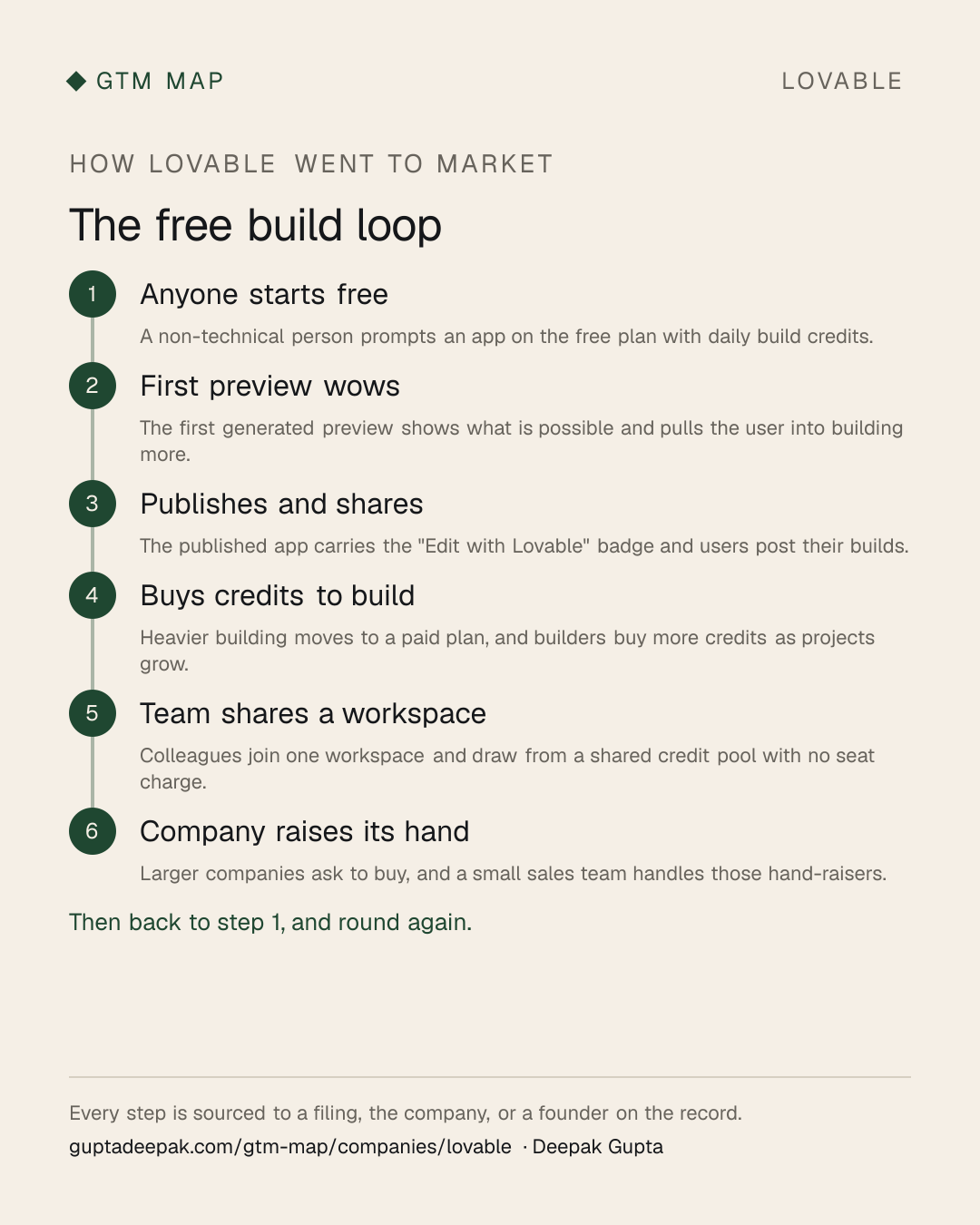
Anyone starts free
A non-technical person prompts an app on the free plan with daily build credits.[25]
First preview wows
The first generated preview shows what is possible and pulls the user into building more.[29]
Buys credits to build
Heavier building moves to a paid plan, and builders buy more credits as projects grow.[29]
Team shares a workspace
Colleagues join one workspace and draw from a shared credit pool with no seat charge.[21]
Company raises its hand
Larger companies ask to buy, and a small sales team handles those hand-raisers.[29]
Back to step 1, and round again
01The phases
PrimarySupportingTried, then dropped
2023 to 2024
Open-source proof, then a waitlisted web app
The CEO's open-source tool drew a developer audience, which the company used to build a web version for people who do not write code. Two launches under the GPT Engineer name failed to gain traction, and the company renamed itself Lovable because the old name read as a fun tool.
- Open source
gpt-engineer, an open-source project from mid 2023, became the fastest growing code repository on GitHub to that date with over 50,000 stars. Its traction led to a commercial web version for non-technical users and to founding the company in late 2023.[1],[28],[6]
- Product-led
The first web product launched behind a waitlist and iterated on user feedback. The early launches under the GPT Engineer name generated some noise but failed to gain significant traction.[28],[5]
- Open source
2024 to 2025
Launch, ship daily, and post it
Lovable launched publicly on 21 November 2024 with a free tier and paid plans from $20, and grew almost only through word of mouth while the team posted every release on social media. A Product Hunt launch with a prepared promo video was part of the relaunch.
- Product-led
The launch offered 5 free messages a day, unlimited public projects, and one-click deploy, with a $20 Starter plan. The CEO says ARR reached about $1M within a week and kept growing almost only through organic word of mouth.[28],[2],[8]
- Brand narrative
Building in public: the CEO, employees, and company accounts post what shipped and talk about it constantly. The CEO says posting releases on social media is how people know about Lovable, and the Head of Growth calls building in public one of its biggest strategies.[28],[29],[5]
- Viral loop
Apps published on the free plan carry an "Edit with Lovable" badge that only paid plans can hide, and users were asked to share builds with #BuiltWithLovable for reposts. Lovable-built sites drew half a billion visits in six months; no source measures how many signups the badge drives.[2],[26],[3],[7],[15]
- Community
Hackathons, user project showcases on X, LinkedIn, and YouTube, and a Builder Hall of Fame for the most impressive builds ran from the first months.[6],[4]
- Partner channel
Lovable co-marketed with the infrastructure products it integrates, such as Supabase, Replicate, and Resend, which benefit directly from its success. This was integration co-marketing, not a reseller channel.[6],[5]
- Product-led
2025 to 2026
Credits, giveaways, and a community at scale
Pricing moved from one credit per message to credits that vary with the work done, then to one credit balance for building and running apps. Free usage and hackathon credits were treated as marketing cost, and a community of ambassadors, meetups, and a large Discord carried the word.
- Usage pricing
Agent Mode, the default from 23 July 2025, charges less than one credit or several depending on complexity. Usage-based billing followed for hosting and AI in apps, then a single credit balance for building and running them. Plans are priced by credits, not seats.[9],[11],[13],[17],[21]
- Product-led
The Head of Growth says you have to give a lot of the product away for free, with freemium only the baseline, and that the team discusses giving more away to win market share. Free, Pro, and Business plans include 5 daily build credits.[29],[25]
- Community
Lovable sponsors any user-run hackathon with free credits and books them as marketing cost. Community managers and an ambassador program support it, fans host 10 to 30 meetups and hackathons a week, and the Discord has 160K+ members.[29],[22],[14],[30]
- Paid acquisition
Paid influencer marketing has worked from the beginning and is ten times bigger than paid social. The Head of Growth puts paid at low double digits of growth and says it is not the majority.[29]
- Education
From August 2025 verified students worldwide get 50% off Pro. The offer now covers students and teachers for up to 12 months.[12],[25],[22]
- Land and expand
Net dollar retention comes from builders buying more credits to build. Workspaces have unlimited members drawing on one shared credit pool, so inviting people does not change the subscription cost.[29],[21]
- Usage pricing
2025 to now
Enterprise, partners, and marketplaces
Employees inside large companies were already building prototypes and internal tools. Lovable added a small sales team that works hand-raisers, enterprise controls such as SSO, SCIM, and SOC 2 Type II, a formal partner program, and a Microsoft Marketplace listing.
- Sales-assist
In late 2025 the Head of Growth described only a couple of sales people working hand-raisers who already want to buy. By October 2026 the enterprise page routes to an Account Executive and the careers page lists mid-market and strategic account executives and a deal desk.[29],[24],[27],[23]
- Land and expand
Adoption starts with employees building internal tools, prototypes, and landing pages, then spreads. Lovable says it reached employees at half of the Fortune 500 in its first year and nearly two-thirds less than a year later, and names a customer that rolled it out to 200+ employees.[29],[18]
- Partner channel
A partner program launched in September 2026 with Experts and Solution Partners, up to 20% commission on referred enterprise deals, and co-selling. It formalised client work by more than 800,000 individuals and agencies, and 500+ Solution Partners signed ahead of launch.[19],[23]
- Cloud marketplace
Lovable is listed on Microsoft Marketplace with private offers, alongside publishing apps into a customer's Microsoft tenant.[20]
- Sales-assist
02The numbers
Show the data
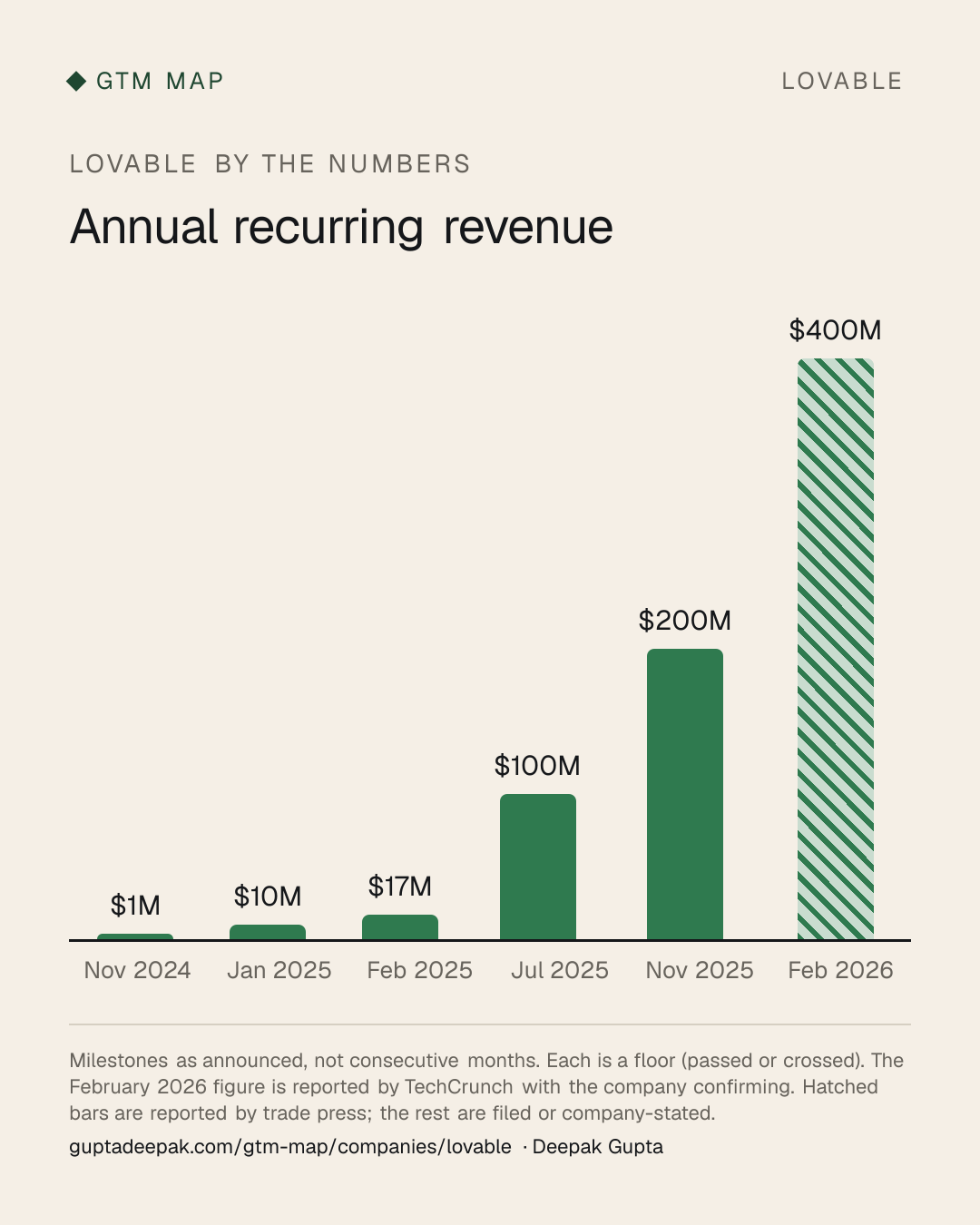
| Nov 2024 | $1M | Company-stated |
|---|---|---|
| Jan 2025 | $10M | Company-stated |
| Feb 2025 | $17M | Company-stated |
| Jul 2025 | $100M | Company-stated |
| Nov 2025 | $200M | Company-stated |
| Feb 2026 | $400M | Reported |
| Metric | Value | As of | Basis |
|---|---|---|---|
| ARR one week after launch | About $1M[28] | November 2024 | Company-stated |
| Annual recurring revenue | $10M in 2 months[6] | January 28, 2025 | Company-stated |
| Annual recurring revenue (15-person team) | $17M[8] | February 25, 2025 | Company-stated |
| Monthly active users / paying | 300,000 / 30,000[28] | March 9, 2025 | Company-stated |
| Annual recurring revenue | Over $100M[11] | July 23, 2025 | Company-stated |
| Active users / paying subscribers | 2.3M+ / 180,000[31] | July 23, 2025 | Reported |
| Annual recurring revenue | $200M[14] | November 18, 2025 | Company-stated |
| People who have tried Lovable | Over 8 million[29] | December 18, 2025 | Company-stated |
| Series B | $330M at a $6.6B valuation[15] | December 18, 2025 | Company-stated |
| Annual recurring revenue | Over $400M[32] | February 2026 | Reported |
| Full-time employees | 146[32] | March 11, 2026 | Reported |
| Annualized revenue run rate | Over $500M[33] | June 9, 2026 | Reported |
| Builders in self-identified non-technical roles | 80%[16] | June 9, 2026 | Company-stated |
| Series C | $400M at a $13.3B valuation[18] | August 12, 2026 | Company-stated |
“Reported” figures come from trade press, not the company, and are shown with their date.
03Myth checks
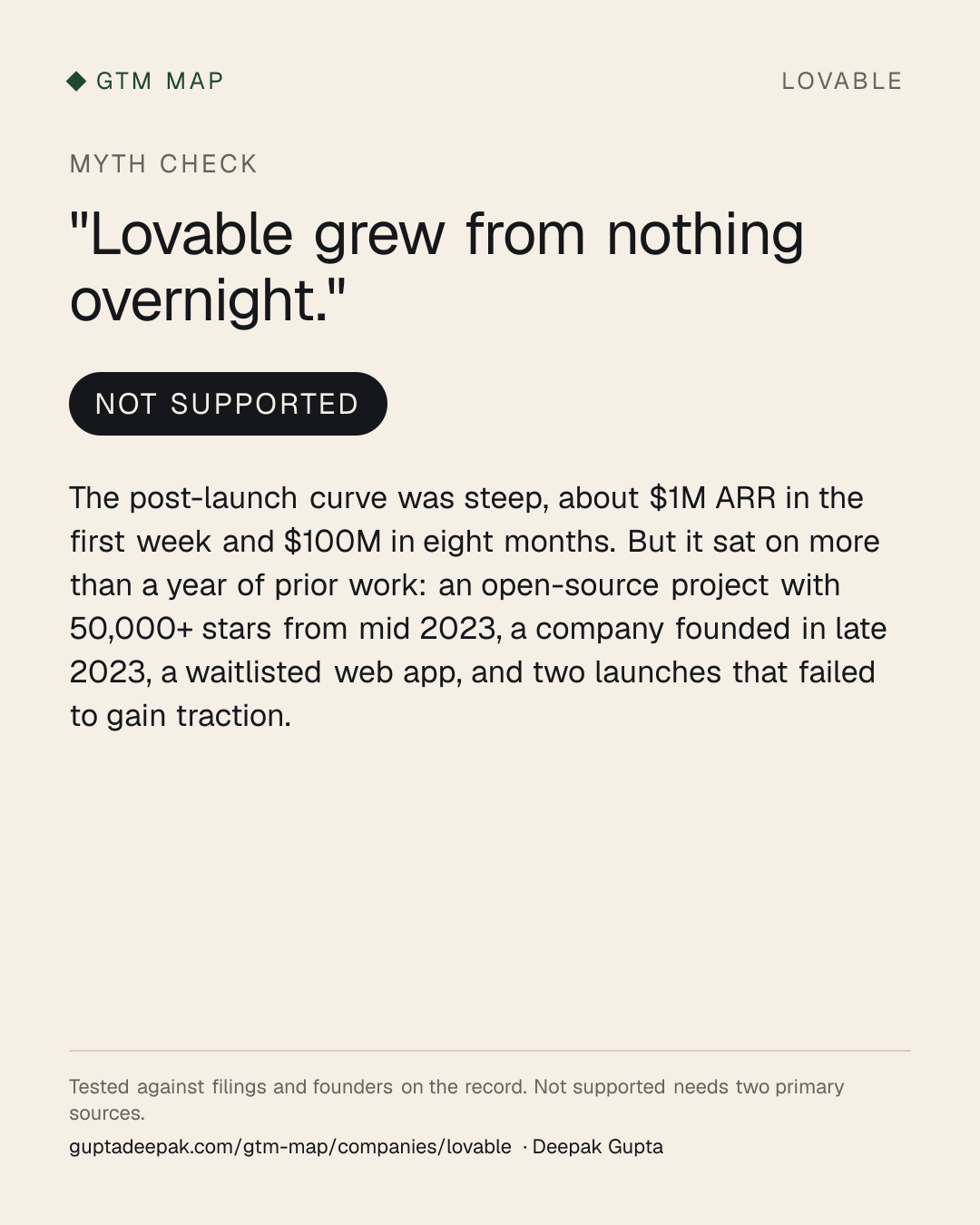
“Lovable grew from nothing overnight.”
Not supportedThe post-launch curve was steep, about $1M ARR in the first week and $100M in eight months. But it sat on more than a year of prior work: an open-source project with 50,000+ stars from mid 2023, a company founded in late 2023, a waitlisted web app, and two launches that failed to gain traction.[1],[28],[5],[29]
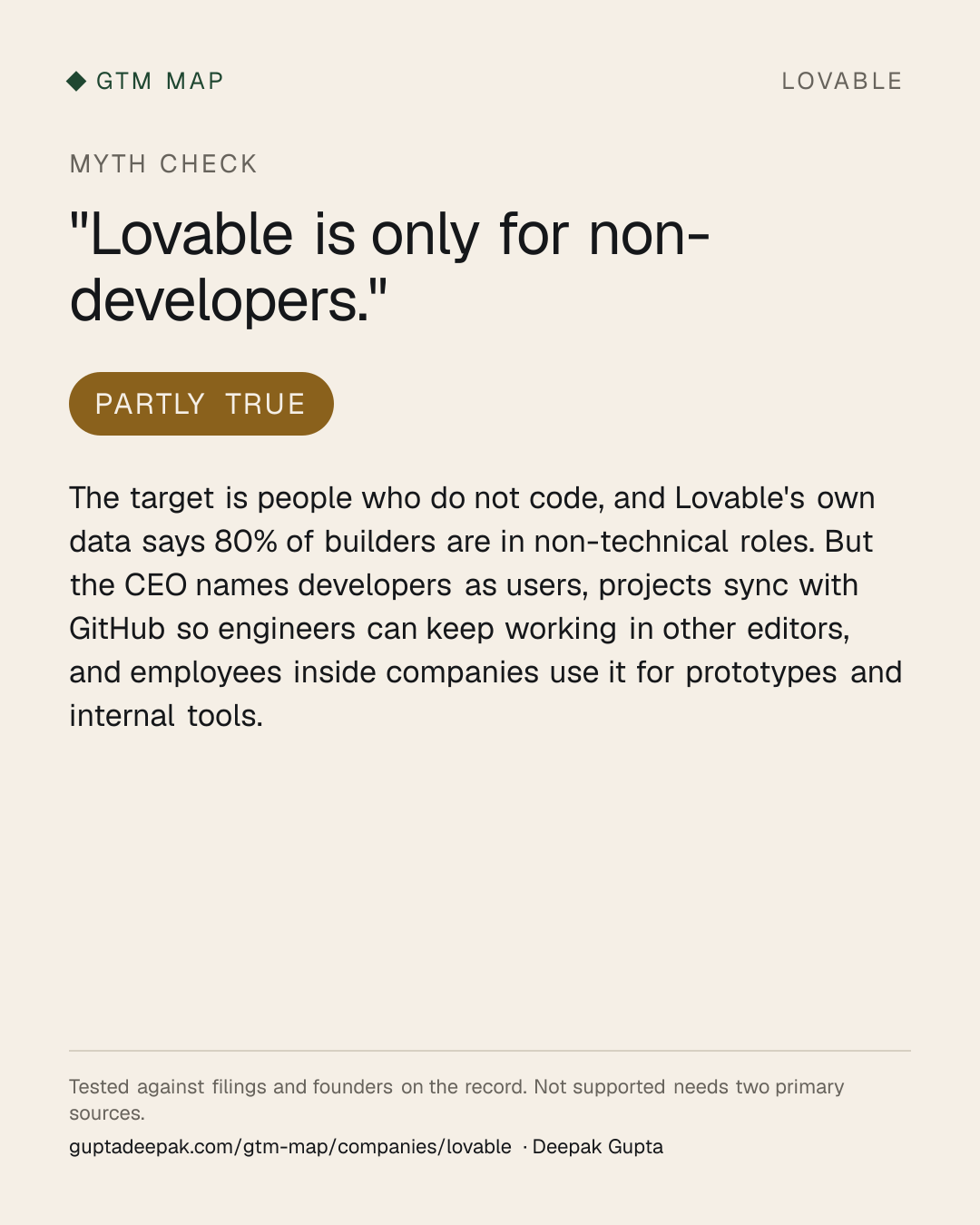
“Lovable is only for non-developers.”
Partly trueThe target is people who do not code, and Lovable's own data says 80% of builders are in non-technical roles. But the CEO names developers as users, projects sync with GitHub so engineers can keep working in other editors, and employees inside companies use it for prototypes and internal tools.[16],[28],[29]
On the record
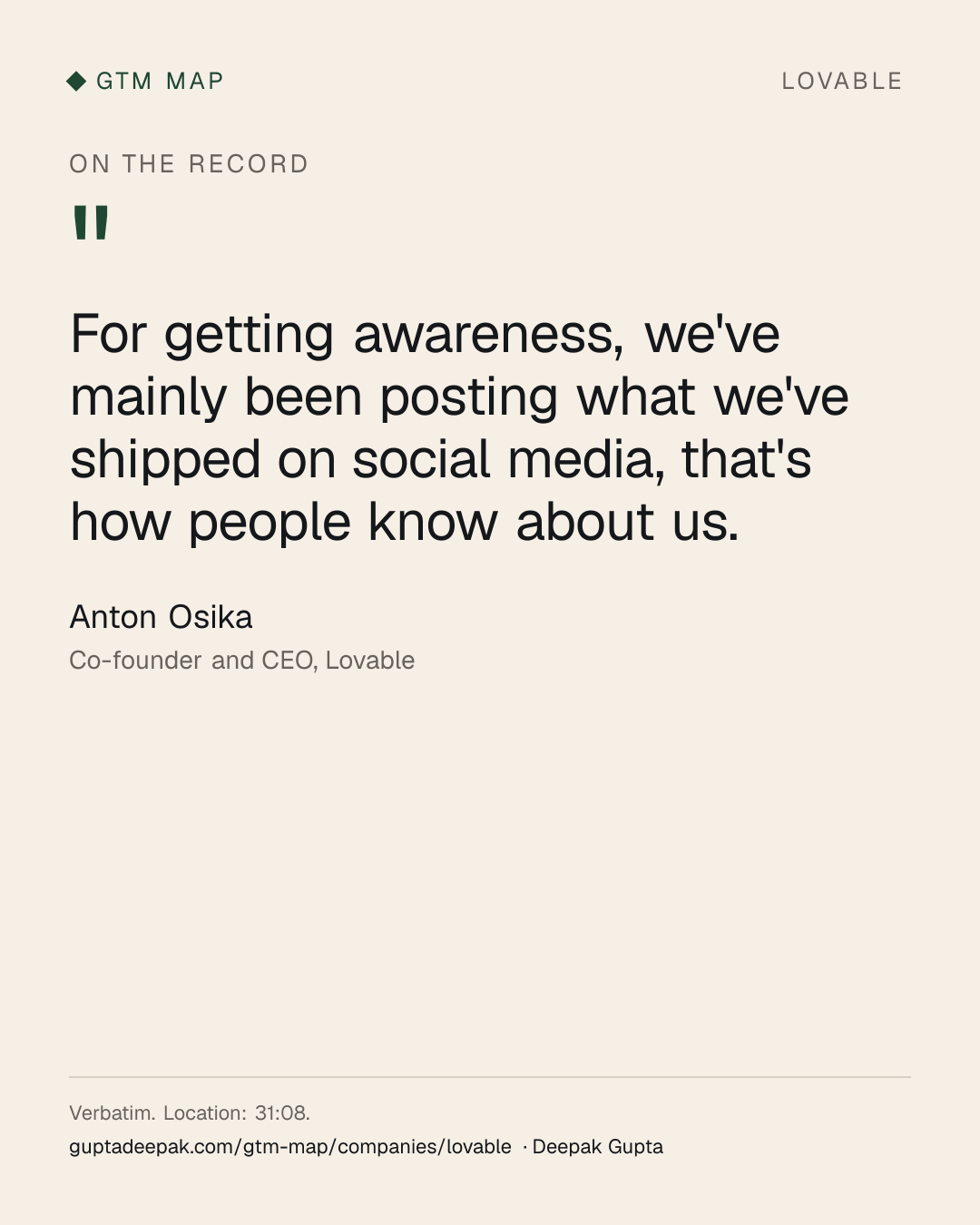
“For getting awareness, we've mainly been posting what we've shipped on social media, that's how people know about us.”
Anton Osika, Co-founder and CEO, Lovable[28]
31:08
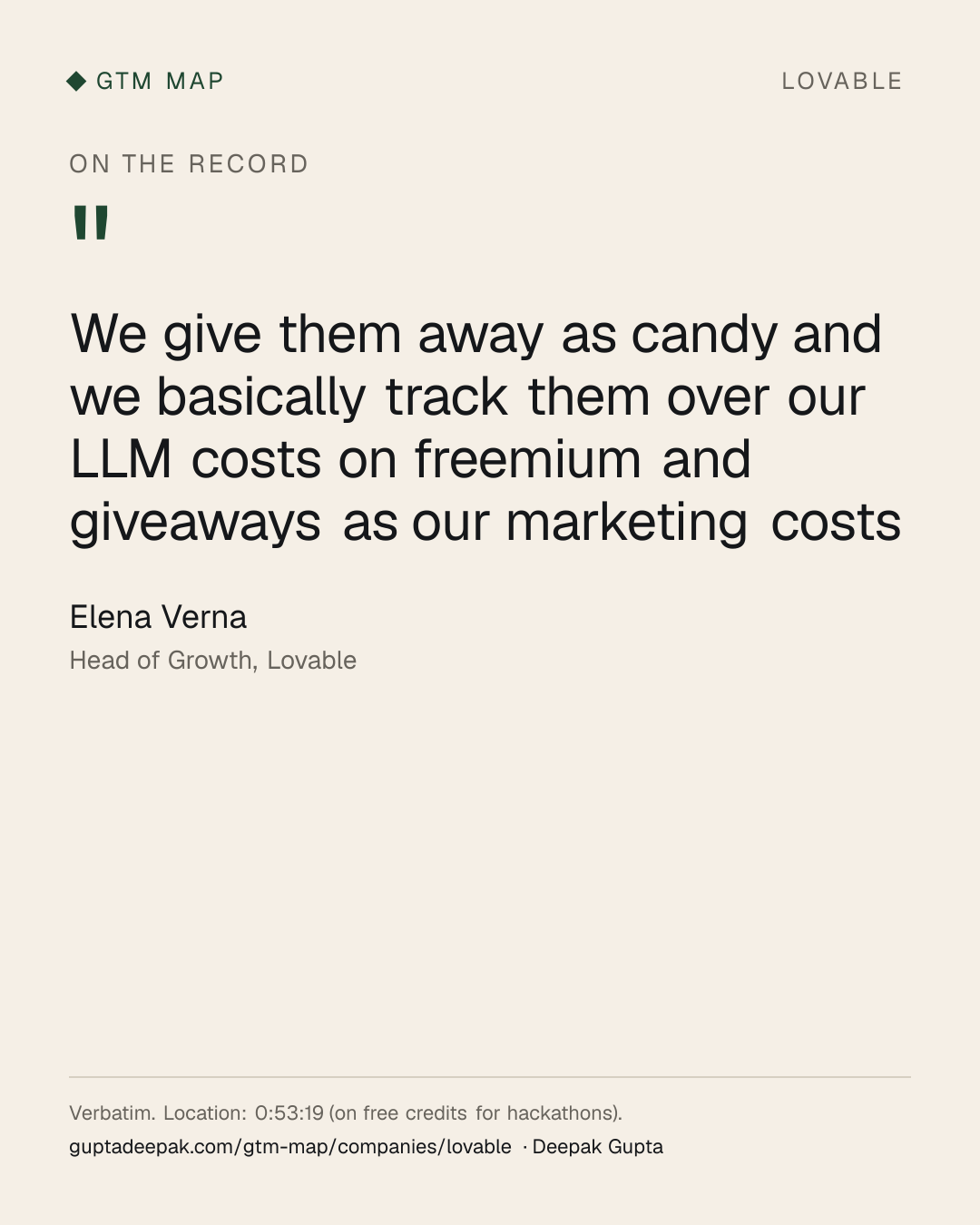
“We give them away as candy and we basically track them over our LLM costs on freemium and giveaways as our marketing costs”
Elena Verna, Head of Growth, Lovable[29]
0:53:19 (on free credits for hackathons)
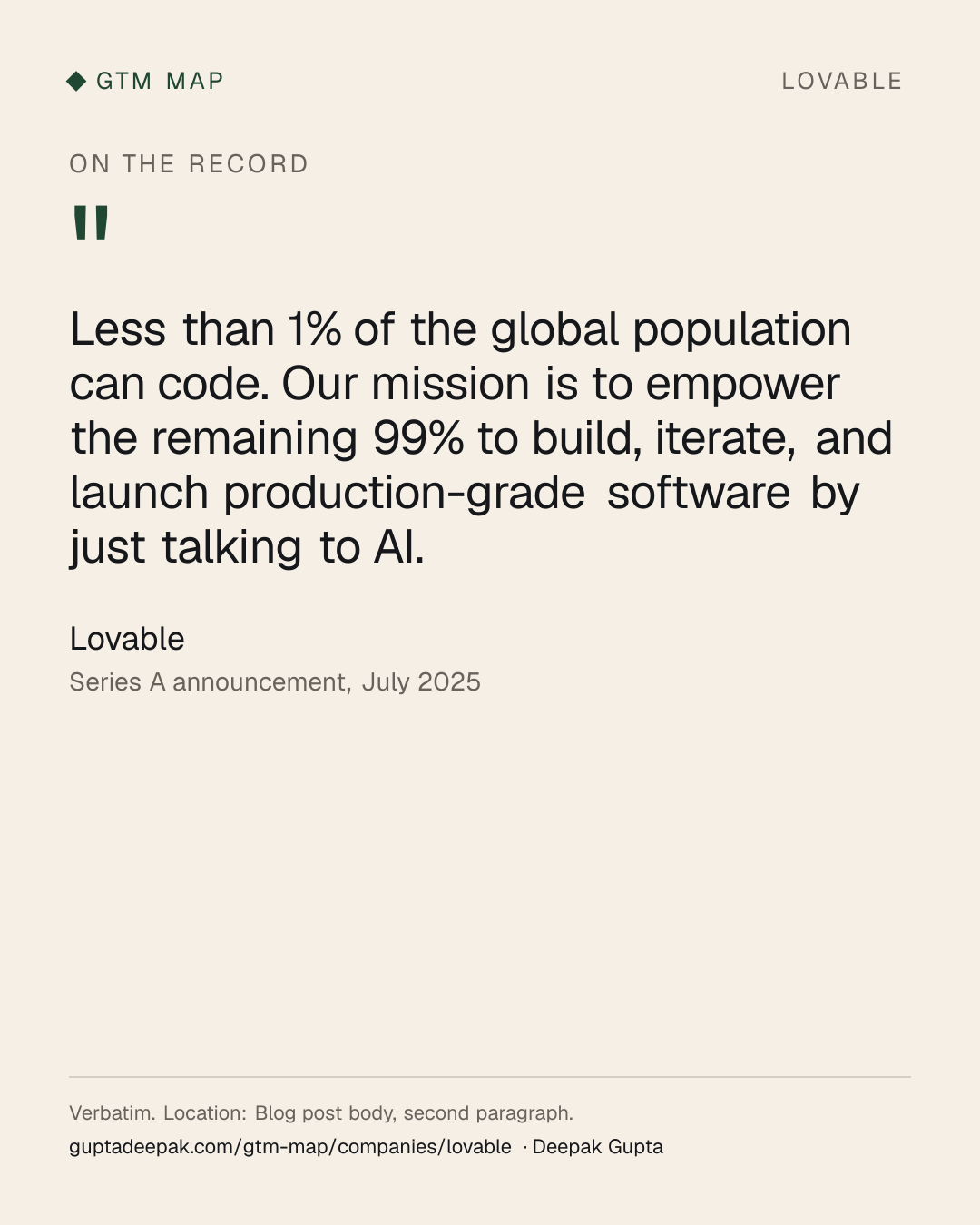
“Less than 1% of the global population can code. Our mission is to empower the remaining 99% to build, iterate, and launch production-grade software by just talking to AI.”
Lovable, Series A announcement, July 2025[10]
Blog post body, second paragraph
04What other companies can take from it
Prove the capability in public before you sell it, then rebuild for a different audience.
Works when: The capability is new and easy to demo in a short video, and the open-source user is adjacent to a much larger paying audience a hosted product can serve.
Backfires when: The open-source audience is the only audience, so the hosted product competes with its own free version, or the demo does not show the value in seconds.
Based on: Open-source proof, then a waitlisted web app, Open source
Treat launches as repeatable, not one shot, and rename when the market reads the product wrong.
Works when: Early launches get attention but not retention, and user language shows the name or framing undersells the product.
Backfires when: The product itself is the problem, so a rebrand burns the second chance at attention.
Based on: Open-source proof, then a waitlisted web app, Product-led; Launch, ship daily, and post it, Product-led
Make shipping velocity the marketing calendar.
Works when: The product changes visibly every week, the founder and team will post in their own voice, and buyers live on X and LinkedIn.
Backfires when: Release cycles are slow or regulated, or the buyer (security, procurement) does not follow vendor social feeds.
Count free usage and giveaways as acquisition spend, not as margin leakage.
Works when: The first session produces a visible result, daily caps bound the cost of each free user, and heavy use converts to paid credits.
Backfires when: Inference cost per free user is high and unbounded, or the free result is too thin to make anyone return.
Based on: Credits, giveaways, and a community at scale, Product-led; Credits, giveaways, and a community at scale, Community; Credits, giveaways, and a community at scale, Usage pricing
05 · GTM Now
What changes in the AI era, and what to do now
Analysis by Deepak Gupta. This is opinion built on the sourced record above, not part of it.[29],[9],[11],[17],[19],[20]
Still works
- A demo that shows the result from one prompt, spread through social video and creators. The Head of Growth says influencer marketing works because it shows what a person can do.
- Community-run hackathons with sponsored credits, which travel through people rather than search (analysis).
Breaks
- Search-led organic marketing. The Head of Growth, who says she was long focused on search, now describes organic as all about social.
- Flat per-message pricing, once agent requests varied widely in how much work they did.
What replaces it
- Credit pricing that scales with the work done and spans building and running apps.
- Employee and founder posting in place of a brand marketing team, which the Head of Growth says Lovable does not have yet.
- Partner commissions and a Microsoft Marketplace listing for the enterprise route.
Apply it now
If you are
A seed-stage AI product for non-technical prosumers, self-serve, under $1K ACV, where the first output is visible within a minute
- Ship a public demo or open-source proof first, and watch which audience reacts.
- Launch with a free daily allowance and a low entry price, and put a removable built-with mark on anything users publish.
- Post every release from the founder's and team's own accounts, several times a week.
- Sponsor any user who offers to run a hackathon with free credits, and book that as marketing cost.
- Price heavy usage by work done rather than per message once usage cost varies widely.
You will know it works when: Share of new signups that arrive from a published app, a shared post, or a community event (one-question signup survey plus referrer data), and week-four retention by acquisition source.
Based on Lovable's Open-source proof, then a waitlisted web app, Launch, ship daily, and post it, Launch, ship daily, and post it, Credits, giveaways, and a community at scale, Credits, giveaways, and a community at scale
If you are
A product-led AI tool with hundreds of thousands of paying individuals, many inside large companies, and no sales team yet
- Find accounts with many individual paying users on company email domains, and route only those hand-raisers to a small sales team.
- Ship SSO, SCIM, audit logs, and a SOC 2 report before scaling account executives.
- Price workspaces by shared credits with unlimited members, so a team can expand without a seat negotiation.
- Turn the agencies already doing client work into a partner program with commissions and a directory.
You will know it works when: Net dollar retention of company-domain workspaces, and the share of enterprise pipeline sourced from partners versus inbound hand-raisers.
Based on Lovable's Enterprise, partners, and marketplaces, Credits, giveaways, and a community at scale, Enterprise, partners, and marketplaces
Motions in this record
Compare with every other company on the GTM matrix.
Share the visuals
Every card is drawn from the sourced record above and sized 1080 by 1350 for LinkedIn and X. Free to share with a link back to this page.
Sources
- [1]CompanyGPT Engineer (legacy explainer page) (undated)
- [2]CompanyTargeted Edits, Supabase Integration Improvements, and Pricing Updates (November 11, 2024)
- [3]CompanyRebranding: GPT Engineer to Lovable (December 3, 2024)
- [4]CompanyStreamlined Supabase Keys Management, Flexible Plans, and New Integrations (December 11, 2024)
- [5]CompanyLovable's two Failed Launches and What we got wrong about PLG (January 22, 2025)
- [6]CompanyZero to $10M ARR in 2 months (January 28, 2025)
- [7]CompanyAnnouncing Lovable Launched (January 31, 2025)
- [8]CompanyAnnouncing $15m added funding to build the last piece of software (February 25, 2025)
- [9]CompanyIntroducing Agent Mode (Beta) (June 30, 2025)
- [10]CompanyLovable Raises $200M, Valued at $1.8B, Just Eight Months After Launch (July 17, 2025)
- [11]Company$100M ARR & Lovable Agent (July 23, 2025)
- [12]CompanyLovable Goes Back to School (August 14, 2025)
- [13]CompanyIntroducing Lovable Cloud and AI (September 29, 2025)
- [14]CompanyOne year of Lovable: Welcome to the age of the builder (November 18, 2025)
- [15]CompanyLovable raises $330M to power the age of the builder (December 18, 2025)
- [16]CompanyA first look at the build economy (June 9, 2026)
- [17]CompanyWe're simplifying how billing works on Lovable (June 13, 2026)
- [18]CompanyWe just raised $400M in Series C funding to help people run their businesses (August 12, 2026)
- [19]CompanyIntroducing the Lovable Partner Program (September 9, 2026)
- [20]CompanyLovable + Microsoft: run the apps you build inside your company's Microsoft tenant (September 28, 2026)
- [21]CompanyLovable Pricing (FAQ) (undated)
- [22]CompanyLovable Community (undated)
- [23]CompanyLovable Careers (snapshot 2026-10-18) (undated)
- [24]CompanyEnterprise: Book a personalized product demo (undated)
- [25]CompanySubscription plans (docs) (undated)
- [26]CompanyProject settings (docs) (undated)
- [27]CompanyLovable for Enterprise (docs) (undated)
- [28]Founder interviewBuilding Lovable: $10M ARR in 60 days with 15 people (Lenny's Podcast, transcript) (Anton Osika, March 9, 2025, at 06:17, 07:42, 22:42 to 22:59, 25:27, 26:00 to 26:33, 31:01 to 31:08, 35:25)
- [29]Founder interviewThe new AI growth playbook for 2026: How Lovable hit $200M ARR in one year (Lenny's Podcast, transcript) (Elena Verna, December 18, 2025, at 0:06:12 to 0:07:10, 0:10:24, 0:13:37, 0:14:24, 0:24:47 to 0:26:05, 0:29:58 to 0:30:24, 0:34:12 to 0:34:50, 0:50:58 to 0:51:23, 0:52:34 to 0:53:19, 0:56:55 to 0:57:24)
- [30]Founder interviewAs Lovable hits $200M ARR, its CEO credits staying in Europe for its success (TechCrunch, Slush 2025) (Anton Osika, November 19, 2025, at article body, direct quote)
- [31]Trade pressEight months in, Swedish unicorn Lovable crosses the $100M ARR milestone (TechCrunch, July 23, 2025)
- [32]Trade pressLovable says it added $100M in revenue last month alone, with just 146 employees (TechCrunch, March 11, 2026)
- [33]Trade pressLovable says it has hit $500M in annualized revenue, with 1 million new projects a week (TechCrunch, June 9, 2026)
Every phase, motion, and myth verdict cites a filing, the company's own pages, or a founder speaking on the record. See the methodology.