
AI-native · private
How OpenAI went to market
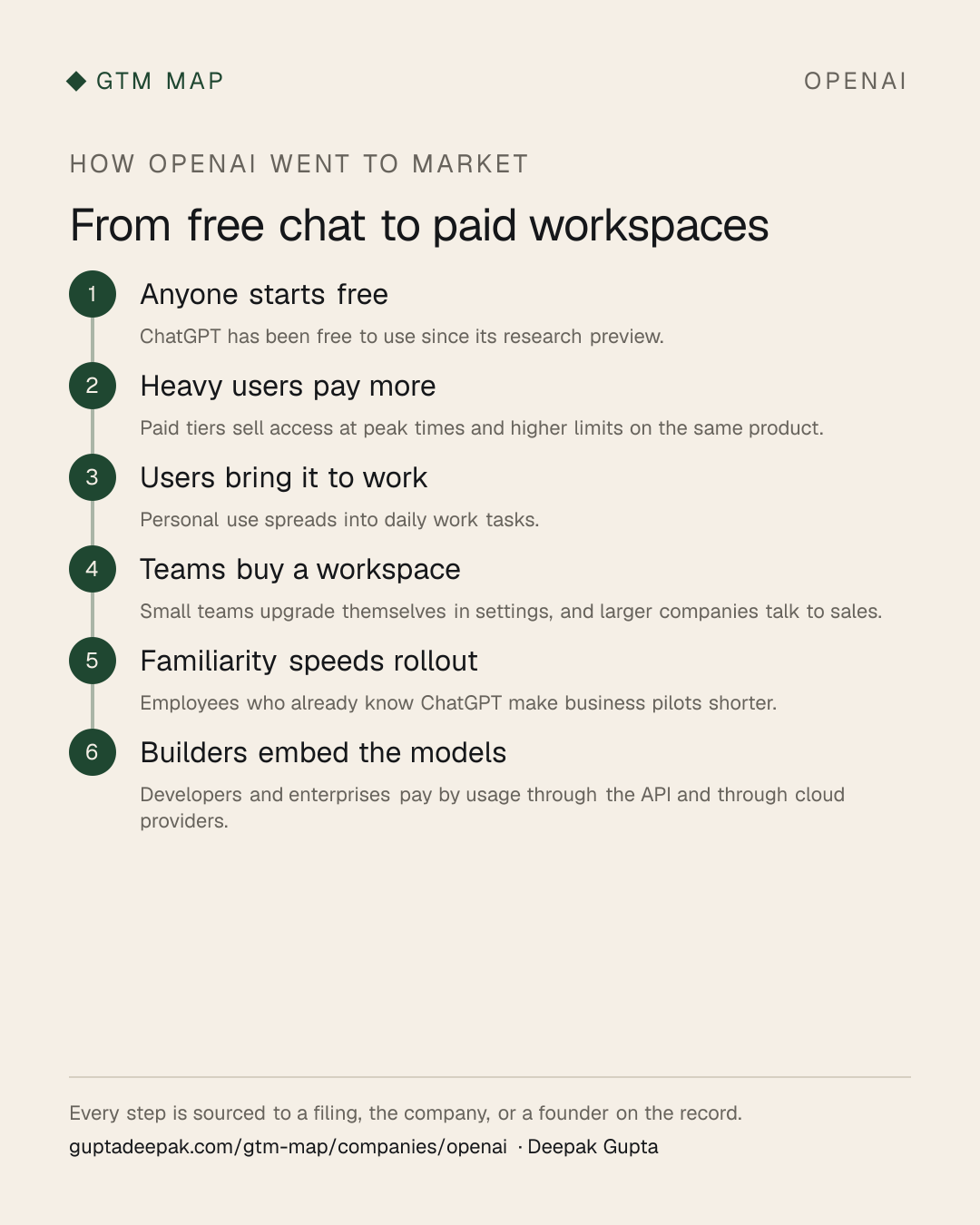
OpenAI sold a developer API from 2020, then launched ChatGPT free in late 2022 and added paid tiers: Plus, a self-serve team plan, and sales-led Enterprise. By 2026 it ran free, ad-supported, subscription, and usage-priced tiers and sold through other clouds besides Azure. It is private, with a confidential draft S-1 submitted.
- Buyer:
- Consumers, Prosumers, Developers, Small business, Enterprise
- Contract size:
- Mixed
- Checked:
- October 18, 2026
01The phases
PrimarySupportingTried, then dropped
2020 to 2022
API first, behind a waitlist
OpenAI's first commercial product was a general-purpose API for developers, launched as a reviewed private beta in June 2020 and opened to self-serve signup without a waitlist in November 2021.
- Developer-led
The API launched in private beta with a mandatory production review before applications went live, and OpenAI said commercial products would help fund its research. In November 2021 developers in supported countries could sign up directly, and OpenAI said tens of thousands were already building on it.[1],[2]
- Developer-led
2022 to 2023
ChatGPT goes free, then paid, then to work
ChatGPT launched free as a research preview in November 2022. A paid tier, cheaper API pricing, the Azure channel, and a sales-led Enterprise plan followed within a year.
- Product-led
ChatGPT was free during the research preview. In February 2023 ChatGPT Plus added a $20 per month tier with access at peak times while free access continued. Altman says the demo came from watching developers talk to the model in the API playground.[3],[5],[30]
- Usage pricing
The ChatGPT model went on the API in March 2023 at $0.002 per 1,000 tokens, which OpenAI said was 10x cheaper than its existing GPT-3.5 models, and DevDay in November 2023 cut several prices again. Both were framed as passing savings to developers.[6],[8]
- Cloud marketplace
From January 2023 OpenAI said it deployed its technology through its own API and Microsoft's Azure OpenAI Service, with Azure as the exclusive cloud for all its workloads. Microsoft's 10-K says it deploys OpenAI models across its own consumer and enterprise products.[4],[27]
- Sales-led
ChatGPT Enterprise launched in August 2023 behind a Contact sales path. OpenAI said teams in over 80% of Fortune 500 companies had adopted ChatGPT, counted by accounts on corporate email domains.[7]
- Viral loop
Shared links let a user send a whole conversation to anyone with the link, including through social networks. No source gives the feature's launch date or how many viewers become users.[26]
- Owned events
DevDay, OpenAI's own developer event, was the venue for its November 2023 model, API, and price announcements.[8]
- Product-led
2024 to 2025
Self-serve teams, ecosystem, and campus
A self-serve Team plan sat below Enterprise, an app ecosystem formed inside ChatGPT, universities and teachers got their own versions, the paid ladder extended to $200, and OpenAI aired its first television ad.
- Sales-assist
ChatGPT Team launched in January 2024 at $25 per user per month billed annually, bought by upgrading in ChatGPT settings, and was renamed ChatGPT Business in August 2025. OpenAI says consumer familiarity makes business pilots shorter, and its then COO described a tail wind from organic consumer adoption.[9],[19],[31],[32]
- Land and expand
By November 2025 OpenAI reported more than 7 million ChatGPT for Work seats, up 40% in two months, with Enterprise seats up 9x year over year. ChatGPT Edu was built from university Enterprise deployments.[19],[12]
- Partner channel
The GPT Store opened in January 2024, with over 3 million custom GPTs created and a planned builder revenue program paid on engagement. By late 2025 Canva, Figma, Zillow, Spotify and others had apps inside ChatGPT, and retailers and payment firms were building on the Agentic Commerce Protocol.[10],[19]
- Education
ChatGPT Edu for universities launched in May 2024. In November 2025 ChatGPT for Teachers was made free for verified U.S. K-12 educators through June 2028.[12],[20]
- Product-led
The free tier received GPT-4o with usage limits in May 2024, and ChatGPT Pro added a $200 monthly plan in December 2024. Altman's 2025 letter to employees describes the aim as making it super easy for people to use for whatever they want.[11],[13],[15]
- Brand narrative
OpenAI's first television ad aired during the February 2025 Super Bowl, framing AI as the Intelligence Age and aimed at people new to it. OpenAI had a Chief Marketing Officer by then.[14]
- Sales-assist
2025 to now
Monetise every tier, sell through every cloud
In October 2025 the for-profit became OpenAI Group PBC, a public benefit corporation in which the nonprofit OpenAI Foundation holds a 26% equity stake. OpenAI then widened the free base with a Go tier and ads, priced business use by usage, and from April 2026 sold through clouds other than Azure.
- Cloud marketplace
The October 2025 Microsoft agreement, signed alongside the recapitalization, kept Azure API exclusivity. The April 2026 amendment kept Microsoft as primary cloud partner with first-ship rights on Azure and let OpenAI serve all products on any cloud. OpenAI models, Codex, and managed agents launched on Amazon Bedrock the next day, with Codex usage counting toward AWS commitments.[17],[18],[23],[24]
- Product-led
ChatGPT Go at $8 per month came to the U.S. in January 2026 after launching in 171 countries, and OpenAI said it would test ads in the free and Go tiers, with none in Plus, Pro, Business, or Enterprise. In March 2024 Altman had said he disliked ads as an aesthetic choice.[21],[22],[29]
- Usage pricing
The CFO describes consumer subscriptions, workplace subscriptions with usage-based pricing, and a platform business where API spend grows with the outcomes delivered.[22]
- Sales-led
The business announcement routes to Contact sales, and OpenAI counts more than 1 million organizations paying through ChatGPT for Work or the developer platform.[19]
- Cloud marketplace
02The numbers
Show the data
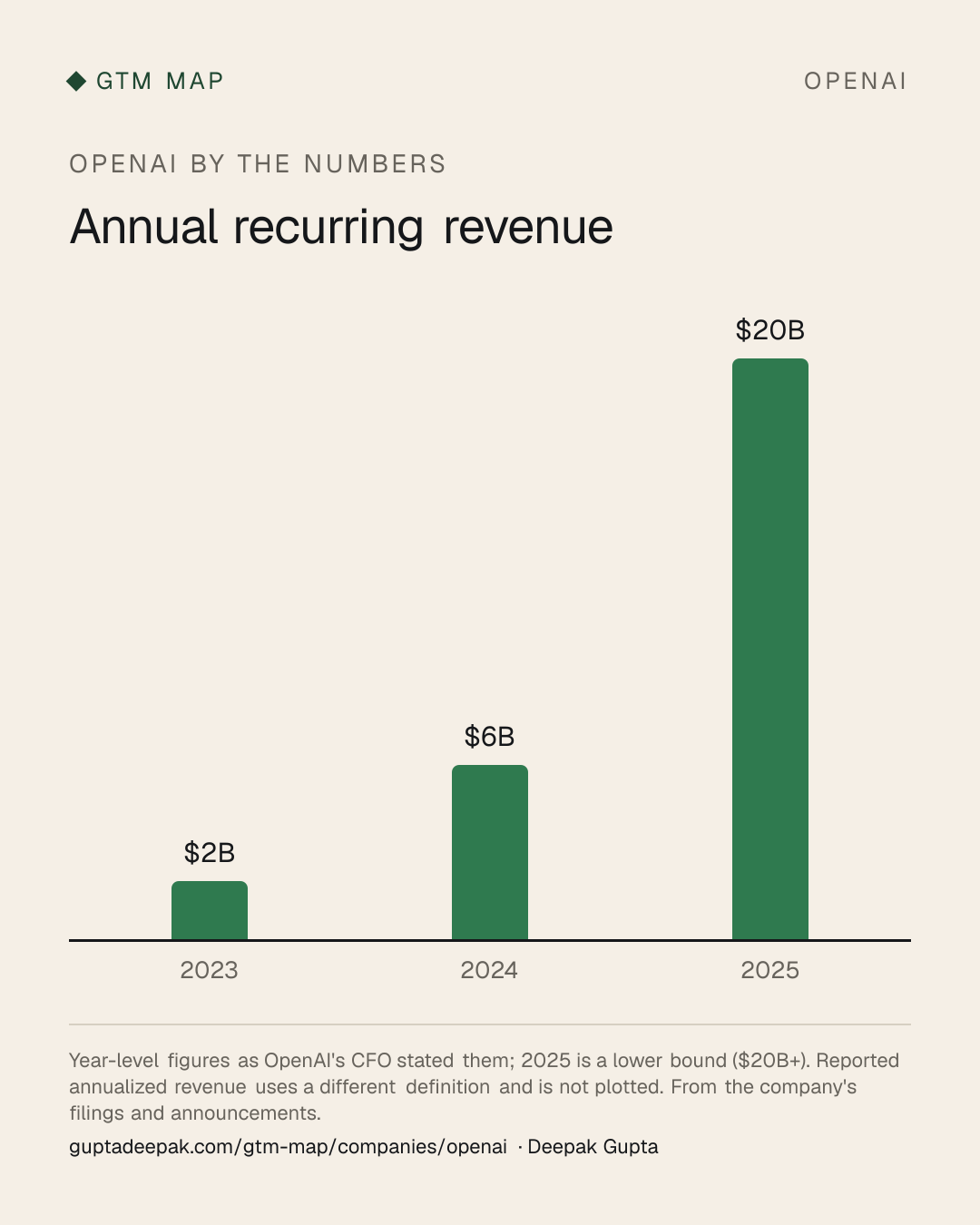
| 2023 | $2B | Company-stated |
|---|---|---|
| 2024 | $6B | Company-stated |
| 2025 | $20B | Company-stated |
| Metric | Value | As of | Basis |
|---|---|---|---|
| Developers on the API | Tens of thousands[2] | November 18, 2021 | Company-stated |
| Fortune 500 companies with registered ChatGPT accounts | Over 80%[7] | August 28, 2023 | Company-stated |
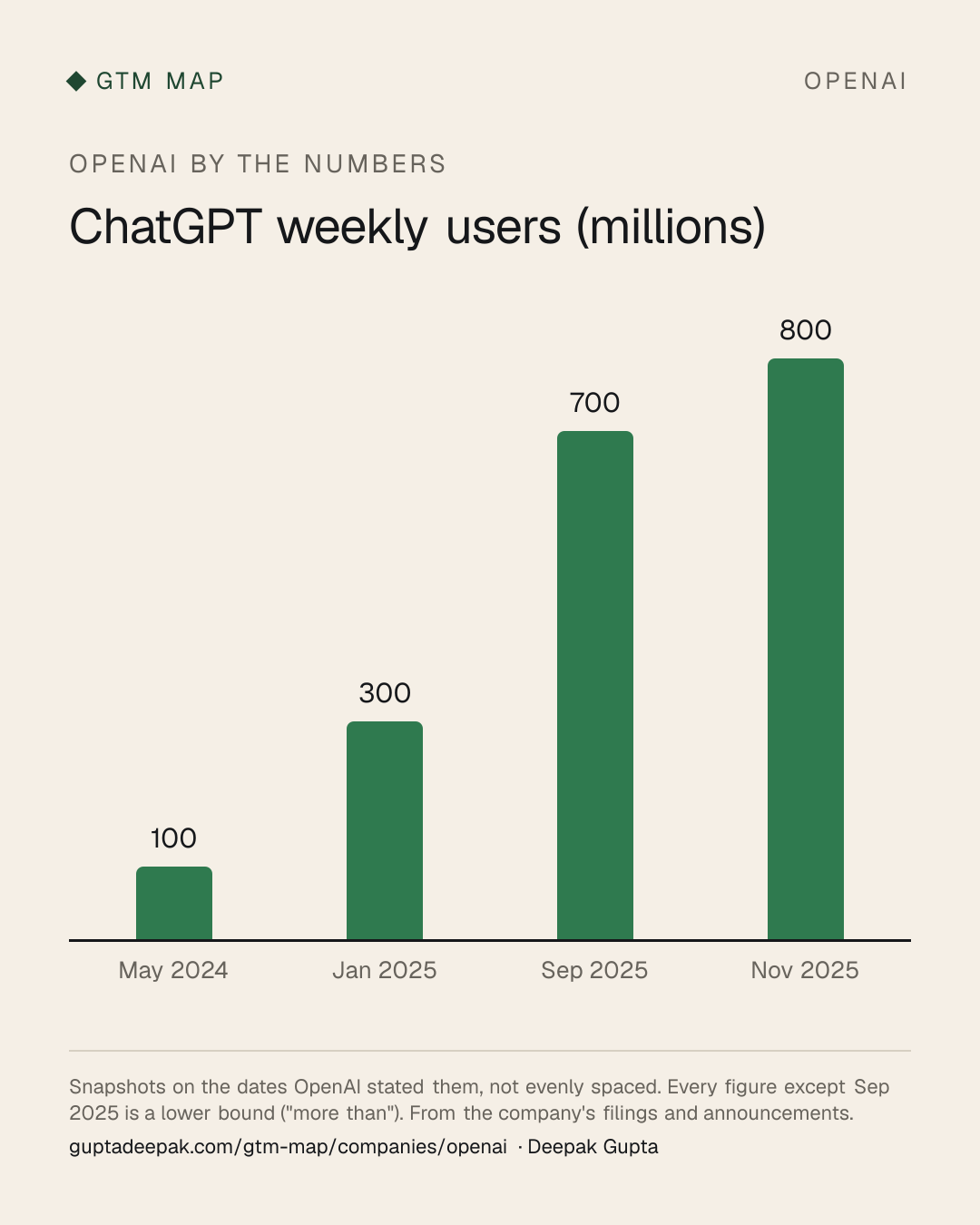
| ChatGPT weekly active users | 700 million[16] | September 15, 2025 | Company-stated |
| Consumer usage that is work-related | About 30%[16] | September 15, 2025 | Company-stated |
| Business customers paying OpenAI | More than 1 million[19] | November 5, 2025 | Company-stated |
| ChatGPT for Work seats | More than 7 million[19] | November 5, 2025 | Company-stated |
| Ownership of OpenAI Group PBC after the recapitalization | OpenAI Foundation 26%, Microsoft roughly 27%, employees and investors 47%[18] | October 28, 2025 | Company-stated |
| Annual recurring revenue, 2025 | $20B+ (from $2B in 2023 and $6B in 2024)[22] | January 18, 2026 | Company-stated |
| Codex weekly users | More than 4 million[24] | April 28, 2026 | Company-stated |
| IPO status | Confidential draft S-1 submitted to the SEC; timing not decided[25] | June 8, 2026 | Company-stated |
| Microsoft revenue from commercial arrangements with OpenAI, FY2026 | $24.1B[28] | June 30, 2026 | From a filing |
| Microsoft interest in OpenAI Group, as-converted | Approximately 25%[28] | June 30, 2026 | From a filing |
| Revenue mix | Enterprise larger than consumer, after entering 2026 at 60-40 consumer[33] | August 14, 2026 | Reported |
| Annualized revenue | Roughly $50B[34] | September 30, 2026 | Reported |
“Reported” figures come from trade press, not the company, and are shown with their date.
03Myth checks
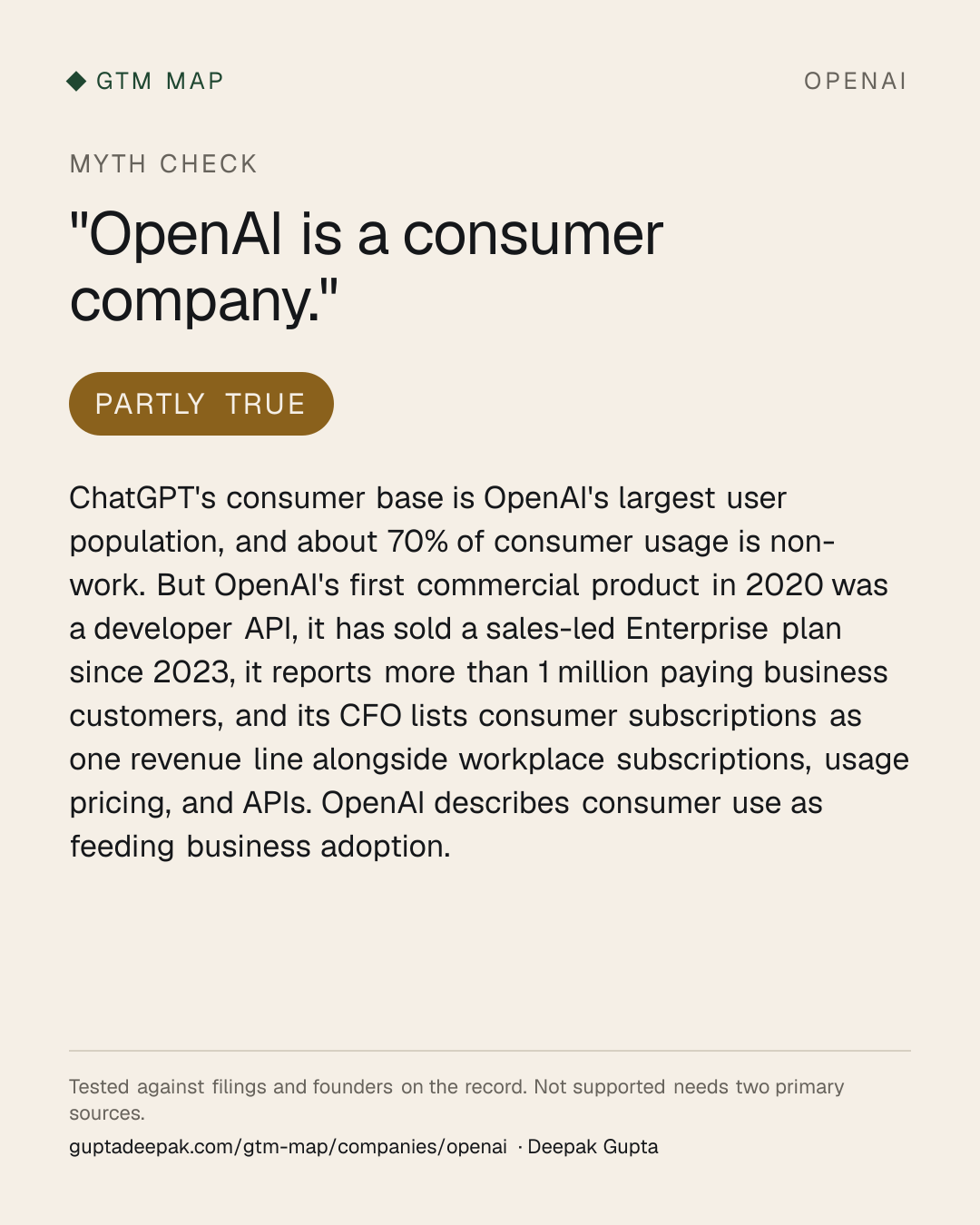
“OpenAI is a consumer company.”
Partly trueChatGPT's consumer base is OpenAI's largest user population, and about 70% of consumer usage is non-work. But OpenAI's first commercial product in 2020 was a developer API, it has sold a sales-led Enterprise plan since 2023, it reports more than 1 million paying business customers, and its CFO lists consumer subscriptions as one revenue line alongside workplace subscriptions, usage pricing, and APIs. OpenAI describes consumer use as feeding business adoption.[16],[1],[7],[19],[22]
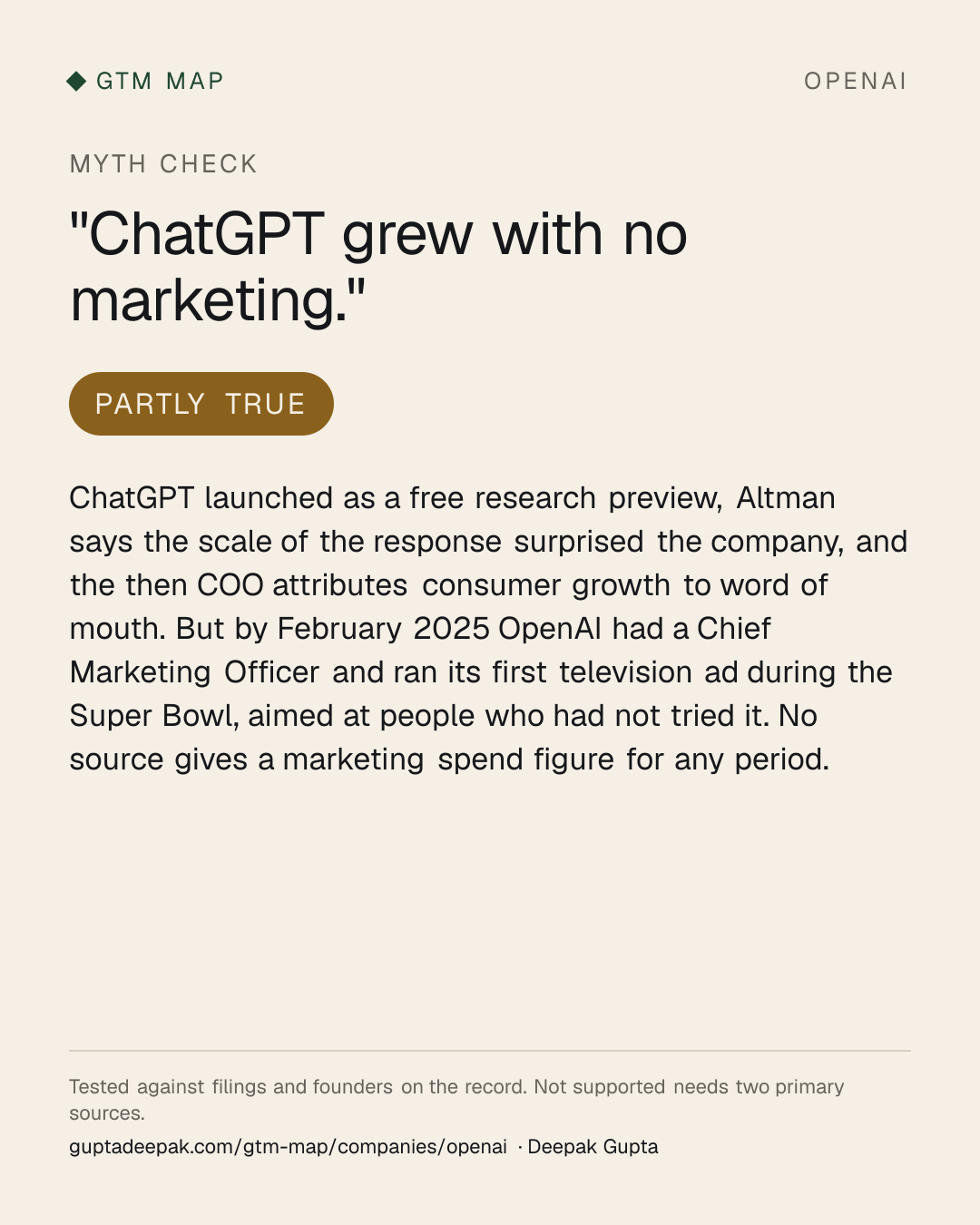
“ChatGPT grew with no marketing.”
Partly trueChatGPT launched as a free research preview, Altman says the scale of the response surprised the company, and the then COO attributes consumer growth to word of mouth. But by February 2025 OpenAI had a Chief Marketing Officer and ran its first television ad during the Super Bowl, aimed at people who had not tried it. No source gives a marketing spend figure for any period.[3],[30],[31],[14]
On the record
“We had been watching people use the playground feature of our API and knew that developers were really enjoying talking to the model.”
Sam Altman, CEO, OpenAI[30]
Reflections, paragraph 5
“Our enterprise momentum is fueled in part by consumer adoption.”
OpenAI, 1 million business customers, November 2025[19]
Section "From personal use to companywide impact"
“our business model should scale with the value intelligence delivers.”
Sarah Friar, CFO, OpenAI[22]
Paragraph 8
04What other companies can take from it
A free consumer product can be the top of an enterprise funnel, if you count the corporate domains inside it.
Works when: The same product is useful at home and at work, individuals can sign up without IT, and the paid business tier adds what employers need, such as data controls, SSO, and admin, rather than different features.
Backfires when: The consumer use case has nothing to do with the work use case, or employers ban personal accounts, so the consumer base never carries into a company deal.
Based on: ChatGPT goes free, then paid, then to work, Sales-led; Self-serve teams, ecosystem, and campus, Sales-assist
Ship the developer platform first, then let a consumer product show which use people keep coming back to.
Works when: The core capability is general-purpose and the best application is unknown, so developer usage is a cheap way to watch which interaction holds attention.
Backfires when: The product is narrow and the use case is already known, so an API-first period delays the end-user product without teaching anything.
Based on: API first, behind a waitlist, Developer-led; ChatGPT goes free, then paid, then to work, Product-led
Add tiers in both directions from a free base: a cheaper tier below and a premium tier above.
Works when: Unit costs are real and vary by user, willingness to pay varies by orders of magnitude, and the free base is large enough that a small paid share is material.
Backfires when: The free tier is cheap to serve and the user base is small, so extra tiers add decision friction and support load without meaningful revenue.
Based on: ChatGPT goes free, then paid, then to work, Product-led; Self-serve teams, ecosystem, and campus, Product-led; Monetise every tier, sell through every cloud, Product-led
A cloud exclusivity can bring distribution early and limit it later, so agree the exit terms up front.
Works when: A hyperscaler partner brings capital, compute, and enterprise procurement paths you cannot build alone.
Backfires when: Your buyers standardise on another cloud and the exclusivity keeps you out of their marketplace and committed-spend budgets.
Based on: ChatGPT goes free, then paid, then to work, Cloud marketplace; Monetise every tier, sell through every cloud, Cloud marketplace
05 · GTM Now
What changes in the AI era, and what to do now
Analysis by Deepak Gupta. This is opinion built on the sourced record above, not part of it.[19],[24],[23],[29],[21],[22],[10]
Still works
- A free product people use daily, carrying over into the workplace. OpenAI says familiarity means pilots are shorter and rollouts face less friction.
- Selling where procurement already happens. OpenAI on AWS lets eligible customers apply Codex usage to their AWS cloud commitments; that this grows in weight as AI budgets sit inside cloud commits is analysis.
Breaks
- A single cloud partner as the only marketplace channel. The April 2026 amendment let OpenAI serve all products on any cloud.
- An ad-free, subscription-only consumer model at this scale. Altman said in March 2024 that he disliked ads as an aesthetic choice, and in January 2026 OpenAI announced ad tests in the free and Go tiers.
What replaces it
- A multi-tier model the CFO describes as consumer and team subscriptions, a free ad- and commerce-supported tier, and usage-based APIs tied to production workloads.
- Third-party apps and commerce partners inside ChatGPT alongside the earlier GPT Store.
- Distribution through several clouds, with Azure keeping first-ship rights.
Apply it now
If you are
An AI product company with a free consumer or prosumer tier, real per-user inference cost, and a growing share of signups from company email domains
- Tag every signup by email domain and report a weekly count of companies with five or more individual users.
- Ship a self-serve team plan with admin and data controls that can be bought from inside product settings.
- Route domains above a seat threshold to sales with a usage summary, and sell the enterprise plan on data controls, SSO, and admin.
- Track seat growth inside converted accounts as the expansion metric.
You will know it works when: Share of new business contracts that started as three or more individual accounts on the same domain, and time from first team seat to enterprise contract.
Based on OpenAI's ChatGPT goes free, then paid, then to work, Self-serve teams, ecosystem, and campus, Self-serve teams, ecosystem, and campus
If you are
A model or API company selling to enterprises whose IT standardises on one or more hyperscalers
- List on the marketplaces where target accounts already have committed spend, and make usage count toward those commitments.
- Keep a direct API with token pricing for developers who want to start without procurement.
- If a partner offers exclusivity, negotiate a dated or conditional exit before you sign.
- Publish price cuts as passed-through savings, as a reason for existing users to build more.
You will know it works when: Share of new enterprise revenue transacted through marketplaces versus direct, and API spend growth in accounts that first arrived through a marketplace.
Based on OpenAI's Monetise every tier, sell through every cloud, API first, behind a waitlist, ChatGPT goes free, then paid, then to work
Motions in this record
Compare with every other company on the GTM matrix.
Share the visuals
Every card is drawn from the sourced record above and sized 1080 by 1350 for LinkedIn and X. Free to share with a link back to this page.
Sources
- [1]CompanyOpenAI API (June 11, 2020)
- [2]CompanyOpenAI's API now available with no waitlist (November 18, 2021)
- [3]CompanyIntroducing ChatGPT (November 30, 2022)
- [4]CompanyOpenAI and Microsoft extend partnership (January 23, 2023)
- [5]CompanyIntroducing ChatGPT Plus (February 1, 2023)
- [6]CompanyIntroducing APIs for GPT-3.5 Turbo and Whisper (originally Introducing ChatGPT and Whisper APIs) (March 1, 2023)
- [7]CompanyIntroducing ChatGPT Enterprise (August 28, 2023)
- [8]CompanyNew models and developer products announced at DevDay (November 6, 2023)
- [9]CompanyIntroducing ChatGPT Team (January 10, 2024)
- [10]CompanyIntroducing the GPT Store (January 10, 2024)
- [11]CompanyIntroducing GPT-4o and more tools to ChatGPT free users (May 13, 2024)
- [12]CompanyIntroducing ChatGPT Edu (May 30, 2024)
- [13]CompanyIntroducing ChatGPT Pro (December 5, 2024)
- [14]CompanyOpenAI's Super Bowl Ad: Introducing the Intelligence Age (OpenAI Forum event) (February 12, 2025)
- [15]CompanyEvolving OpenAI's structure (May 5, 2025)
- [16]CompanyHow people are using ChatGPT (September 15, 2025)
- [17]CompanyThe next chapter of the Microsoft OpenAI partnership (October 28, 2025)
- [18]CompanyOur structure (undated)
- [19]Company1 million business customers: the fastest-growing business platform in history (November 5, 2025)
- [20]CompanyA free version of ChatGPT built for teachers (November 19, 2025)
- [21]CompanyOur approach to advertising and expanding access to ChatGPT (January 16, 2026)
- [22]CompanyA business that scales with the value of intelligence (January 18, 2026)
- [23]CompanyThe next phase of the Microsoft OpenAI partnership (April 27, 2026)
- [24]CompanyOpenAI models, Codex, and Managed Agents come to AWS (April 28, 2026)
- [25]CompanyConfidential submission of draft S-1 to the SEC (June 8, 2026)
- [27]SEC filingMicrosoft Corporation Form 10-K, fiscal year ended June 30, 2023 (July 27, 2023)
- [28]SEC filingMicrosoft Corporation Form 10-K, fiscal year ended June 30, 2026 (July 29, 2026)
- [29]Founder interviewLex Fridman Podcast #419: Sam Altman (transcript) (Sam Altman, March 18, 2024, at 00:24:52, 01:20:16, 01:21:08)
- [30]Founder interviewReflections (Sam Altman's blog) (Sam Altman, January 6, 2025, at paragraphs 5 to 7 and 15)
- [31]Founder interviewOpenAI tops 400 million users despite DeepSeek's emergence (CNBC) (Brad Lightcap, February 20, 2025, at direct quotes in the article body)
- [32]Founder interviewOpenAI tops 3 million paying business users, launches new features for workplace (CNBC) (Brad Lightcap, June 4, 2025, at direct quotes in the article body)
- [33]Trade pressOpenAI CFO Friar tells investors that enterprise business now bigger than consumer by revenue (CNBC, August 14, 2026)
- [34]Trade pressNvidia, Oracle, CoreWeave and other AI stocks sink on OpenAI revenue report (CNBC, October 8, 2026)
Every phase, motion, and myth verdict cites a filing, the company's own pages, or a founder speaking on the record. See the methodology.