
Developer and enterprise · private
How Stripe went to market
Stripe launched as a self-serve payments API for developers, priced per charge with no setup fees, then let platforms resell it through Connect. From 2020 it built enterprise sales on top of that base, and it now sells a suite beyond payments to startups and half of the Fortune 100.
- Buyer:
- Developers, Small business, Enterprise
- Contract size:
- Mixed
- Checked:
- October 18, 2026
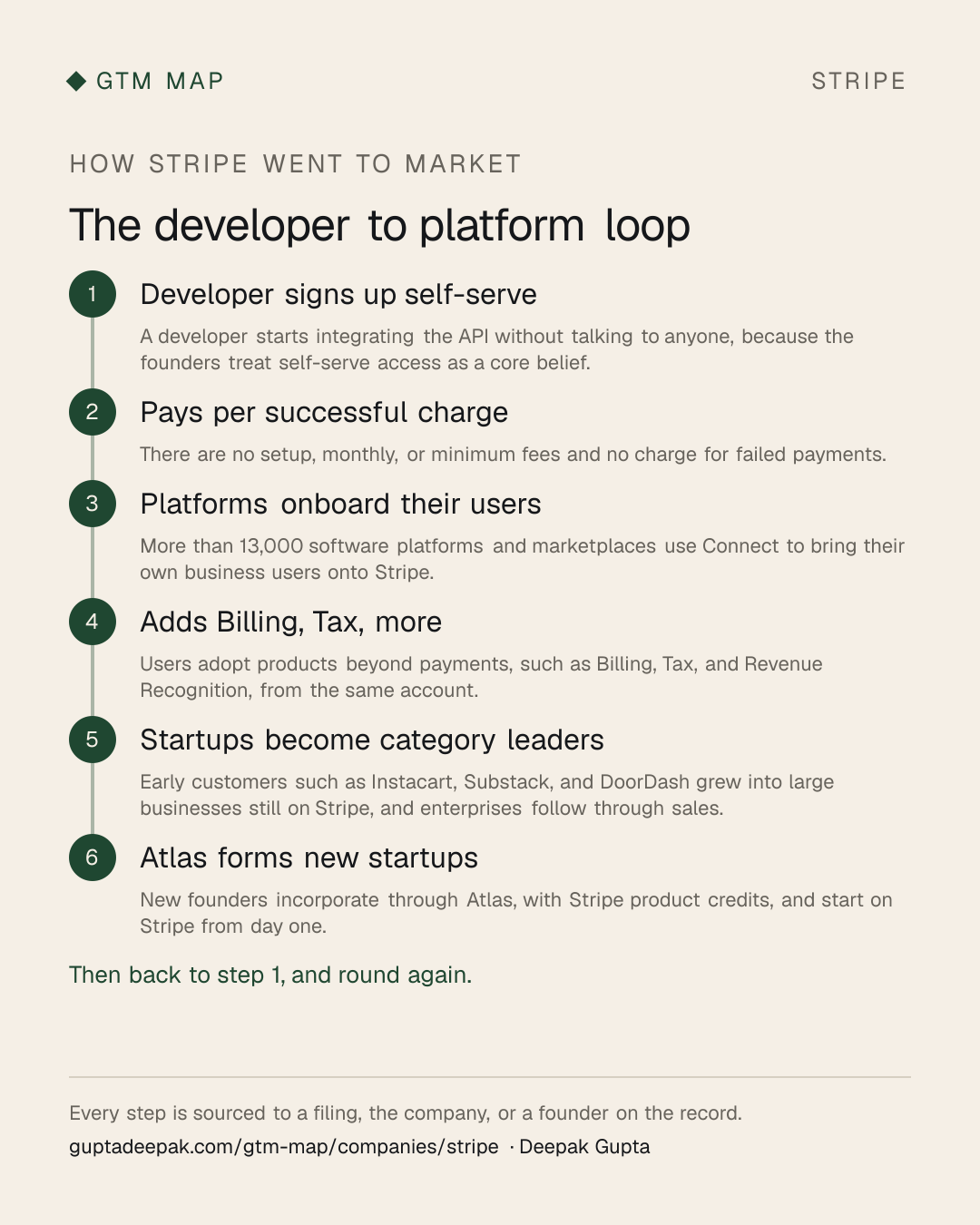
Pays per successful charge
There are no setup, monthly, or minimum fees and no charge for failed payments.[1]
Platforms onboard their users
More than 13,000 software platforms and marketplaces use Connect to bring their own business users onto Stripe.[18]
Adds Billing, Tax, more
Users adopt products beyond payments, such as Billing, Tax, and Revenue Recognition, from the same account.[17]
Back to step 1, and round again
01The phases
PrimarySupportingTried, then dropped
2011 to 2015
Payments for developers
Stripe launched as a self-serve payments API pitched at developers, with a per-charge price and no setup fees, and opened Connect in 2012 so platforms could bring their own users onto Stripe.
- Developer-led
The founders framed payments as a code problem. Patrick Collison recalls that Stripe's first website said transactions on the web were a problem rooted in code, not finance.[18]
- Product-led
Signup and payment acceptance were self-serve, and even large users were asked to email support rather than meet a sales rep. The founders still describe self-serve access as something they believe in extremely strongly.[20],[1]
- Usage pricing
One published fee per successful charge, with no setup, monthly, minimum, or card storage fees and no charge for failed payments. Volume discounts were offered by email above $1 million a year.[1]
- Partner channel
Connect launched in 2012 so marketplaces, store builders, and invoicing tools could onboard their own users to Stripe and collect a fee on each transaction.[5],[2]
- Developer-led
2016 to 2019
Startups first, beyond payments
Stripe added products around the payment (Atlas for company formation, Radar for fraud, Billing for subscriptions), started publishing through Increment and Stripe Press, and ran Sessions as its annual user event.
- Land and expand
New products were built on the payments base and sold to existing users. Billing was an evolution of Subscriptions built from customer feedback, Radar launched in 2016, and Atlas put founders on Stripe at incorporation.[6],[7],[3]
- Partner channel
Atlas launched with banking, accounting, legal, and cloud partners (Silicon Valley Bank, PwC, Orrick, and Amazon), and Stripe kept extending Connect for marketplaces and platforms.[3],[5]
- Brand narrative
Stripe started Increment, a quarterly software engineering magazine, in 2017, and Stripe Press, which publishes books about economic and technological advancement, in 2018.[4],[8]
- Owned events
Sessions is an annual event to show users what is new and hear their feedback. In 2018 over a thousand people came to Sessions events in San Francisco, New York, Paris, and London.[9]
- Land and expand
2020 to 2022
March into the enterprise
Stripe hired a chief revenue officer to lead and grow a global sales organisation, signed enterprise partnerships such as Salesforce Commerce Cloud and Atlassian, and formalised a partner ecosystem with consultancies and systems integrators.
- Sales-led
The 2020 chief revenue officer hire was to lead and grow a global sales organisation as Stripe accelerated its march into the enterprise. Stripe's own letter says its startup focus had been a drawback with incumbents, and that this later inverted.[10],[11],[13]
- Partner channel
Salesforce Commerce Cloud Payments was built on Stripe in 2020. By 2022 more than 10,000 companies used Connect, and Stripe launched a partner programme with more than 1,800 vetted partners, including Accenture and Thoughtworks.[11],[14],[15]
- Land and expand
Enterprise deals could start beyond core payments. Atlassian moved its subscription and revenue management onto Stripe Billing, with over a dozen custom features designed with Stripe.[12],[13]
- Brand narrative
The annual letter became a public narrative around the mission to grow the GDP of the internet, with Stripe Press framed as helping spread startup know-how.[15]
- Sales-led
2023 to now
Multi-product platform for startups and enterprises
Revenue products beyond payments passed a $500 million run rate and are on track for $1 billion, Connect serves over 13,000 platforms, Sessions became a conference with enterprise tracks, and Atlas and AI-tool sandboxes keep bringing new startups in.
- Land and expand
Billing grew into a Revenue and Finance Automation suite (Billing, Tax, Revenue Recognition, and later Metronome usage billing) sold into the payments base. It passed a $500 million run rate and is on track for $1 billion.[17],[19],[21]
- Partner channel
Platforms embed Stripe to offer payments to their own business users: more than 13,000 platforms serve more than 8 million businesses through Connect. Stripe also became the default payments provider for Salesforce Commerce Cloud.[18],[19]
- Sales-led
Enterprise is a named segment, with more than 100 companies processing over $1 billion a year. Large businesses are routed to Contact sales for custom pricing, and the 2026 leadership note describes a revenue organisation built from the ground up.[17],[23],[22]
- Owned events
Sessions 2023 was more than three times the size of 2019, and Sessions 2024 ran breakout tracks for enterprises, platforms, and developers.[16],[18]
- Developer-led
The developer entry point now extends into AI coding tools: claimable sandboxes start a Stripe integration inside tools like Replit and Vercel, and more than 100,000 have been created that way.[21],[16]
- Brand narrative
The annual letter frames Stripe volume as a share of the world economy: $1.9 trillion in 2025, roughly 1.6% of global GDP.[21]
- Land and expand
02The numbers
Show the data
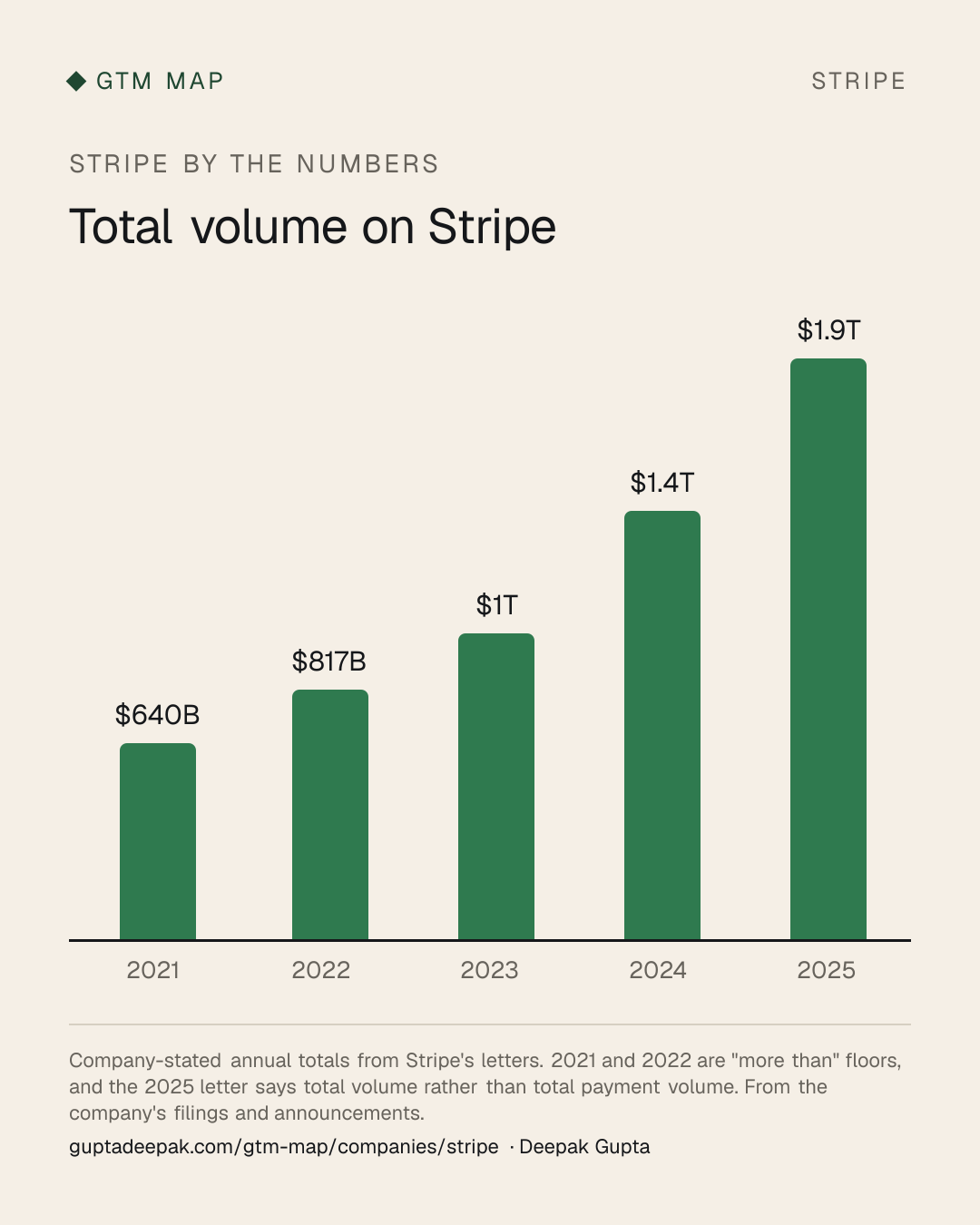
| 2021 | $640B | Company-stated |
|---|---|---|
| 2022 | $817B | Company-stated |
| 2023 | $1T | Company-stated |
| 2024 | $1.4T | Company-stated |
| 2025 | $1.9T | Company-stated |
| Metric | Value | As of | Basis |
|---|---|---|---|
| Customers with $1B+ a year in payment volume on Stripe | 40[11] | September 23, 2020 | Company-stated |
| Companies using Connect | More than 10,000[14] | April 28, 2022 | Company-stated |
| Companies handling $1B+ a year in payments with Stripe | More than 100[15] | 2022 | Company-stated |
| Stripe-vetted partners in the Partner Ecosystem program | More than 1,800[15] | 2022 | Company-stated |
| Total payment volume | $1 trillion[17] | 2023 | Company-stated |
| Platforms using Connect | More than 13,000, serving 8M+ businesses[18] | April 25, 2024 | Company-stated |
| Total payment volume | $1.4 trillion[19] | 2024 | Company-stated |
| Revenue and Finance Automation run rate | Over $500M[19] | February 27, 2025 | Company-stated |
| Companies using Stripe Billing | More than 300,000[19] | February 27, 2025 | Company-stated |
| Fortune 100 companies using Stripe | Half[19] | February 27, 2025 | Company-stated |
| Total volume | $1.9 trillion, up 34%[21] | 2025 | Company-stated |
| Businesses powered, directly or via platforms | More than 5 million[21] | February 24, 2026 | Company-stated |
| Dow Jones Industrial Average companies using Stripe | 90%[21] | February 24, 2026 | Company-stated |
| Delaware corporations created with Stripe Atlas | 25%[21] | February 24, 2026 | Company-stated |
“Reported” figures come from trade press, not the company, and are shown with their date.
03Myth checks
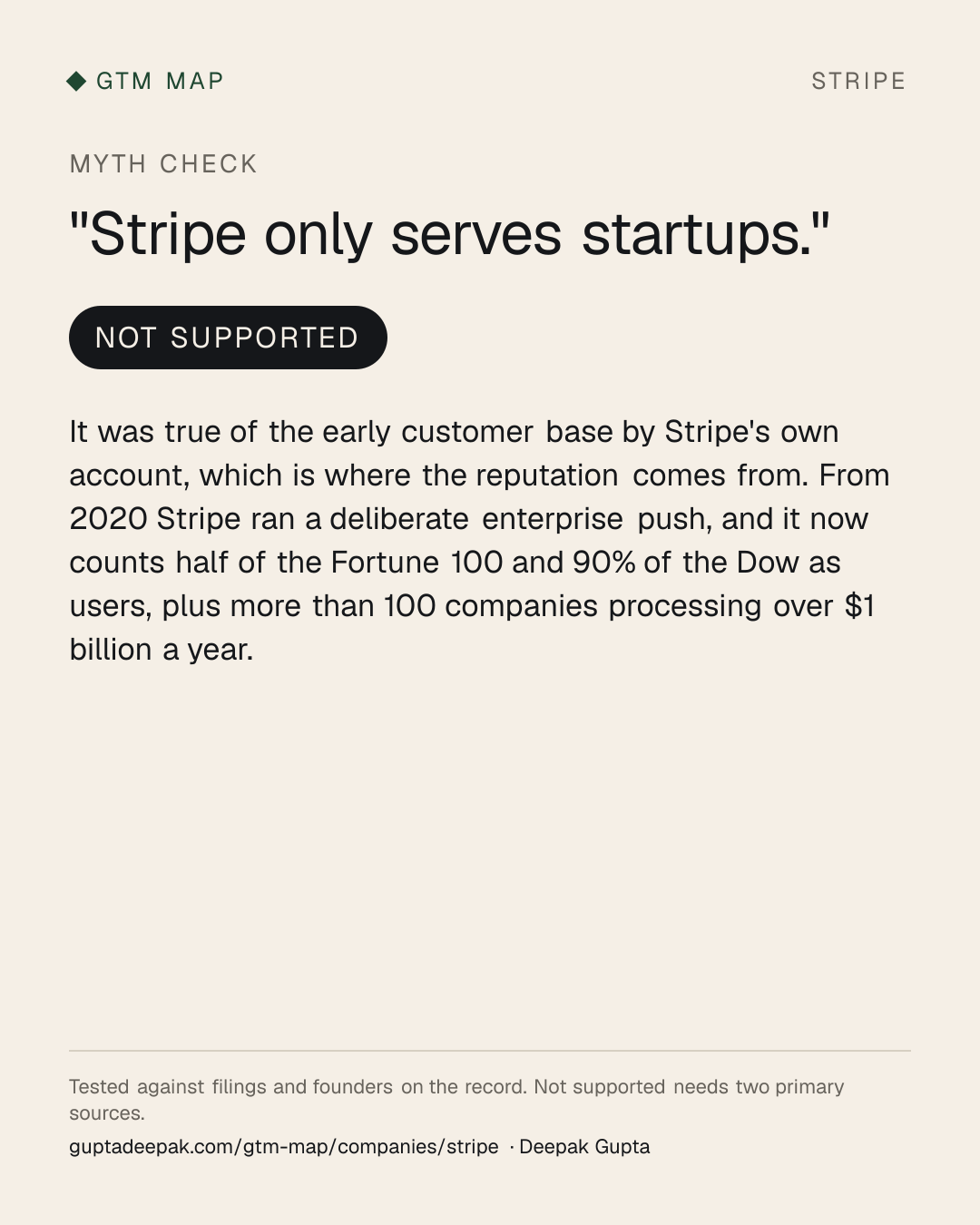
“Stripe only serves startups.”
Not supportedIt was true of the early customer base by Stripe's own account, which is where the reputation comes from. From 2020 Stripe ran a deliberate enterprise push, and it now counts half of the Fortune 100 and 90% of the Dow as users, plus more than 100 companies processing over $1 billion a year.[13],[10],[17],[19],[21]
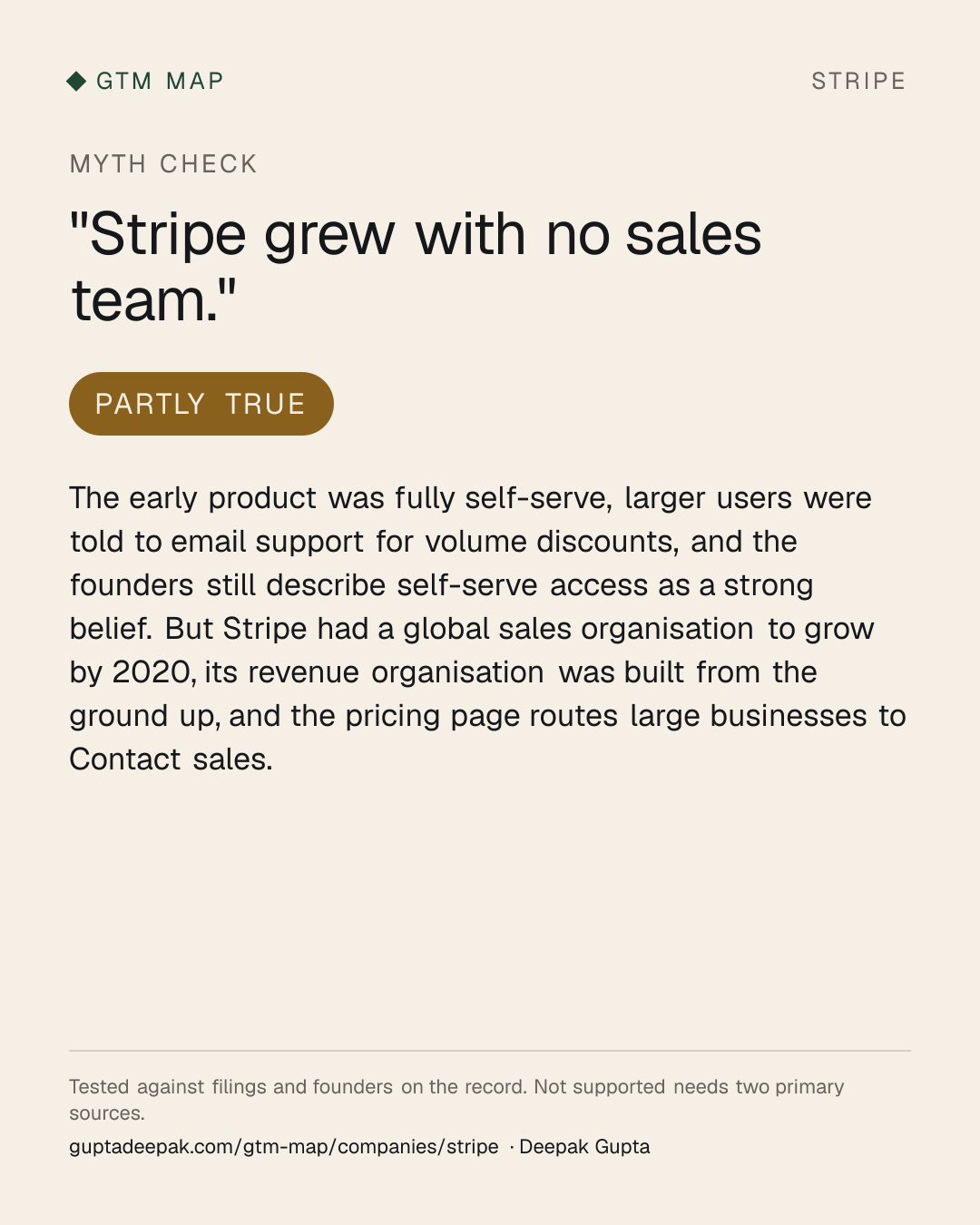
“Stripe grew with no sales team.”
Partly trueThe early product was fully self-serve, larger users were told to email support for volume discounts, and the founders still describe self-serve access as a strong belief. But Stripe had a global sales organisation to grow by 2020, its revenue organisation was built from the ground up, and the pricing page routes large businesses to Contact sales.[1],[20],[10],[22],[23]
On the record
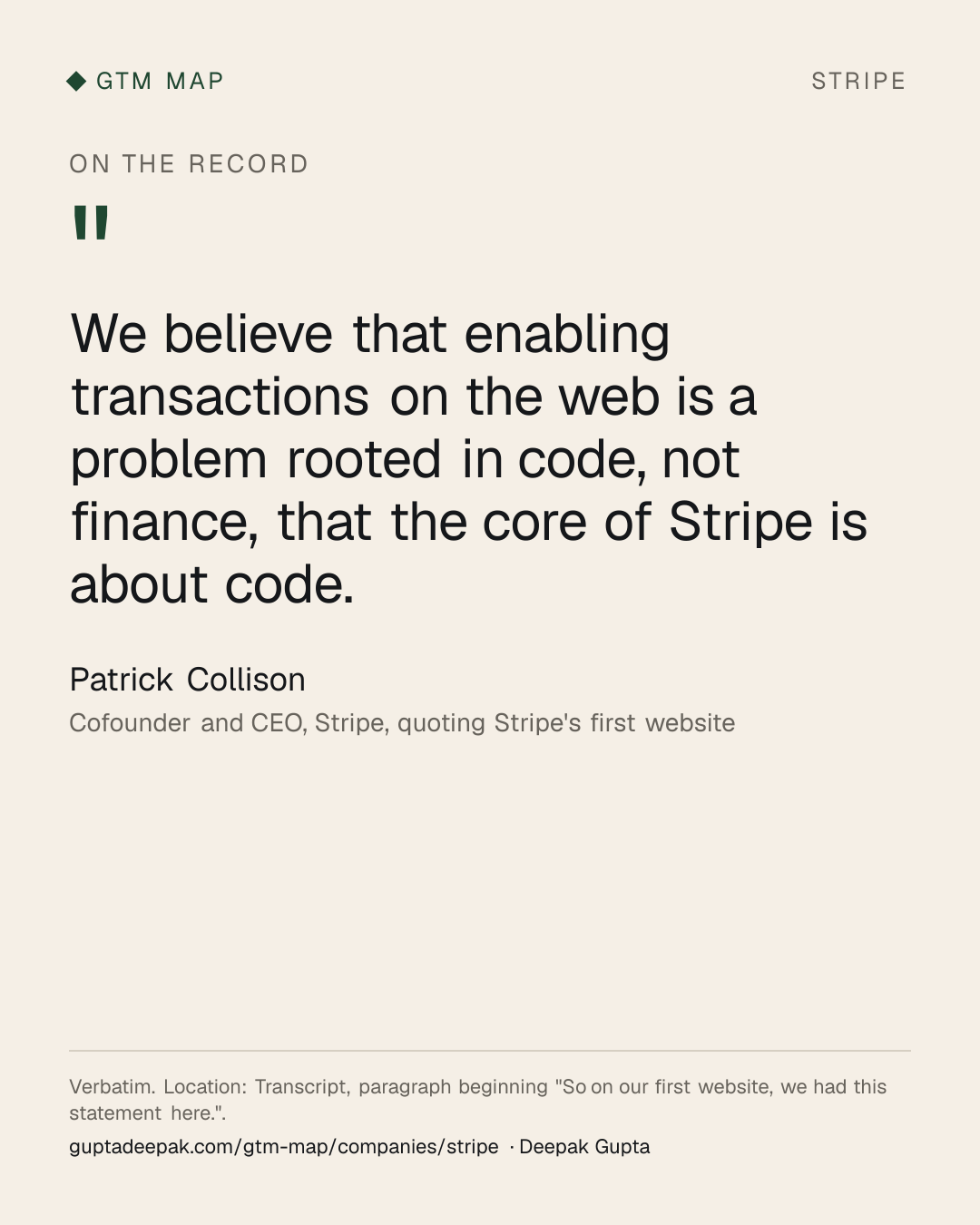
“We believe that enabling transactions on the web is a problem rooted in code, not finance, that the core of Stripe is about code.”
Patrick Collison, Cofounder and CEO, Stripe, quoting Stripe's first website[18]
Transcript, paragraph beginning "So on our first website, we had this statement here."
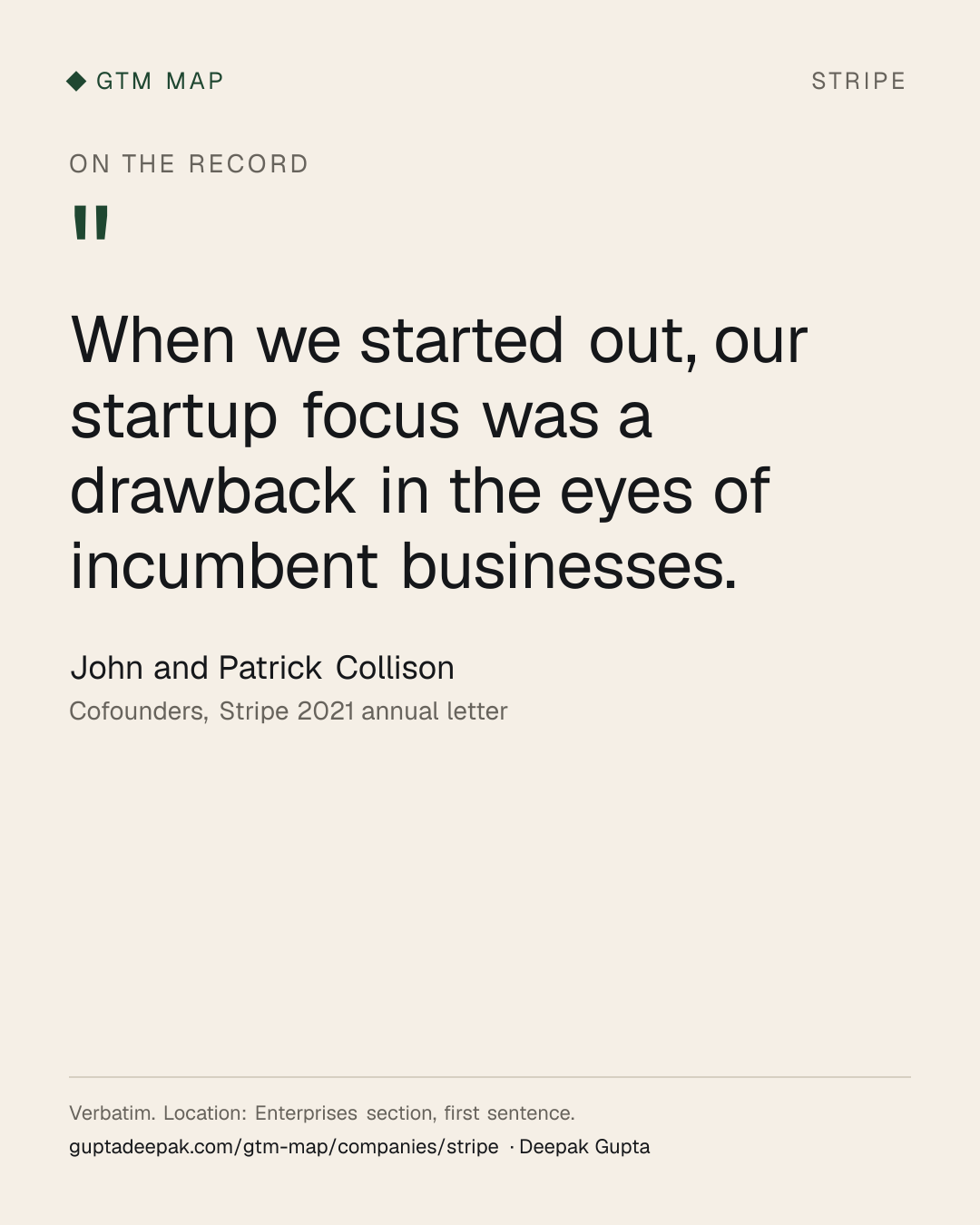
“When we started out, our startup focus was a drawback in the eyes of incumbent businesses.”
John and Patrick Collison, Cofounders, Stripe 2021 annual letter[13]
Enterprises section, first sentence
“a lot of people just, like, don’t want to have to talk to somebody in order to get going. You want to do it immediately.”
Patrick Collison, Cofounder and CEO, Stripe[20]
Answer to "If you had to build Stripe again from scratch, is there anything you'd do differently?"
04What other companies can take from it
Make the first integration a self-serve developer task, then keep that path open after you add sales.
Works when: The person who integrates is an engineer who can ship without procurement, the product is infrastructure behind an API, and value appears on the first live transaction.
Backfires when: The buyer needs legal, risk, or compliance sign-off before any test, as in core banking or regulated health data, so self-serve signups produce accounts that never go live.
Based on: Payments for developers, Developer-led; Payments for developers, Product-led; Multi-product platform for startups and enterprises, Developer-led
Price on the customer's success, keep the public rate simple, and set the volume line for custom pricing early.
Works when: The product sits in the revenue path, usage scales with the customer's growth, and small customers would never sign a minimum commitment.
Backfires when: Usage is decoupled from customer value, as with internal tools, or unit costs are volatile enough that one public rate loses money on large users.
Based on: Payments for developers, Usage pricing; Multi-product platform for startups and enterprises, Sales-led
Grow alongside your earliest customers, then sell the same product to incumbents.
Works when: A meaningful share of early customers become large companies, giving reference logos that enterprises respect.
Backfires when: The early base stays small (hobbyists, tiny businesses), so there are no grown-up references and enterprise sales becomes cold outbound.
Based on: March into the enterprise, Sales-led; Multi-product platform for startups and enterprises, Sales-led
Let platforms resell you to their users, and expand with products those platforms can embed.
Works when: Many software vendors serve long-tail businesses that need the same capability, such as payments, tax, or financing, and the vendor can earn margin on it.
Backfires when: The platform cannot monetise or support the capability, or it sees you as a competitor for its users.
Based on: Payments for developers, Partner channel; Multi-product platform for startups and enterprises, Partner channel; Multi-product platform for startups and enterprises, Land and expand
05 · GTM Now
What changes in the AI era, and what to do now
Analysis by Deepak Gupta. This is opinion built on the sourced record above, not part of it.[21]
Still works
- An API-first developer entry point. Stripe now meets developers inside AI coding tools with claimable sandboxes, and more than 100,000 have been created that way; AI coding tools favouring well-documented, testable APIs is analysis.
- Usage pricing in the revenue path. Metronome, now in Stripe's revenue suite, powers usage-based billing for companies such as OpenAI, Anthropic, Confluent, and NVIDIA.
Breaks
- Developer word of mouth and docs search as the discovery channel, when an agent picks the provider and the developer never reads a comparison (analysis).
- Long essays and books reach fewer builders directly when answers replace clicks, so their value shifts to being the source AI answers cite (analysis).
What replaces it
- Default placement inside AI build tools, with sandboxes that become live accounts, as Stripe is doing with its claimable sandboxes.
- Annual data letters that become citable statistics, and platform partnerships where the platform, not the developer, picks the provider (analysis).
Apply it now
If you are
A seed to Series B API or infrastructure company in your customers' revenue or transaction path, with developers as the integrating user and an ACV under $10K at first
- Ship a public self-serve signup with a working test mode and copy-paste requests on the landing page.
- Publish one simple usage price with no setup or monthly fee, plus a stated volume threshold where custom pricing starts.
- Make your product installable from inside AI coding tools, with a sandbox that converts to a live account.
- Build a platform API so software vendors can onboard their own users and take a fee.
You will know it works when: Share of new accounts that reach a first live transaction within 7 days without talking to anyone, and the share that arrive through a platform or AI tool.
Based on Stripe's Payments for developers, Payments for developers, Payments for developers, Payments for developers, Multi-product platform for startups and enterprises
If you are
A growth-stage infrastructure company with a large self-serve base, where some customers have become large businesses, starting an enterprise motion
- Count how many existing customers now exceed an enterprise volume threshold and use them as references.
- Hire a sales leader who has sold usage-priced infrastructure, and keep the self-serve path unchanged.
- Lead enterprise deals with an adjacent product the buyer cannot easily build, such as billing or embedded finance, rather than a price cut on the core.
- Run one owned annual event with separate enterprise, platform, and developer tracks.
You will know it works when: Number of customers above the enterprise volume threshold year over year, and revenue from non-core products as a share of total.
Based on Stripe's March into the enterprise, March into the enterprise, Multi-product platform for startups and enterprises
Motions in this record
Compare with every other company on the GTM matrix.
Share the visuals
Every card is drawn from the sourced record above and sized 1080 by 1350 for LinkedIn and X. Free to share with a link back to this page.

Sources
- [1]CompanyStripe: Pricing, United States (Internet Archive copy, 2013-01-21) (January 21, 2013)
- [2]CompanyStripe Connect product page (Internet Archive copy, 2014-01-22) (January 22, 2014)
- [3]CompanyAnnouncing Stripe Atlas: helping entrepreneurs start a global business from anywhere (February 24, 2016)
- [4]CompanyIntroducing Increment (April 13, 2017)
- [5]CompanyImproving Connect to enable more platforms (May 25, 2017)
- [6]CompanyIntroducing Stripe Billing (April 5, 2018)
- [7]CompanyImproved fraud prevention with Radar 2.0 (April 18, 2018)
- [8]CompanyStripe Press (Patrick Collison, Internet Archive copy) (July 17, 2018)
- [9]CompanyStripe Sessions (John Collison) (June 10, 2019)
- [10]CompanyStripe hires Mike Clayville as Chief Revenue Officer (August 5, 2020)
- [11]CompanyStripe named a Leader by Forrester, strikes global commerce partnership with Salesforce (September 23, 2020)
- [12]CompanySaaS giant Atlassian selects Stripe to create a single platform for global billing and payments (March 3, 2021)
- [13]CompanyStripe 2021 business update (annual letter) (April 2022)
- [14]CompanyStripe Connect at 10: embedded finance and the next decade of software growth (April 28, 2022)
- [15]CompanyStripe 2022 update (annual letter) (April 5, 2023)
- [16]CompanySessions 2023 keynote: Powering growth for the internet economy (transcript) (May 3, 2023)
- [17]CompanyStripe 2023 annual letter (March 13, 2024)
- [18]CompanySessions 2024 opening keynote (transcript) (April 25, 2024)
- [19]CompanyStripe 2024 annual letter (February 27, 2025)
- [20]Founder interviewSessions 2025: AMA with Patrick and John Collison, hosted by Claire Hughes Johnson (transcript) (Patrick Collison, John Collison, May 8, 2025, at Answer to "If you had to build Stripe again from scratch, is there anything you'd do differently?")
- [21]CompanyStripe 2025 annual letter (February 24, 2026)
- [22]CompanyEileen O'Mara named vice chair of Stripe; Tyler Bryson appointed chief revenue officer (June 22, 2026)
- [23]CompanyStripe Pricing (live page) (October 18, 2026)
- [24]CompanyStripe Atlas (live page) (October 18, 2026)
Every phase, motion, and myth verdict cites a filing, the company's own pages, or a founder speaking on the record. See the methodology.