
Classic SaaS · public
How Salesforce went to market
Salesforce named an enemy, "The End of Software", and paid for attention with advertising and stunts, but a direct sales force segmented by company size did the converting. It then grew inside accounts, built a partner marketplace and Dreamforce, cross-sold new clouds, and now sells Agentforce into its installed base on consumption pricing.
- Buyer:
- Small business, Mid-market, Enterprise
- Contract size:
- Mixed
- Checked:
- October 18, 2026
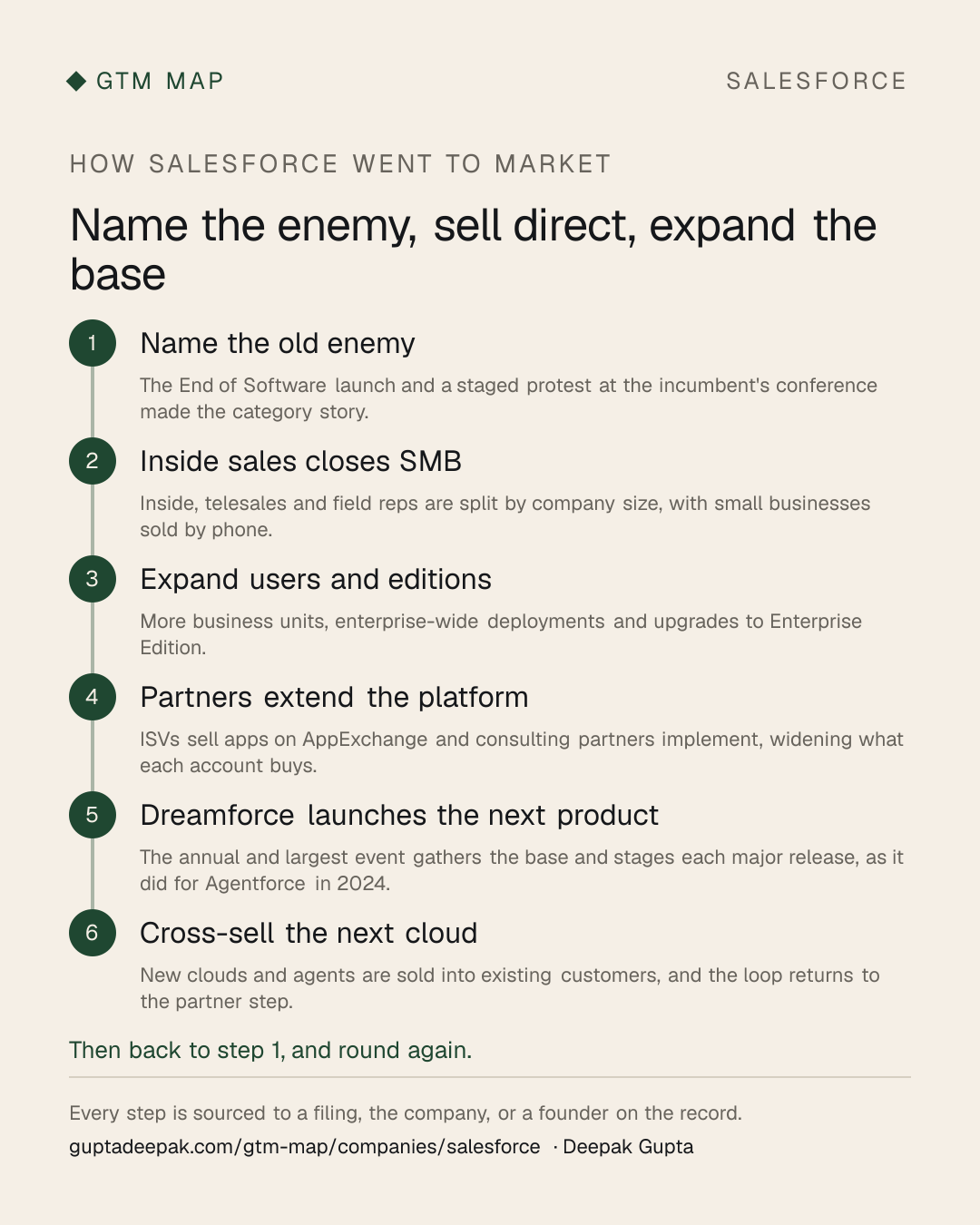
Name the old enemy
The End of Software launch and a staged protest at the incumbent's conference made the category story.[9]
Inside sales closes SMB
Inside, telesales and field reps are split by company size, with small businesses sold by phone.[1]
Expand users and editions
More business units, enterprise-wide deployments and upgrades to Enterprise Edition.[1]
Partners extend the platform
ISVs sell apps on AppExchange and consulting partners implement, widening what each account buys.[6]
Cross-sell the next cloud
New clouds and agents are sold into existing customers, and the loop returns to the partner step.[7]
Back to step 1, and round again
01The phases
PrimarySupportingTried, then dropped
1999 to 2004
The End of Software, sold by phone
Founded in February 1999, Salesforce began offering its on-demand CRM service in February 2000 and framed itself against installed enterprise software. Advertising and stunts bought attention; a segmented direct sales force closed the deals until the June 2004 IPO.
- Category creation
Salesforce registered "The End of Software", the "No Software" logo and "Success. Not Software." as trademarks, and pitched on-demand CRM as a new delivery model. It launched in February 2000 at an event themed around The End of Software, with 1,500 attendees.[1],[2],[9]
- Brand narrative
In March 2000 the company hired actors to stage a mock protest with anti-software signs outside a Siebel Systems conference, which it credits with its first major press coverage, in The Wall Street Journal. Benioff now calls the stunt "frivolous".[9],[15]
- Paid acquisition
Advertising dominated early spend: 62% of fiscal 2001 and 47% of fiscal 2002 marketing and sales expense. From fiscal 2003, sales costs took a larger share as advertising fell.[1]
- Sales-led
Inside sales, telesales and field reps were split by company size, and small businesses were sold primarily over the phone, with website free trials among the marketing initiatives. Small businesses were about 40% of fiscal 2004 revenue.[1]
- Owned events
Launch events and sponsored marketing events were a named line from the start. The first Dreamforce, in 2003, had just over 1,000 registered attendees and 52 presentations.[1],[9]
- Partner channel
Consulting firms, technology vendors and systems integrators referred prospects and were typically paid a percentage of the first-year subscription revenue from the customers they referred.[1]
- Category creation
2004 to 2008
AppExchange and the move to larger customers
After the IPO, growth came from third-party apps on the platform and from selling into medium and large businesses. Customers grew from about 13,900 in January 2005 to about 41,000 in January 2008.
- Partner channel
The sforce platform and then the AppExchange directory (now AgentExchange) let partners build and list apps that customers install on Salesforce. More than 700 apps had been posted by January 2008.[1],[3],[13]
- Land and expand
Growth inside accounts came from more business units, enterprise-wide deployments and upgrades to fuller editions such as Enterprise Edition. Paying subscriptions went from 147,000 in April 2004 to about 1.1 million in January 2008.[1],[3]
- Sales-led
The company tied its growth to medium and large businesses and expected greater costs and longer sales cycles there. Account executives stayed split across small business, general business and enterprise.[1],[3]
- Owned events
User conferences and launch events were listed as a primary marketing activity, and Dreamforce reached 10,000 registered attendees in 2008.[3],[9]
- Paid acquisition
Search engine marketing and online and print advertising drove traffic to the website, where free trials, case studies and white papers captured leads for the sales organization.[3]
- Partner channel
2009 to 2024
Many clouds, Dreamforce, Trailblazers and acquisitions
Service Cloud launched in 2009, and Salesforce became a set of clouds sold by a direct sales force into a growing base. Dreamforce became its largest marketing event and Slack its largest acquisition.
- Owned events
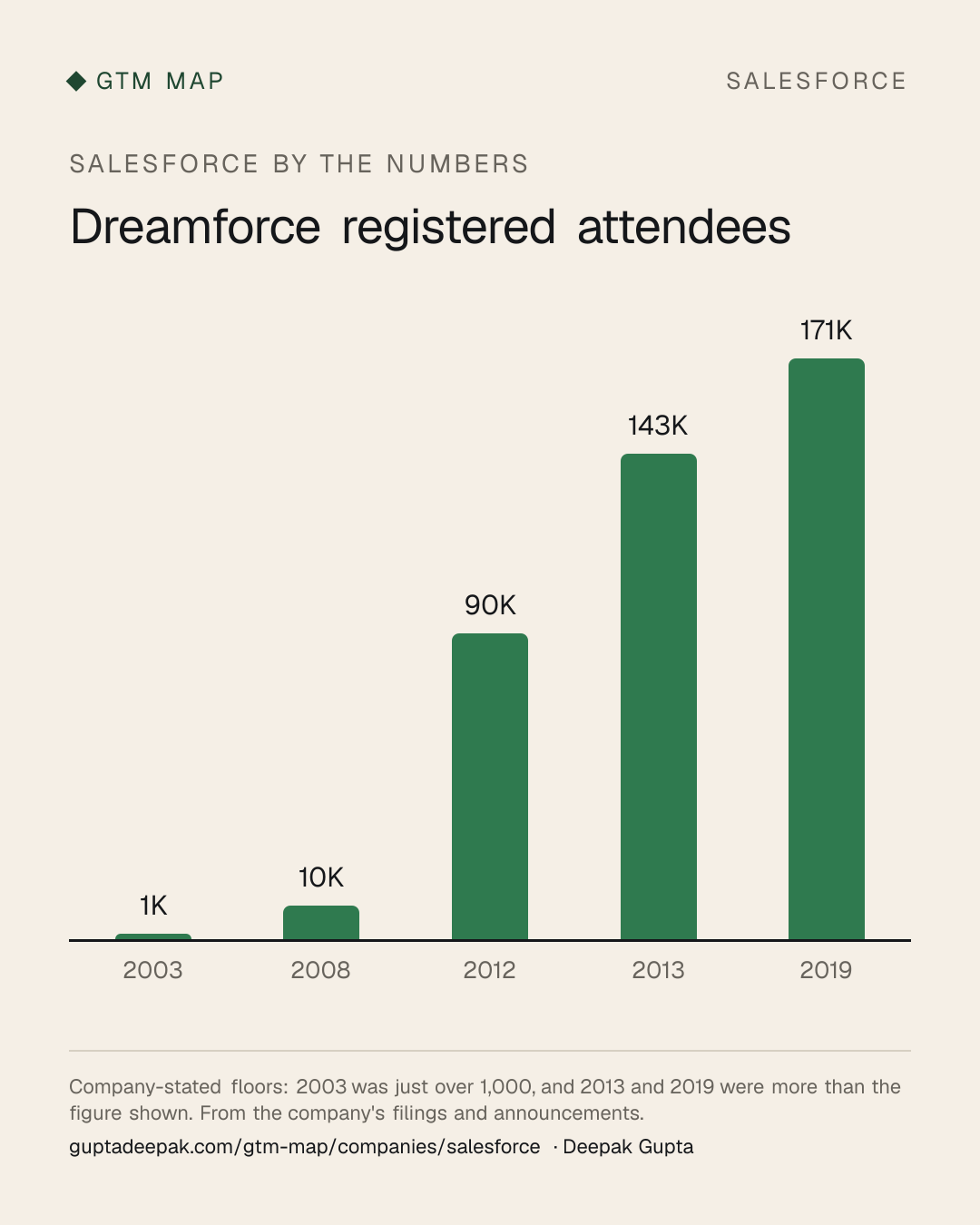
The 10-K calls Dreamforce the annual and largest event, large enough that its timing moves quarterly marketing cost. Registered attendance went from 10,000 in 2008 to more than 171,000 in 2019.[4],[9]
- Land and expand
More clouds, including acquired products, were sold into the base. The fiscal 2022 10-K frames the Slack deal around the combined enterprise customer bases and the anticipated sales opportunities.[5]
- Community
Trailhead, launched in 2014, gives customers and partners free online courses on using, administering and developing on Salesforce, and the Trailblazers community grew around it.[9],[4]
- Partner channel
The referral network spans global consulting firms, systems integrators and regional partners, plus ISVs paid a percentage of subscription revenue. Ninety-five of the Fortune 100 run at least one AppExchange app.[4],[9]
- Inbound content
Content marketing and social channels such as LinkedIn and YouTube joined search engine marketing and advertising in the marketing mix.[4]
- Sales-led
Direct sales stayed the main route: telephone sales in regional hubs and field sales near customers, both supported by reps who generate qualified leads.[4]
- Owned events
2024 to now
Agentforce, digital labor and consumption pricing
Agentforce was announced in September 2024 and generally available in October 2024. Salesforce shipped it into its installed base, priced it on use rather than seats, and added more account executives to sell it.
- Usage pricing
Agents are priced on use: $2 per conversation at launch, then Flex Credits at $0.10 per action from May 2025, with a Flex Agreement that shifts spend between user licenses and digital labor. The 10-K admits limited experience pricing consumption contracts.[11],[12],[14],[6]
- Land and expand
Benioff says he shipped the product into all 135,000 Salesforce customers. More than 60% of Agentforce and Data 360 bookings in Q4 fiscal 2026 came from existing customer expansion.[15],[7]
- Brand narrative
The Agentic Enterprise and digital labor replace No Software as the story. Benioff gave Dreamforce 2024 over to Agentforce and describes looking for a new viral "KNMS moment".[15],[6]
- Sales-led
Benioff planned 1,000 to 2,000 extra account executives just for Agentforce, because Salesforce sells direct. The 10-K adds Forward Deployed Engineers embedded in customer teams and, for the first time, lists self-service offerings beside direct sales.[15],[6]
- Owned events
Dreamforce, Dreamforce to You, World Tours and the Salesforce+ streaming service remain listed marketing activities.[6]
- Partner channel
AgentExchange extends the marketplace to agents, launching with more than 200 partners on top of AppExchange's 13 million app installs. The 10-K leans on ISVs and systems integrators to reach new markets.[13],[6]
- Paid acquisition
Benioff shot three ads for the launch and put them on Twitter for feedback, and the 10-K lists multichannel campaigns spanning email, social media, the web and television.[15],[6]
- Usage pricing
02The numbers
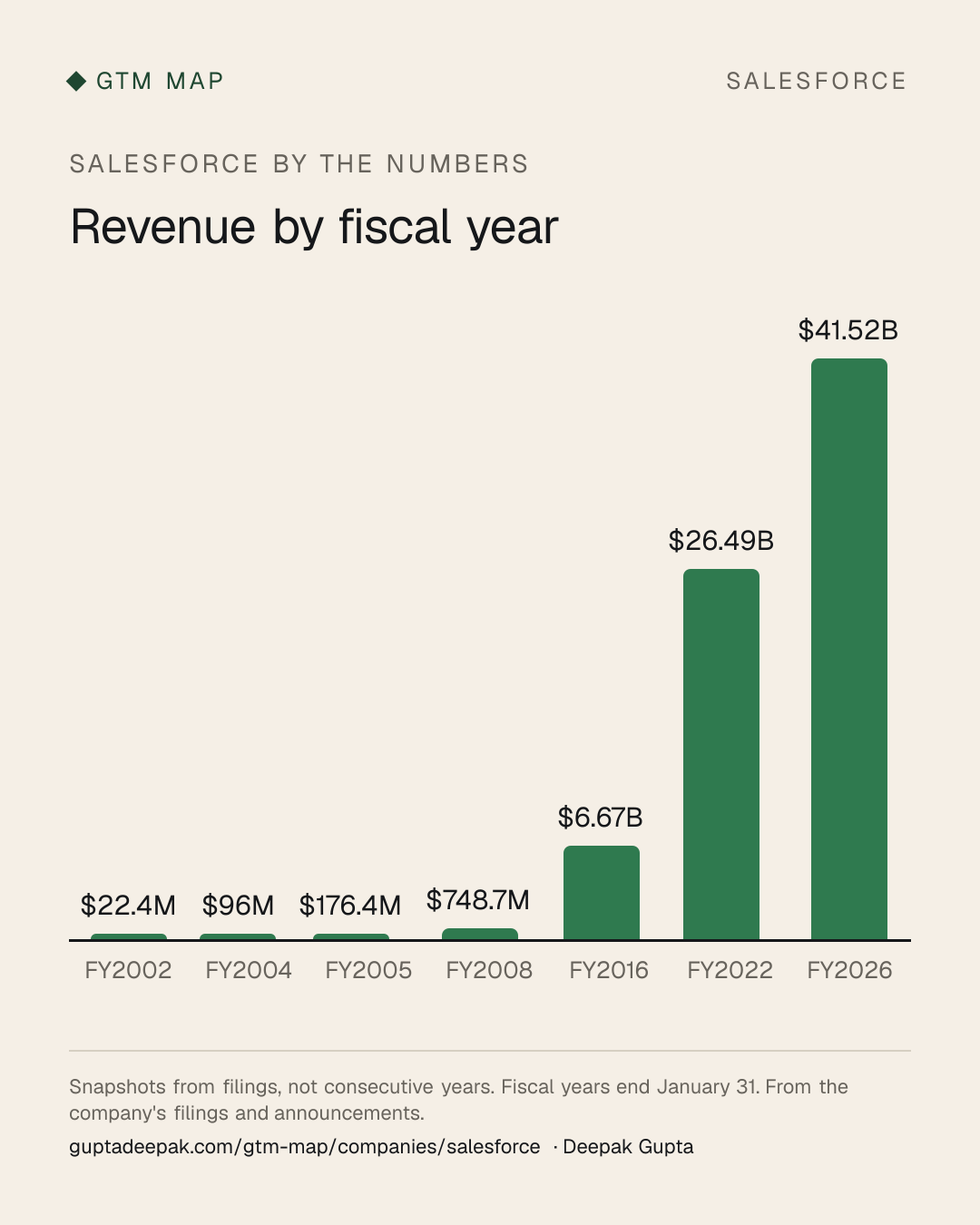
Show the data
| FY2002 | $22.4M | From a filing |
|---|---|---|
| FY2004 | $96M | From a filing |
| FY2005 | $176.4M | From a filing |
| FY2008 | $748.7M | From a filing |
| FY2016 | $6.67B | From a filing |
| FY2022 | $26.49B | From a filing |
| FY2026 | $41.52B | From a filing |
Show the data
| 2003 | 1K | Company-stated |
|---|---|---|
| 2008 | 10K | Company-stated |
| 2012 | 90K | Company-stated |
| 2013 | 143K | Company-stated |
| 2019 | 171K | Company-stated |
| Metric | Value | As of | Basis |
|---|---|---|---|
| Revenue, fiscal 2002 to 2004 | $22.4M, $51.0M, $96.0M[1] | January 31, 2004 | From a filing |
| Customers and paying subscriptions, April 2004 | 9,800 and 147,000[1] | April 30, 2004 | From a filing |
| Marketing and sales as a share of revenue, fiscal 2003 and 2004 | 66%, 57%[1] | January 31, 2004 | From a filing |
| Advertising as a share of marketing and sales expense, fiscal 2001 and 2002 | 62%, 47%[1] | January 31, 2002 | From a filing |
| Small business share of revenue, fiscal 2004 (company estimate) | About 40%[1] | January 31, 2004 | From a filing |
| Revenue, fiscal 2005 | $176.4M, up 84%[2] | January 31, 2005 | From a filing |
| Revenue, fiscal 2008 | $748.7M, up 51%[3] | January 31, 2008 | From a filing |
| Customers and paying subscriptions, January 2008 | About 41,000 and 1.1M[3] | January 31, 2008 | From a filing |
| AppExchange apps posted, January 2008 | More than 700[3] | January 31, 2008 | From a filing |
| Revenue, fiscal 2016 | $6.67B, up 24%[4] | January 31, 2016 | From a filing |
| Slack revenue contribution, fiscal 2022 | About $584M of $26.49B[5] | January 31, 2022 | From a filing |
| Revenue, fiscal 2026 | $41.53B, up 10%[6] | January 31, 2026 | From a filing |
| Sales and marketing as a share of revenue, fiscal 2026 | 35%[6] | January 31, 2026 | From a filing |
| Agentforce ARR, Q4 fiscal 2026 | $800M, up 169%[7] | January 31, 2026 | Company-stated |
| Agentforce ARR, Q2 fiscal 2027 (wider definition) | More than $1.5B[8] | July 31, 2026 | Company-stated |
| AppExchange app installs | More than 13M[13] | March 4, 2025 | Company-stated |
| IPO | $110M raised at $11 per share[9] | June 23, 2004 | Company-stated |
“Reported” figures come from trade press, not the company, and are shown with their date.
03Myth checks
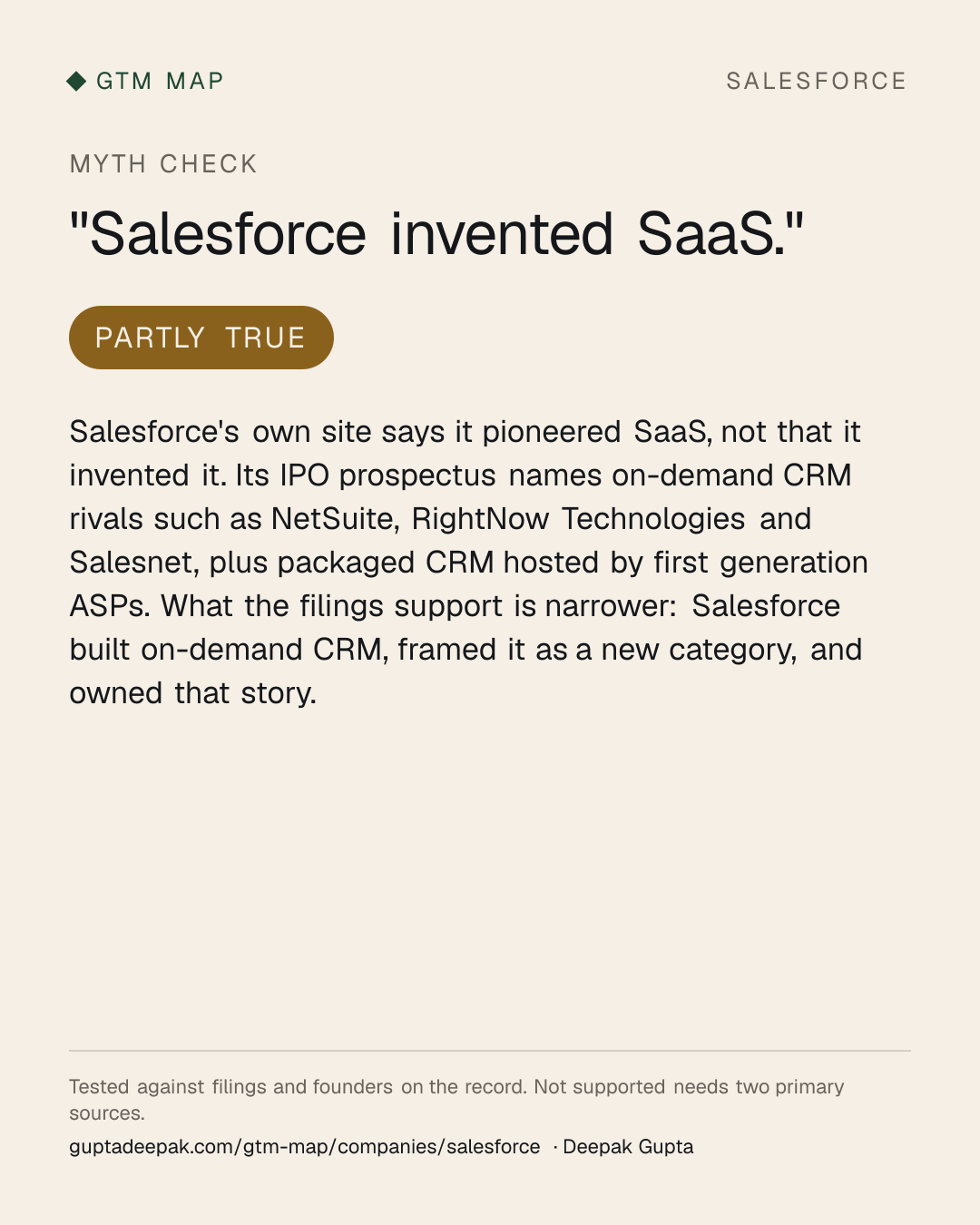
“Salesforce invented SaaS.”
Partly trueSalesforce's own site says it pioneered SaaS, not that it invented it. Its IPO prospectus names on-demand CRM rivals such as NetSuite, RightNow Technologies and Salesnet, plus packaged CRM hosted by first generation ASPs. What the filings support is narrower: Salesforce built on-demand CRM, framed it as a new category, and owned that story.[1],[2],[10]
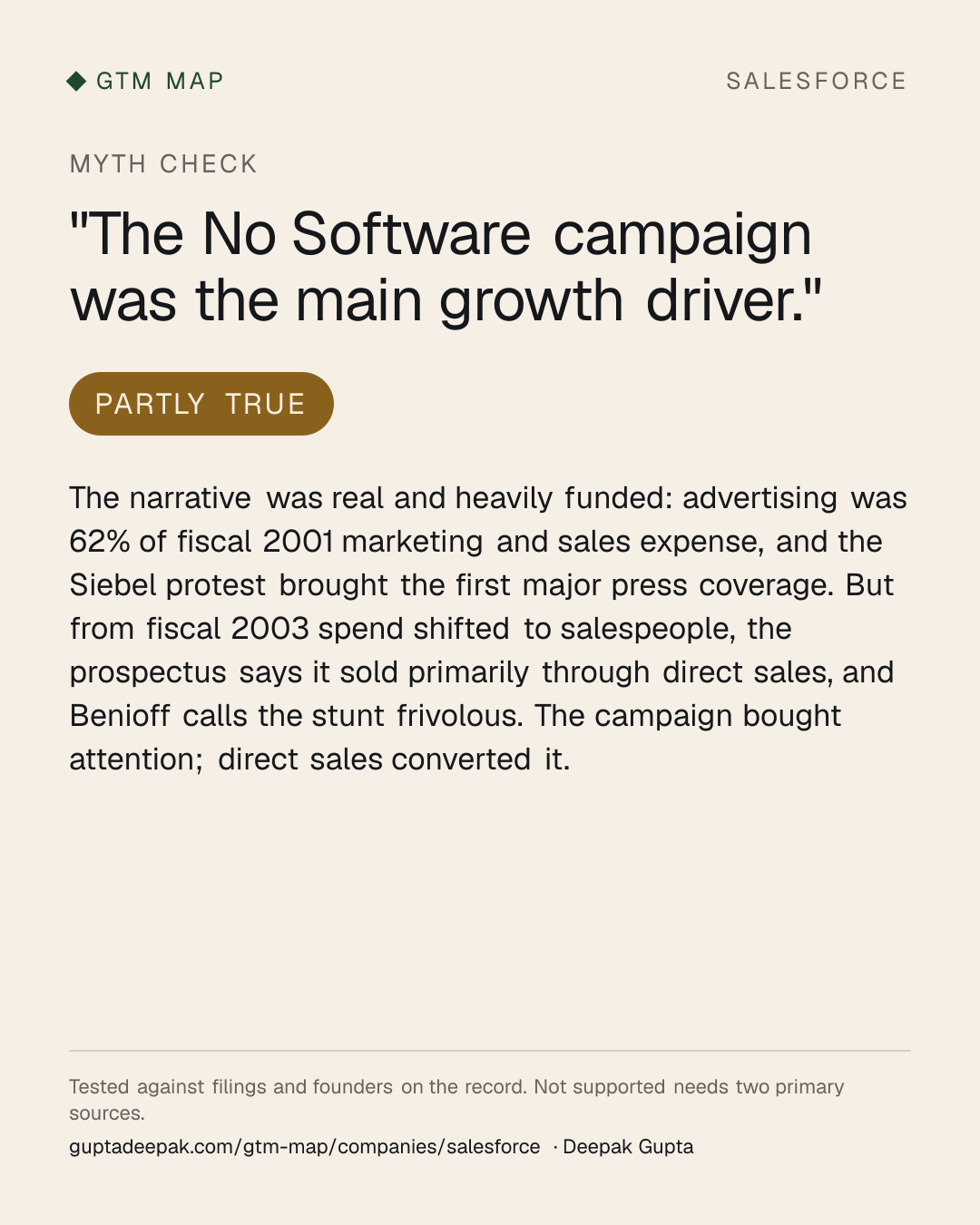
“The No Software campaign was the main growth driver.”
Partly trueThe narrative was real and heavily funded: advertising was 62% of fiscal 2001 marketing and sales expense, and the Siebel protest brought the first major press coverage. But from fiscal 2003 spend shifted to salespeople, the prospectus says it sold primarily through direct sales, and Benioff calls the stunt frivolous. The campaign bought attention; direct sales converted it.[1],[9],[15]
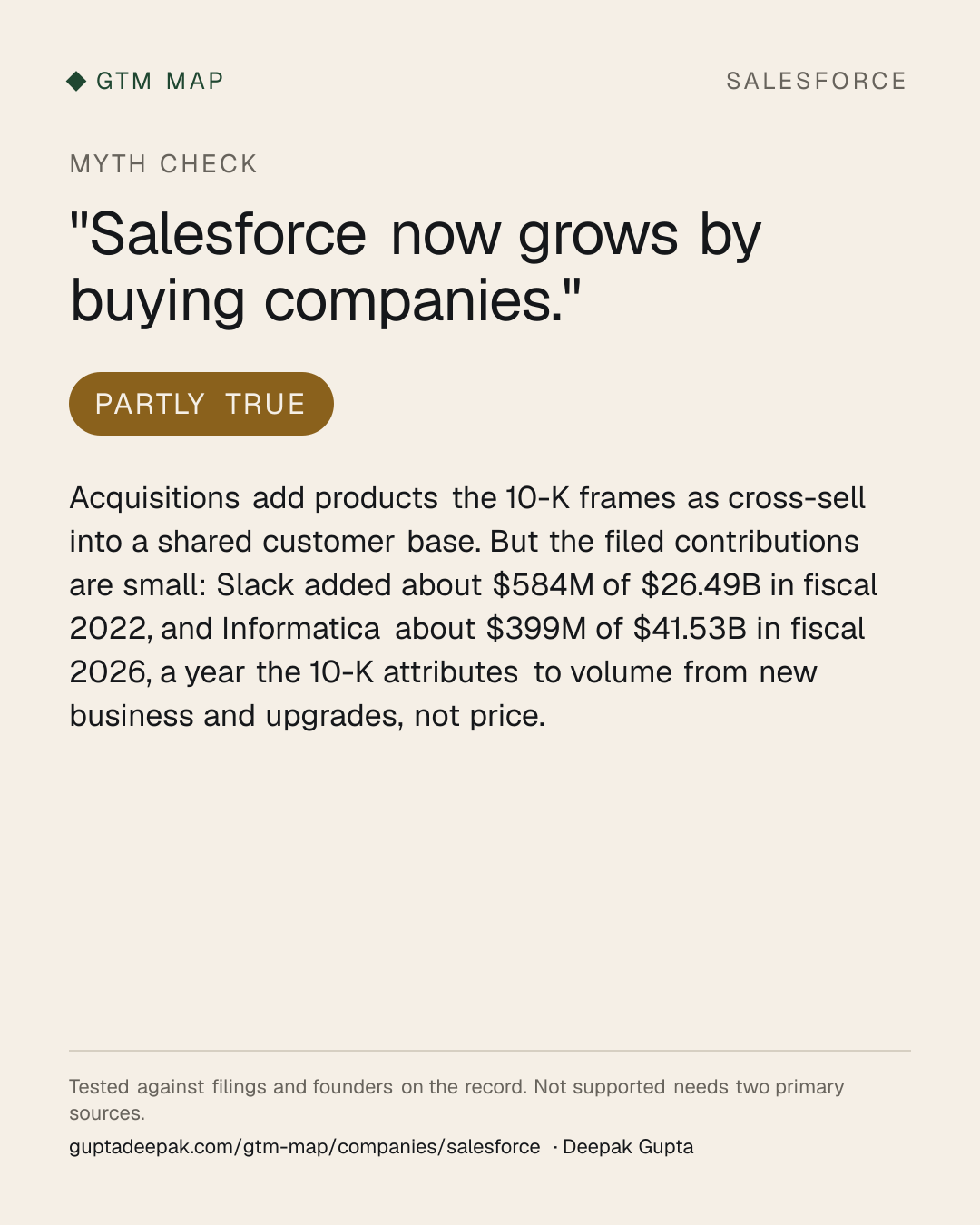
“Salesforce now grows by buying companies.”
Partly trueAcquisitions add products the 10-K frames as cross-sell into a shared customer base. But the filed contributions are small: Slack added about $584M of $26.49B in fiscal 2022, and Informatica about $399M of $41.53B in fiscal 2026, a year the 10-K attributes to volume from new business and upgrades, not price.[5],[6]
On the record
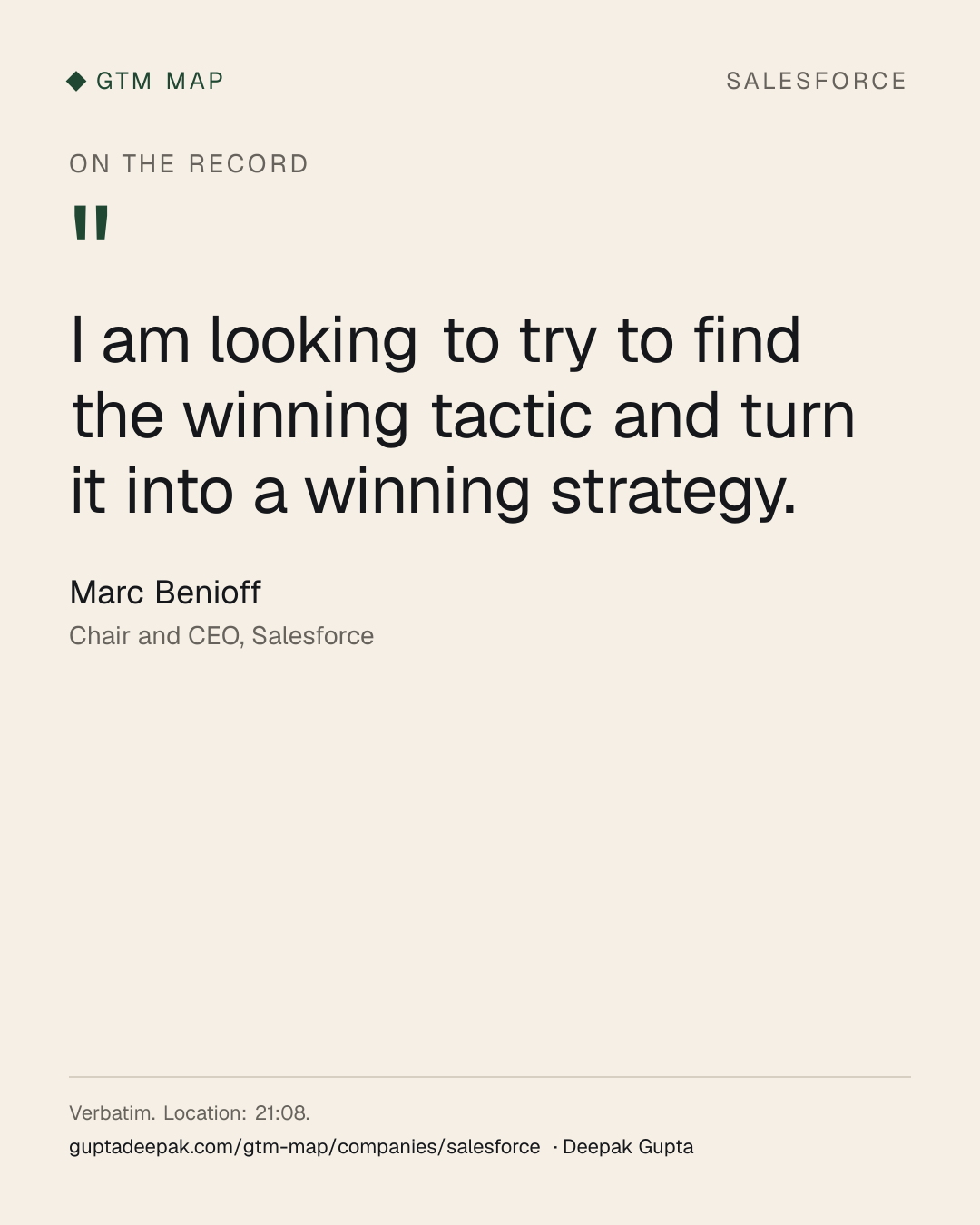
“I am looking to try to find the winning tactic and turn it into a winning strategy.”
Marc Benioff, Chair and CEO, Salesforce[15]
21:08
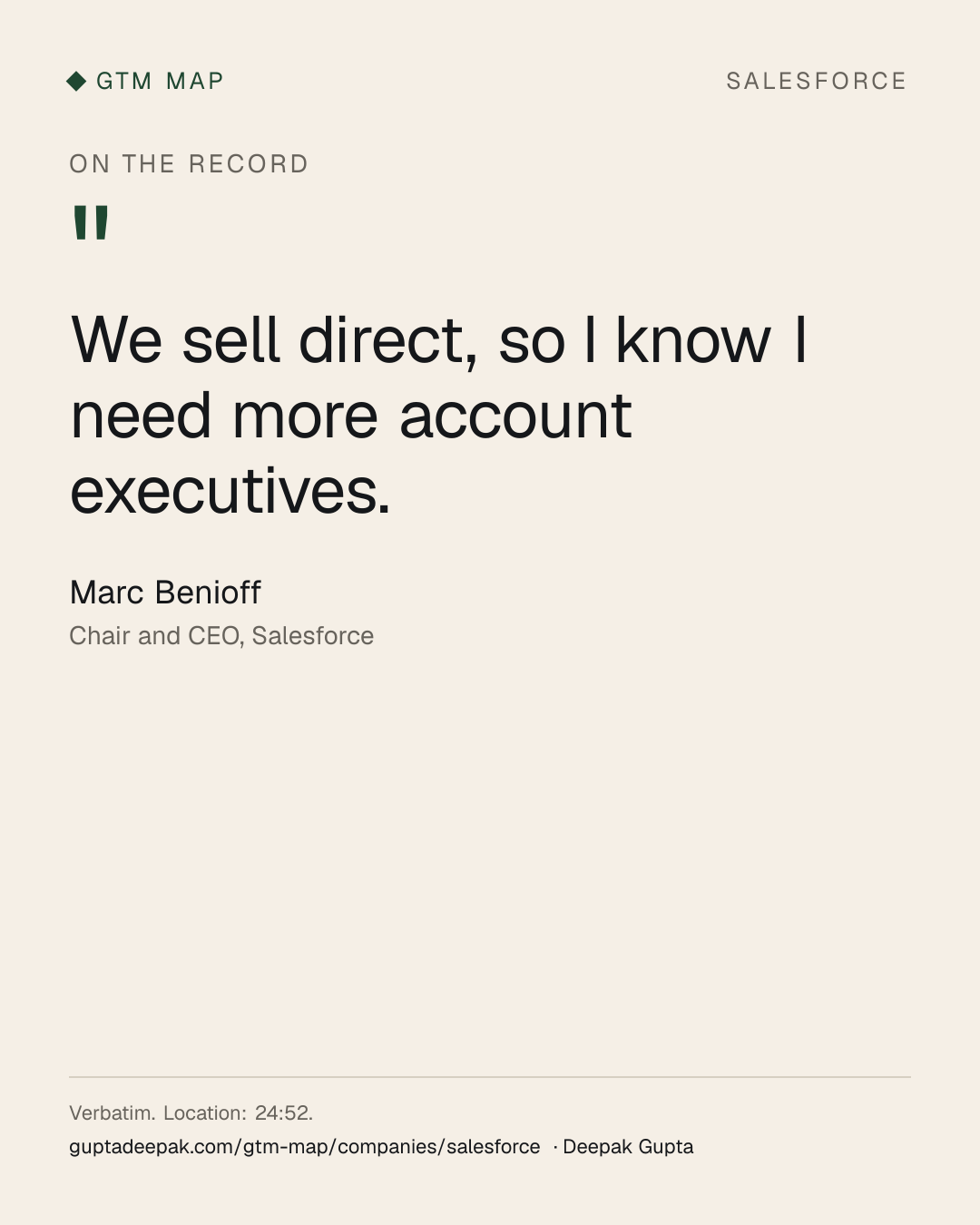
“We sell direct, so I know I need more account executives.”
Marc Benioff, Chair and CEO, Salesforce[15]
24:52
“By subscribing to our service, our customers do not have to make large and risky upfront investments in software, additional hardware, extensive implementation services, and additional IT staff.”
Salesforce, IPO prospectus (Form 424B1)[1]
Business: Our Solution
04What other companies can take from it
A category narrative buys attention; a sales machine converts it.
Works when: The buyer has an entrenched incumbent model you can name and oppose (installed software, seats, manual work), and you can afford a sales team to catch the demand within a quarter or two.
Backfires when: The stunt is the plan. Without an inside sales or self-serve path ready, coverage decays before anyone buys, and opposing an incumbent the buyer does not resent reads as noise.
Based on: The End of Software, sold by phone, Category creation; The End of Software, sold by phone, Brand narrative; The End of Software, sold by phone, Sales-led
Turn your platform into other companies' revenue.
Works when: Your product is a system of record that customers keep extending, and partners can make money building on it.
Backfires when: The product is a point tool with nothing to extend, or you compete with your own partners on every adjacent feature.
Based on: AppExchange and the move to larger customers, Partner channel; Many clouds, Dreamforce, Trailblazers and acquisitions, Partner channel
An owned event becomes the launch channel for every next product.
Works when: Your customer base is large and loyal enough that customers come to meet each other, and you have a release cadence worth staging.
Backfires when: The event is mostly vendor pitches with few customers, or launches are too small to justify the stage, so it stays a cost line rather than a channel.
Based on: Many clouds, Dreamforce, Trailblazers and acquisitions, Owned events; Agentforce, digital labor and consumption pricing, Brand narrative
Ship the new product into the installed base before chasing new logos.
Works when: You already hold the customer's data and workflows, so the new product works on day one without a migration.
Backfires when: The base is small or unhappy, or the new product needs a different buyer than the one you already sell to.
Based on: Agentforce, digital labor and consumption pricing, Land and expand; AppExchange and the move to larger customers, Land and expand
05 · GTM Now
What changes in the AI era, and what to do now
Analysis by Deepak Gupta. This is opinion built on the sourced record above, not part of it.[7],[13],[11],[14],[6]
Still works
- Selling into an installed base that already trusts you with its data. More than 60% of Salesforce's Q4 fiscal 2026 Agentforce and Data 360 bookings came from existing customers.
- A partner marketplace. AgentExchange is the AppExchange model applied to agents, and owned events still stage each launch.
Breaks
- Seat-based pricing when the product does work people used to do. Salesforce moved agents off per-user pricing, and its 10-K admits limited experience pricing consumption contracts.
- Website trials plus search ads as the lead engine are weaker when buyers ask an AI assistant for a shortlist instead of clicking ads. This is analysis, not a sourced fact.
What replaces it
- Consumption pricing per action or outcome, with a contract that lets budget move between seats and credits, which is Salesforce's own Flex Agreement.
- Forward Deployed Engineers embedded in customer teams, doing the job implementation partners and sales engineers did for CRM.
- A labour narrative in place of No Software: digital labor and the Agentic Enterprise.
Apply it now
If you are
A seed to Series B company selling a cloud replacement for an entrenched, disliked way of working to SMB and mid-market buyers at $1K to $10K a year
- Name the old model you are ending in a few words and use the same words everywhere, the way Salesforce used The End of Software.
- Run one memorable, low-cost public stunt aimed at the incumbent's own event or audience, and have press ready the same day.
- Stand up an inside sales team that calls every trial signup within a day, with reps segmented by company size from the start.
- Pay referral partners a share of first-year revenue rather than building a reseller channel.
- Hold a customer-only event as soon as you have a few hundred customers, so customers sell to each other.
You will know it works when: The share of new revenue closed by inside sales from trial and inbound leads, and marketing and sales as a share of revenue falling while revenue grows (Salesforce went from 66% in fiscal 2003 to 50% in fiscal 2008).
Based on Salesforce's The End of Software, sold by phone, The End of Software, sold by phone, The End of Software, sold by phone
If you are
A later-stage seat-based SaaS company adding AI agents to an established product, selling mid-market to enterprise at $10K to $100K-plus a year
- Ship the agent into every existing account, turned off by default with a free starter allotment, and make turning it on the first sales motion.
- Price agents per action or outcome, and offer a contract that lets customers swap seats for credits so the agent does not look like a seat cut.
- Put forward deployed engineers on the first large accounts to get agents into production, and publish those customer stories.
- Open a marketplace for partner-built agents on your platform before competitors become the agent layer.
You will know it works when: The share of AI bookings from existing customers (Salesforce reported more than 60%) and AI ARR growth, tracked on a fixed definition.
Based on Salesforce's Agentforce, digital labor and consumption pricing, Agentforce, digital labor and consumption pricing, Agentforce, digital labor and consumption pricing
Motions in this record
Compare with every other company on the GTM matrix.
Share the visuals
Every card is drawn from the sourced record above and sized 1080 by 1350 for LinkedIn and X. Free to share with a link back to this page.
Sources
- [1]SEC filingsalesforce.com, inc. final IPO prospectus (Form 424B1) (June 23, 2004)
- [2]SEC filingForm 10-K, fiscal year ended January 31, 2005 (March 25, 2005)
- [3]SEC filingForm 10-K, fiscal year ended January 31, 2008 (February 29, 2008)
- [4]SEC filingForm 10-K, fiscal year ended January 31, 2016 (March 7, 2016)
- [5]SEC filingForm 10-K, fiscal year ended January 31, 2022 (March 11, 2022)
- [6]SEC filingForm 10-K, fiscal year ended January 31, 2026 (March 2, 2026)
- [7]EarningsSalesforce Delivers Record Fourth Quarter Fiscal 2026 Results (8-K exhibit) (February 25, 2026)
- [8]EarningsSalesforce Delivers Record Second Quarter Fiscal 2027 Results (8-K exhibit) (August 26, 2026)
- [9]CompanyThe History of Salesforce (January 2025)
- [10]CompanyWe're Salesforce, the #1 AI CRM (Our Story) (October 18, 2026)
- [11]CompanySalesforce Unveils Agentforce: What AI Was Meant to Be (September 12, 2024)
- [12]CompanySalesforce's Agentforce Is Here (October 29, 2024)
- [13]CompanySalesforce unveils AgentExchange trusted marketplace for Agentforce (March 4, 2025)
- [14]CompanySalesforce Introduces New Flexible Agentforce Pricing to Accelerate the Digital Labor Revolution (May 15, 2025)
- [15]Founder interviewBehind the founder: Marc Benioff (Lenny's Podcast) (Marc Benioff, December 22, 2024, at 15:54 to 18:19, 18:59 to 21:46, 24:44 to 25:28)
Every phase, motion, and myth verdict cites a filing, the company's own pages, or a founder speaking on the record. See the methodology.