
Product-led · public
How Figma went to market
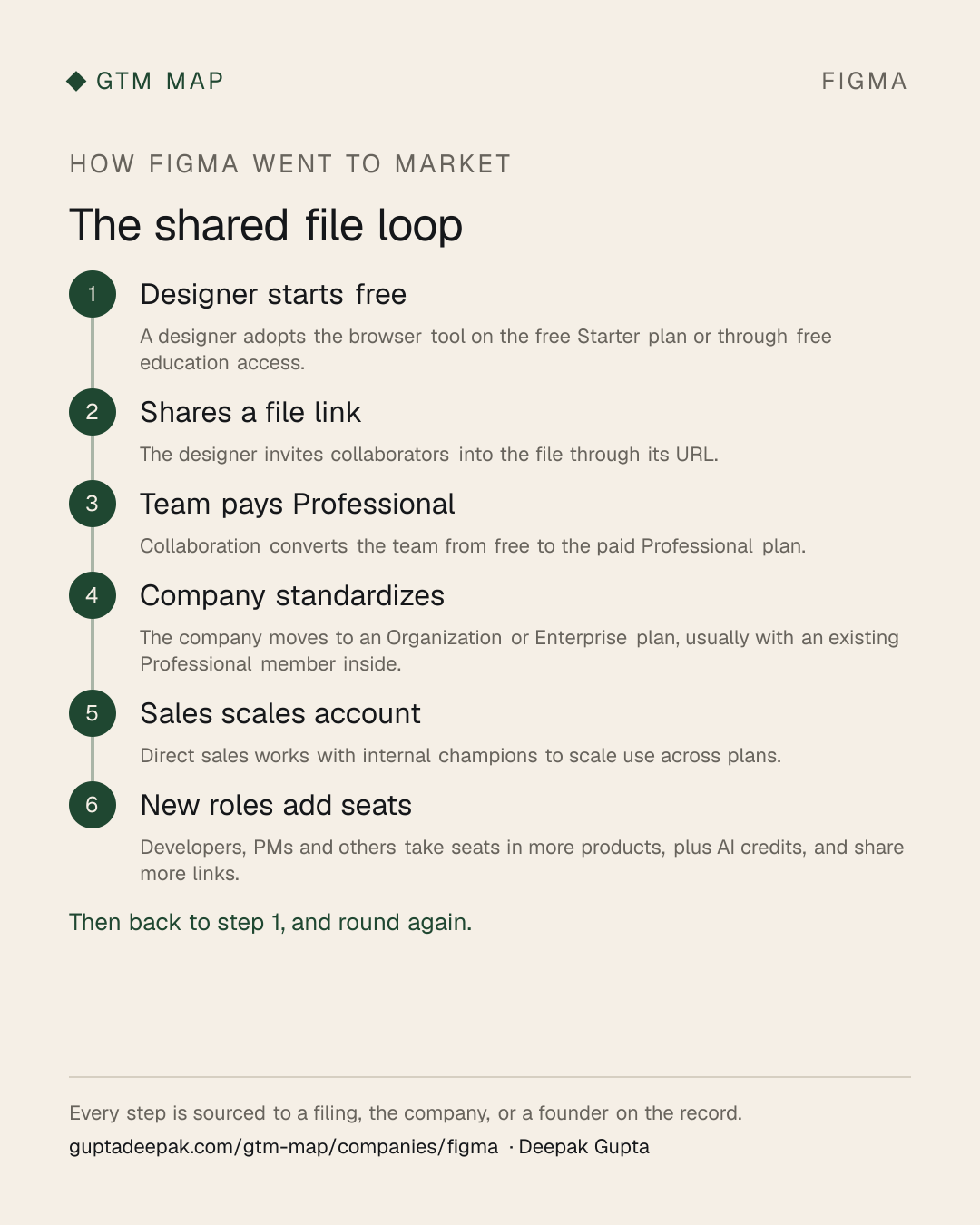
Figma put design in the browser, so every shared file link pulled collaborators in, then converted teams to paid plans from 2017. A first sales rep and the Organization plan followed in 2018. Growth since has come from selling more roles and products into company accounts, with admin-approved seats and AI credits from 2025.
- Buyer:
- Prosumers, Small business, Mid-market, Enterprise
- Contract size:
- Mixed
- Checked:
- October 18, 2026
Shares a file link
The designer invites collaborators into the file through its URL.[1]
Team pays Professional
Collaboration converts the team from free to the paid Professional plan.[1]
Company standardizes
The company moves to an Organization or Enterprise plan, usually with an existing Professional member inside.[1]
Sales scales account
Direct sales works with internal champions to scale use across plans.[3]
Back to step 1, and round again
01The phases
PrimarySupportingTried, then dropped
2012 to 2016
Browser multiplayer and the shared link
Figma was founded in 2012. The S-1 dates the first launch to 2015, while Dylan Field ties the launch with multiplayer to 2016, so the two sources differ on the launch year. Charging began in 2017.
- Viral loop
A browser file is shared as a URL, so users invited collaborators into Figma, and those invites drove conversion once Figma began charging. Field says live collaboration was a launch requirement because a shared link without it was a poor experience.[1],[13]
- Product-led
Early adopters picked up a fast, easy browser design tool themselves and advocated for it inside their companies. Field says the early differentiators were tool quality and simplicity, since multiplayer did not exist yet in the closed beta.[1],[13]
- Community
The founders worked the early user base directly, including house calls to customers' offices and a trip to visit users in Nigeria, and went deep on anyone with strongly positive or negative sentiment.[1],[13]
- Viral loop
2017 to 2020
Paid plans, first sales rep, Community and education
Figma started charging in 2017 with a free Starter plan and a paid Professional plan, then added a direct sales model and the Organization plan in 2018. Community, education access and the Config conference fed the free funnel.
- Product-led
Customers first chose between two self-serve plans: Starter, the free plan, and Professional, the paid plan, with charging from 2017.[1]
- Sales-assist
Figma added a direct sales model on top of bottom-up adoption to serve larger customers. It hired its first sales rep in 2018, the same year it launched the Organization plan with unlimited teams, shared libraries and centralized admin tools.[1]
- Community
Figma Community launched in beta in October 2019 as a public space to publish live design files anyone can inspect and remix, after plugins. More than 200 Friends of Figma chapters organized over 650 events in 2024.[7],[1]
- Education
The Professional plan has been free for students and educators from the beginning, and K-12 schools get a higher tier free. The S-1 gives no launch date for the program beyond "from the beginning".[1],[11]
- Owned events
Config, Figma's own annual conference, started in 2020 and brings thousands of designers, developers and product teams to San Francisco.[1]
- Product-led
2021 to 2023
FigJam, Dev Mode, Enterprise and the Adobe deal
Figma added a second and third product, FigJam and Dev Mode, and an Enterprise plan. Adobe agreed to acquire Figma in 2022, and the two companies terminated the deal in December 2023 for lack of a regulatory path.
- Land and expand
FigJam (2021) took Figma into brainstorming for extended teams, free through 2021 with paid plans in 2022. Dev Mode (2023) gave developers their own paid workspace, free in beta for 2023 and paid from 2024. Net dollar retention expanded through 2024 after Dev Mode.[1],[8],[10]
- Sales-led
An Enterprise plan for the largest customers launched in 2022. By 2024, about 70% of revenue came from customers on Organization and Enterprise plans.[1]
- Viral loop
The Dev Mode launch post says a single link let designers collaborate on in-progress work, and that on paid plans more developers visit Figma than designers.[10]
- Education
While the Adobe deal was pending, Figma committed publicly that all of Figma would stay free for education. The deal was terminated in December 2023.[9],[6]
- Land and expand
2024 to now
Platform seats, IPO and AI credits
Users grow into managed company accounts with more seats and products. In March 2025 Figma made seat upgrades need admin approval and raised Full seat prices, which weakens pure bottom-up growth. It listed in 2025 and added AI credits.
- Land and expand
About 70% of new Organization and Enterprise customers already had a Professional plan member, and 76% of customers used two or more products. In March 2025 Figma ended user-driven upgrades: any seat upgrade now needs administrator approval, and Full seat prices rose 20% to 33%.[1]
- Sales-assist
The filed go-to-market is product-led adoption plus a direct sales motion that works with in-house customer champions, solutions consultants, and designer and developer advocates.[3],[1]
- Usage pricing
AI credits came to all seats in 2025, with limits enforced and add-on or pay-as-you-go plans from March 2026. The second quarter of 2026 was the first full quarter of AI credit monetization.[3],[5]
- Owned events
Config drew over 10,000 attendees in 2026, and the company names it as a cause of seasonal swings in its results, since it is usually held in the second quarter.[5],[1]
- Community
Users have published over 250,000 Community resources, including more than 10,000 plugins and widgets built on public APIs.[1]
- Partner channel
Product integrations, distribution partnerships and certified service partners support adoption. AI-era distribution includes the Figma MCP app in Claude and the Figma app in ChatGPT.[1],[4]
- Inbound content
Marketing supports self-serve with livestreams, YouTube, social, in-product and email content, using organic and paid channels. The filings do not show it as the main demand source.[1]
- Land and expand
02The numbers
Show the data
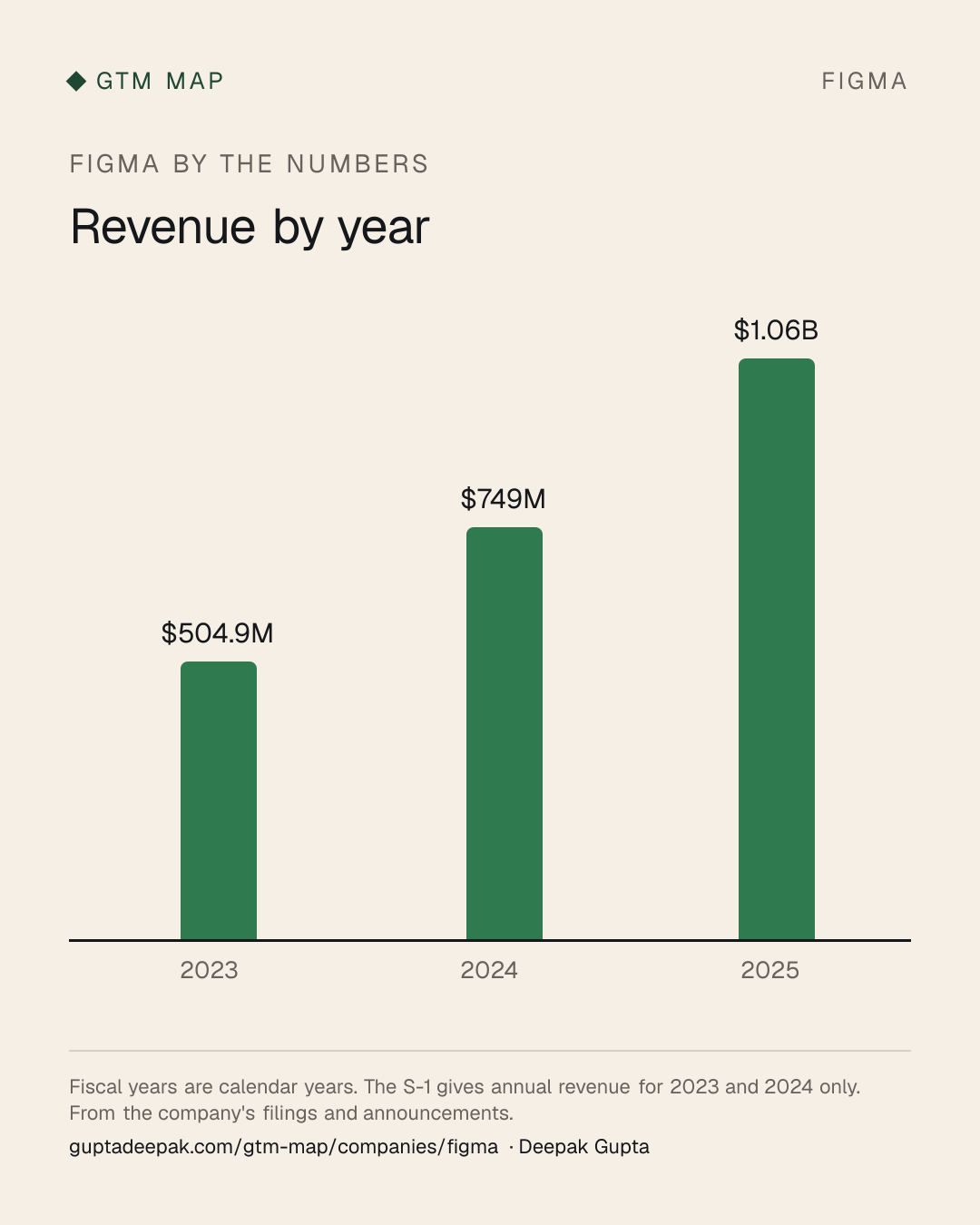
| 2023 | $504.9M | From a filing |
|---|---|---|
| 2024 | $749M | From a filing |
| 2025 | $1.06B | From a filing |
| Metric | Value | As of | Basis |
|---|---|---|---|
| Revenue, 2023 and 2024 | $504.9M, then $749.0M (up 48%)[1] | December 31, 2024 | From a filing |
| Four-year revenue growth rate (compounded) | 53%[1] | December 31, 2024 | From a filing |
| Revenue, 2025 | $1.056B, up 41%[4] | December 31, 2025 | From a filing |
| Revenue, second quarter of 2026 | $370.1M, up 48%[5] | June 30, 2026 | From a filing |
| Monthly active users | More than 13M, two-thirds non-designers[1] | March 31, 2025 | From a filing |
| Developer share of monthly active users | About 30%[1] | March 31, 2025 | From a filing |
| Paid Customers | About 450,000[1] | March 31, 2025 | From a filing |
| Revenue from Organization and Enterprise plans | About 70%[1] | December 31, 2024 | From a filing |
| New Organization and Enterprise customers with a prior Professional plan member | About 70%[1] | December 31, 2024 | From a filing |
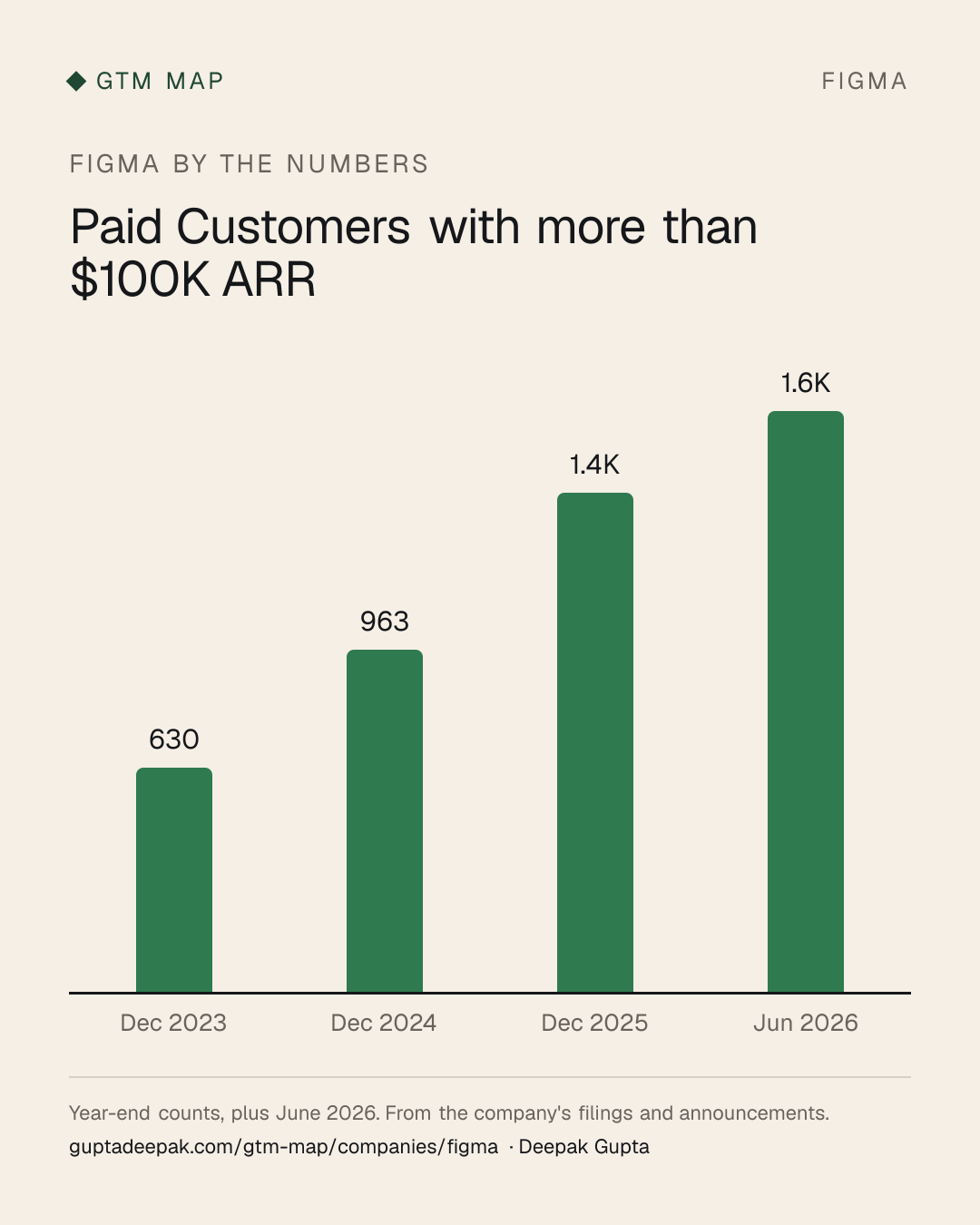
| Paid Customers with more than $1M ARR | 67[4] | December 31, 2025 | From a filing |
| Net Dollar Retention Rate | 136%[5] | June 30, 2026 | From a filing |
| Gross Retention Rate | 96%[1] | March 31, 2025 | From a filing |
| Customers using two or more products | 76%[1] | March 31, 2025 | From a filing |
| Share outside the U.S. | About 85% of monthly active users, 53% of revenue[1] | March 31, 2025 | From a filing |
| Sales and marketing expense, 2025 (includes one-time stock compensation) | $575.5M, up 22%[3] | December 31, 2025 | From a filing |
| Adobe termination fee received | $1.0B[1] | December 20, 2023 | From a filing |
| IPO price per share | $33.00[2] | July 31, 2025 | From a filing |
| IPO first-day close and market value | $115.50 (up 250%), almost $68B[14] | July 31, 2025 | Reported |
“Reported” figures come from trade press, not the company, and are shown with their date.
03Myth checks
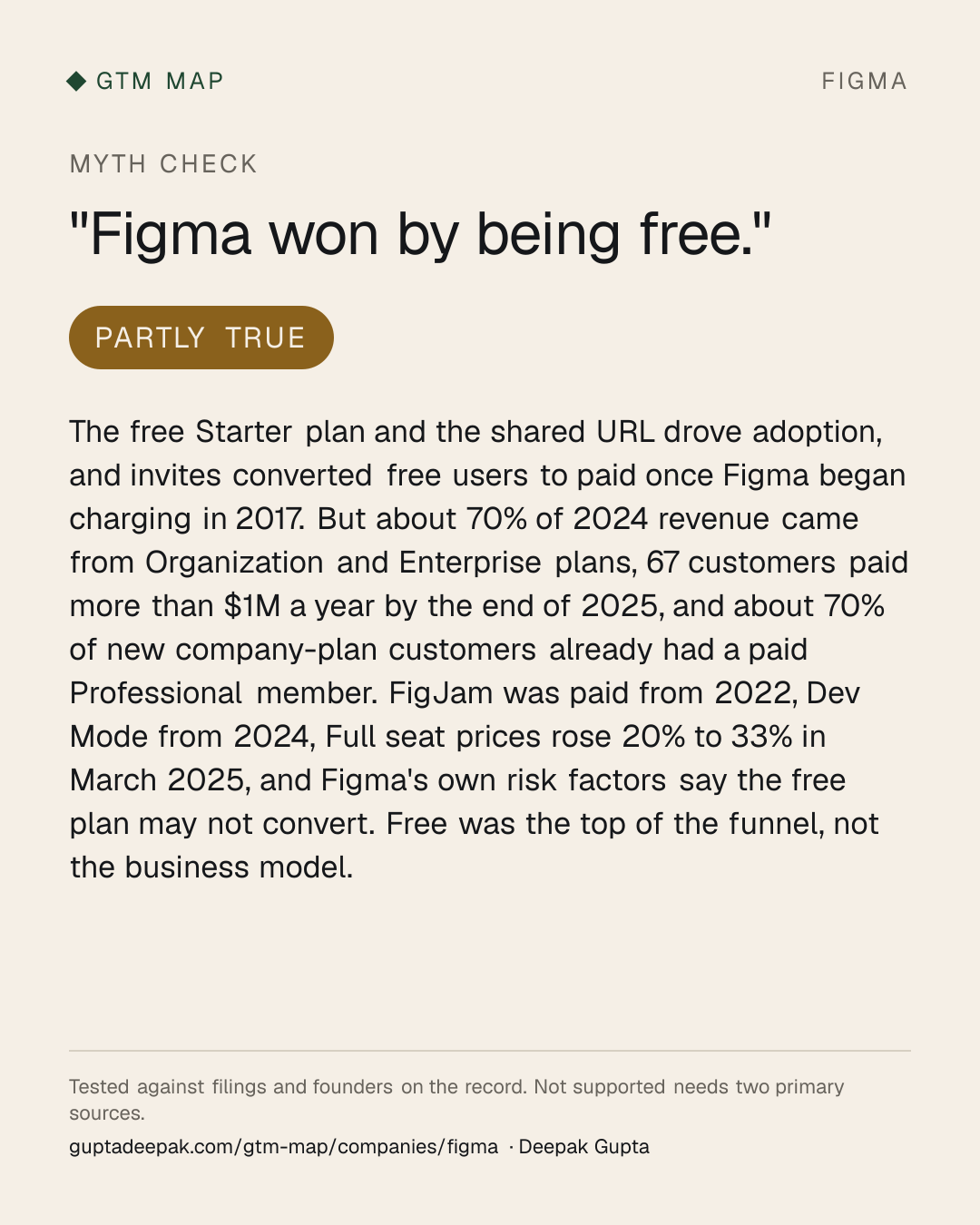
“Figma won by being free.”
Partly trueThe free Starter plan and the shared URL drove adoption, and invites converted free users to paid once Figma began charging in 2017. But about 70% of 2024 revenue came from Organization and Enterprise plans, 67 customers paid more than $1M a year by the end of 2025, and about 70% of new company-plan customers already had a paid Professional member. FigJam was paid from 2022, Dev Mode from 2024, Full seat prices rose 20% to 33% in March 2025, and Figma's own risk factors say the free plan may not convert. Free was the top of the funnel, not the business model.[1],[4],[8],[10]
“Designers chose Figma, not companies.”
Partly trueDesigners did bring Figma in: the S-1 says adoption grew as designers advocated for it inside their organizations. But companies then made their own decision to standardize, which led to the Organization plan in 2018 and the Enterprise plan in 2022. Since March 2025 any seat upgrade needs administrator approval. Two-thirds of monthly active users are non-designers, and on paid plans more developers visit Figma than designers.[1],[10]
“Figma grew bottom-up with no sales team.”
Not supportedFigma hired its first sales rep in 2018, about a year after it began charging, and has run direct sales for larger customers since. Both the S-1 and the 2025 10-K describe product-led adoption plus direct sales, and sales and marketing expense was $575.5M in 2025.[1],[3]
On the record
“The power of the URL, combined with a self-serve option for new users interested in the product, fueled adoption and community growth.”
Figma, S-1 registration statement[1]
Our Go-To-Market Motion
“I think it’s critical that you build tools that work for someone individually, that they can then graduate into a collaborative stance and use with their team.”
Dylan Field, Co-founder and CEO, Figma[13]
Section "Work in Figma", answer on whether Figma makes sense for one person
“We hired our first sales rep in 2018, the same year we launched our Organization plan.”
Figma, S-1 registration statement[1]
MD&A, Our Go-To-Market Motion
04What other companies can take from it
Make the file the invitation.
Works when: The work artifact is reviewed or edited by people outside the creator's role (designs, docs, diagrams, specs), and opening it needs only a browser.
Backfires when: The artifact is private by nature, such as credentials or internal security configuration, or recipients need a heavy install or admin approval just to view it.
Based on: Browser multiplayer and the shared link, Viral loop; FigJam, Dev Mode, Enterprise and the Adobe deal, Viral loop
Add sales early, aimed at standardization, not at the first user.
Works when: Teams adopt self-serve and later need shared libraries, admin and compliance, which a company buys centrally.
Backfires when: The product has no team-level admin value, so there is nothing for a company to standardize on and sales only sells seats users would have bought anyway.
Based on: Paid plans, first sales rep, Community and education, Sales-assist; Platform seats, IPO and AI credits, Land and expand
Expand by role, not only by seat.
Works when: Non-core roles already visit the product to view or comment, so a role-specific workspace monetizes traffic you already have.
Backfires when: The adjacent role has an entrenched tool it lives in all day, and the new workspace is a weaker copy of it.
Based on: FigJam, Dev Mode, Enterprise and the Adobe deal, Land and expand; Platform seats, IPO and AI credits, Land and expand
Treat community and education as supply for the free funnel.
Works when: The buyer's job is a craft learned in school or bootcamps, and practitioners share reusable assets.
Backfires when: The buyer is a committee purchasing for compliance, with no practitioner identity to build around.
Based on: Paid plans, first sales rep, Community and education, Community; Paid plans, first sales rep, Community and education, Education
05 · GTM Now
What changes in the AI era, and what to do now
Analysis by Deepak Gupta. This is opinion built on the sourced record above, not part of it.[1],[3],[4],[5],[13]
Still works
- The shared link and the canvas as the place a team reviews work. Prompt-generated UI still needs somewhere designers, PMs and developers converge, which is Field's own argument.
- Role-based expansion. AI credits added a second expansion lever on top of seats, and Figma reports customers expanding both seats and AI credit add-ons.
Breaks
- If code-generation agents produce working UI directly, the design file stops being a required step for developers, which would weaken the Dev Mode expansion path. This is analysis; no source here measures it.
- User-driven seat upgrades, a classic bottom-up lever, were already replaced by admin approval in March 2025, so expansion now depends more on sales and admin decisions.
What replaces it
- Distribution inside AI assistants and agents, not only browser links: Figma's apps in Claude and ChatGPT.
- Consumption pricing through AI credits, which plays the role the next paid seat used to play.
Apply it now
If you are
A seed to Series B collaborative creation tool (design, docs, diagrams) with prosumer and SMB entry under $10K first-year ACV, where the output is reviewed by people in other roles
- Make every artifact openable from a link in the browser, with free view and comment.
- Keep a free personal tier and a paid team tier, and track how many company-plan customers already contain a paid team member (Figma's filed figure is about 70%).
- Add the company plan (shared libraries, admin, SSO) and a first sales hire when several teams in one domain pay separately.
- Seed supply with free access for students and a public gallery where users publish reusable files.
- Publish an MCP server or assistant app so the artifact can be created and opened from inside AI tools.
You will know it works when: The share of new paying teams whose first user arrived through a shared link or a Community file, and the share of company-plan wins that already had a paid team inside.
Based on Figma's Browser multiplayer and the shared link, Paid plans, first sales rep, Community and education, Platform seats, IPO and AI credits
If you are
A growth-stage seat-based SaaS company with a strong core persona and many view-only visitors from other roles
- Measure visits by role on paid accounts, as Figma did before Dev Mode.
- Build a role-specific workspace, give it free to existing paid editors during beta, then charge a lower-priced role seat.
- Report net dollar retention with and without the new role seat to see whether expansion comes from roles or headcount.
- Add consumption pricing such as AI credits on top of seats, and enforce limits only after usage is established.
You will know it works when: Net dollar retention above 130% (Figma's filed range was 122% to 136%) and the share of customers using two or more products (Figma's filed figure is 76%).
Based on Figma's FigJam, Dev Mode, Enterprise and the Adobe deal, Platform seats, IPO and AI credits
Motions in this record
Compare with every other company on the GTM matrix.
Share the visuals
Every card is drawn from the sourced record above and sized 1080 by 1350 for LinkedIn and X. Free to share with a link back to this page.
Sources
- [1]SEC filingFigma, Inc. Form S-1 (July 1, 2025)
- [2]SEC filingFigma, Inc. Prospectus (Form 424B4) (July 31, 2025)
- [3]SEC filingForm 10-K, fiscal year ended December 31, 2025 (February 18, 2026)
- [4]EarningsFigma Announces Fourth Quarter and Fiscal Year 2025 Financial Results (8-K exhibit) (February 18, 2026)
- [5]EarningsFigma Announces Second Quarter 2026 Financial Results (8-K exhibit) (August 5, 2026)
- [6]SEC filingAdobe and Figma Mutually Agree to Terminate Merger Agreement (Adobe 8-K exhibit) (December 18, 2023)
- [7]CompanyBeyond multiplayer: Building community together in Figma (Dylan Field) (October 22, 2019)
- [8]CompanyIntroducing FigJam (Yuhki Yamashita) (April 21, 2021)
- [9]CompanyA new collaboration with Adobe (Dylan Field) (September 15, 2022)
- [10]CompanyMaking Figma better for developers with Dev Mode (Kris Rasmussen) (June 21, 2023)
- [11]CompanyFigma for Education (October 18, 2026)
- [12]CompanyFigma pricing (October 18, 2026)
- [13]Founder interviewAn Interview with Figma CEO Dylan Field About Design and AI (Stratechery, transcript) (Dylan Field, June 25, 2026, at sections "WebGL and the Foundation of Figma" and "Work in Figma", answers on going to market and on single users)
- [14]Trade pressFigma more than triples in NYSE debut after selling shares at $33 (CNBC, July 31, 2025)
Every phase, motion, and myth verdict cites a filing, the company's own pages, or a founder speaking on the record. See the methodology.