
Product-led · public
How Shopify went to market
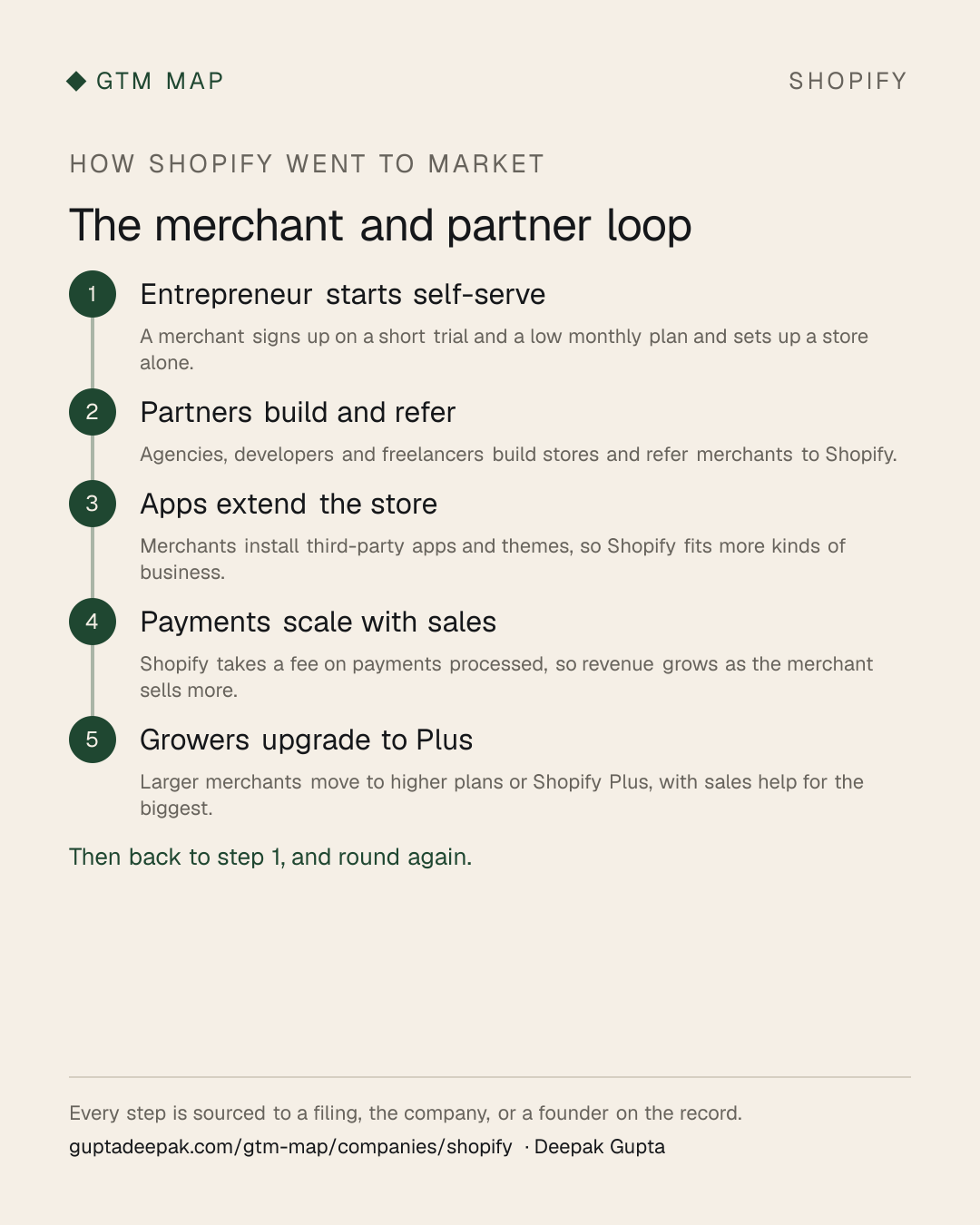
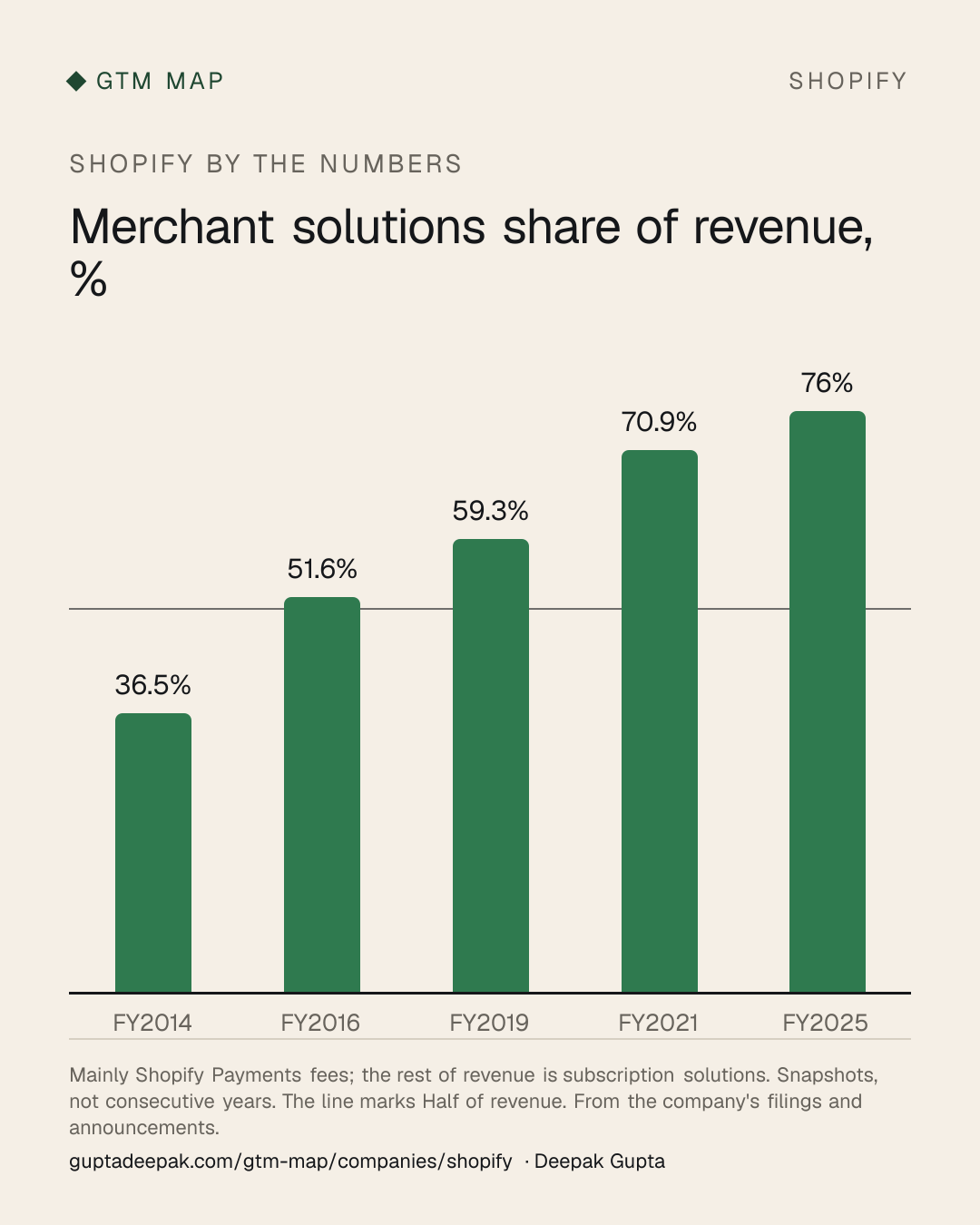
Shopify sold a cheap self-serve store to new entrepreneurs, then let agencies, app developers and theme designers become its channel. Shopify Payments made revenue grow with merchant sales: merchant solutions rose from 36.5% of revenue in 2014 to 76% in 2025. Merchants who grew upgraded to Shopify Plus, and enterprise sales followed the volume.
- Buyer:
- Small business, Mid-market, Enterprise
- Contract size:
- Mixed
- Checked:
- October 18, 2026
Entrepreneur starts self-serve
A merchant signs up on a short trial and a low monthly plan and sets up a store alone.[15]
Partners build and refer
Agencies, developers and freelancers build stores and refer merchants to Shopify.[8]
Apps extend the store
Merchants install third-party apps and themes, so Shopify fits more kinds of business.[1]
Payments scale with sales
Shopify takes a fee on payments processed, so revenue grows as the merchant sells more.[10]
Growers upgrade to Plus
Larger merchants move to higher plans or Shopify Plus, with sales help for the biggest.[11]
Back to step 1, and round again
01The phases
PrimarySupportingTried, then dropped
2006 to 2012
Self-serve store builder and the first ecosystem
Shopify launched its platform in 2006 for new entrepreneurs rather than enterprises. Tobi Lütke says the product came together around 2008 and 2009, and growth stayed product-first and cash-constrained until a set of paid marketing tests worked.
- Product-led
A cheap, self-serve monthly plan that a merchant could set up alone in under 15 minutes. Lütke describes merchants moving from a $900,000 a year bill to a $59 a month plan.[1],[20]
- Partner channel
Instead of building every feature request, Shopify opened APIs and recruited app and theme developers by hand, including a theme design competition, and aligned partners' interests with its own.[21],[1]
- Paid acquisition
After years of product-first growth, Lütke split a $25,000 test across five marketing ideas at once, including radio and adverts. All five worked, and he used the result to decide Shopify was a growth company that should raise venture capital.[20]
- Product-led
2013 to 2015
Payments, paid search and the IPO
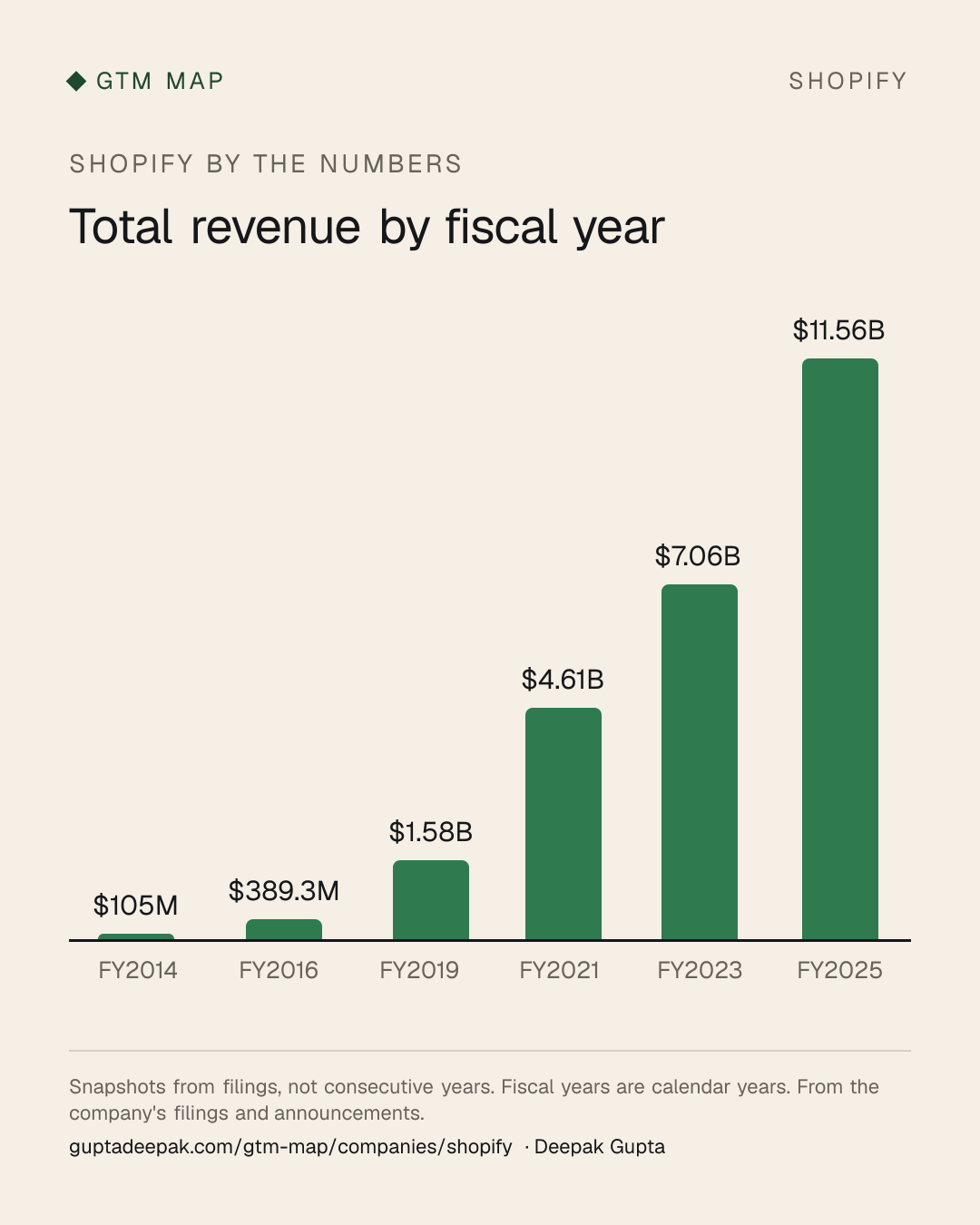
Shopify Payments launched in August 2013, and the F-1 says most revenue growth came in 2013 and 2014. Revenue roughly doubled each year, from $23.7M in 2012 to $105.0M in 2014, and the IPO closed on May 27, 2015.
- Usage pricing
Shopify Payments added a fee on every order processed, so revenue rises with merchant sales. Merchant solutions went from 36.5% of revenue in 2014 to 45.4% in 2015.[1],[3]
- Paid acquisition
The F-1 says marketing ran primarily on search, social and banner ads, and most of the 2014 rise in sales and marketing was an $18.0 million increase in programs such as Google AdWords.[1]
- Partner channel
Thousands of design and marketing agencies built stores and referred merchants, Shopify sent work back through its Shopify Experts directory, resellers sold the platform, and about 75% of merchants had installed apps from an App Store of more than 900.[1]
- Land and expand
Merchants who grew moved to higher plans and used more merchant solutions, and the F-1 says higher billings from remaining merchants largely offset decline within each cohort.[1]
- Inbound content
The Shopify Blog passed five million page views a year, and about 20,000 new businesses entered the Build A Business competition, selling a combined $100 million during it.[1]
- Sales-led
Shopify Plus launched on February 4, 2014 for higher-volume merchants, and Shopify began hiring sales staff to sell it.[1],[2]
- Usage pricing
2016 to 2019
Shopify Plus, Unite and merchant solutions take over
Merchant solutions passed half of revenue in 2016, the year of the first Unite partner conference. By the end of 2019 Shopify had over one million merchants, $1,578.2M in revenue and $61.1B in GMV.
- Land and expand
Merchants start on cheap plans and grow into higher ones. Over half of the first 1,000+ Plus merchants were upgrades, and most GMV came from the Advanced and Plus plans, where retention is also higher.[11],[2]
- Usage pricing
Merchant solutions became the larger revenue line, 51.6% in 2016 and 59.3% in 2019. The company says Payments needs far less sales and marketing spend than subscriptions and drives higher retention.[3],[5]
- Partner channel
Referring partners grew from about 11,000 to about 24,500, a Plus Partner Program for agencies launched, and the App Store grew to about 3,700 apps.[2],[4]
- Sales-led
Outbound sales for Shopify Plus, hired from early 2015, targeted larger merchants migrating off legacy platforms. Plus had about 2,500 merchants by the end of 2016 and was 27% of MRR at the end of 2019.[2],[12]
- Owned events
Unite, an in-person partner conference, was first held in San Francisco in 2016 with more than 650 partners and was used to launch platform tools such as the Sales Channel SDK.[2],[4]
- Paid acquisition
Organic search, paid search and social media stayed the core of acquisition. In 2019 Shopify added offline brand media to widen the top of the funnel and make direct marketing more efficient.[2],[4],[5]
- Inbound content
Content marketing ran across Shopify blogs, podcasts, Shopify Studios video, eBooks and free tools.[4]
- Land and expand
2020 to 2022
Pandemic surge and a better developer deal
The pandemic brought a flood of new merchants on standard plans. Merchant solutions reached 70.9% of revenue in 2021, and Shopify cut its app revenue share to win developers.
- Product-led
The standard 14-day free trial was stretched to 90 days for signups from March 21 to May 31, 2020. So many standard-plan merchants joined that Plus fell from 27% to 25% of MRR.[12]
- Partner channel
About 42,200 partners referred a merchant in 2020, the App Store passed 8,000 apps, and in 2021 Shopify dropped its revenue share to zero on a developer's first $1 million a year.[12],[6]
- Usage pricing
Merchant solutions reached 70.9% of revenue in 2021, with Shopify Payments processing 48.9% of GMV.[7]
- Paid acquisition
Sales and marketing rose 49.7% to $901.6 million in 2021, mainly marketing programs on search, display and social plus payments to partners, even as it fell to 19.5% of revenue.[7]
- Sales-led
Self-serve onboarding sat alongside outbound sales reps for Shopify Plus and POS Pro.[6]
- Owned events
Shopify Editions, introduced in Q2 2022, is a twice-yearly product release showcase that presents new launches and improvements across the platform.[8],[18]
- Product-led
2023 to now
Enterprise push, merchant solutions and AI channels
Shopify moved upmarket with Commerce Components and sold its logistics business to Flexport in 2023. Merchant solutions are now 76% of revenue, and Shopify is adding AI platforms as merchant sales channels.
- Sales-led
Commerce Components (January 2023) lets enterprise retailers adopt parts of Shopify without re-platforming. Sales and account reps sell Plus, Commerce Components and POS Pro, Plus starts at $2,300 a month, and most GMV now comes from Plus and enterprise.[8],[10],[15]
- Usage pricing
Merchant solutions are 76% of revenue, Payments penetration is 65.6% of GMV, and some subscription contracts now carry a variable fee tied to GMV.[10]
- Partner channel
More than 21,000 apps, 100,000+ partners and $1.3 billion paid to partners in 2025, with system integrators now among referrers. The zero revenue share now covers a developer's first $1 million in lifetime revenue from January 1, 2025, not each year.[10],[17],[19],[8]
- Product-led
The free trial is now 3 days, then $1 a month for three months, plus up to $10,000 in sales-based credits. The 10-K names trial experiences as a way to grow the merchant base.[15],[16],[10]
- Paid acquisition
Paid search, social, radio, television and direct mail, judged on return on marketing spend. In 2025 marketing program spend rose $242 million while affiliate payouts fell $15 million.[8],[10]
- Owned events
Editions continues as the twice-yearly product release showcase, rolling out hundreds of updates every six months, and DotDev is an in-person developer event.[17],[18]
- Sales-led
02The numbers
| Metric | Value | As of | Basis |
|---|---|---|---|
| Revenue, 2012 to 2014 | $23.7M, $50.3M, $105.0M[1] | December 31, 2014 | From a filing |
| Sales and marketing, 2014 | $45.9M, 43.7% of revenue[1] | December 31, 2014 | From a filing |
| Merchants at the F-1 | 162,261 in about 150 countries[1] | March 31, 2015 | From a filing |
| IPO | 8,855,000 shares at $17.00, $150.5M gross proceeds[2] | May 27, 2015 | From a filing |
| Shopify Plus merchants | About 2,500[2] | December 31, 2016 | From a filing |
| Revenue and GMV, 2019 | $1,578.2M revenue, $61.1B GMV[5] | December 31, 2019 | From a filing |
| Merchants, 2019 | Over one million in about 175 countries[4] | December 31, 2019 | From a filing |
| Partners referring a merchant, past 12 months | About 42,200, up 72%[12] | December 31, 2020 | From a filing |
| Shopify Plus share of MRR | 25%, from 27% a year earlier[12] | December 31, 2020 | From a filing |
| Revenue, 2025 | $11.6B, up 30%[10] | December 31, 2025 | From a filing |
| GMV and Payments penetration, 2025 | $378.4B GMV, 65.6% through Shopify Payments[10] | December 31, 2025 | From a filing |
| Sales and marketing, 2025 | $1,663M, 14% of revenue[10] | December 31, 2025 | From a filing |
| US ecommerce market share | More than 14%[13] | December 31, 2025 | Company-stated |
| Revenue, Q2 2026 | $3,583M, up 34%[14] | June 30, 2026 | From a filing |
“Reported” figures come from trade press, not the company, and are shown with their date.
03Myth checks
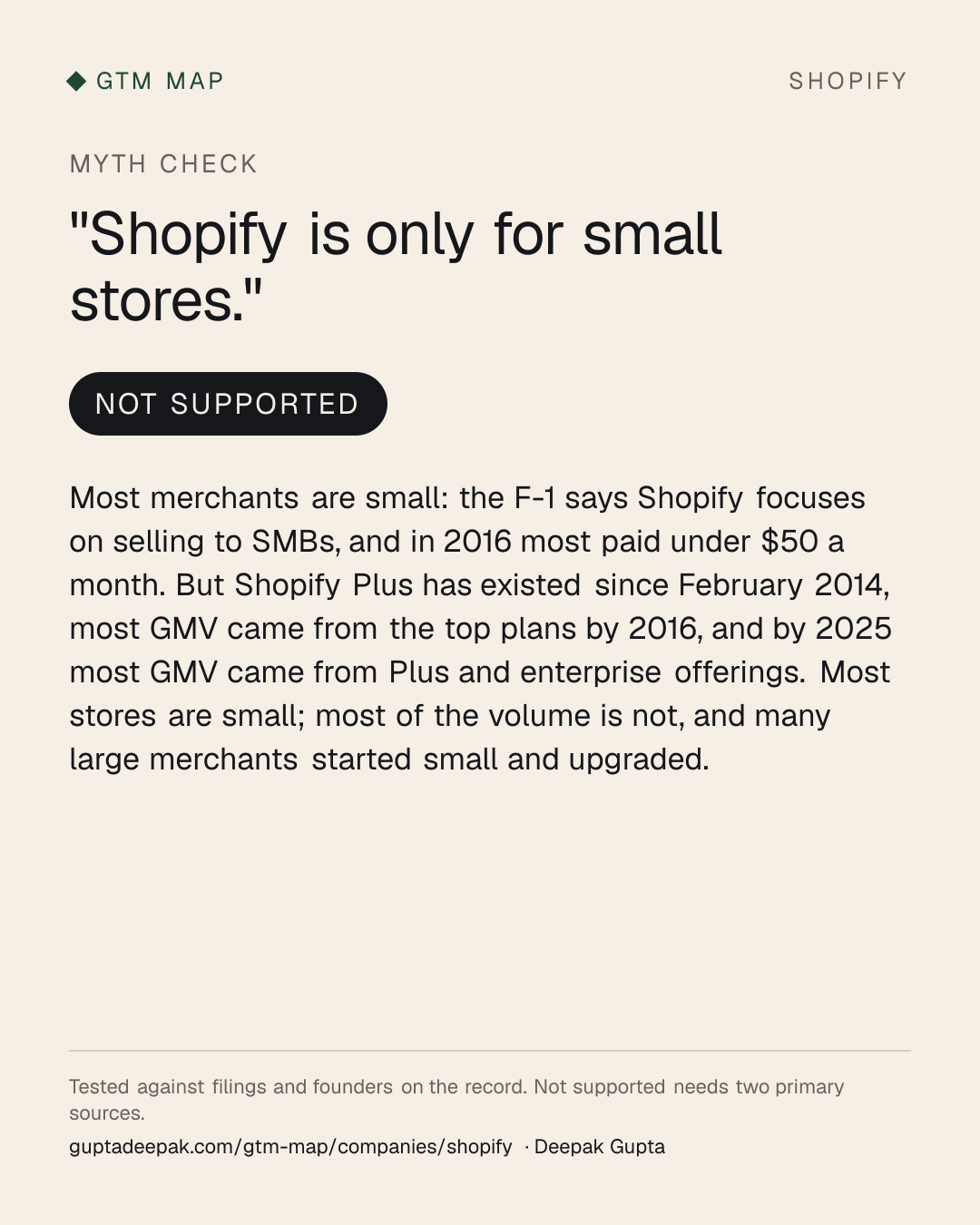
“Shopify is only for small stores.”
Not supportedMost merchants are small: the F-1 says Shopify focuses on selling to SMBs, and in 2016 most paid under $50 a month. But Shopify Plus has existed since February 2014, most GMV came from the top plans by 2016, and by 2025 most GMV came from Plus and enterprise offerings. Most stores are small; most of the volume is not, and many large merchants started small and upgraded.[1],[2],[11],[8],[10]
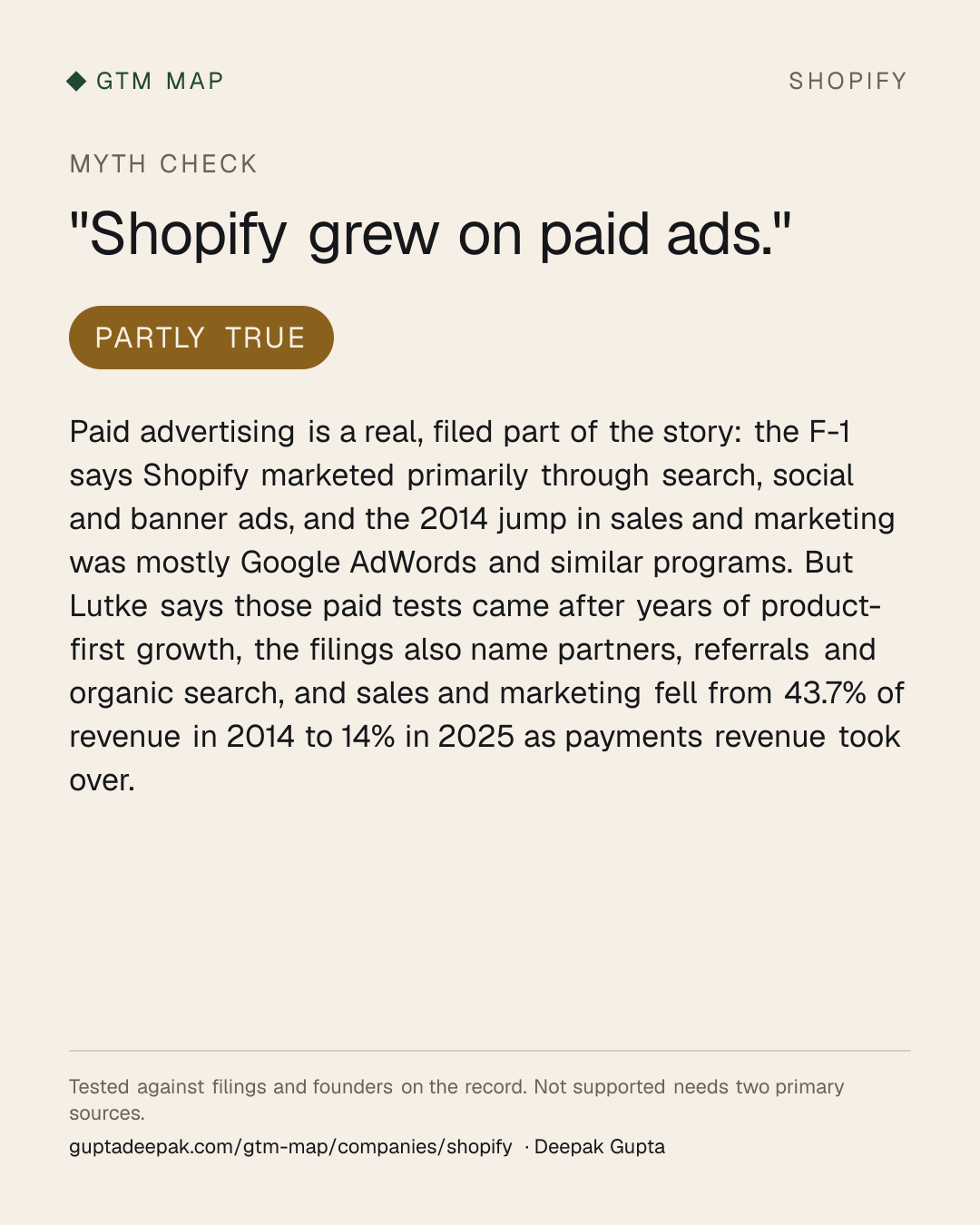
“Shopify grew on paid ads.”
Partly truePaid advertising is a real, filed part of the story: the F-1 says Shopify marketed primarily through search, social and banner ads, and the 2014 jump in sales and marketing was mostly Google AdWords and similar programs. But Lütke says those paid tests came after years of product-first growth, the filings also name partners, referrals and organic search, and sales and marketing fell from 43.7% of revenue in 2014 to 14% in 2025 as payments revenue took over.[1],[20],[2],[12],[10]
On the record
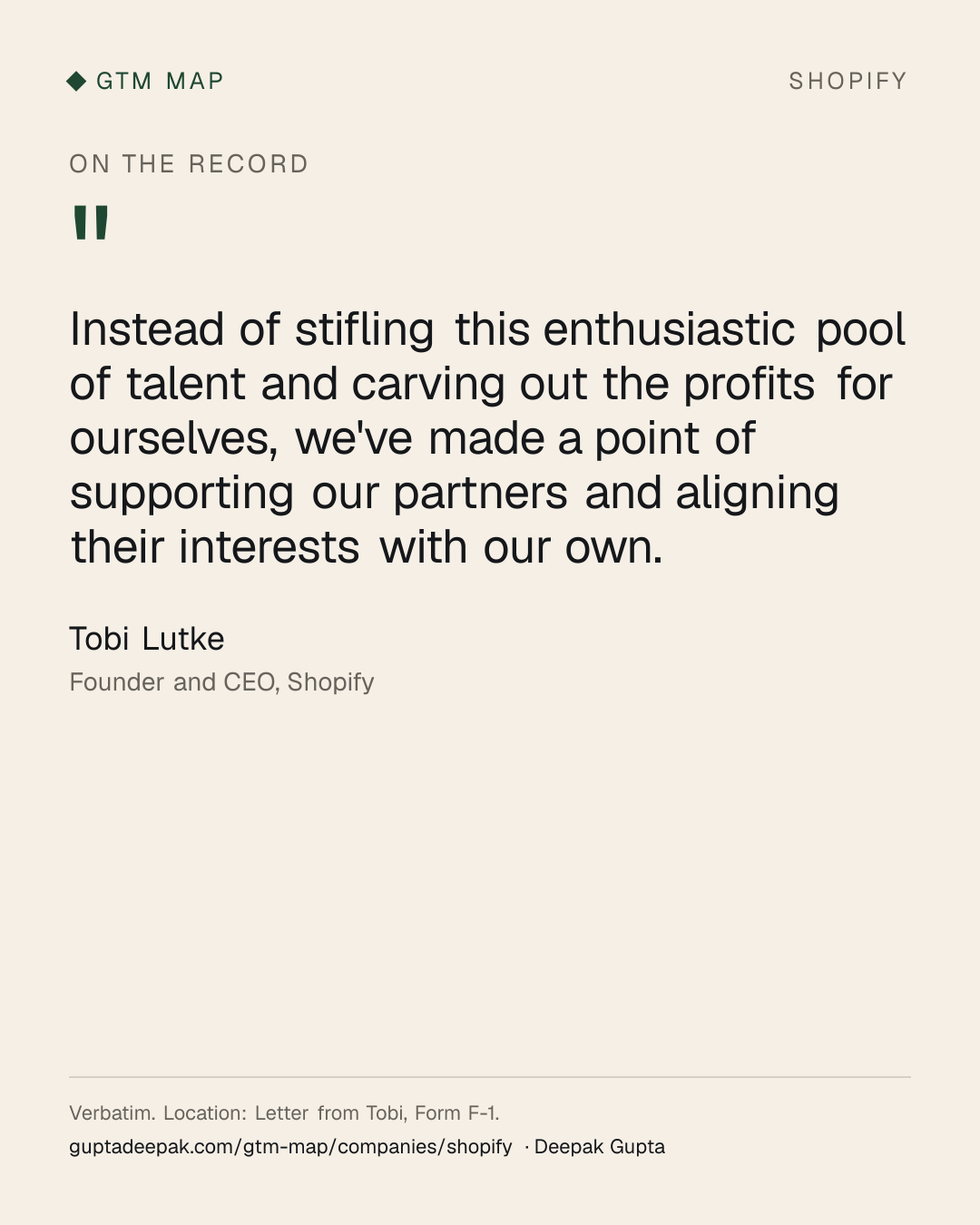
“Instead of stifling this enthusiastic pool of talent and carving out the profits for ourselves, we’ve made a point of supporting our partners and aligning their interests with our own.”
Tobi Lütke, Founder and CEO, Shopify[1]
Letter from Tobi, Form F-1
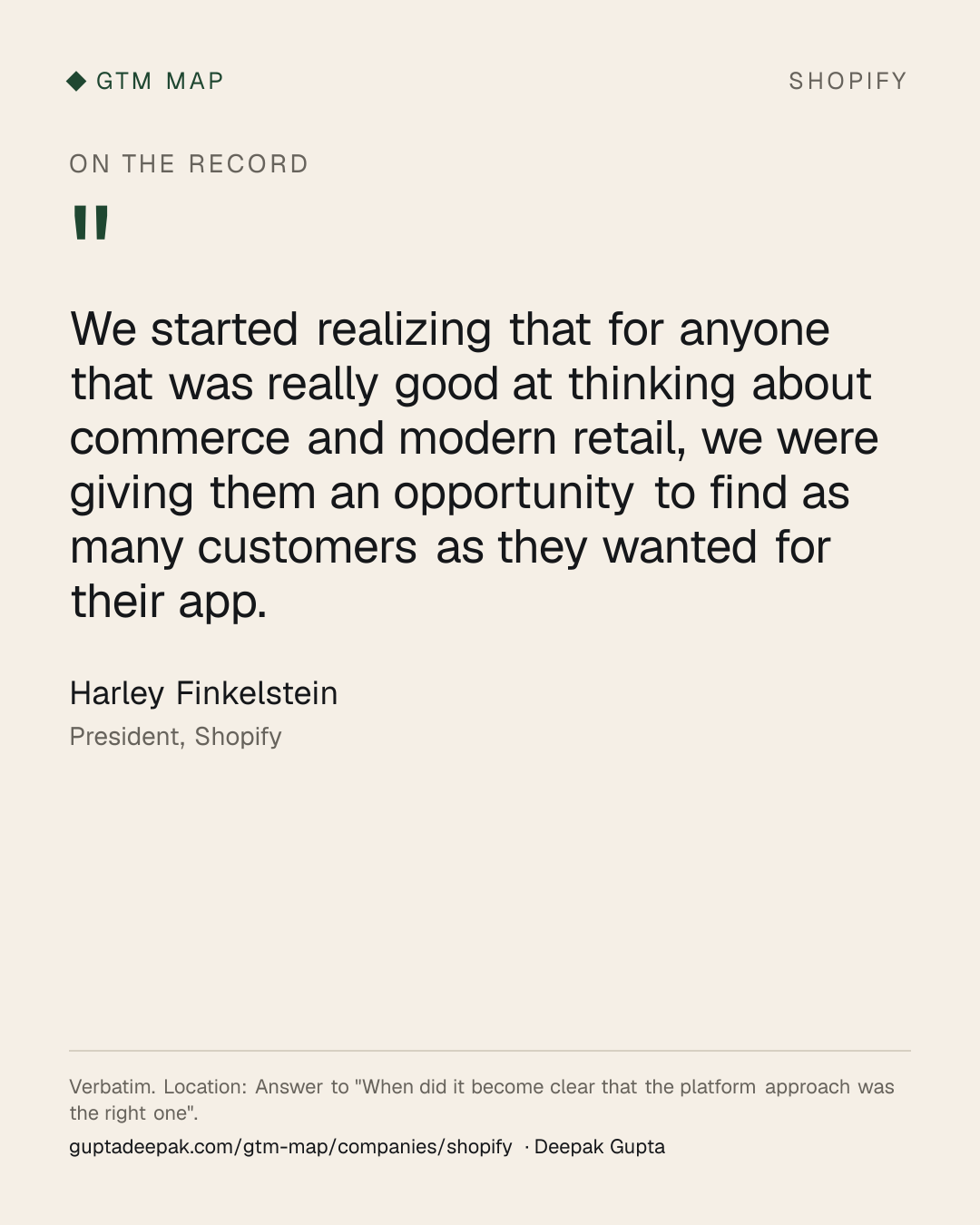
“We started realizing that for anyone that was really good at thinking about commerce and modern retail, we were giving them an opportunity to find as many customers as they wanted for their app.”
Harley Finkelstein, President, Shopify[21]
Answer to "When did it become clear that the platform approach was the right one"
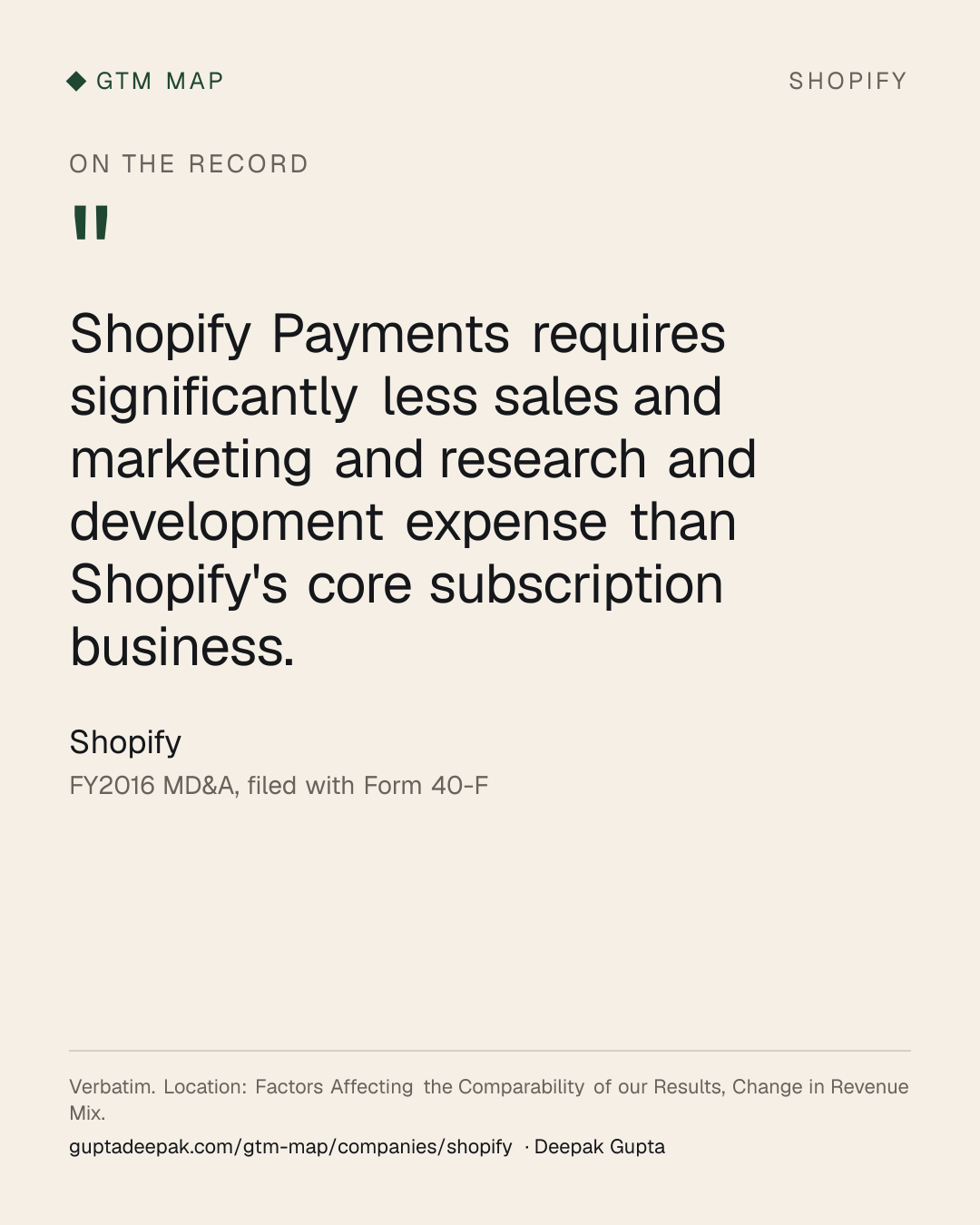
“Shopify Payments requires significantly less sales and marketing and research and development expense than Shopify’s core subscription business.”
Shopify, FY2016 MD&A, filed with Form 40-F[3]
Factors Affecting the Comparability of our Results, Change in Revenue Mix
04What other companies can take from it
Make your platform the go-to-market for other businesses, and they become your channel.
Works when: Customers need help or add-ons you will never build (design, integrations, niche features), and third parties can make real money serving your customer base.
Backfires when: The customer base is too small to pay partners, or you keep absorbing partner features into the core product, so partners stop investing.
Based on: Self-serve store builder and the first ecosystem, Partner channel; Payments, paid search and the IPO, Partner channel; Pandemic surge and a better developer deal, Partner channel
Charge on the customer's success, not only on the plan.
Works when: Your product sits in the customer's money flow (payments, transactions, usage) and their volume can grow far beyond the subscription price.
Backfires when: There is no natural transaction to take a share of, or the take rate competes with a cheaper processor the customer already trusts.
Based on: Payments, paid search and the IPO, Usage pricing; Shopify Plus, Unite and merchant solutions take over, Usage pricing; Enterprise push, merchant solutions and AI channels, Usage pricing
Serve the kitchen-table starter and let them grow into the top plans.
Works when: The same product can grow with a customer from tiny to large, and some small customers become very large.
Backfires when: Small customers almost never grow, so the bottom of the funnel is pure churn and support cost.
Based on: Shopify Plus, Unite and merchant solutions take over, Land and expand; Enterprise push, merchant solutions and AI channels, Sales-led
Test paid channels in parallel once the product is good, and use the result to fund scale.
Works when: The product already retains users and you can measure return per channel quickly.
Backfires when: Retention is weak, so paid spend fills a leaky bucket, or ad prices rise faster than customer value.
Based on: Self-serve store builder and the first ecosystem, Paid acquisition; Payments, paid search and the IPO, Paid acquisition
05 · GTM Now
What changes in the AI era, and what to do now
Analysis by Deepak Gupta. This is opinion built on the sourced record above, not part of it.[10],[13],[17],[15]
Still works
- Taking a share of merchant volume. Merchant solutions are 76% of revenue and grow with merchants however they were acquired.
- The partner economy, which still pays partners at scale: $1.3 billion in 2025.
- A cheap self-serve start, now 3 days free and then $1 a month for three months.
Breaks
- Analysis: paid search as the main acquisition channel weakens when people ask an AI assistant how to start an online store and get an answer without clicking an ad. The 10-K itself flags dependence on visibility on third-party advertising platforms.
- Analysis: long free trials matter less when an AI tool can build a working store in minutes, and Shopify has already shortened its trial.
- App developers face AI tools that let merchants build their own solutions, a risk the 10-K names directly.
What replaces it
- Shopify's own move is to put merchants inside AI channels: Agentic Storefronts for agent-assisted discovery and checkout across AI platforms, Sidekick, Catalog and Universal Commerce Protocol.
- Analysis: the equivalent of the old paid-search funnel is being the default commerce layer AI agents check out through, so the volume share keeps growing even if signups arrive through AI answers. The filings do not say how merchants now find Shopify.
Apply it now
If you are
A seed to Series B platform for SMBs, under $1K a year at entry, where customers need add-ons, design or setup help you will not build yourself
- Publish APIs and a theme or template system early, and recruit the first 20 builders by hand, as Shopify did with app developers and a theme competition.
- Give partners a referral payment and a directory that sends them paid work, so agencies bring you customers.
- Take zero or a small revenue share from partners until they reach real scale, and say so publicly.
- Run an owned partner event or release showcase on a fixed schedule so partners can plan around your roadmap.
You will know it works when: The share of new paying customers referred by partners, and partner payouts growing faster than your own sales and marketing spend.
Based on Shopify's Self-serve store builder and the first ecosystem, Pandemic surge and a better developer deal, Shopify Plus, Unite and merchant solutions take over
If you are
A growth-stage SMB SaaS company whose product sits in customers' transactions (payments, bookings, invoices, shipping), with most revenue still from flat subscriptions
- Add a built-in, volume-priced service such as payments as the default, as Shopify Payments did, and report its penetration rate.
- Price top plans so the highest-volume customers upgrade before they leave, and track upgrades separately from new logos.
- Add a sales team only for customers already at high volume or migrating from legacy systems, as Shopify did for Plus.
- Make your service usable inside AI assistants and agents, so volume still reaches you when discovery moves off search ads.
You will know it works when: Volume-based revenue as a share of total (Shopify's path was 36.5% to 76%), and sales and marketing falling as a share of revenue while growth holds.
Based on Shopify's Payments, paid search and the IPO, Shopify Plus, Unite and merchant solutions take over, Enterprise push, merchant solutions and AI channels
Motions in this record
Compare with every other company on the GTM matrix.
Share the visuals
Every card is drawn from the sourced record above and sized 1080 by 1350 for LinkedIn and X. Free to share with a link back to this page.
Sources
- [1]SEC filingShopify Inc. Form F-1 Registration Statement (includes Letter from Tobi) (April 14, 2015)
- [2]SEC filing2016 Annual Information Form (Form 40-F Exhibit 1.1) (February 15, 2017)
- [3]SEC filingMD&A for fiscal 2016 (Form 40-F Exhibit 1.3) (February 15, 2017)
- [4]SEC filing2019 Annual Information Form (Form 40-F Exhibit 1.1) (February 12, 2020)
- [5]SEC filingMD&A for fiscal 2019 (Form 40-F Exhibit 1.3) (February 12, 2020)
- [6]SEC filing2021 Annual Information Form (Form 40-F Exhibit 1.1) (February 16, 2022)
- [7]SEC filingMD&A for fiscal 2021 (Form 40-F Exhibit 1.3) (February 16, 2022)
- [8]SEC filing2023 Annual Information Form (Form 40-F Exhibit 1.1) (February 13, 2024)
- [9]SEC filingMD&A for fiscal 2023 (Form 40-F Exhibit 1.3) (February 13, 2024)
- [10]SEC filingForm 10-K, fiscal year ended December 31, 2025 (February 11, 2026)
- [11]EarningsShopify Announces Fourth-Quarter and Full-Year 2015 Financial Results (Form 6-K) (February 17, 2016)
- [12]EarningsShopify fourth-quarter and full-year 2020 results (Form 6-K Exhibit 99.1) (February 17, 2021)
- [13]EarningsShopify's Standout 2025 (Form 8-K Exhibit 99.1) (February 11, 2026)
- [14]EarningsShopify Delivers Big: 30%+ Growth, second-quarter 2026 results (Form 8-K Exhibit 99.1) (August 5, 2026)
- [15]CompanyShopify pricing (October 18, 2026)
- [16]CompanyFree trial signup: Your business starts with Shopify (October 18, 2026)
- [17]CompanyShopify Partner Program (October 18, 2026)
- [18]CompanyShopify Editions archive (October 18, 2026)
- [20]Founder interviewThe Tim Ferriss Show Transcripts: Tobi Lütke (#359) (Tobi Lütke, February 11, 2019, at answers to "What do you think caused you to be the bottleneck?" and "Why did things work?")
- [21]Founder interviewCatalyzing Entrepreneurship (Greylock, interview by Mike Duboe, transcript) (Harley Finkelstein, October 4, 2022, at answer to "When did it become clear that the platform approach was the right one")
Every phase, motion, and myth verdict cites a filing, the company's own pages, or a founder speaking on the record. See the methodology.