
Developer and enterprise · public
How MongoDB went to market
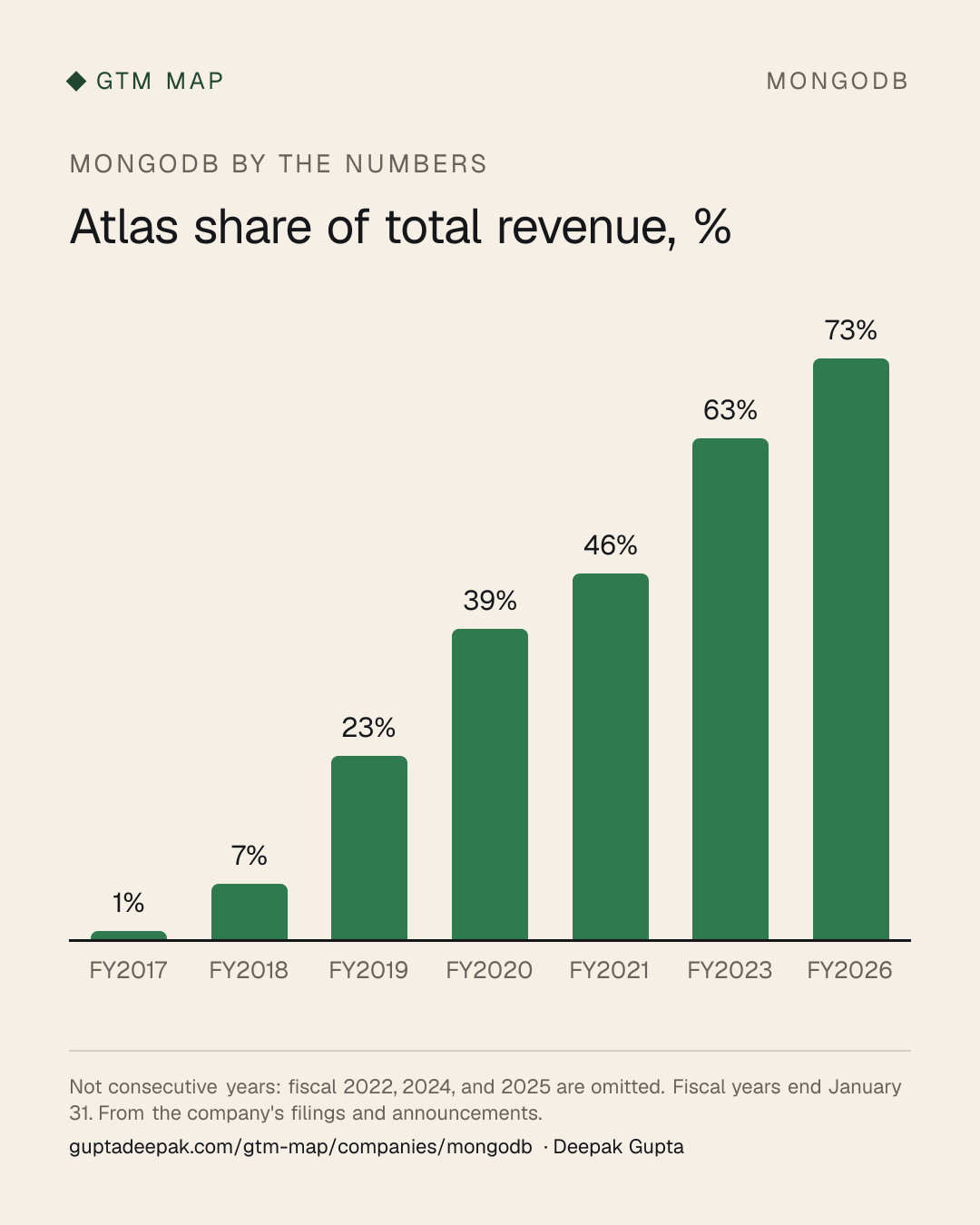
MongoDB gave developers a free database, open source under the AGPL until 2018 and source-available under the SSPL since, then sold proprietary subscriptions through a sales force that landed one workload and expanded. Atlas, its hosted, usage-priced service, grew from 1% of revenue in fiscal 2017 to 73% in fiscal 2026.
- Buyer:
- Developers, Mid-market, Enterprise
- Contract size:
- Mixed
- Checked:
- October 18, 2026
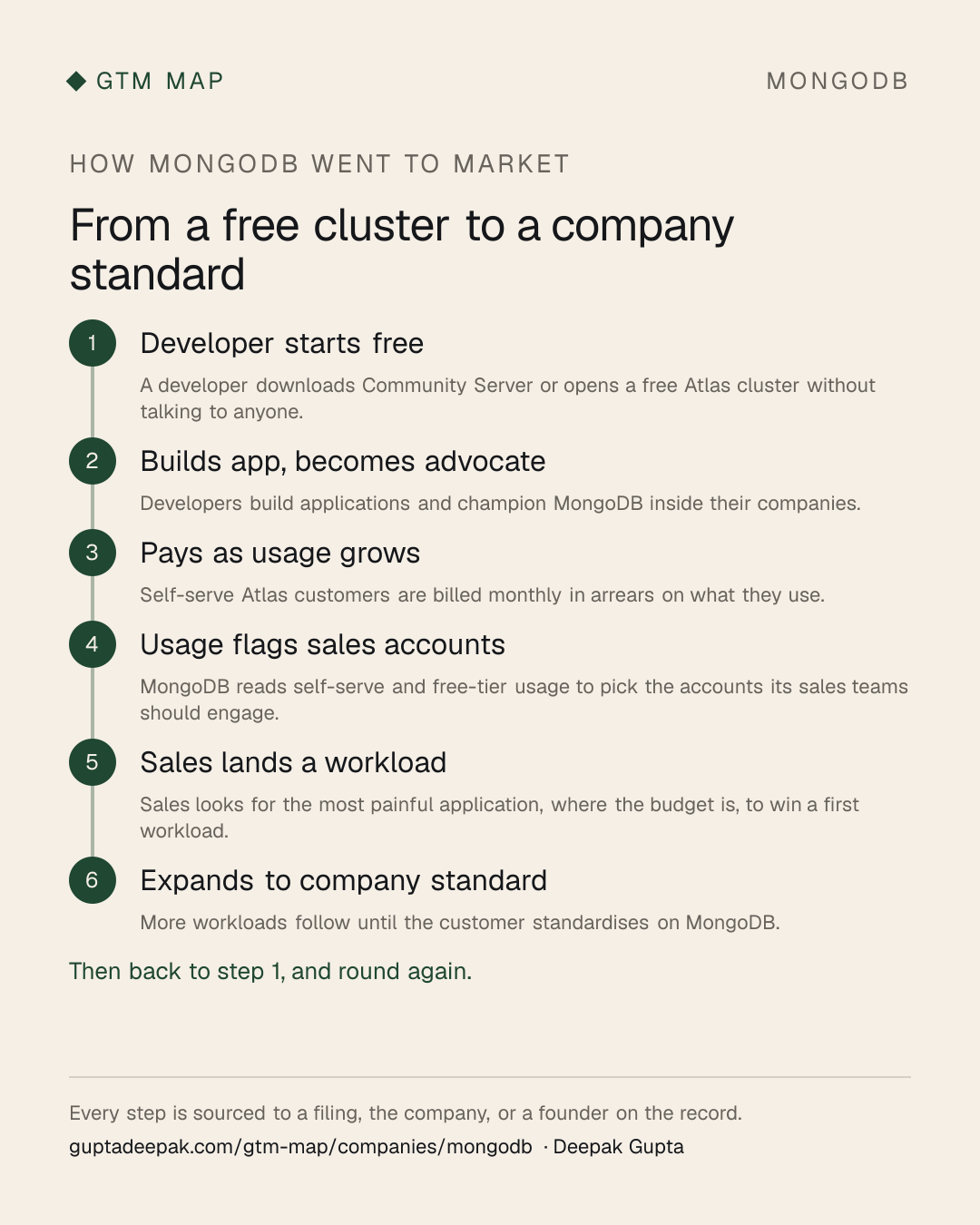
Developer starts free
A developer downloads Community Server or opens a free Atlas cluster without talking to anyone.[5]
Builds app, becomes advocate
Developers build applications and champion MongoDB inside their companies.[1]
Pays as usage grows
Self-serve Atlas customers are billed monthly in arrears on what they use.[5]
Usage flags sales accounts
MongoDB reads self-serve and free-tier usage to pick the accounts its sales teams should engage.[5]
Sales lands a workload
Sales looks for the most painful application, where the budget is, to win a first workload.[11]
Expands to company standard
More workloads follow until the customer standardises on MongoDB.[1]
Back to step 1, and round again
01The phases
PrimarySupportingTried, then dropped
2009 to 2013
A free database for developers
MongoDB, incorporated in 2007 as 10gen, introduced Community Server in 2009 as a free download under the AGPL. Developers were the target user, and the company wrote and owned the code.
- Open source
Community Server was a free download under an open source licence (the AGPL at the time). MongoDB owns the code it wrote and describes the free version as analogous to freemium, not as crowdsourced R&D.[1],[11]
- Developer-led
Developers could evaluate the database without asking anyone, which the S-1 credits for its popularity and for driving enterprise adoption of the paid subscription. Ittycheria: the business starts and stops with developers.[1],[11]
- Open source
2013 to 2016
Enterprise Advanced and direct sales
Enterprise Advanced arrived in 2013 and Dev Ittycheria became CEO in 2014. A field and inside sales force sold per-server subscriptions to enterprises that already ran the free version.
- Sales-led
Field and inside sales sold paid subscriptions, generally priced per server, to enterprises whose developers already knew Community Server. Customers sold by sales and partners were 96% of subscription revenue in fiscal 2016.[1]
- Land and expand
A first application lands, then more applications, departments, and geographies follow. Net ARR expansion was 128% at July 2017 and above 120% for ten straight quarters before the IPO.[1],[11]
- Partner channel
Global system integrators, value-added resellers, and independent software vendors resold and integrated MongoDB; the S-1 names Accenture, AWS, Microsoft, and more than 1,000 other partner organizations.[1]
- Sales-led
2016 to 2019
Atlas, usage pricing, and the licence change
Atlas, the hosted database service, launched in June 2016 with self-serve signup and usage billing, and a free tier followed by 2017. In October 2018 new Community Server releases moved to the SSPL, and in November 2018 MongoDB bought mLab for about 4,200 customers.
- Product-led
Atlas added a self-serve path with a free tier to drive developer adoption, and it grew from 1% of revenue in fiscal 2017 to 23% in fiscal 2019. A free 512MB cluster is still offered.[1],[2],[10]
- Usage pricing
Atlas is charged monthly on consumption. Ittycheria says this solved the classic open source paywall problem, because a pay-as-you-go service can monetize everything.[1],[11]
- Open source
In October 2018 new Community Server releases moved from the AGPL to MongoDB's Server Side Public License, which makes anyone offering MongoDB as a service open source their service stack; MongoDB blamed cloud vendors capturing value. The OSI does not recognise the SSPL. Downloads rose from 30 million at the IPO to over 700 million by January 2026, and customers from over 13,400 (January 2019) to over 65,200, though the filings do not isolate the licence's effect.[2],[9],[11],[1],[3],[5]
- Community
MongoDB sponsored user groups and ran MongoDB University courses: 116 meetup groups with over 55,000 members and over 730,000 University course registrations by July 2017.[1]
- Owned events
MongoDB World, the annual user conference, is named in the S-1 alongside MongoDB University as a brand investment.[1]
- Product-led
2019 to now
Atlas becomes the business, sold with the clouds
Atlas passed 39% of revenue in fiscal 2020 and 73% in fiscal 2026, sold alongside AWS, Google Cloud, and Azure. Ittycheria, CEO since 2014, was succeeded by CJ Desai in November 2025; Desai left for Meta in September 2026 and Ittycheria returned as interim CEO while a search runs.
- Usage pricing
Atlas was 73% of revenue in fiscal 2026, and MongoDB expects more Atlas contracts billed monthly in arrears on usage, with no upfront commitment.[5]
- Sales-assist
Self-serve Atlas customers become Direct Sales Customers, and MongoDB analyses self-serve and free-tier usage to pick the accounts its sales teams should engage.[3],[5]
- Sales-led
Direct Sales Customers were 87% of subscription revenue in fiscal 2023, and 2,799 customers paid $100K or more in ARR at January 2026. Ittycheria tells salespeople to look for where the pain is.[4],[5],[11]
- Land and expand
Land a workload, find adjacencies, then become the company standard. Net ARR expansion was about 121% at January 31, 2026.[11],[5]
- Cloud marketplace
Atlas is sold on AWS Marketplace and Azure Marketplace, with unified billing on Google Cloud. The clouds co-market and co-sell, and per Ittycheria align their sellers' compensation, while also competing.[3],[4],[11]
- Product-led
The free, source-available Community Server (SSPL; open source under the AGPL until 2018) and the Atlas free tier still feed the funnel. Downloads passed 700 million, and the 10-K credits word of mouth.[5]
- Community
MongoDB University registrations passed 3.0 million at January 31, 2026, up from over one million in January 2021.[3],[5]
- Owned events
MongoDB World returned in person in fiscal 2023. By fiscal 2026 the 10-K names .local user conferences instead, many aimed at AI-native customers, and in-person events and digital marketing spend rose.[4],[5]
- Developer-led
The AI-era developer entry: an Atlas Managed MCP Server that connects coding agents to live Atlas data, and Voyage AI embedding and reranking models, acquired in 2025.[6],[5]
- Usage pricing
02The numbers
Show the data
| FY2017 | 1% | From a filing |
|---|---|---|
| FY2018 | 7% | From a filing |
| FY2019 | 23% | From a filing |
| FY2020 | 39% | From a filing |
| FY2021 | 46% | From a filing |
| FY2023 | 63% | From a filing |
| FY2026 | 73% | From a filing |
Show the data
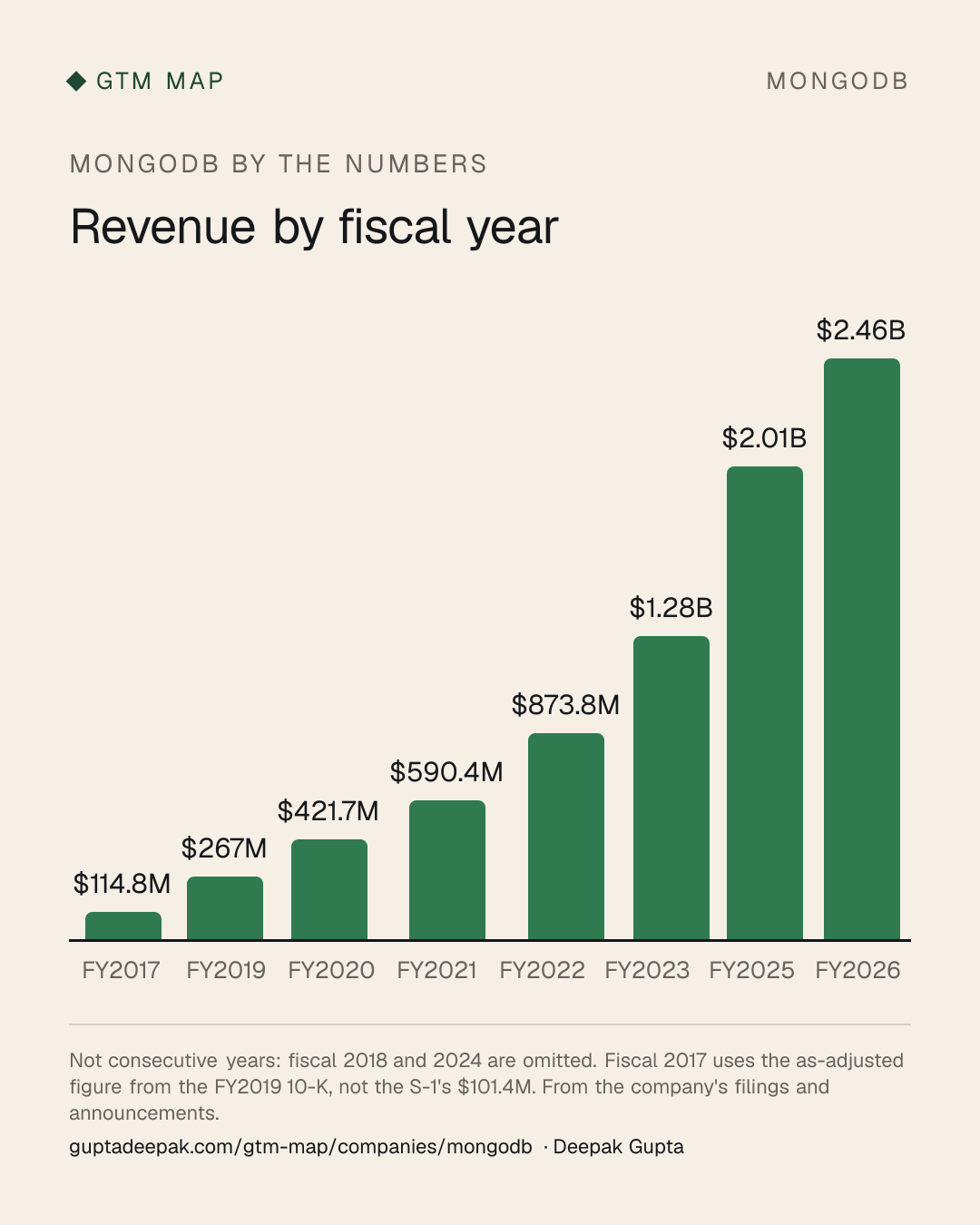
| FY2017 | $114.8M | From a filing |
|---|---|---|
| FY2019 | $267M | From a filing |
| FY2020 | $421.7M | From a filing |
| FY2021 | $590.4M | From a filing |
| FY2022 | $873.8M | From a filing |
| FY2023 | $1.28B | From a filing |
| FY2025 | $2.01B | From a filing |
| FY2026 | $2.46B | From a filing |
| Metric | Value | As of | Basis |
|---|---|---|---|
| Revenue, fiscal 2015 to 2017 (as first filed in the S-1) | $40.8M, $65.3M, $101.4M[1] | January 31, 2017 | From a filing |
| Sales and marketing as a share of revenue, fiscal 2016, 2017, H1 fiscal 2018 | 87%, 78%, 72%[1] | July 31, 2017 | From a filing |
| Net ARR expansion rate at IPO | 128%, over 120% for ten straight quarters[1] | July 31, 2017 | From a filing |
| Atlas customers 13 months after launch | Over 1,900[1] | July 31, 2017 | From a filing |
| Revenue, fiscal 2019 (as adjusted) | $267.0M, up 61%[2] | January 31, 2019 | From a filing |
| Direct Sales Customers share of subscription revenue, fiscal 2017 to 2019 | 96%, 92%, 85%[2] | January 31, 2019 | From a filing |
| Direct Sales Customers share of subscription revenue, fiscal 2023 | 87%[4] | January 31, 2023 | From a filing |
| Revenue, fiscal 2026 | $2,463.8M, up 23%[5] | January 31, 2026 | From a filing |
| Revenue, second quarter fiscal 2027 | $771.8M, up 30%[6] | July 31, 2026 | From a filing |
| Customers, total and on Atlas | Over 65,200 total, over 63,900 on Atlas[5] | January 31, 2026 | From a filing |
| Customers with $100K or more in ARR, fiscal 2024 to 2026 | 2,052, 2,396, 2,799[5] | January 31, 2026 | From a filing |
| Net ARR expansion rate | About 121%[5] | January 31, 2026 | From a filing |
| Sales and marketing as a share of revenue, fiscal 2024 to 2026 | 47%, 43%, 38%[5] | January 31, 2026 | From a filing |
| Downloads since February 2009 (cumulative) | More than 700M[5] | January 31, 2026 | From a filing |
“Reported” figures come from trade press, not the company, and are shown with their date.
03Myth checks
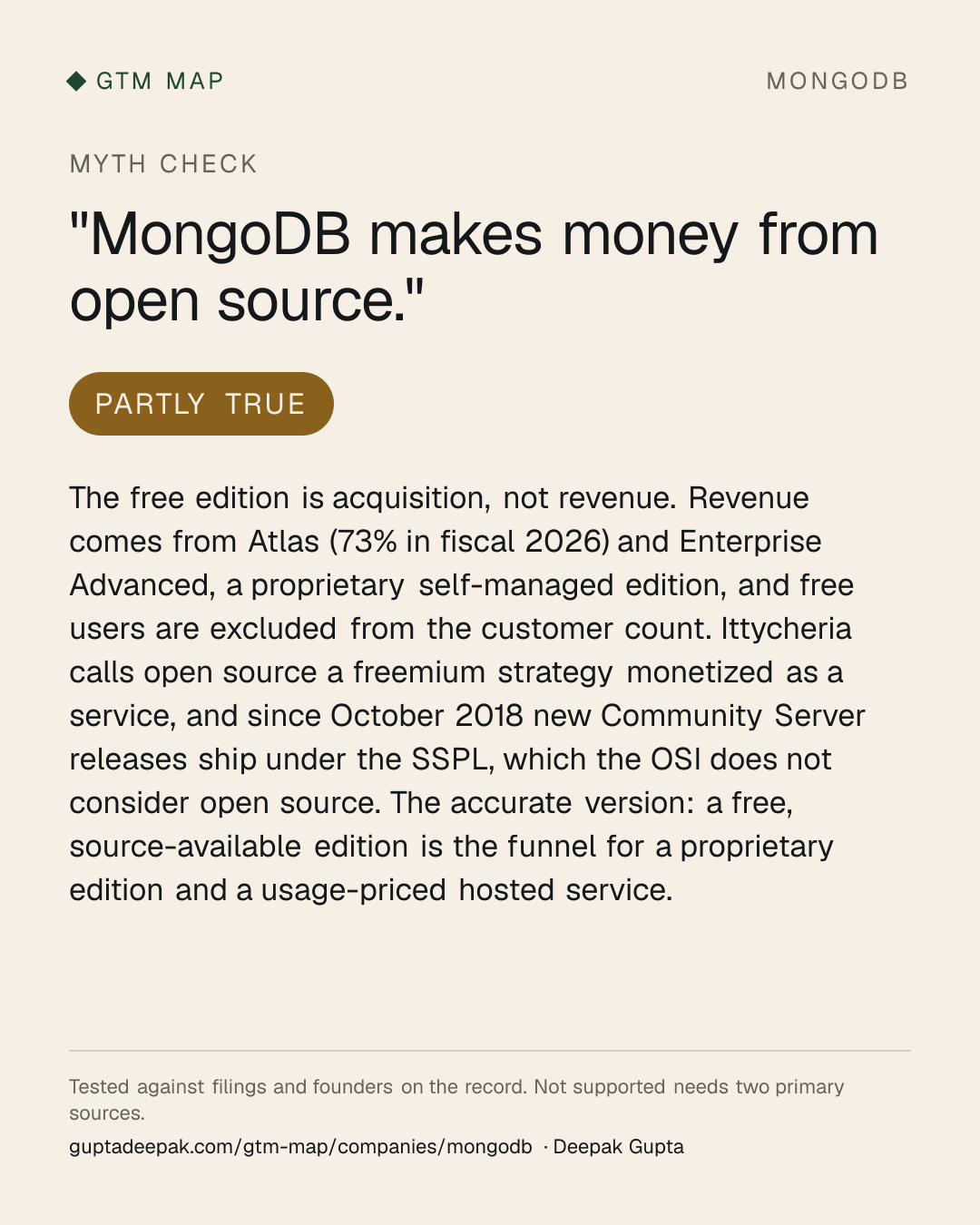
“MongoDB makes money from open source.”
Partly trueThe free edition is acquisition, not revenue. Revenue comes from Atlas (73% in fiscal 2026) and Enterprise Advanced, a proprietary self-managed edition, and free users are excluded from the customer count. Ittycheria calls open source a freemium strategy monetized as a service, and since October 2018 new Community Server releases ship under the SSPL, which the OSI does not consider open source. The accurate version: a free, source-available edition is the funnel for a proprietary edition and a usage-priced hosted service.[1],[5],[11],[9]
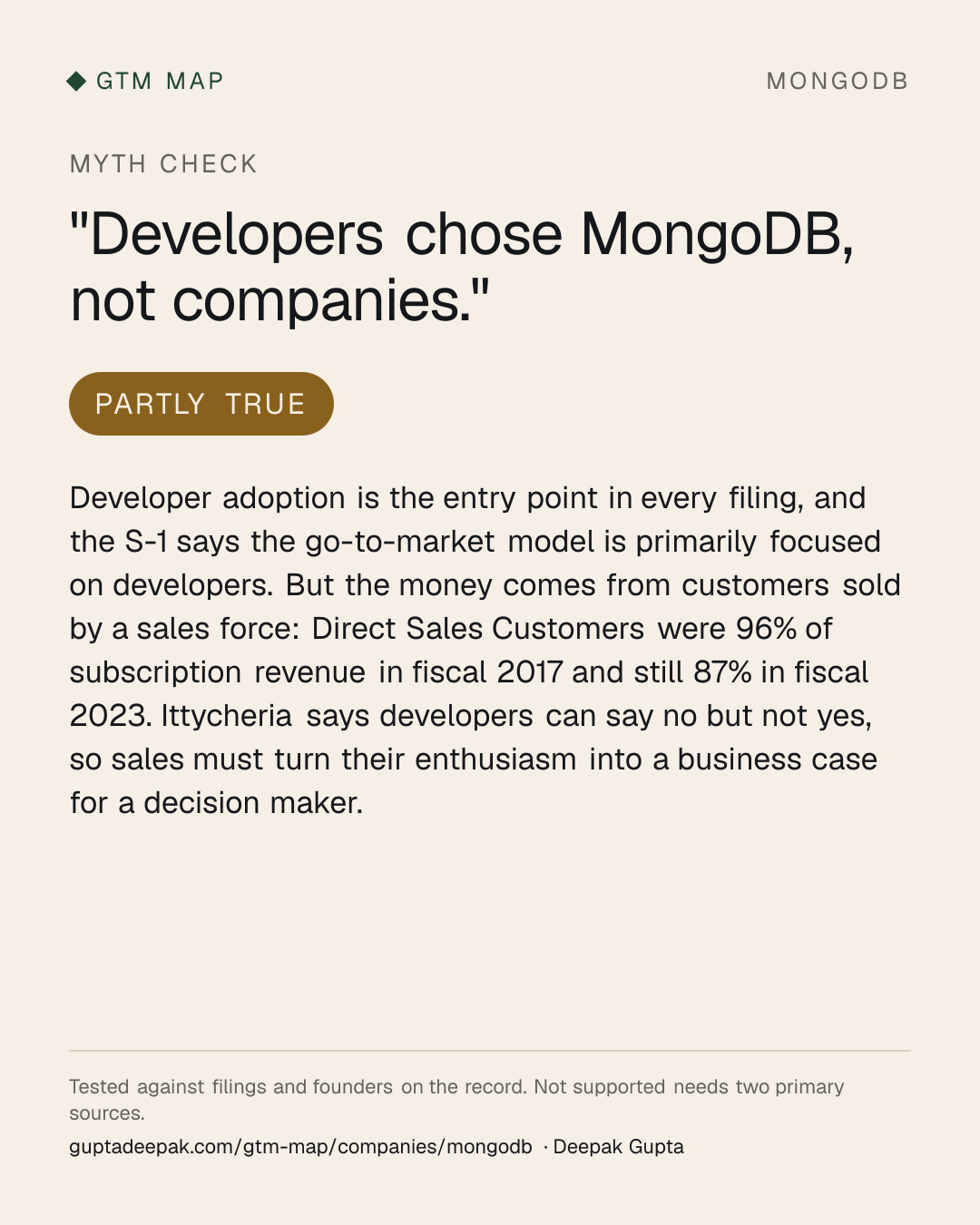
“Developers chose MongoDB, not companies.”
Partly trueDeveloper adoption is the entry point in every filing, and the S-1 says the go-to-market model is primarily focused on developers. But the money comes from customers sold by a sales force: Direct Sales Customers were 96% of subscription revenue in fiscal 2017 and still 87% in fiscal 2023. Ittycheria says developers can say no but not yes, so sales must turn their enthusiasm into a business case for a decision maker.[1],[2],[4],[11]
On the record
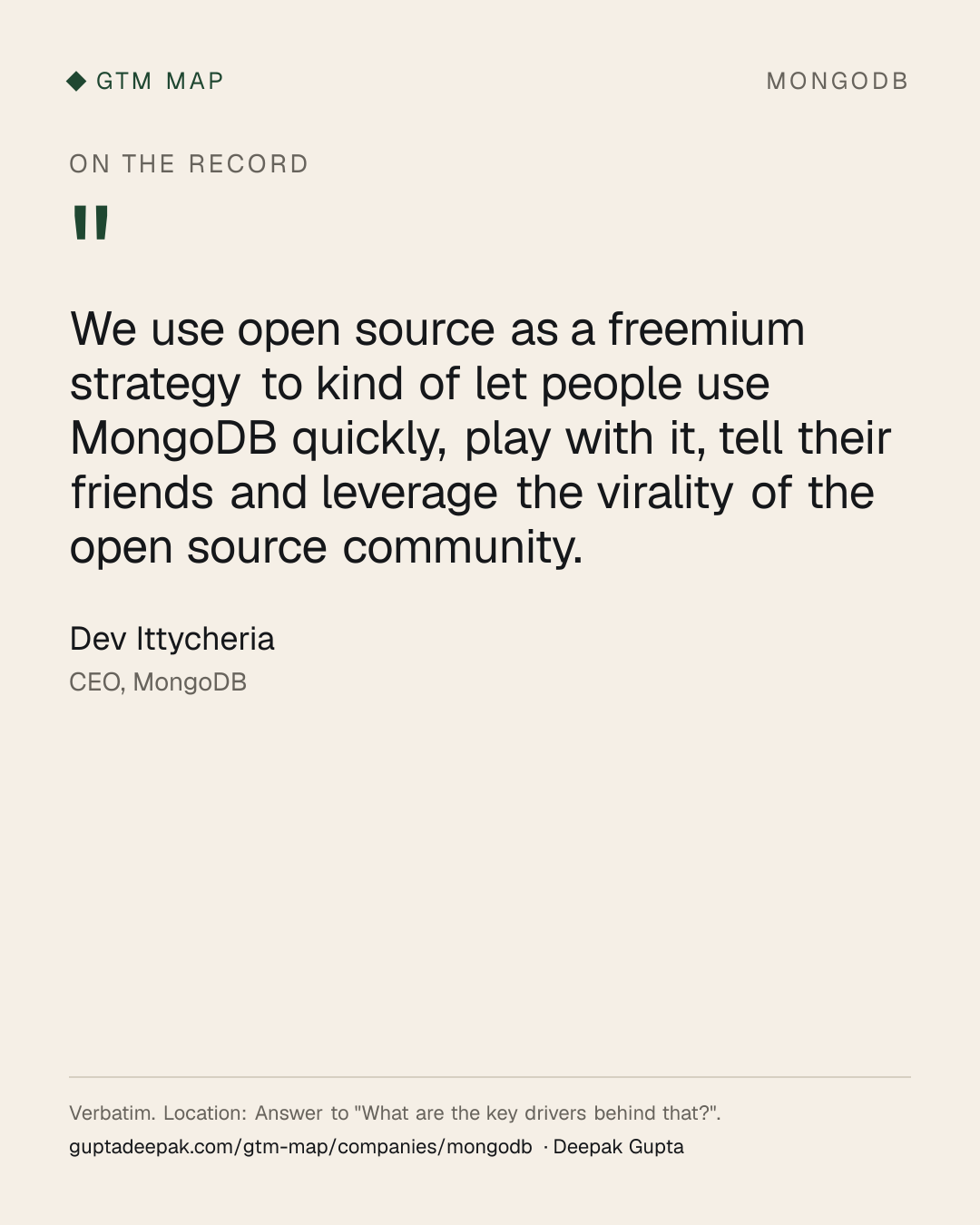
“We use open source as a freemium strategy to kind of let people use MongoDB quickly, play with it, tell their friends and leverage the virality of the open source community.”
Dev Ittycheria, CEO, MongoDB[11]
Answer to "What are the key drivers behind that?"
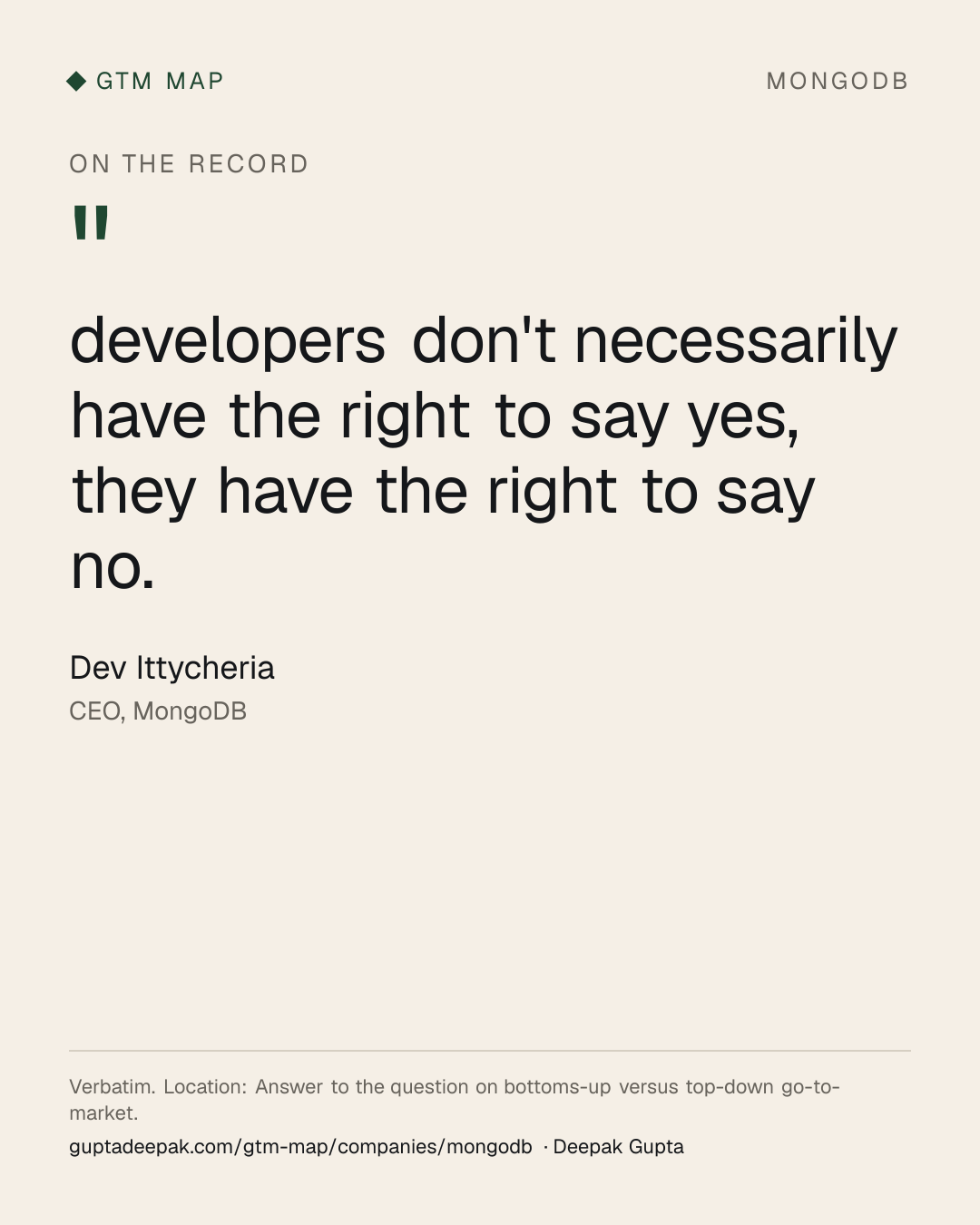
“developers don’t necessarily have the right to say yes, they have the right to say no.”
Dev Ittycheria, CEO, MongoDB[11]
Answer to the question on bottoms-up versus top-down go-to-market
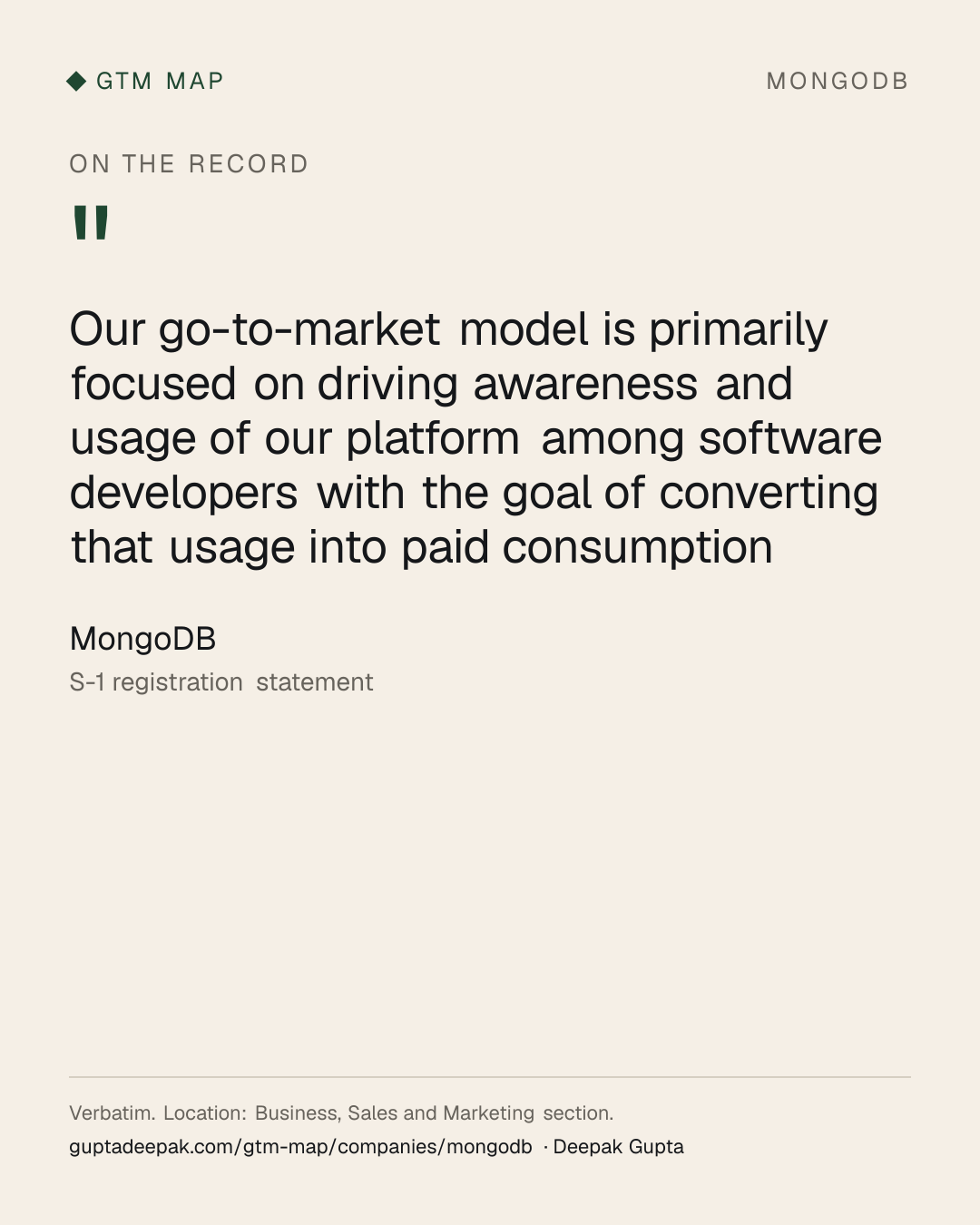
“Our go-to-market model is primarily focused on driving awareness and usage of our platform among software developers with the goal of converting that usage into paid consumption”
MongoDB, S-1 registration statement[1]
Business, Sales and Marketing section
04What other companies can take from it
Treat a free edition as distribution, and own the code so you control the terms.
Works when: You wrote the core yourself, the market is very large, and wide free use creates the developers who later pull in a paid deal.
Backfires when: The project depends on outside contributors who would fork or leave over a licence change, or the market is too small for free use to leave enough paying users.
Based on: A free database for developers, Open source; Atlas, usage pricing, and the licence change, Open source
A hosted, usage-priced service fixes the paywall problem of a free self-managed edition.
Works when: Running the software is real operational work the customer would rather not do, and cost scales with usage.
Backfires when: The product is light to self-host, or a cloud provider can offer the same service cheaper, which is the risk the SSPL was written to block.
Based on: Atlas, usage pricing, and the licence change, Usage pricing; Atlas becomes the business, sold with the clouds, Usage pricing
Developers hold a veto, not a budget, so sell to the pain and land one workload.
Works when: The product is infrastructure used across many applications, so each new application is a fresh expansion opportunity inside the same account.
Backfires when: The purchase is a one-time, company-wide platform decision, Ittycheria's own Workday and Salesforce contrast, where landing workload by workload is too slow.
Based on: Enterprise Advanced and direct sales, Sales-led; Enterprise Advanced and direct sales, Land and expand; Atlas becomes the business, sold with the clouds, Land and expand
Make the hyperscalers a channel while you defend against them.
Works when: Your product runs on their infrastructure and drives their consumption, so their sellers gain from your deals.
Backfires when: The cloud provider's own first-party service is good enough for most buyers, so co-selling mostly helps them displace you.
Based on: Atlas, usage pricing, and the licence change, Open source; Atlas becomes the business, sold with the clouds, Cloud marketplace
05 · GTM Now
What changes in the AI era, and what to do now
Analysis by Deepak Gupta. This is opinion built on the sourced record above, not part of it.[6],[5],[10],[11],[7],[8]
Still works
- The free tier and usage pricing. MongoDB still offers a free Atlas cluster with pay-as-you-go growth, which fits an AI-built prototype that needs a database (analysis).
- Landing by workload. AI projects typically start as one application, which suits a land-and-expand motion (analysis).
Breaks
- Developer mindshare built through downloads, docs, and University courses is weaker when coding agents choose the stack for the developer (analysis).
- The developer veto Ittycheria describes now partly sits with an agent's defaults, which no download count measures; no source here measures agent-driven database choice (analysis).
What replaces it
- Meet the agent where it works: MongoDB launched an Atlas Managed MCP Server that connects coding agents to live Atlas data.
- Own the AI retrieval layer: Voyage AI embeddings and marketing aimed at AI-native customers. Whether these change agent defaults is unsourced (analysis).
Apply it now
If you are
A seed to Series B infrastructure or data company (database, queue, search, observability) whose first user is a developer, with a self-managed edition today and enterprise deals at $50K to $500K ACV
- Decide in writing whether the free edition is distribution or a community project, and keep IP ownership (or a CLA) so the licence terms stay yours.
- Ship a hosted version with a permanent free tier and pure usage pricing, so the paywall question goes away.
- Score self-serve and free accounts on usage and route the top ones to sales, as MongoDB's 10-K describes.
- Train sales to win one painful workload per account, and track workload count per account as the expansion metric.
- List on the cloud marketplaces your customers already buy from, so their committed cloud spend can pay you.
You will know it works when: The share of subscription revenue from accounts that started self-serve or free, and net ARR expansion above 120% (MongoDB's filed range).
Based on MongoDB's Atlas, usage pricing, and the licence change, Atlas becomes the business, sold with the clouds, Atlas becomes the business, sold with the clouds
If you are
An established open-core or source-available vendor whose hosted product is growing but whose developer funnel now runs through AI coding agents
- Publish an MCP server or agent integration for your hosted product so agents can provision and query it directly.
- Make the free tier usable from an agent with no human signup friction, and count agent-originated signups separately.
- Add the AI capability your category needs (retrieval, embeddings, evaluation) inside the existing product, as MongoDB did with Voyage AI.
- Keep routing usage to sales, and add agent-originated usage as a signal.
You will know it works when: The share of new hosted accounts created through an agent or MCP integration, and their conversion to paid usage within 90 days.
Based on MongoDB's Atlas becomes the business, sold with the clouds, Atlas becomes the business, sold with the clouds
Motions in this record
Compare with every other company on the GTM matrix.
Share the visuals
Every card is drawn from the sourced record above and sized 1080 by 1350 for LinkedIn and X. Free to share with a link back to this page.
Sources
- [1]SEC filingMongoDB, Inc. Form S-1 Registration Statement (September 21, 2017)
- [2]SEC filingForm 10-K, fiscal year ended January 31, 2019 (April 1, 2019)
- [3]SEC filingForm 10-K, fiscal year ended January 31, 2021 (March 22, 2021)
- [4]SEC filingForm 10-K, fiscal year ended January 31, 2023 (March 17, 2023)
- [5]SEC filingForm 10-K, fiscal year ended January 31, 2026 (March 11, 2026)
- [6]EarningsMongoDB, Inc. Announces Second Quarter Fiscal 2027 Financial Results (8-K exhibit) (September 1, 2026)
- [7]SEC filingMongoDB Announces Leadership Transition (8-K exhibit) (November 3, 2025)
- [8]SEC filingMongoDB Announces CEO Transition (8-K exhibit) (September 28, 2026)
- [9]CompanyServer Side Public License FAQ (undated)
- [10]CompanyMongoDB Pricing (undated)
- [11]Founder interviewIn conversation with Dev Ittycheria, CEO, MongoDB (Data Driven NYC, edited transcript) (Dev Ittycheria, May 4, 2021, at Edited transcript with no timestamps; each quote is located by the host question its answer follows)
Every phase, motion, and myth verdict cites a filing, the company's own pages, or a founder speaking on the record. See the methodology.