
Security · public
How CrowdStrike went to market
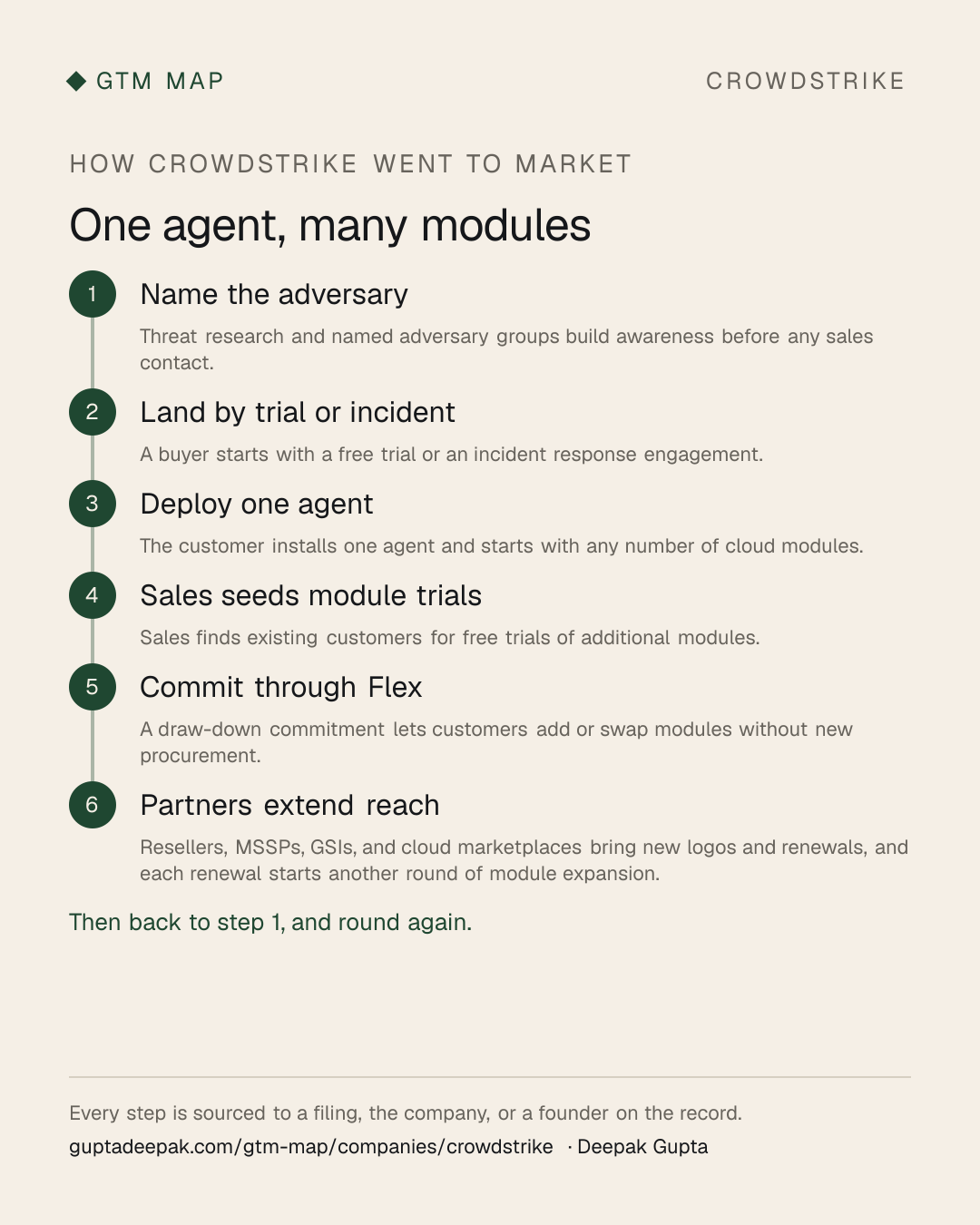
CrowdStrike sold threat intelligence and incident response first, then one Falcon agent whose extra modules switch on without a new install. Direct sales and channel partners landed accounts, trials and marketplaces widened reach, and Falcon Flex commitments now carry expansion. After the July 2024 incident it offered customer commitment packages, and ARR kept growing.
- Buyer:
- Small business, Mid-market, Enterprise
- Contract size:
- Mixed
- Checked:
- October 18, 2026
Name the adversary
Threat research and named adversary groups build awareness before any sales contact.[6]
Deploy one agent
The customer installs one agent and starts with any number of cloud modules.[1]
Sales seeds module trials
Sales finds existing customers for free trials of additional modules.[6]
Commit through Flex
A draw-down commitment lets customers add or swap modules without new procurement.[19]
Partners extend reach
Resellers, MSSPs, GSIs, and cloud marketplaces bring new logos and renewals, and each renewal starts another round of module expansion.[6]
Back to step 1, and round again
01The phases
PrimarySupportingTried, then dropped
2012 to 2017
Intelligence, incident response, then one EDR product
CrowdStrike launched its threat intelligence product in July 2012 and provided intelligence and incident response services while it built Falcon, which first shipped EDR as a single solution in June 2013.
- Brand narrative
Intelligence and services came before the platform, and the S-1 lists identifying and naming adversary groups, alongside regular industry reports, as a marketing activity.[1]
- Sales-led
The S-1 says CrowdStrike began as a large enterprise solution, and the FY2020 10-K says it and its channel partners historically sold primarily to large organizations.[1],[2]
- Brand narrative
2017 to 2020
Modules, trial-to-pay, marketplace and channel
In February 2017 the platform moved from a single offering to multiple cloud module SKUs on one agent. A website trial followed in December 2017 and AWS Marketplace in May 2018.
- Land and expand
Customers start with any number of modules, and more are activated in real time on the agent already deployed. Net retention was 104%, 119% and 147% at January 2017, 2018 and 2019, and 47% of customers had four or more modules by January 2019.[1]
- Sales-led
Field and inside sales, segmented by a customer's number of endpoints, sell most subscriptions, and sales also finds existing customers for free trials of more modules. Incident response and proactive services are described as a way to cross-sell subscriptions.[1],[2]
- Partner channel
Sales leans on channel partners, and Dell and SecureWorks agreed to sell Falcon as their preferred endpoint security offering. Kurtz says the revenue scale needs a great reseller channel.[1],[17]
- Product-led
From December 2017 a 15-day free trial of Falcon Prevent was offered directly from the website, which the S-1 says should extend reach to customers of all sizes.[1],[2]
- Cloud marketplace
Falcon Prevent became available for trial and purchase on AWS Marketplace in May 2018, and Falcon for AWS later offered metered pay-as-you-go billing there.[2]
- Owned events
Fal.Con is the annual user conference. The September 2018 edition in Miami was announced as the second annual Fal.Con, with sessions for executives and IT professionals.[1],[18]
- Brand narrative
Naming adversary groups and publishing industry reports sit alongside paid media, web marketing, analyst work, demand generation and targeted displacement campaigns in the marketing mix.[1]
- Land and expand
2020 to 2024
Platform scale and module depth
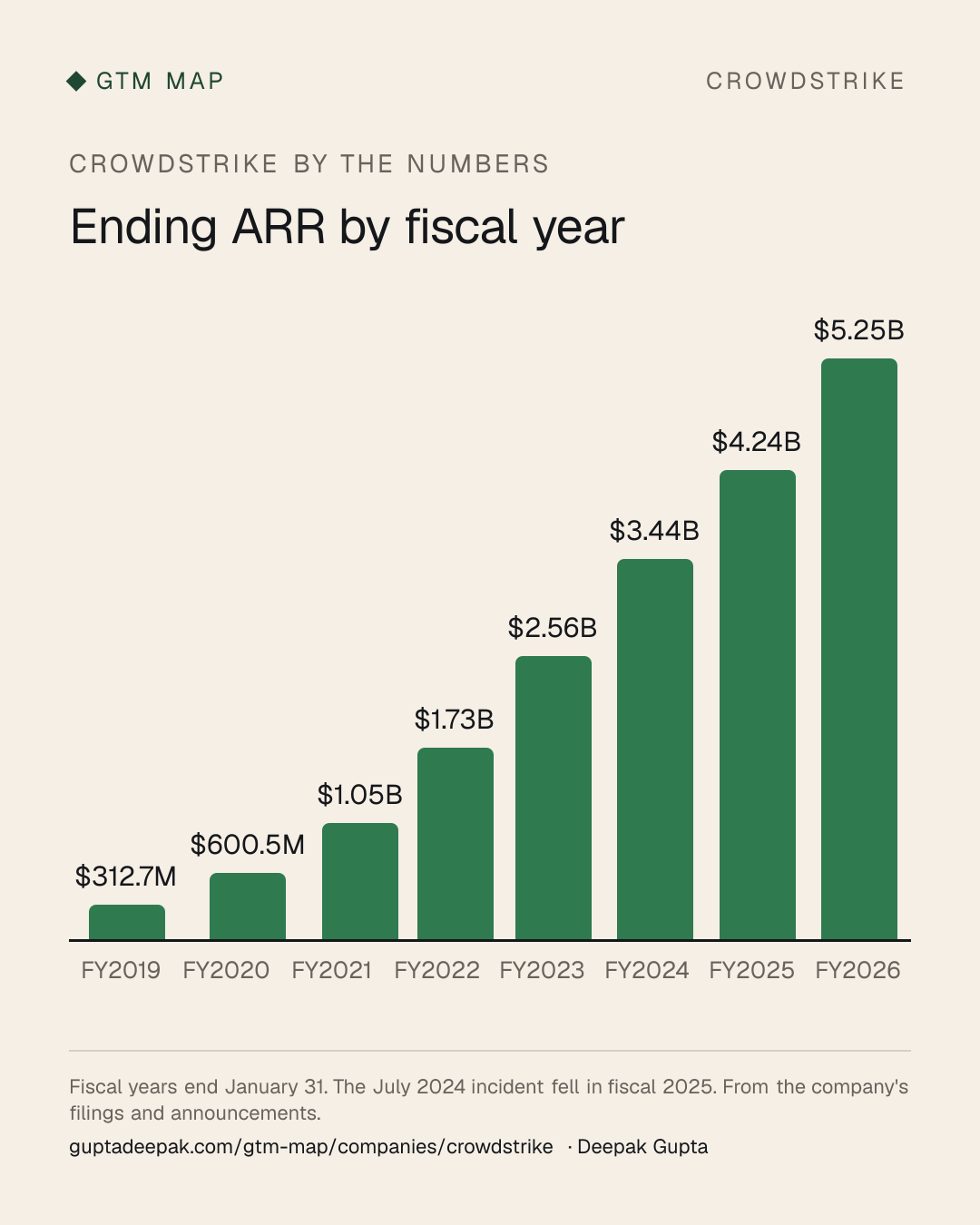
ARR grew from $600.5M at January 2020 to $3.44B at January 2024 as module depth rose, sales was reorganised by organizational size, and Falcon Flex launched at Fal.Con 2023.
- Land and expand
Customers with five or more modules went from 33% at January 2020 to 57% at January 2022 and 64% at January 2024, the last excluding Falcon Go bundles. Falcon Flex replaced fixed bundles with a model where customers expand, adopt and swap modules without new procurement cycles.[7],[8],[9],[19]
- Sales-led
The global sales team of field and inside sales is now segmented by a customer's organizational size rather than endpoint count.[4]
- Partner channel
The FY2020 10-K says sales leverages a network of channel partners; by FY2024 it describes a powerful go-to-market sales motion with a vast ecosystem of channel and alliances partners.[2],[4]
- Product-led
The 10-K names the trial-to-pay model as the main way it increasingly sells to small and medium-sized businesses, and a Falcon Go bundle serves organizations with 100 endpoints or fewer.[3],[9]
- Owned events
Fal.Con is where pricing and products launch: Falcon Flex was introduced at Fal.Con 2023 in Las Vegas in September 2023.[19]
- Brand narrative
The company blog explains the adversary naming scheme behind names such as FANCY BEAR and WIZARD SPIDER, which also appear on CrowdStrike t-shirts, and the 10-K still lists naming adversary groups as marketing.[16],[4]
- Land and expand
2024 to now
After the July 2024 incident: Flex and partner-first
After the July 19, 2024 incident the company introduced customer commitment packages. It now describes a partner-first go-to-market strategy, and Falcon Flex accounts carry a growing share of ARR.
- Land and expand
The 10-K says customer commitment packages included discounting, additional modules, professional services, flexible payment terms or subscription extensions, and have increased contraction and decreased upsell dollar values. Guidance in August 2024 included an estimated $30M subscription revenue impact in each remaining FY2025 quarter from those incentives. ARR from Falcon Flex accounts reached $1.69B at January 2026 and over $2.29B at July 2026.[5],[10],[11],[14],[15],[22]
- Partner channel
The 10-K describes a partner-first go-to-market strategy to land new logos and expand in existing accounts, working with resellers, distributors, MSSPs, MSPs and global system integrators.[5],[6]
- Cloud marketplace
Beyond AWS, CrowdStrike sells through Google Marketplace and, from FY2027, Microsoft Marketplace, where buyers can use an existing Azure consumption commitment. AWS named it Global Marketplace Partner of the Year.[6],[13],[14]
- Owned events
Fal.Con 2024 in Las Vegas sold out with 6,000 attendees, and the first Fal.Con Europe opened with a partner summit of more than 400 participants.[20]
- Sales-led
A Zero Dollar Flex Fund gives qualifying new services customers 200 hours of services with no up-front cost, framed as a path to broader platform adoption. The 10-K still calls services an opportunity to cross-sell subscriptions.[21],[6]
- Product-led
The free Falcon Go trial is offered from the website and three cloud marketplaces. The trial page offers 15 days with no credit card and says it is not intended for partners or MSSPs.[6],[23]
- Brand narrative
Identifying and naming adversary groups is still listed in the marketing section of the FY2026 10-K.[6]
- Land and expand
02The numbers
Show the data
| FY2019 | $312.7M | From a filing |
|---|---|---|
| FY2020 | $600.5M | From a filing |
| FY2021 | $1.05B | From a filing |
| FY2022 | $1.73B | From a filing |
| FY2023 | $2.56B | From a filing |
| FY2024 | $3.44B | From a filing |
| FY2025 | $4.24B | From a filing |
| FY2026 | $5.25B | From a filing |
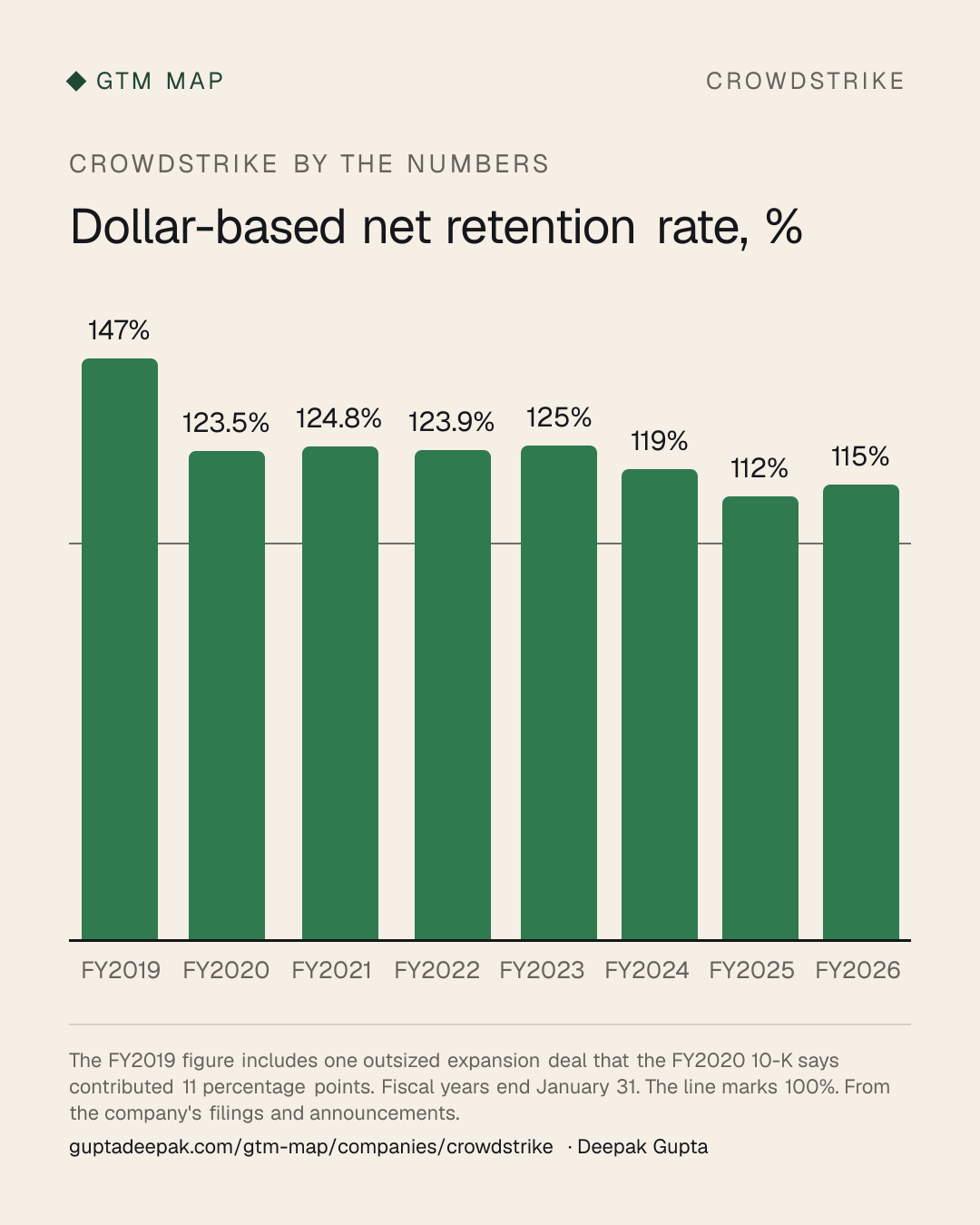
Show the data
| FY2019 | 147% | From a filing |
|---|---|---|
| FY2020 | 123.5% | From a filing |
| FY2021 | 124.8% | From a filing |
| FY2022 | 123.9% | From a filing |
| FY2023 | 125% | From a filing |
| FY2024 | 119% | From a filing |
| FY2025 | 112% | From a filing |
| FY2026 | 115% | From a filing |
| Metric | Value | As of | Basis |
|---|---|---|---|
| Revenue, fiscal 2019 | $249.8M, up 110%[1] | January 31, 2019 | From a filing |
| Subscription customers, fiscal 2019 | 2,516, including 44 of the Fortune 100[1] | January 31, 2019 | From a filing |
| Share of subscription customers under 1,000 employees (company estimate) | About two-thirds[1] | January 31, 2019 | From a filing |
| Dollar-based gross retention, fiscal 2018 and 2019 | 96%, 98%[1] | January 31, 2019 | From a filing |
| Customers with four or more modules | 47%[1] | January 31, 2019 | From a filing |
| Sales and marketing as a share of revenue, fiscal 2018 to 2020 | 88%, 69%, 55%[2] | January 31, 2020 | From a filing |
| Subscription customers, fiscal 2022 | 16,325, up 65%[3] | January 31, 2022 | From a filing |
| Estimated subscription revenue impact from customer commitment package incentives | $30M in each remaining FY2025 quarter[10] | August 28, 2024 | From a filing |
| Gross retention (Kurtz, Q4 FY2025 release) | 97%[12] | January 31, 2025 | Company-stated |
| Sales and marketing as a share of revenue, fiscal 2024 to 2026 | 37%, 39%, 38%[6] | January 31, 2026 | From a filing |
| Revenue, fiscal 2026 | $4.81B, up 22%[6] | January 31, 2026 | From a filing |
| Organizations protected, including MSSP end customers | More than 88,000[6] | January 31, 2026 | From a filing |
| Customers with six, seven, and eight or more modules | 50%, 34%, 24%[14] | January 31, 2026 | From a filing |
| ARR, Q2 FY2027 | $5.84B, up 25%; $332.8M net new[15] | July 31, 2026 | From a filing |
“Reported” figures come from trade press, not the company, and are shown with their date.
03Myth checks
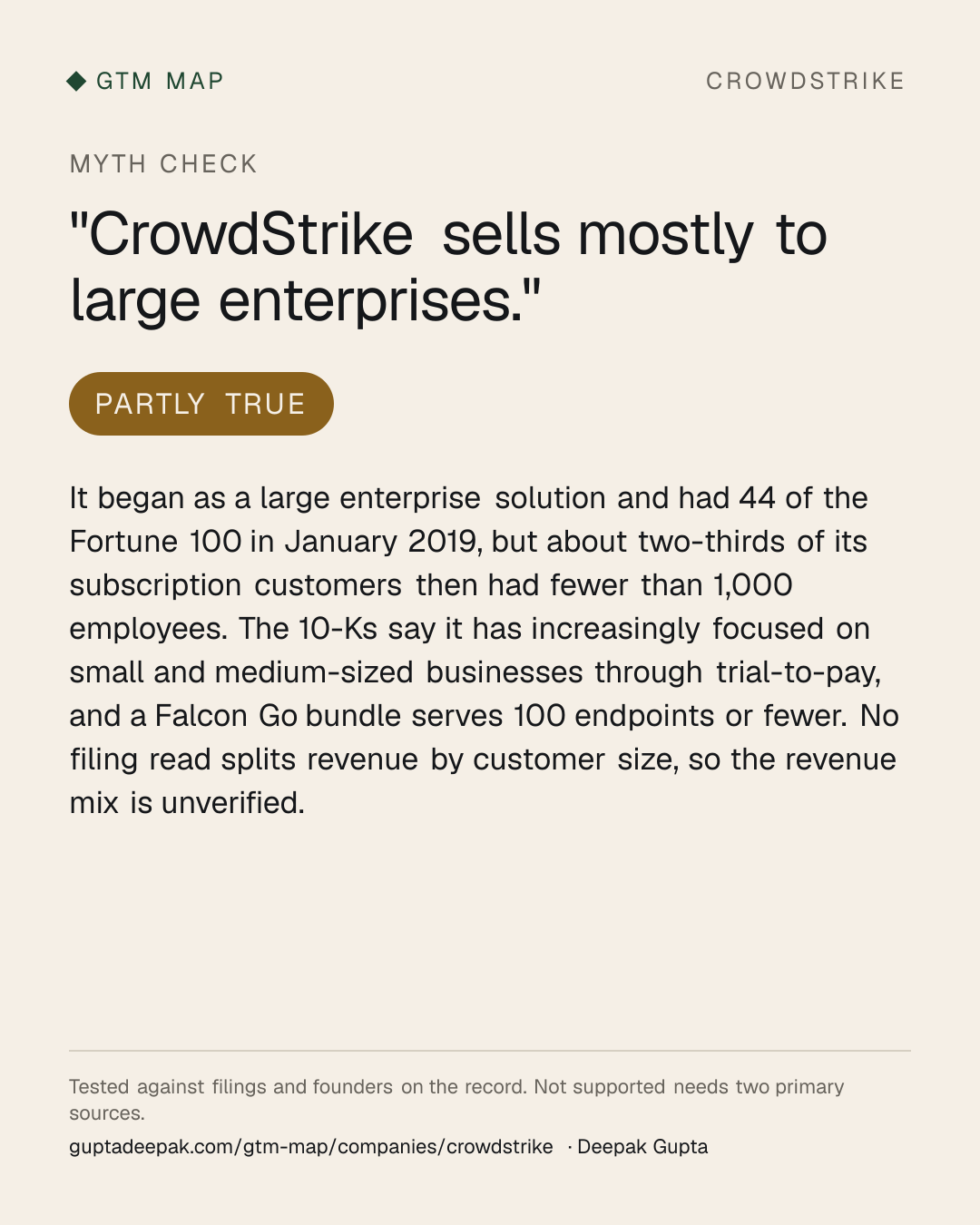
“CrowdStrike sells mostly to large enterprises.”
Partly trueIt began as a large enterprise solution and had 44 of the Fortune 100 in January 2019, but about two-thirds of its subscription customers then had fewer than 1,000 employees. The 10-Ks say it has increasingly focused on small and medium-sized businesses through trial-to-pay, and a Falcon Go bundle serves 100 endpoints or fewer. No filing read splits revenue by customer size, so the revenue mix is unverified.[1],[3],[6],[9]
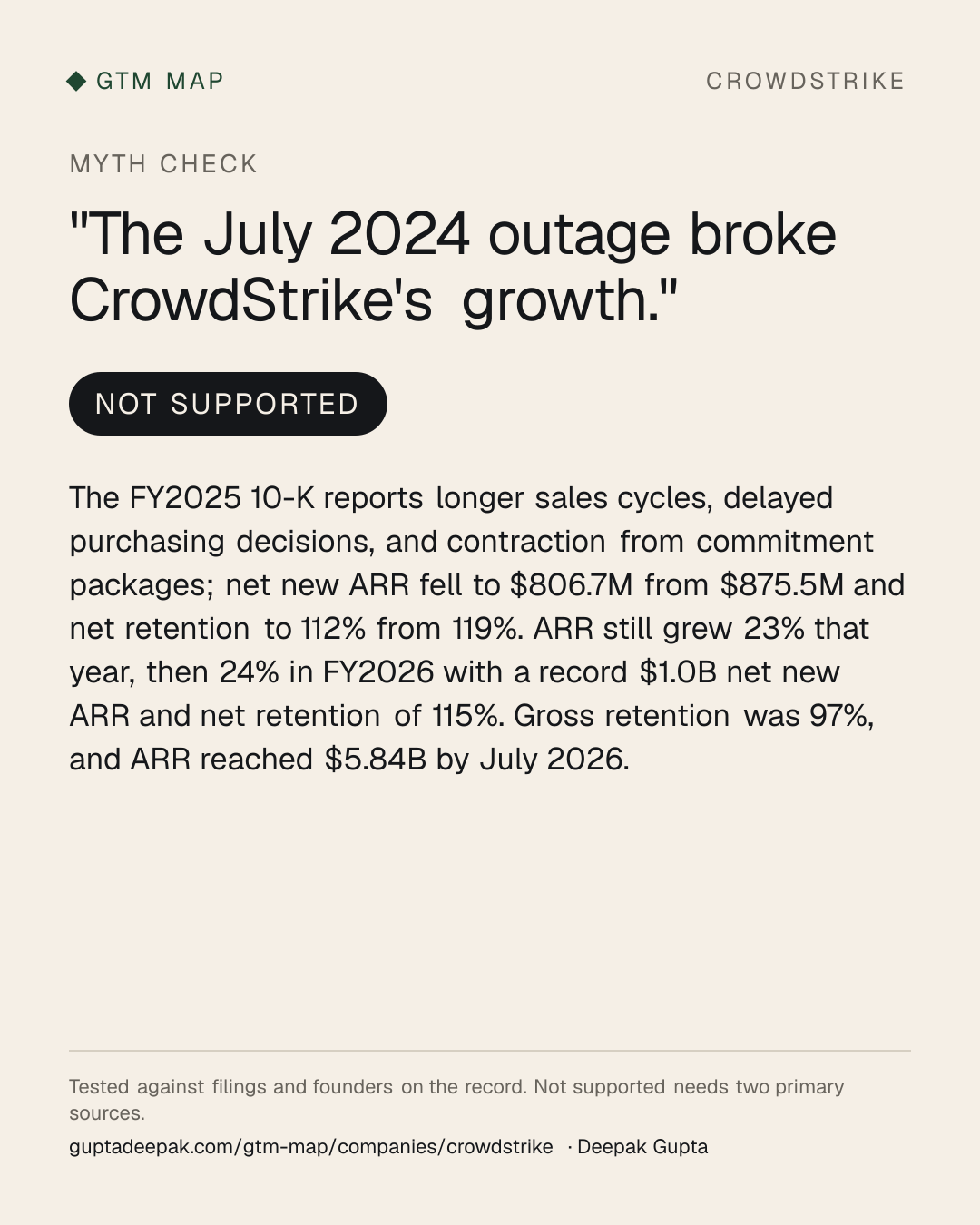
“The July 2024 outage broke CrowdStrike's growth.”
Not supportedThe FY2025 10-K reports longer sales cycles, delayed purchasing decisions, and contraction from commitment packages; net new ARR fell to $806.7M from $875.5M and net retention to 112% from 119%. ARR still grew 23% that year, then 24% in FY2026 with a record $1.0B net new ARR and net retention of 115%. Gross retention was 97%, and ARR reached $5.84B by July 2026.[5],[6],[12],[15]
On the record
“There's no way that you're going to get to the revenue scale that we're at without having, No. 1, a great reseller channel.”
George Kurtz, Co-founder and CEO, CrowdStrike[17]
Section "Partnerships are Key", quoting his POD 2112 podcast answers
“Every enterprise will run on AI, and securing it is the largest market opportunity in our history.”
George Kurtz, Co-founder and CEO, CrowdStrike[15]
Q2 FY2027 earnings release
“We view our professional services business primarily as an opportunity to cross-sell subscriptions to our Falcon platform and cloud modules.”
CrowdStrike, S-1 registration statement[1]
MD&A, "Our Go-To-Market Strategy"
04What other companies can take from it
Sell the adversary, not the product category.
Works when: The buyer faces an intelligent opponent (security, fraud, compliance enforcement) and your telemetry or services work lets you see that opponent before others do.
Backfires when: There is no human adversary to name, or you cannot back the narrative with original research, so it reads as fear marketing with no proof.
Based on: Intelligence, incident response, then one EDR product, Brand narrative; Platform scale and module depth, Brand narrative
One agent, many modules: make the second purchase a switch, not a deployment.
Works when: The expensive step for the buyer is deployment, and additional products can share the same footprint, data, and console.
Backfires when: Each new product needs its own install, integration, or buyer, so platform pricing is just bundling.
Based on: Modules, trial-to-pay, marketplace and channel, Land and expand; Platform scale and module depth, Land and expand
Use paid services as the front door for an enterprise subscription.
Works when: There is an urgent, high-trust moment (a breach, an audit, a migration) where the vendor's people are in the customer's environment.
Backfires when: Services become a margin business of their own, or services staff are rewarded for billable hours rather than subscription conversion.
Based on: Modules, trial-to-pay, marketplace and channel, Sales-led; After the July 2024 incident: Flex and partner-first, Sales-led
Recover from a trust failure by trading price for depth.
Works when: The product is deeply deployed and switching is costly, so a concession that adds modules locks in more surface area than it gives away.
Backfires when: The product is easy to replace, or the concessions are cash refunds that add nothing to the footprint.
Based on: After the July 2024 incident: Flex and partner-first, Land and expand
05 · GTM Now
What changes in the AI era, and what to do now
Analysis by Deepak Gupta. This is opinion built on the sourced record above, not part of it.[15],[14],[22]
Still works
- Named adversaries and original threat research. Analysis: AI answers lean on named, citable entities and primary data, so the vendor that names the actor owns the term people and AI systems repeat.
- The single-agent module model. The latest releases tie new AI security products to the same Falcon platform and Flex commitments.
Breaks
- Analysis: inbound demand built on search engine marketing and content syndication is weaker when AI answers replace clicks. The company does not say this.
- Analysis: per-module pricing is under pressure when AI agents do work that once justified a separate module, and Flex's swap-anytime design partly hedges that. The company does not say this.
What replaces it
- Commitment-based platform licensing through Falcon Flex, plus marketplace purchase against pre-committed cloud spend such as a Microsoft Azure Consumption Commitment, in place of the module-by-module upsell conversation.
- Securing AI as the new narrative: Kurtz calls it the largest market opportunity in the company's history. Analysis: the shift in narrative is sourced, its effect on pipeline is not.
Apply it now
If you are
A Series A to C security or risk product selling to mid-market and enterprise buyers at $25K to $250K ACV, with an agent, connector, or data pipeline in the customer's environment
- Publish original research that names the threats you see, with a consistent naming scheme, so journalists and AI answers cite you by default.
- Offer a fast, credit-card-free trial of one module, and route trials from larger domains to sales within the trial window.
- Design every later product to turn on from the existing footprint, with no new install.
- Package your services team (incident response, audits, migrations) as an entry offer that ends in a subscription proposal.
- List on the cloud marketplaces your buyers already commit spend to, before you build a large reseller program.
You will know it works when: Net dollar retention above 120% driven by module count, and the share of new logos that started as a trial, a services engagement, or a marketplace purchase.
Based on CrowdStrike's Intelligence, incident response, then one EDR product, Modules, trial-to-pay, marketplace and channel, Modules, trial-to-pay, marketplace and channel, After the July 2024 incident: Flex and partner-first, Modules, trial-to-pay, marketplace and channel
If you are
A later-stage multi-product company where customers stall at two or three products and every expansion needs a new procurement cycle
- Introduce a pre-committed, draw-down licence that covers the full portfolio and lets customers swap products, as Falcon Flex does.
- Report the share of customers above product-count thresholds every quarter, and move the threshold up as adoption rises.
- Put partners and MSSPs in the primary plan for new logos, not just fulfilment.
- If a quality incident hits, make concessions in extra products and term length rather than cash, and say publicly what it costs.
You will know it works when: ARR from accounts on the commitment licence and its growth rate, plus gross retention above 95% through any incident.
Based on CrowdStrike's Platform scale and module depth, After the July 2024 incident: Flex and partner-first, After the July 2024 incident: Flex and partner-first
Motions in this record
Compare with every other company on the GTM matrix.
Share the visuals
Every card is drawn from the sourced record above and sized 1080 by 1350 for LinkedIn and X. Free to share with a link back to this page.
Sources
- [1]SEC filingCrowdStrike Holdings Form S-1 (May 14, 2019)
- [2]SEC filingForm 10-K, fiscal year ended January 31, 2020 (March 23, 2020)
- [3]SEC filingForm 10-K, fiscal year ended January 31, 2022 (March 16, 2022)
- [4]SEC filingForm 10-K, fiscal year ended January 31, 2024 (March 7, 2024)
- [5]SEC filingForm 10-K, fiscal year ended January 31, 2025 (March 10, 2025)
- [6]SEC filingForm 10-K, fiscal year ended January 31, 2026 (March 5, 2026)
- [7]EarningsCrowdStrike Q4 and fiscal 2020 results (8-K exhibit) (March 19, 2020)
- [8]EarningsCrowdStrike Q4 and fiscal 2022 results (8-K exhibit) (March 9, 2022)
- [9]EarningsCrowdStrike Q4 and fiscal 2024 results (8-K exhibit) (March 5, 2024)
- [10]EarningsCrowdStrike Q2 fiscal 2025 results (8-K exhibit) (August 28, 2024)
- [11]EarningsCrowdStrike Q3 fiscal 2025 results (8-K exhibit) (November 26, 2024)
- [12]EarningsCrowdStrike Q4 and fiscal 2025 results (8-K exhibit) (March 4, 2025)
- [13]EarningsCrowdStrike Q3 fiscal 2026 results (8-K exhibit) (December 2, 2025)
- [14]EarningsCrowdStrike Q4 and fiscal 2026 results (8-K exhibit) (March 3, 2026)
- [15]EarningsCrowdStrike Q2 fiscal 2027 results (8-K exhibit) (August 26, 2026)
- [16]CompanyNaming Adversaries and Why It Matters to Your Security Team (May 31, 2022)
- [17]CompanyPodcast Features George Kurtz on What it Takes to Build a Unicorn (September 17, 2018)
- [18]CompanyCrowdStrike Announces Agenda and Sponsors for its Second Annual User Conference "Fal.Con POWER UP 2018" (September 5, 2018)
- [19]CompanyCrowdStrike Unveils New Data Protection, Exposure Management and IT Automation Innovations to Drive Platform Consolidation (September 19, 2023)
- [20]CompanyCrowdStrike's Premier Fal.Con Conference Expands to Europe (October 30, 2024)
- [21]CompanyCrowdStrike Launches Flex for Services (March 24, 2026)
- [22]CompanyCrowdStrike Falcon Flex (pricing page) (October 18, 2026)
- [23]CompanyCrowdStrike Falcon Free Trial (October 18, 2026)
Every phase, motion, and myth verdict cites a filing, the company's own pages, or a founder speaking on the record. See the methodology.