
Developer and enterprise · public
How Cloudflare went to market
Cloudflare gave away a stripped-down firewall in the cloud so it could work up to banks and governments, then layered inside, field and channel sales on top of self-serve. Free sites fed threat data and brand, yearly Birthday Week launches moved paid features into the free plan, and Workers turned the network into a developer platform.
- Buyer:
- Developers, Small business, Mid-market, Enterprise
- Contract size:
- Mixed
- Checked:
- October 18, 2026
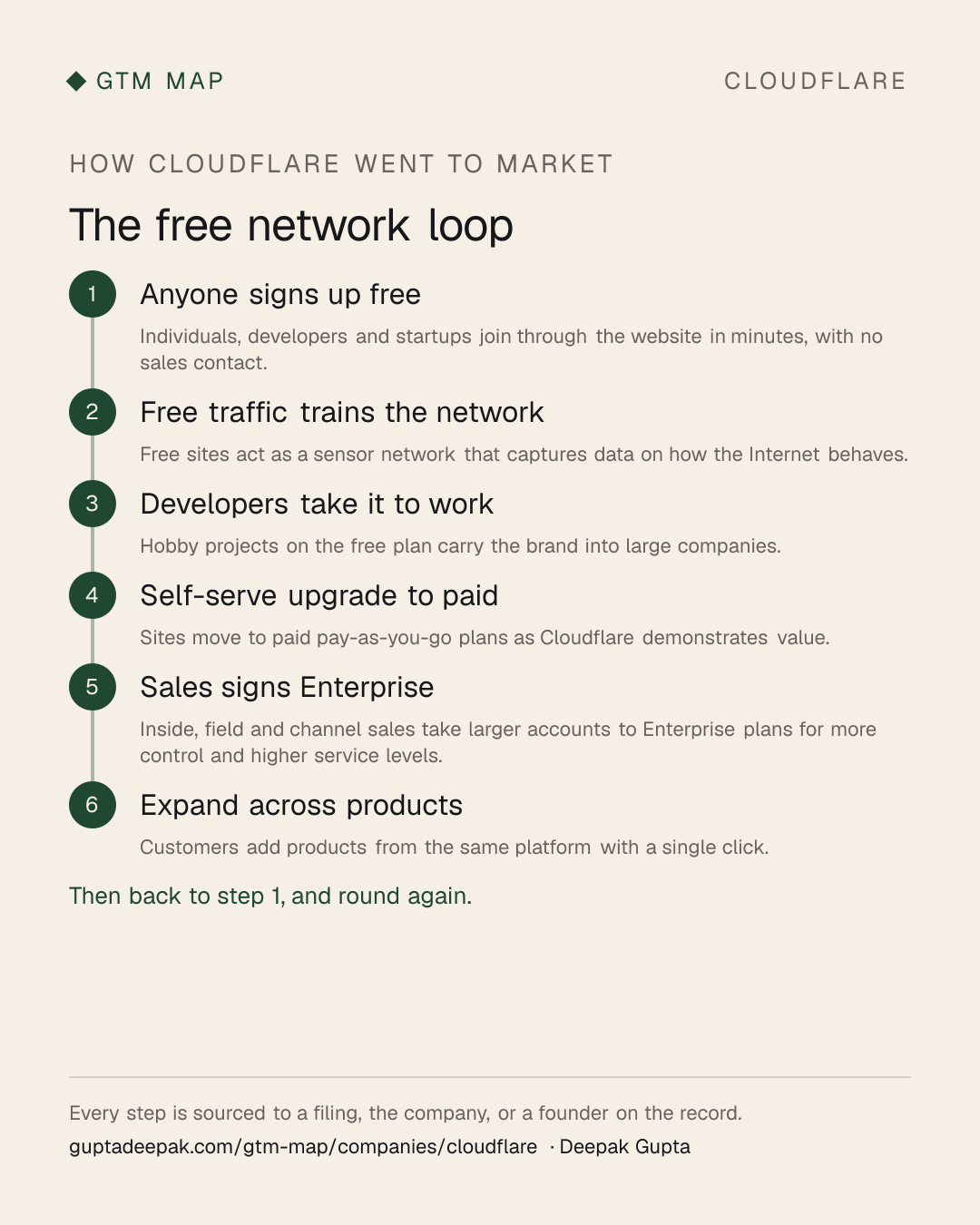
Anyone signs up free
Individuals, developers and startups join through the website in minutes, with no sales contact.[1]
Free traffic trains the network
Free sites act as a sensor network that captures data on how the Internet behaves.[1]
Developers take it to work
Hobby projects on the free plan carry the brand into large companies.[1]
Self-serve upgrade to paid
Sites move to paid pay-as-you-go plans as Cloudflare demonstrates value.[2]
Sales signs Enterprise
Inside, field and channel sales take larger accounts to Enterprise plans for more control and higher service levels.[5]
Expand across products
Customers add products from the same platform with a single click.[1]
Back to step 1, and round again
01The phases
PrimarySupportingTried, then dropped
2009 to 2013
Free firewall in the cloud, start small
Cloudflare launched at TechCrunch Disrupt in 2010 with a free, limited service, planning from the start to move up market to large enterprises.
- Product-led
A stripped-down free plan, signed up for in minutes, was the deliberate entry point. The S-1 ranks converting free users as secondary, to a lesser extent than upgrading paying ones: the free base's first jobs are threat data, product testing, leverage with ISPs and brand, and its bandwidth is booked as a sales and marketing cost. Net retention even excludes free-to-paid upgrades.[18],[1],[5]
- Brand narrative
Prince framed the free plan as the way to earn the right to sell to JP Morgan, governments and hospital groups, and the S-1 calls the free base a vast sensor network on the Internet.[18],[1]
- Product-led
2014 to 2017
Giveaway launches, Birthday Week and the blog
From 2014, Cloudflare began moving headline paid capabilities into the free plan and announcing them in a September launch week on its blog.
- Brand narrative
Each Birthday Week ships features into the free plan: SSL for 2 million free sites in 2014, accepted by the board despite the short-term revenue risk, and unmetered DDoS mitigation on every plan in 2017. Project Galileo has protected at-risk groups for free since 2014.[9],[10],[15],[5]
- Product-led
Higher plans keep the paid reasons to upgrade, such as reporting, tools, support and legacy browser SSL, while the free plan absorbs the headline capability.[10],[9]
- Inbound content
The blog is the launch channel for every Birthday Week item. Filings name it as a way to build brand with developers and as a channel for material investor information.[2],[8],[14]
- Brand narrative
2016 to 2019
Enterprise sales layered on self-serve
Sales teams were added on top of self-serve to serve larger customers, and by the 2019 IPO most revenue came from Enterprise plan customers they acquired.
- Sales-led
Inside and field sales sell the Enterprise plan, and a majority of 2018 revenue came from customers they acquired. Customers with Annualized Billings over $100,000 grew from 95 at the end of 2016 to 408 by mid-2019.[1]
- Product-led
Self-serve plans kept acquiring paying customers quickly and at much lower acquisition cost, with sales added for larger customers and annual-contract sales cycles under one quarter.[1]
- Land and expand
Customers start with part of their network needs and add products with one click. Over 70% of enterprise customers used four or more products, and net retention stayed above 110% for eight quarters.[1]
- Partner channel
Pay-as-you-go plans are also sold through hosting partners, and the Enterprise plan through channel partners.[2],[1]
- Paid acquisition
Digital performance marketing began in 2017, alongside brand awareness advertising and third-party industry events.[1]
- Developer-led
The S-1 says developers at large companies use the free plan for hobby projects and then take Cloudflare to work, which it says lowers acquisition cost.[1]
- Sales-led
2017 to 2024
Developer platform on the network
Workers, announced in Birthday Week 2017, made the network programmable and grew into a product line for compute, storage and later AI.
- Developer-led
Workers let developers run JavaScript on Cloudflare's servers, launched as a paid add-on in 2018, and opened what the S-1 calls an entirely new market in compute and storage. Prince says the company built it because it needed it itself.[11],[12],[1],[18]
- Usage pricing
Workers moved to CPU-time billing in 2023 while keeping a free plan. Enterprise contracts generally combine a base subscription with a smaller usage-based portion.[13],[1]
- Brand narrative
Birthday Week stayed the launch vehicle for developer products, from Workers in 2017 to R2 with zero egress fees in 2021 and Workers AI in 2023.[15]
- Land and expand
Dollar-based net retention rose to 125% at the end of 2021, then eased to 115% at the end of 2023.[3],[4]
- Developer-led
2025 to now
Contracted customers, channel and agents
Contracted customers won by sales now produce a substantial majority of revenue, while the narrative moves to answer engines, AI crawlers and agents.
- Sales-led
A substantial majority of 2025 revenue came from contracted customers acquired by inside and field sales. Q4 2025 brought the largest contract ever, averaging $42.5M a year, and new ACV grew nearly 50%.[5],[6]
- Brand narrative
The founders' letter says answer engines are the Internet's next discovery system, and Prince positions Cloudflare as the platform agents run on and the network they pass through.[16],[6],[7]
- Partner channel
The channel now spans managed service providers, resellers, distributors and global system integrators, plus hosting partners for self-serve.[5]
- Product-led
Pay-as-you-go customers onboard without sales and some upgrade to Enterprise. The 10-K still names the free offering as the source of organic awareness for millions of users.[5]
- Usage pricing
Pay per crawl, in private beta, charges AI crawlers per request, with Cloudflare acting as merchant of record.[17]
- Developer-led
Prince reports developers on the platform alongside paying and large customers as a growth headline, without giving a developer count.[7]
- Land and expand
Dollar-based net retention reaccelerated to 120% at the end of 2025, from 111% a year earlier.[5]
- Sales-led
02The numbers
Show the data
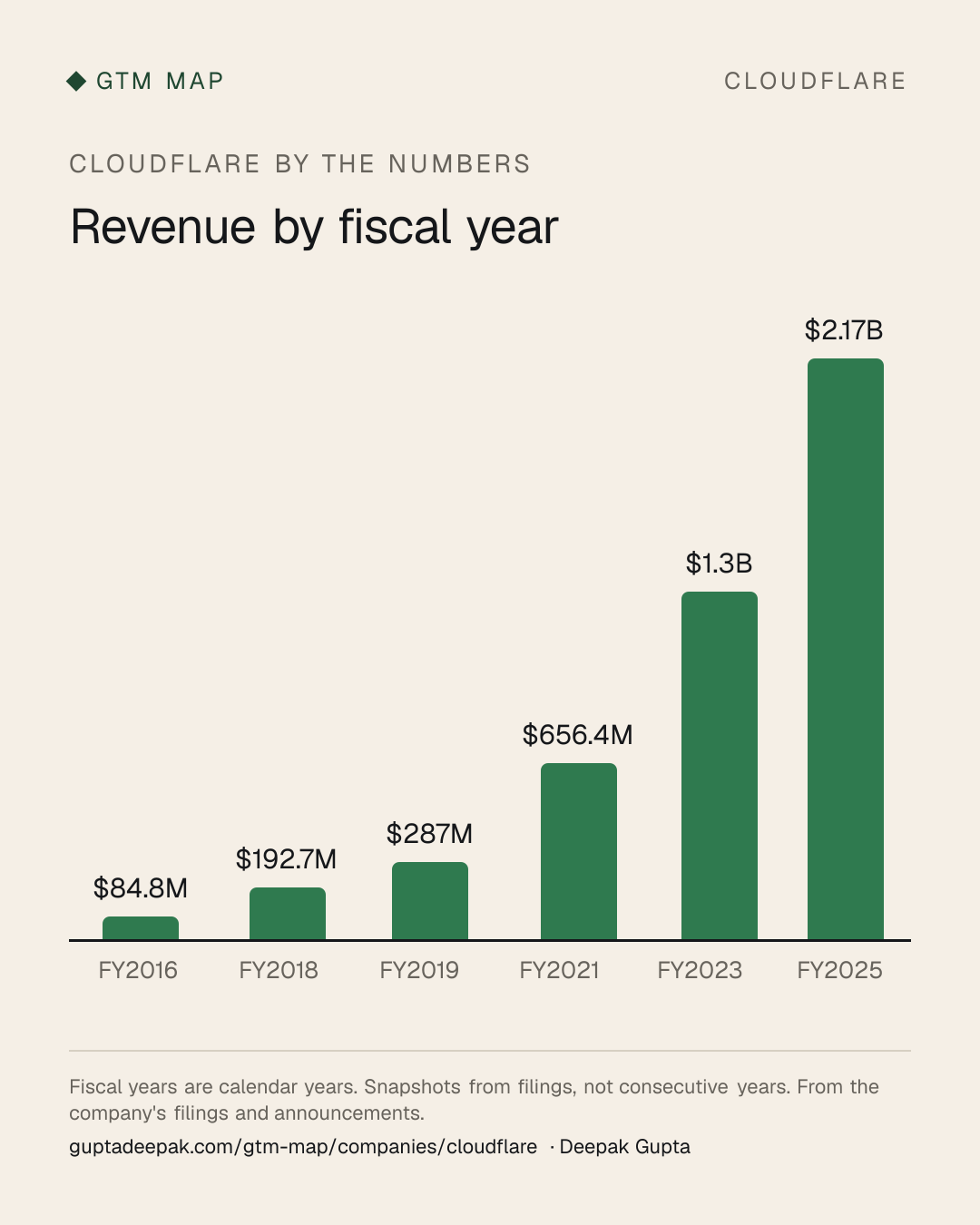
| FY2016 | $84.8M | From a filing |
|---|---|---|
| FY2018 | $192.7M | From a filing |
| FY2019 | $287M | From a filing |
| FY2021 | $656.4M | From a filing |
| FY2023 | $1.3B | From a filing |
| FY2025 | $2.17B | From a filing |
Show the data
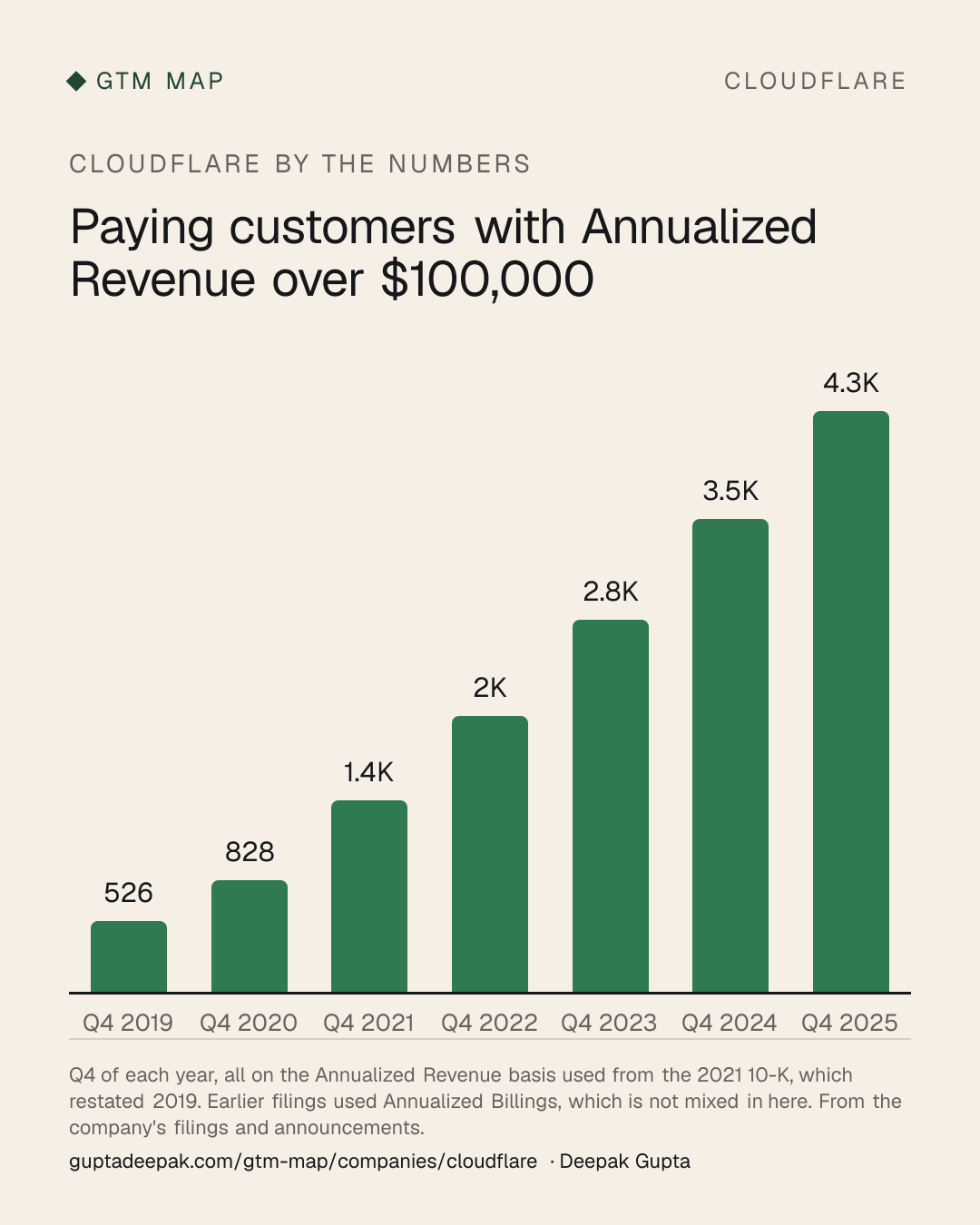
| Q4 2019 | 526 | From a filing |
|---|---|---|
| Q4 2020 | 828 | From a filing |
| Q4 2021 | 1.4K | From a filing |
| Q4 2022 | 2K | From a filing |
| Q4 2023 | 2.8K | From a filing |
| Q4 2024 | 3.5K | From a filing |
| Q4 2025 | 4.3K | From a filing |
| Metric | Value | As of | Basis |
|---|---|---|---|
| Revenue, 2018 | $192.7M, up 43%[1] | December 31, 2018 | From a filing |
| Sales and marketing as a share of revenue, 2016 to 2018 | About 47%, 46%, 49% (derived)[1] | December 31, 2018 | From a filing |
| Paying customers, mid-2019 | 74,873[1] | June 30, 2019 | From a filing |
| Free and paying customers at IPO | 2 million, managing over 20M Internet properties[1] | August 15, 2019 | Company-stated |
| Fortune 1,000 companies that pay Cloudflare | About 10%[1] | August 15, 2019 | Company-stated |
| Enterprise customers using four or more products | Over 70%[1] | August 15, 2019 | Company-stated |
| Free plan sites when Universal SSL launched | 2 million[9] | September 29, 2014 | Company-stated |
| Revenue, 2025 | $2.17B, up 30%[5] | December 31, 2025 | From a filing |
| Paying customers, Q4 2025 | 332,466, up 40%[5] | December 31, 2025 | From a filing |
| Dollar-based net retention, Q4 2025 | 120%[5] | December 31, 2025 | From a filing |
| Sales and marketing, 2025 | $920.8M, about 42% of revenue (derived)[5] | December 31, 2025 | From a filing |
| International share of revenue, 2025 | 51%[5] | December 31, 2025 | From a filing |
| Largest contract ever (Q4 2025) | Averaging $42.5M a year[6] | December 31, 2025 | Company-stated |
| Revenue, Q2 2026 | $696.1M, up 36%[7] | June 30, 2026 | From a filing |
“Reported” figures come from trade press, not the company, and are shown with their date.
03Myth checks
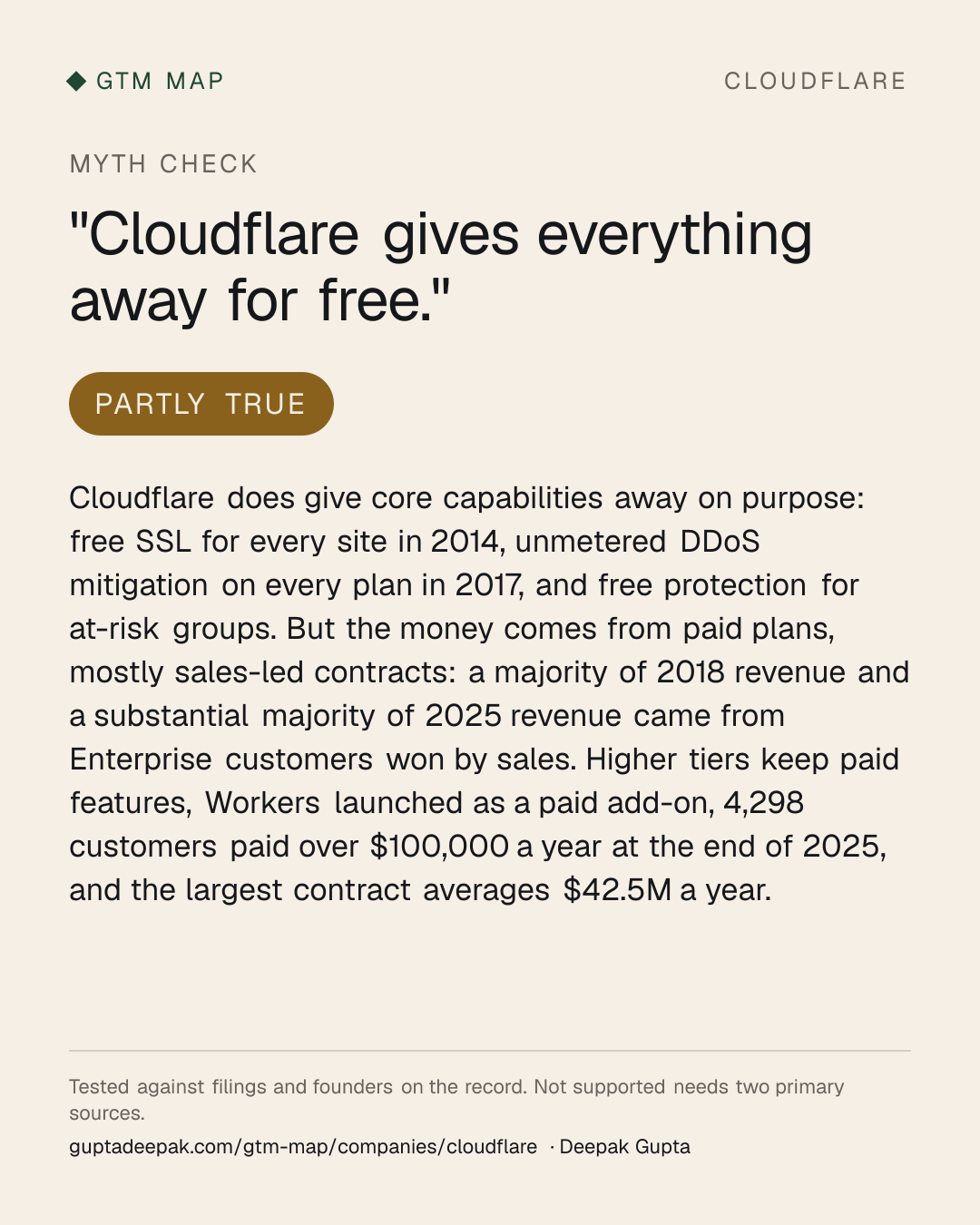
“Cloudflare gives everything away for free.”
Partly trueCloudflare does give core capabilities away on purpose: free SSL for every site in 2014, unmetered DDoS mitigation on every plan in 2017, and free protection for at-risk groups. But the money comes from paid plans, mostly sales-led contracts: a majority of 2018 revenue and a substantial majority of 2025 revenue came from Enterprise customers won by sales. Higher tiers keep paid features, Workers launched as a paid add-on, 4,298 customers paid over $100,000 a year at the end of 2025, and the largest contract averages $42.5M a year.[9],[10],[1],[5],[12],[6]
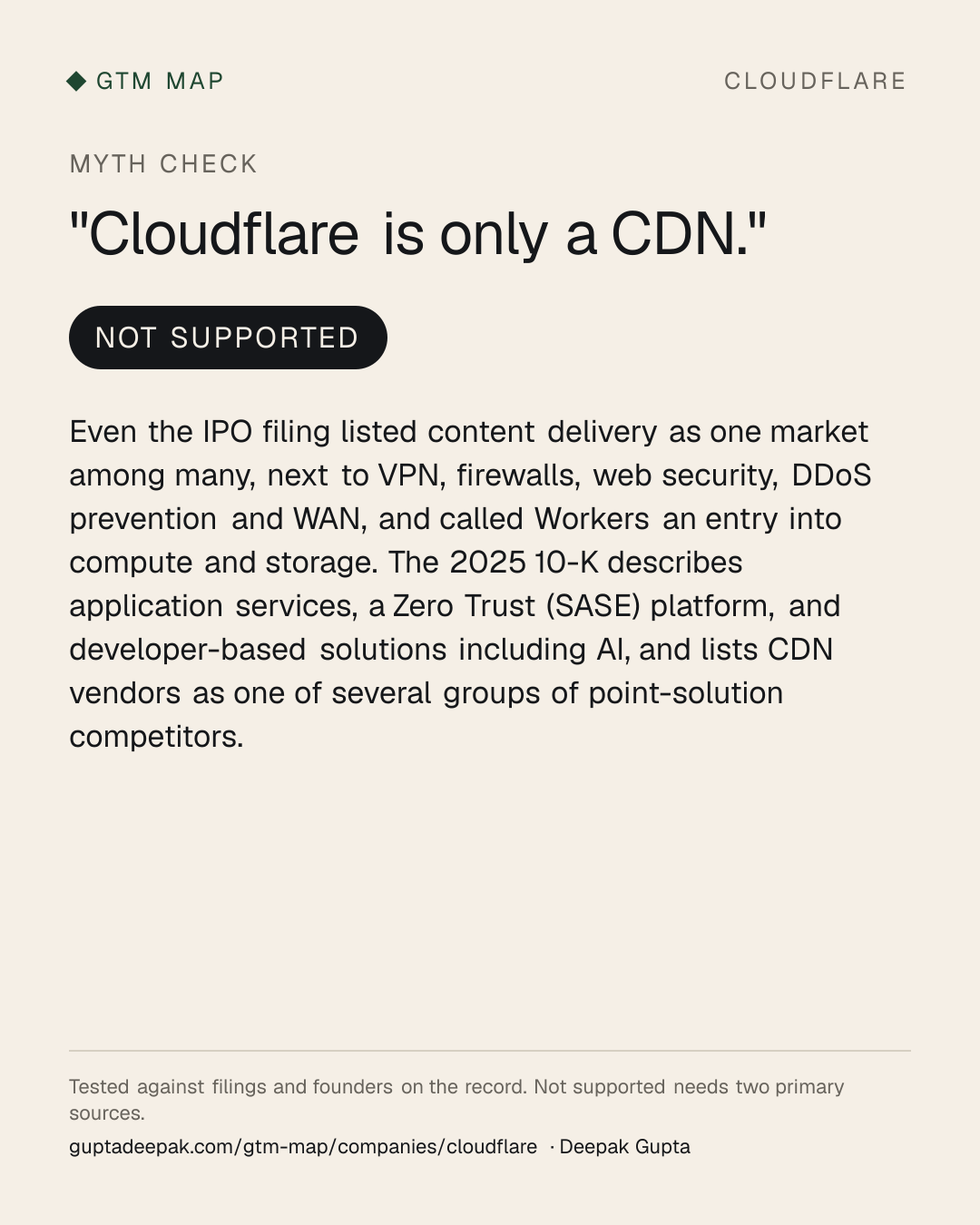
“Cloudflare is only a CDN.”
Not supportedEven the IPO filing listed content delivery as one market among many, next to VPN, firewalls, web security, DDoS prevention and WAN, and called Workers an entry into compute and storage. The 2025 10-K describes application services, a Zero Trust (SASE) platform, and developer-based solutions including AI, and lists CDN vendors as one of several groups of point-solution competitors.[1],[5]
On the record
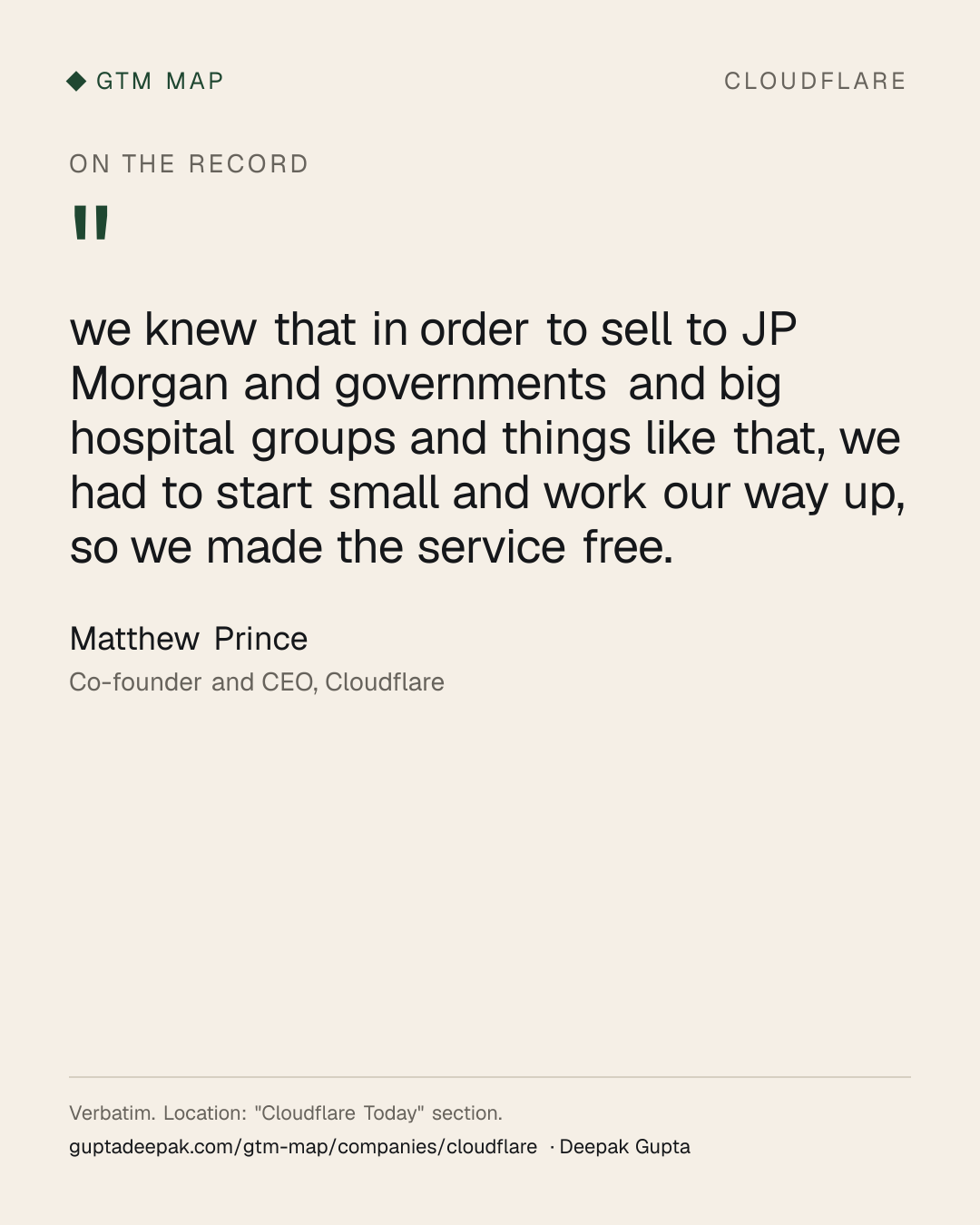
“we knew that in order to sell to JP Morgan and governments and big hospital groups and things like that, we had to start small and work our way up, so we made the service free.”
Matthew Prince, Co-founder and CEO, Cloudflare[18]
"Cloudflare Today" section
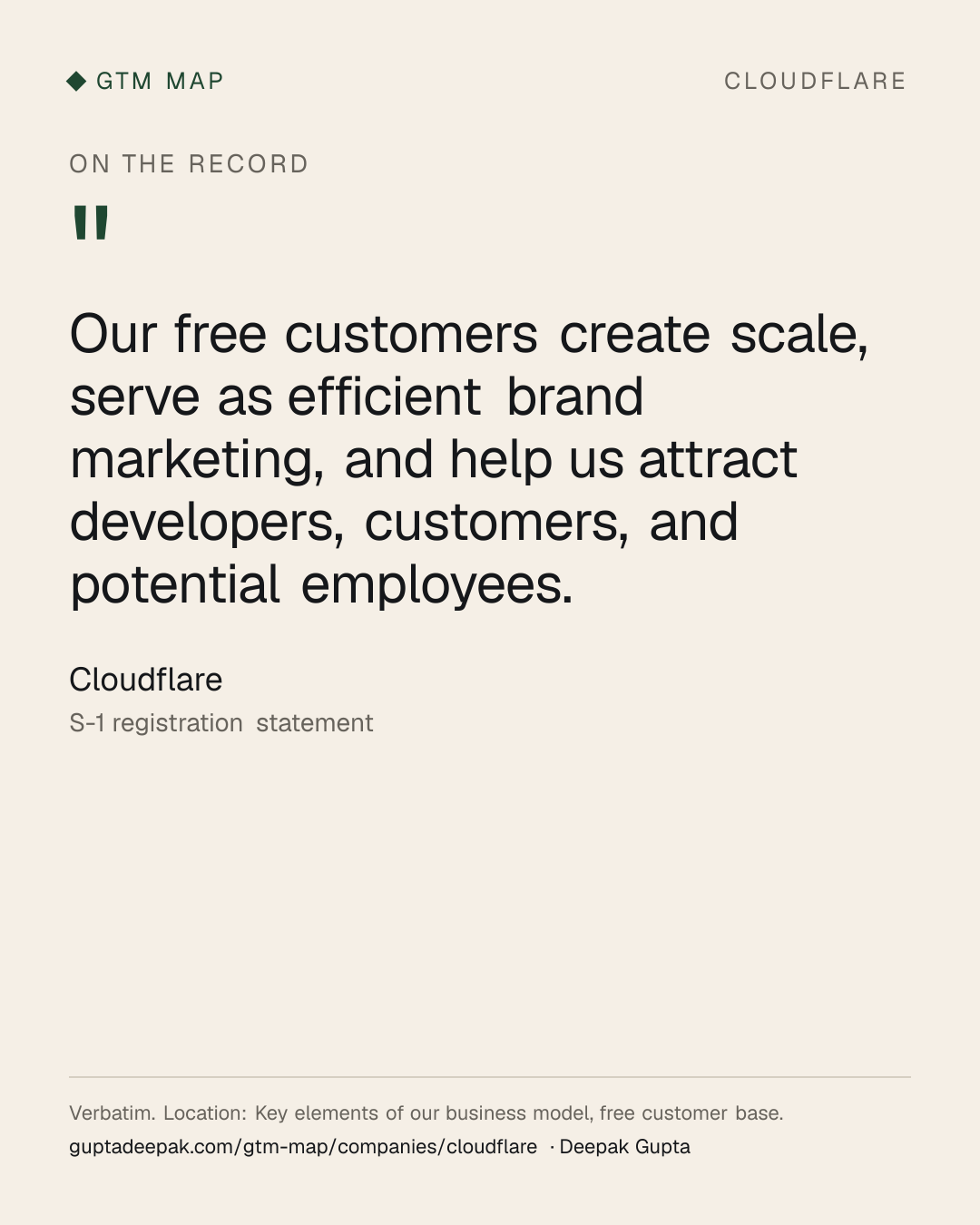
“Our free customers create scale, serve as efficient brand marketing, and help us attract developers, customers, and potential employees.”
Cloudflare, S-1 registration statement[1]
Key elements of our business model, free customer base
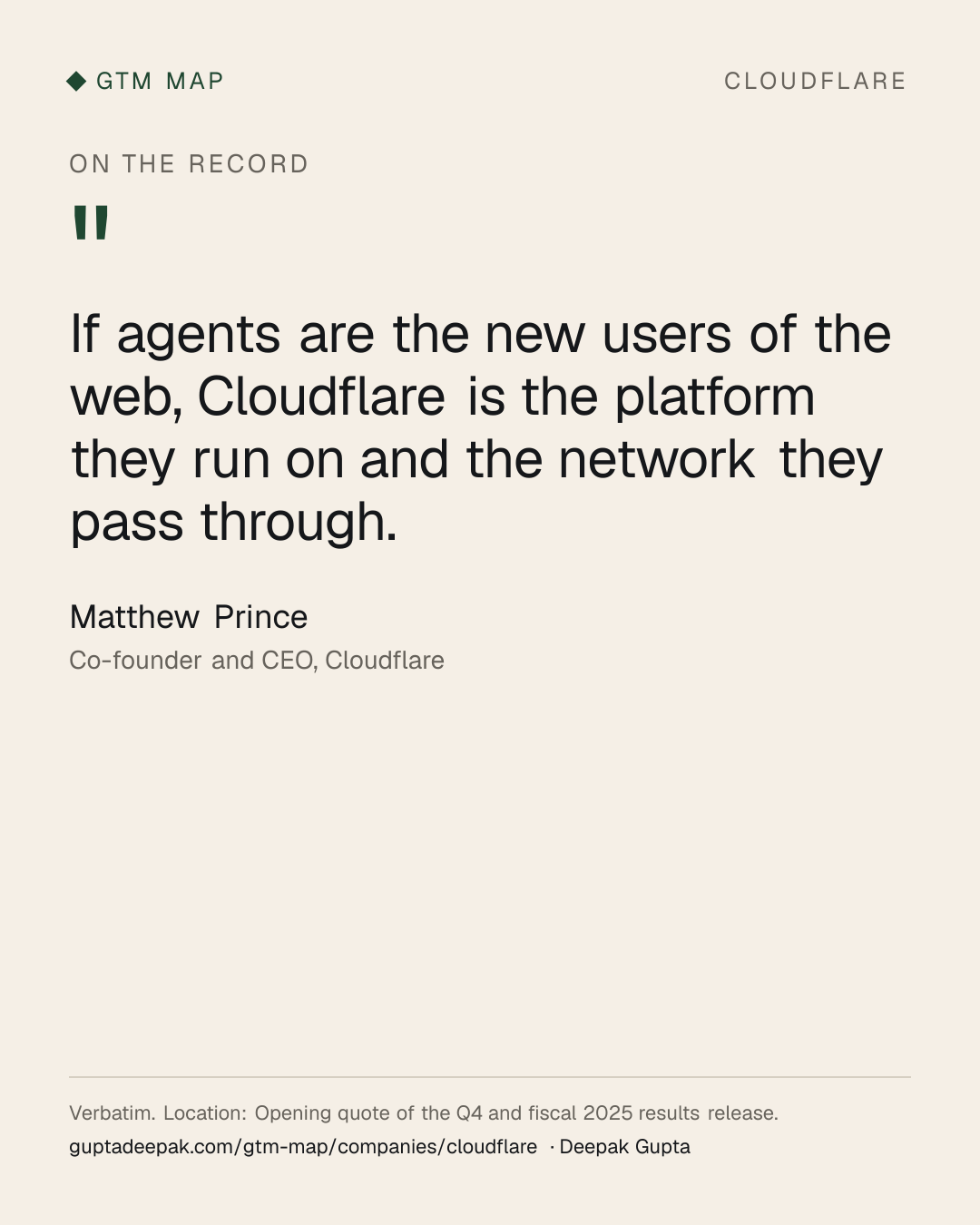
“If agents are the new users of the web, Cloudflare is the platform they run on and the network they pass through.”
Matthew Prince, Co-founder and CEO, Cloudflare[6]
Opening quote of the Q4 and fiscal 2025 results release
04What other companies can take from it
Give the free tier a job that pays you even if nobody converts.
Works when: Each free user costs close to nothing because it rides idle capacity, and free usage makes the product better for paying customers through more threat data, more testing, or better supplier terms.
Backfires when: Each free user carries real variable cost, such as GPU inference or human support, or free usage teaches you nothing paying customers value, so the free tier is pure subsidy.
Based on: Free firewall in the cloud, start small, Product-led; Enterprise sales layered on self-serve, Developer-led
Start stripped down and free, then layer enterprise sales once the product can win big accounts.
Works when: The same product serves a hobbyist and a bank with configuration differences only, and self-serve usage shows which accounts are large.
Backfires when: Enterprise buyers need a different product, for compliance or deployment reasons, so the free base never feeds the sales motion.
Based on: Free firewall in the cloud, start small, Product-led; Enterprise sales layered on self-serve, Sales-led
Turn giveaways into news with a fixed annual launch week.
Works when: You ship often enough to fill a week and your audience reads a technical blog.
Backfires when: The launches are minor, or the giveaway removes the main reason customers pay and leaves no higher-tier feature to sell.
Based on: Giveaway launches, Birthday Week and the blog, Brand narrative; Giveaway launches, Birthday Week and the blog, Inbound content
Build the platform you need, then sell it to the developers already on your network.
Works when: You already run infrastructure close to users and your customers' developers already use your dashboard.
Backfires when: The new product needs a different buyer and sales motion from the existing base, so the installed base gives no head start.
Based on: Developer platform on the network, Developer-led; Contracted customers, channel and agents, Developer-led
05 · GTM Now
What changes in the AI era, and what to do now
Analysis by Deepak Gupta. This is opinion built on the sourced record above, not part of it.[5],[16],[17],[6]
Still works
- A free tier that sits in the traffic path still pays off, now as visibility into AI crawlers and agents: the 2025 10-K lists tools to identify, block and control AI crawlers and agents.
- Self-serve plus sales routing. Paying customers grew 40% in 2025 while contracted customers still produced most revenue.
Breaks
- Blog-led awareness depends on clicks, and Cloudflare's own founders' letter says answer engines have already cut traffic to media sites dramatically.
- A free tier gets more expensive when free usage means GPU inference rather than idle bandwidth. Cost of revenue rose 46% in 2025 and gross margin fell from 77% to 75%; the filing gives several causes, so tying this to the free tier is analysis.
What replaces it
- Charge the machines: pay per crawl bills AI crawlers per request, and Workers is pitched as where agents run.
- Analysis: for other companies, the equivalent of free-tier brand reach is being the default tool an agent picks, which means docs and APIs an agent can use without a human.
Apply it now
If you are
A seed to Series B infrastructure or security product with near-zero marginal cost per free user, developer and SMB entry buyers, and enterprise deals of $100K a year and up
- Write down what the free tier does for you besides conversion, such as data, testing or supplier leverage, and instrument each one.
- Put the headline capability in the free plan but keep reporting, controls and support in paid tiers.
- Run one fixed launch week a year on your own blog, with each day shipping something free or cheaper.
- Add inside sales when self-serve accounts cross a usage threshold, and track $100K-plus customers as a headline metric.
You will know it works when: The count of $100K-plus customers whose first touch was a free or self-serve account, and net retention above 110% excluding free upgrades, the way Cloudflare defines it.
Based on Cloudflare's Free firewall in the cloud, start small, Giveaway launches, Birthday Week and the blog, Giveaway launches, Birthday Week and the blog, Enterprise sales layered on self-serve
If you are
A later-stage platform company whose inbound traffic is falling as answer engines and agents replace clicks
- Measure bot and agent traffic to your docs and product separately from human traffic.
- Make the product usable by agents directly through APIs, docs and usage-priced access.
- Price agent use per request or per unit of work rather than per seat.
- Keep a sales team for contracted customers, since that is still where most of Cloudflare's revenue comes from.
You will know it works when: The share of new paying accounts whose first activity came through an API or agent integration rather than a web visit.
Based on Cloudflare's Contracted customers, channel and agents, Contracted customers, channel and agents, Contracted customers, channel and agents
Motions in this record
Compare with every other company on the GTM matrix.
Share the visuals
Every card is drawn from the sourced record above and sized 1080 by 1350 for LinkedIn and X. Free to share with a link back to this page.
Sources
- [1]SEC filingCloudflare, Inc. Form S-1 Registration Statement (August 15, 2019)
- [2]SEC filingForm 10-K, fiscal year ended December 31, 2019 (March 4, 2020)
- [3]SEC filingForm 10-K, fiscal year ended December 31, 2021 (March 1, 2022)
- [4]SEC filingForm 10-K, fiscal year ended December 31, 2023 (February 21, 2024)
- [5]SEC filingForm 10-K, fiscal year ended December 31, 2025 (February 26, 2026)
- [6]EarningsCloudflare Announces Fourth Quarter and Fiscal Year 2025 Financial Results (8-K exhibit) (February 10, 2026)
- [7]EarningsCloudflare Announces Second Quarter 2026 Financial Results (8-K exhibit) (August 6, 2026)
- [8]SEC filingForm 8-K/A, Items 2.02, 2.05 and 7.01 (May 7, 2026)
- [9]CompanyIntroducing Universal SSL (Matthew Prince) (September 29, 2014)
- [10]CompanyUnmetered Mitigation: DDoS Protection Without Limits (Matthew Prince) (September 25, 2017)
- [11]CompanyIntroducing Cloudflare Workers: Run JavaScript Service Workers at the Edge (Kenton Varda) (September 29, 2017)
- [12]CompanyEveryone can now run JavaScript on Cloudflare with Workers (Kenton Varda) (March 13, 2018)
- [13]CompanyNew Workers pricing: never pay to wait on I/O again (Rita Kozlov and Brendan Irvine-Broque) (September 28, 2023)
- [14]CompanyWrapping up another Birthday Week celebration (September 30, 2024)
- [15]Company15 years of helping build a better Internet: A look back at Birthday Week 2025 (September 29, 2025)
- [16]CompanyCloudflare's 2025 Annual Founders' Letter (Matthew Prince and Michelle Zatlyn) (September 21, 2025)
- [17]CompanyIntroducing pay per crawl: Enabling content owners to charge AI crawlers for access (Will Allen and Simon Newton) (July 1, 2025)
- [18]Founder interviewAn Interview with Cloudflare Founder and CEO Matthew Prince About Internet History and Pay-per-crawl (Stratechery, transcript) (Matthew Prince, September 4, 2025, at answer on Clay Christensen's course, and answer under the "Cloudflare Today" section)
Every phase, motion, and myth verdict cites a filing, the company's own pages, or a founder speaking on the record. See the methodology.