
Developer and enterprise · public
How Datadog went to market
Datadog let developers and operations engineers install its monitoring agent in minutes on a free trial, then layered inside sales, an enterprise team, and customer success on top. Usage pricing and a growing product list drove net retention of 141% to 151% before the IPO, and the same pricing let customers optimize usage in 2023.
- Buyer:
- Developers, Small business, Mid-market, Enterprise
- Contract size:
- Mixed
- Checked:
- October 18, 2026
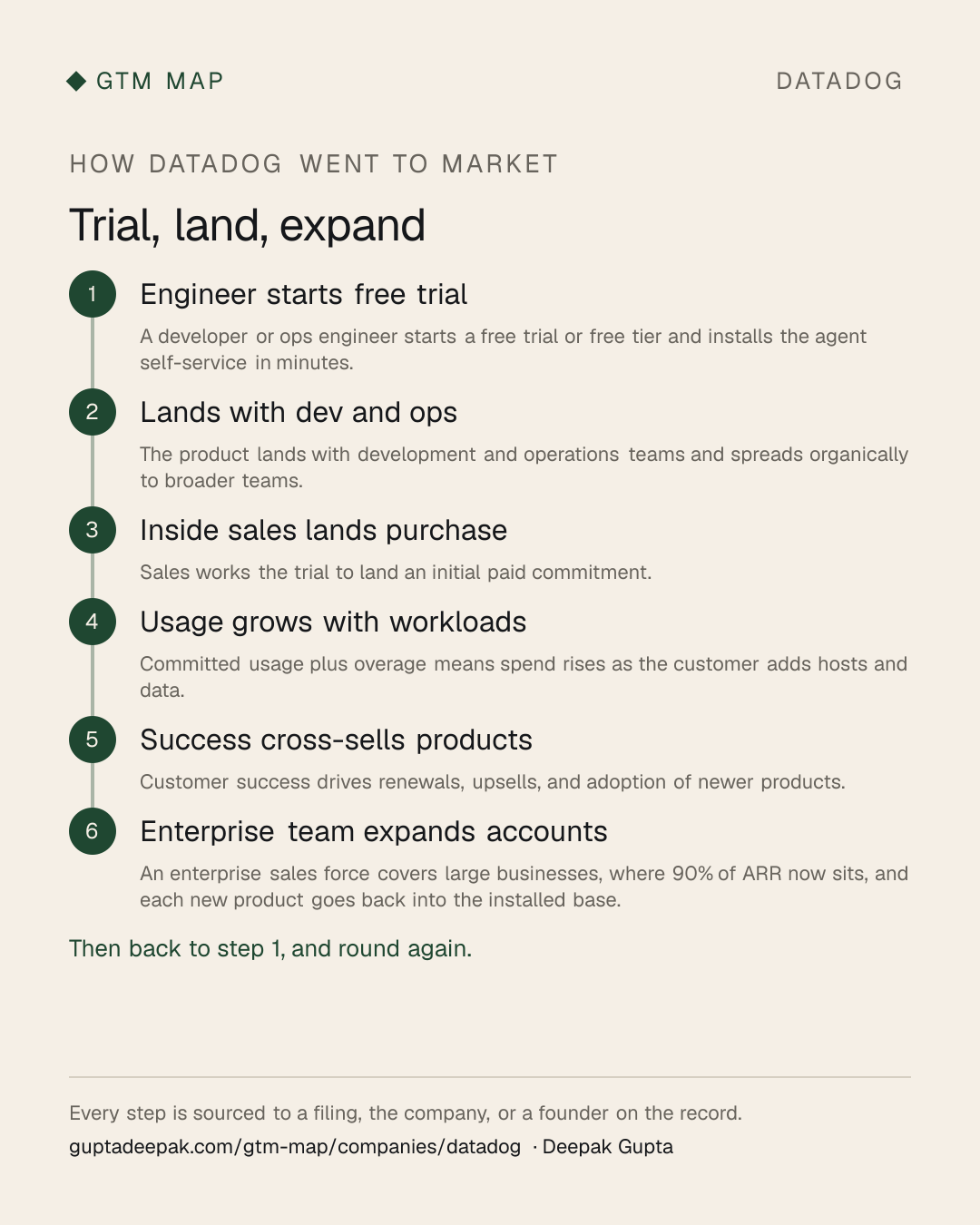
Engineer starts free trial
A developer or ops engineer starts a free trial or free tier and installs the agent self-service in minutes.[1]
Lands with dev and ops
The product lands with development and operations teams and spreads organically to broader teams.[1]
Inside sales lands purchase
Sales works the trial to land an initial paid commitment.[1]
Usage grows with workloads
Committed usage plus overage means spend rises as the customer adds hosts and data.[1]
Success cross-sells products
Customer success drives renewals, upsells, and adoption of newer products.[1]
Back to step 1, and round again
01The phases
PrimarySupportingTried, then dropped
2010 to 2015
Self-serve monitoring for DevOps teams
Datadog was founded in New York in 2010 and launched Infrastructure Monitoring in 2012. Engineers installed it themselves, and it passed 1,000 customers in 2015 before any enterprise sales team existed.
- Developer-led
Datadog was built to bring development and operations teams together. The S-1 says the product lands with development and IT operations teams first, then spreads organically to broader teams.[1],[10]
- Product-led
A hand-picked closed alpha gave weak signal, so Datadog opened a wide beta and let users self-select. The platform installs self-service within minutes and is offered through free trials and a free tier.[11],[1]
- Sales-assist
The first head of product also ran sales. Pomel says the first salesperson came only after a modest amount of ARR, with the team built bottom-up, and deals were sold month to month for a long time so churn showed up fast.[10],[11]
- Owned events
Datadog exhibited and gave demos at cloud conferences, with engineers running the demos, because companies migrating to the cloud go to events to learn. Its technical leaders also spoke at events such as DevOpsDays and AWS re:Invent.[11],[1]
- Community
The agent, integration plugins, SDKs, and documentation are open source, with developers from over 650 organizations contributing. This is community around the client software, not an open-source product funnel.[1]
- Developer-led
2016 to 2019
Inside sales, enterprise team, and multi-product expansion
Datadog set up an enterprise sales team in 2016, launched APM in 2017 and logs in 2018, opened a Dublin sales office, held its first DASH conference, and went public in September 2019.
- Land and expand
Customers land on one product and expand on a self-service basis. Net retention was 141% to 151%, and about 60% of new customers in the first half of 2019 landed with more than one product, up from about 15% a year earlier.[1],[2]
- Sales-assist
A self-service tier, a high velocity inside sales team, and an enterprise sales force worked as one model. Sales turns a trial into a first purchase, and customer success drives renewals, upsells, and cross-sells.[1]
- Usage pricing
Subscriptions commit to usage measured mainly by hosts or indexed data volume, and customers pay for usage above the commitment, so revenue grows as their cloud workloads grow.[1]
- Sales-led
An enterprise sales team sold to large businesses from 2016, and the sales and marketing organization had 474 people by June 2019.[1]
- Owned events
DASH, Datadog's own user conference, was first held in New York in 2018, alongside regional, national, and global events.[1]
- Partner channel
A partner team worked with resellers, distributors, and managed service providers.[1]
- Inbound content
Marketing reached the dev and ops community through content, email, events, digital advertising, social media, and community programs. The S-1 lists it as one tactic among many, not the main demand source.[1]
- Land and expand
2020 to 2022
Platform expansion and peak net retention
Datadog added security, database, and incident products from 2020. By the end of 2022, 81% of customers used more than one product and net retention stayed above 130%.
- Land and expand
Cloud SIEM, Incident Management, Cloud Security Posture Management, and Database Monitoring were among the 2020 and 2021 launches. About 81% of customers used more than one product at December 2022, and trailing net retention for that month was later restated as mid-140s.[3],[4],[5]
- Usage pricing
The usage commitment model held, and revenue concentrated in larger accounts: about 2,780 customers above $100,000 in ARR made up 85% of ARR at December 2022.[3]
- Partner channel
A Marketplace let customers buy products partners built on the Datadog platform, alongside resellers, system integrators, referral partners, and managed service providers.[3]
- Cloud marketplace
The filings name cloud-provider marketplaces as a sales route, a pricing factor, and a margin risk. They do not disclose how much revenue flows through them.[1],[3]
- Sales-led
The sales and marketing organization grew to about 2,300 people by December 2022.[3]
- Land and expand
2023 to now
Usage optimization, enterprise scale, and AI
Customers optimized usage in 2023 and trailing net retention fell to the mid-110s. Datadog kept adding products, including LLM Observability and the Bits AI SRE agent, and recovered to about 120% in 2025.
- Usage pricing
Usage pricing cut both ways. The FY2023 10-K blames the drop to mid-110s on slower usage growth from existing customers, and by 2025 an AI-native cohort that includes the largest customer added about seven points of Q4 revenue growth.[4],[5]
- Land and expand
At December 2025, about 55% of customers used four or more products, 18% eight or more, and 9% ten or more. Launches in 2024 and 2025 included LLM Observability, OnCall, Product Analytics, and Bits AI SRE.[5]
- Sales-led
About 4,310 customers above $100,000 in ARR made up 90% of ARR at December 2025, 603 customers were above $1 million, and the sales and marketing organization had about 3,600 people.[5]
- Cloud marketplace
A December 2025 collaboration agreement with AWS covers AWS Marketplace availability and joint go-to-market programs. The 10-K still lists marketplace pricing as a factor in results.[8],[5]
- Owned events
DASH continues in New York, and Datadog launched more than 100 new capabilities at DASH 2026.[7]
- Product-led
A free trial and a free tier of up to 5 hosts remain the front door, and the 10-K still lists both as a way to drive adoption.[9],[5]
- Usage pricing
02The numbers
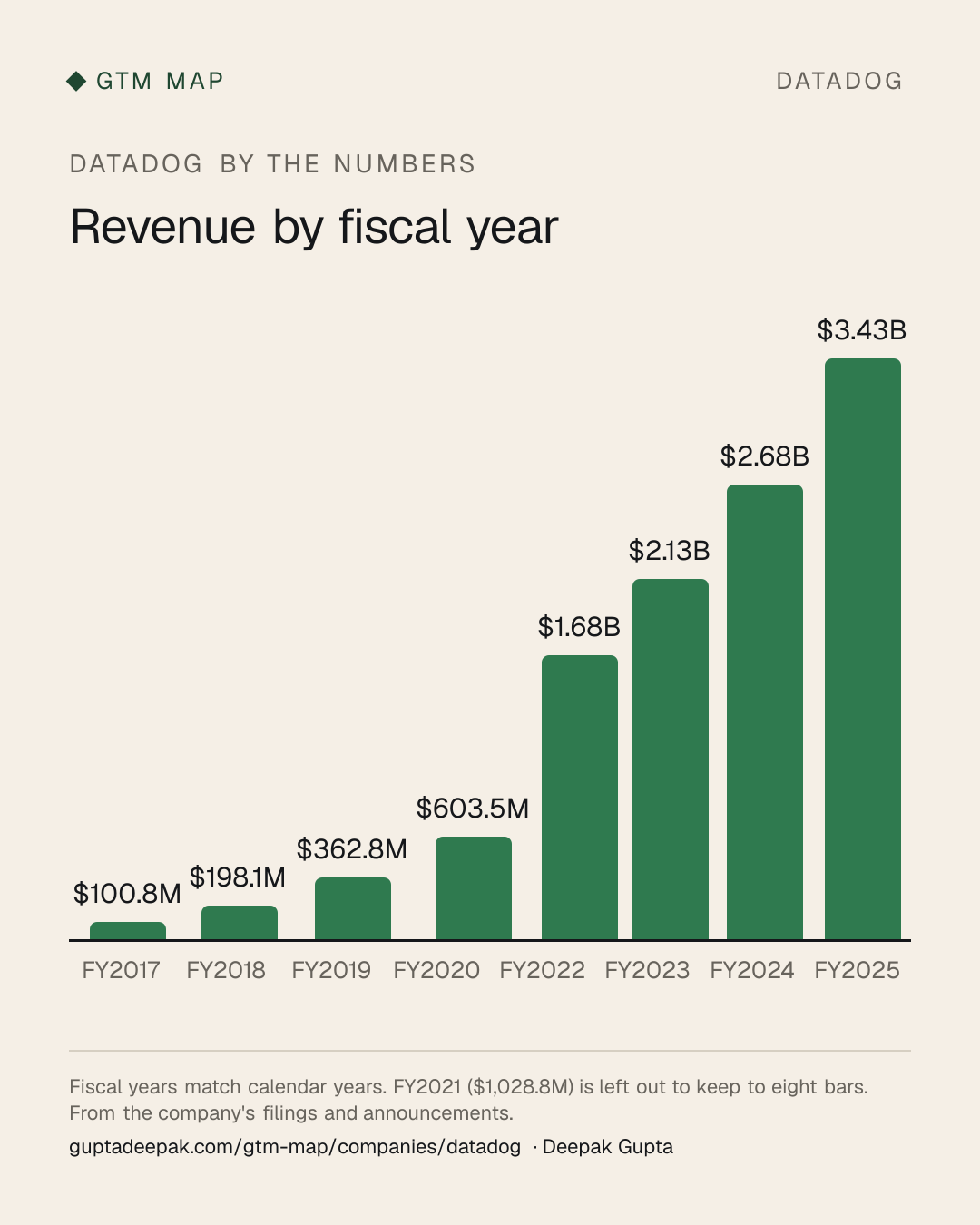
Show the data
| FY2017 | $100.8M | From a filing |
|---|---|---|
| FY2018 | $198.1M | From a filing |
| FY2019 | $362.8M | From a filing |
| FY2020 | $603.5M | From a filing |
| FY2022 | $1.68B | From a filing |
| FY2023 | $2.13B | From a filing |
| FY2024 | $2.68B | From a filing |
| FY2025 | $3.43B | From a filing |
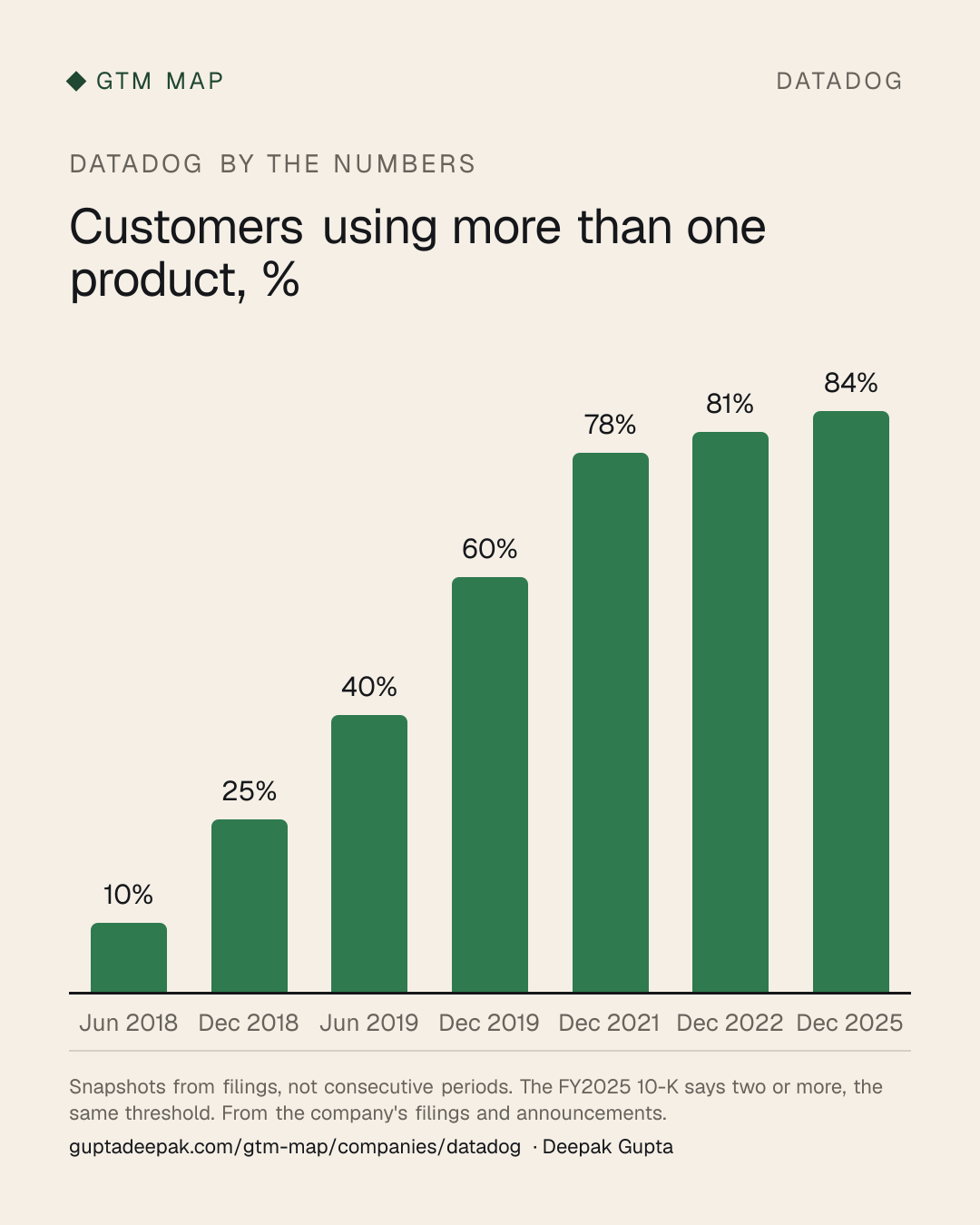
Show the data
| Jun 2018 | 10% | From a filing |
|---|---|---|
| Dec 2018 | 25% | From a filing |
| Jun 2019 | 40% | From a filing |
| Dec 2019 | 60% | From a filing |
| Dec 2021 | 78% | From a filing |
| Dec 2022 | 81% | From a filing |
| Dec 2025 | 84% | From a filing |
| Metric | Value | As of | Basis |
|---|---|---|---|
| Revenue, 2017 and 2018 | $100.8M and $198.1M, up 97%[1] | December 31, 2018 | From a filing |
| Capital raised before the IPO | $92.0M, net of share repurchases[1] | June 30, 2019 | From a filing |
| Customers, 2016 to mid-2019 | About 3,800, 5,400, 7,700, then 8,800[1] | June 30, 2019 | From a filing |
| Customers with $100K+ ARR, 2016 to mid-2019 | 126 to 594, from 48% to 72% of ARR[1] | June 30, 2019 | From a filing |
| Dollar-based net retention, 2017, 2018, mid-2019 | 141%, 151%, 146%[1] | June 30, 2019 | From a filing |
| Dollar-based gross retention | Low-to-mid 90% range[1] | June 30, 2019 | From a filing |
| Top 25 customers' ARR growth from their first month | Median 33.9x[1] | December 31, 2018 | From a filing |
| Sales and marketing as a share of revenue, 2017 to 2019 | 44%, 45%, 40%[2] | December 31, 2019 | From a filing |
| Revenue, 2019 | $362.8M, up 83%[6] | December 31, 2019 | From a filing |
| Customers using more than one product | About 81%[3] | December 31, 2022 | From a filing |
| Trailing 12-month net retention, 2022 to 2023 | Mid-140s, then mid-110s[4] | December 31, 2023 | From a filing |
| Trailing 12-month net retention | About 120%[5] | December 31, 2025 | From a filing |
| Customers using 4+, 6+, 8+, 10+ products | 55%, 33%, 18%, 9%[5] | December 31, 2025 | From a filing |
| Revenue, 2025 | $3,427.2M[5] | December 31, 2025 | From a filing |
| Sales and marketing spend, 2025 | $956.4M, 28% of revenue[5] | December 31, 2025 | From a filing |
| Customers, 2025 | About 32,700; 4,310 at $100K+ ARR; 603 at $1M+[5] | December 31, 2025 | From a filing |
| Revenue, Q2 2026 | $1.12B, up 36%[7] | June 30, 2026 | From a filing |
| Customers with $100K+ ARR, Q2 2026 | About 4,720, up 23%[7] | June 30, 2026 | From a filing |
“Reported” figures come from trade press, not the company, and are shown with their date.
03Myth checks
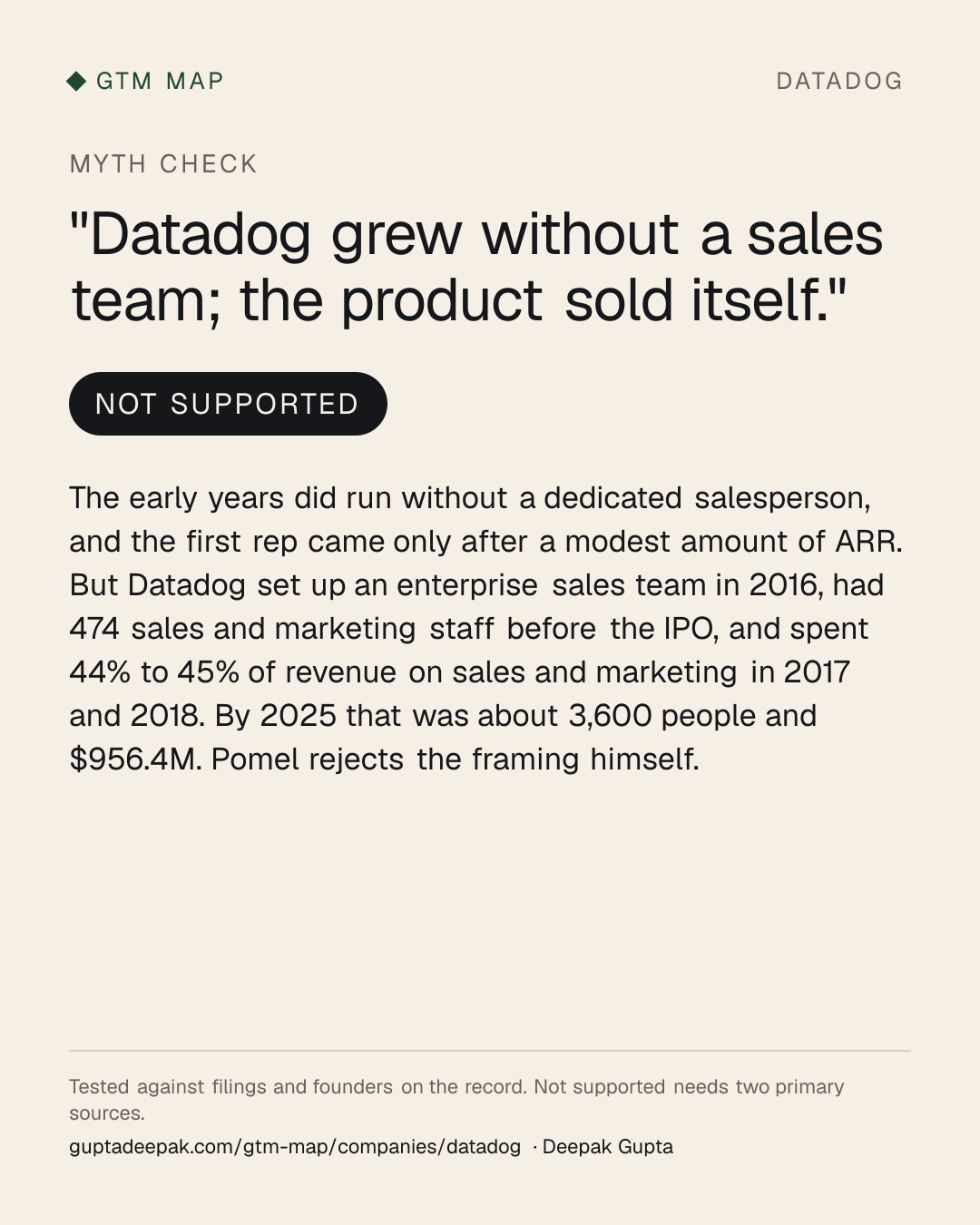
“Datadog grew without a sales team; the product sold itself.”
Not supportedThe early years did run without a dedicated salesperson, and the first rep came only after a modest amount of ARR. But Datadog set up an enterprise sales team in 2016, had 474 sales and marketing staff before the IPO, and spent 44% to 45% of revenue on sales and marketing in 2017 and 2018. By 2025 that was about 3,600 people and $956.4M. Pomel rejects the framing himself.[1],[5],[10]
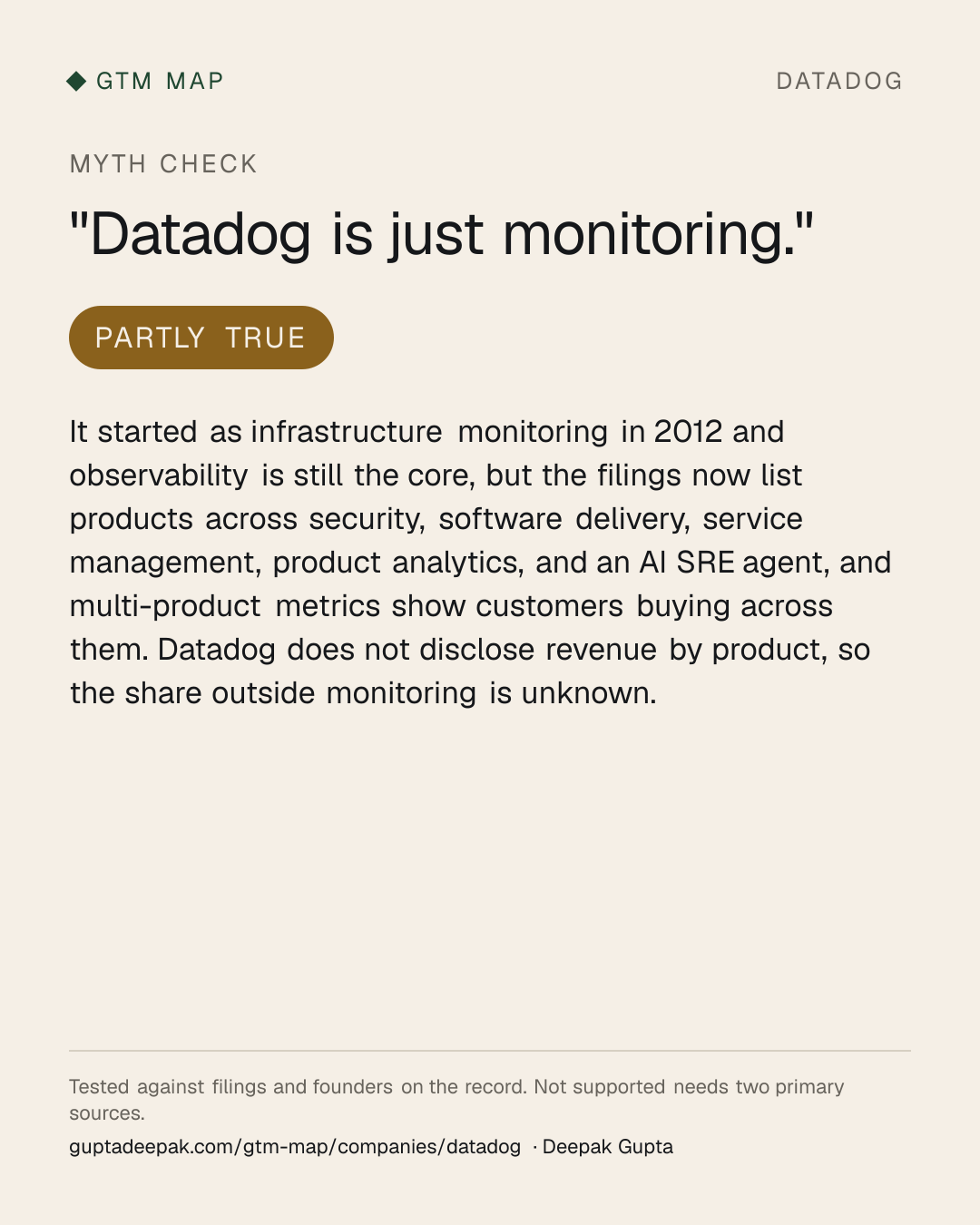
“Datadog is just monitoring.”
Partly trueIt started as infrastructure monitoring in 2012 and observability is still the core, but the filings now list products across security, software delivery, service management, product analytics, and an AI SRE agent, and multi-product metrics show customers buying across them. Datadog does not disclose revenue by product, so the share outside monitoring is unknown.[1],[5]
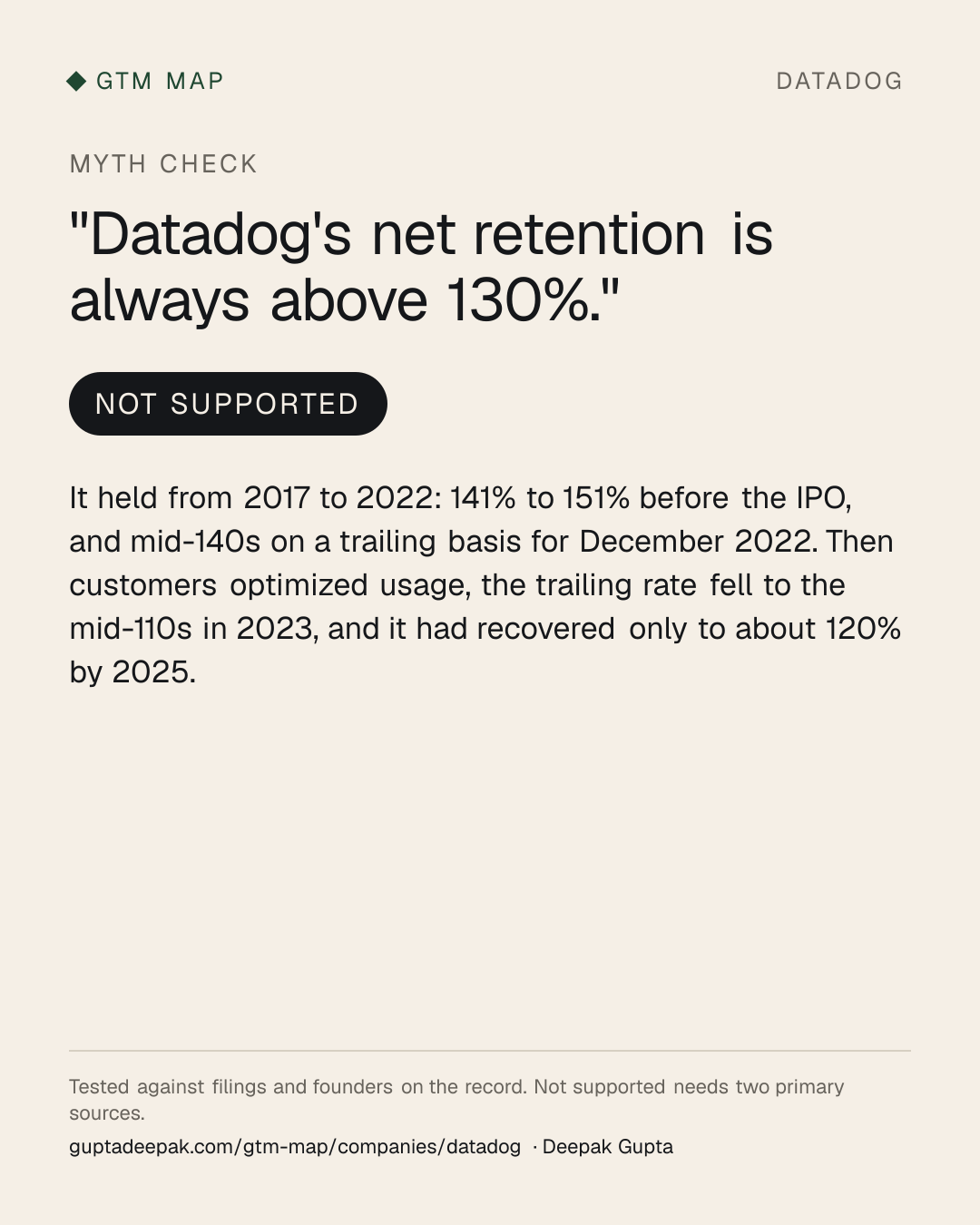
“Datadog's net retention is always above 130%.”
Not supportedIt held from 2017 to 2022: 141% to 151% before the IPO, and mid-140s on a trailing basis for December 2022. Then customers optimized usage, the trailing rate fell to the mid-110s in 2023, and it had recovered only to about 120% by 2025.[4],[5]
On the record
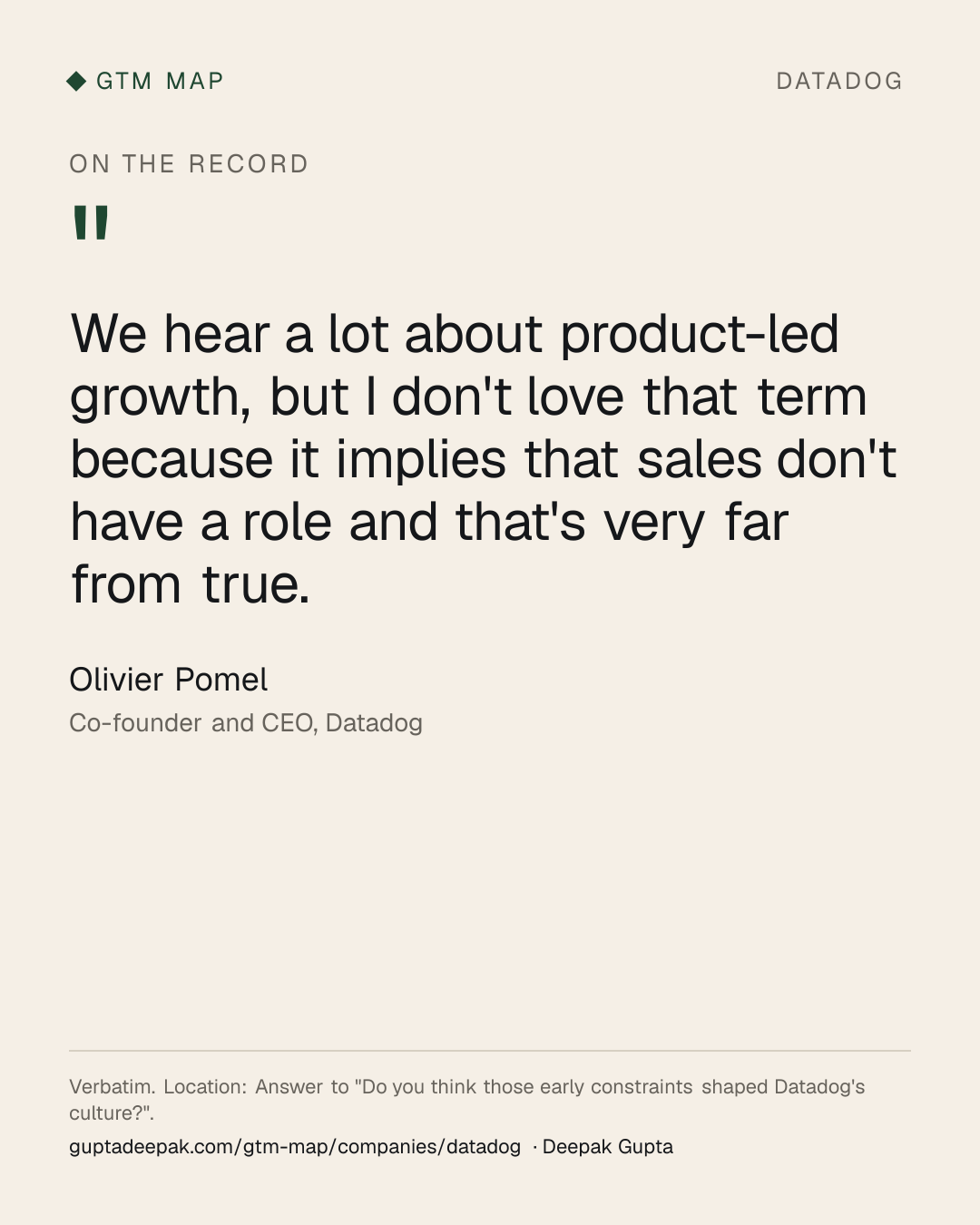
“We hear a lot about product-led growth, but I don’t love that term because it implies that sales don’t have a role and that’s very far from true.”
Olivier Pomel, Co-founder and CEO, Datadog[10]
Answer to "Do you think those early constraints shaped Datadog's culture?"
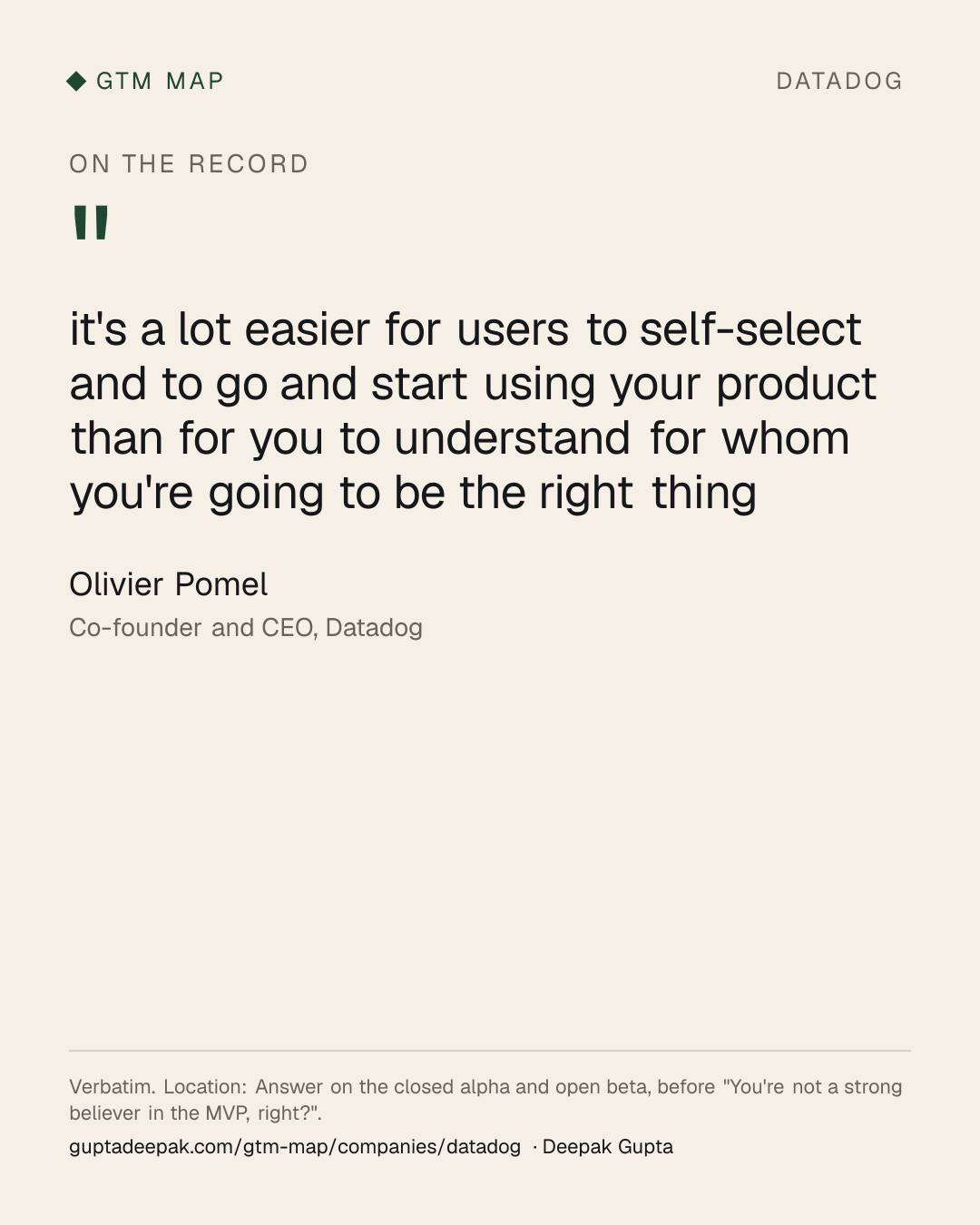
“it’s a lot easier for users to self-select and to go and start using your product than for you to understand for whom you’re going to be the right thing”
Olivier Pomel, Co-founder and CEO, Datadog[11]
Answer on the closed alpha and open beta, before "You're not a strong believer in the MVP, right?"
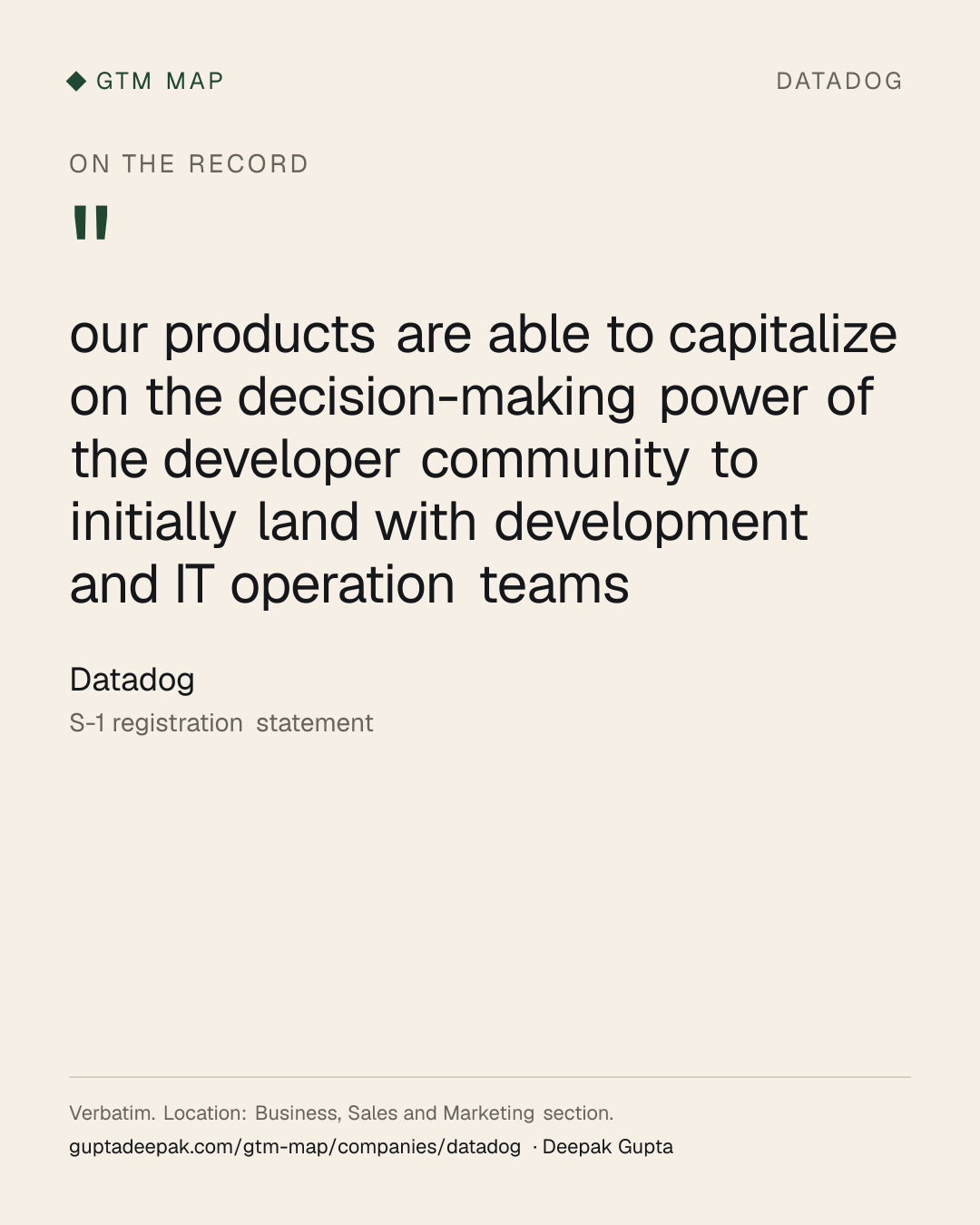
“our products are able to capitalize on the decision-making power of the developer community to initially land with development and IT operation teams”
Datadog, S-1 registration statement[1]
Business, Sales and Marketing section
04What other companies can take from it
Price on the unit that grows with the customer's own business.
Works when: The product's value scales with infrastructure, data, traffic, or transactions the customer is already growing, and usage is easy to meter.
Backfires when: Customers can cut usage quickly without losing value, or a few large customers dominate usage, so revenue swings with their cost programs.
Based on: Inside sales, enterprise team, and multi-product expansion, Usage pricing; Usage optimization, enterprise scale, and AI, Usage pricing
Make the second product the growth plan, not an upsell of the first.
Works when: Products share one agent, one data model, and one buyer, so the second product needs no new install or new budget owner.
Backfires when: Each new product needs a different buyer or a separate deployment, so a cross-sell costs as much as a new logo.
Based on: Inside sales, enterprise team, and multi-product expansion, Land and expand; Usage optimization, enterprise scale, and AI, Land and expand
Treat self-serve and sales as one system, not a choice.
Works when: The entry user can install and see value alone, but the buyer of a large commitment is a senior leader.
Backfires when: The product needs a long implementation before any value appears, so there is no self-serve stage for sales to build on.
Based on: Self-serve monitoring for DevOps teams, Product-led; Inside sales, enterprise team, and multi-product expansion, Sales-assist
Let users self-select early instead of hand-picking pilots.
Works when: The user who feels the pain can sign up and install without procurement.
Backfires when: The buyer is a regulated enterprise that cannot trial software without legal review, so design partners are the only route.
Based on: Self-serve monitoring for DevOps teams, Product-led; Self-serve monitoring for DevOps teams, Sales-assist
05 · GTM Now
What changes in the AI era, and what to do now
Analysis by Deepak Gupta. This is opinion built on the sourced record above, not part of it.[5],[7],[8]
Still works
- One agent plus usage pricing. Revenue tracks infrastructure and data volume, AI workloads add both, and the FY2025 10-K credits an AI-native cohort with about seven points of Q4 growth.
- The free trial and developer entry. Engineers still pick tools by trying them.
Breaks
- Usage pricing concentrates risk when a few AI-native customers drive growth and can optimize fast, which the FY2025 10-K flags.
- Developer discovery through docs and search weakens when AI coding assistants choose and wire up instrumentation for the engineer.
What replaces it
- Selling AI products into the same base, which is Datadog's own move: LLM Observability in 2024, Bits AI SRE in 2025, and Bits Agent Builder in 2026.
- Deeper hyperscaler routes, such as the AWS agreement covering Marketplace availability and joint go-to-market.
- Landing in the agent's toolchain instead of only with the developer: being the default integration an AI coding or SRE agent installs.
Apply it now
If you are
A seed to Series B infrastructure, data, or developer tool selling to engineers, with value that scales with the customer's workloads and ACV from under $10K to over $100K
- Ship a free tier and trial that installs in minutes with no sales call, and open access wide rather than hand-picking pilots.
- Meter on the unit that tracks your customer's growth (hosts, events, tokens, requests) and sell committed usage with overage.
- Put a high velocity inside sales team on trials to land the first paid commitment, then hand accounts to customer success for expansion.
- Build the second product on the same agent and data model so it sells to the same buyer with no new install.
You will know it works when: The share of new customers landing with more than one product (Datadog's filed jump was from about 15% to 60% in a year) and net retention above 130%.
Based on Datadog's Self-serve monitoring for DevOps teams, Inside sales, enterprise team, and multi-product expansion, Inside sales, enterprise team, and multi-product expansion
If you are
A later-stage usage-priced platform whose net retention is sliding as customers optimize
- Report retention on a trailing basis and break out cohorts, as Datadog's 10-Ks do from FY2023, so one cohort's optimization shows early.
- Track concentration: how much growth comes from your largest cohort (Datadog disclosed about seven points from its AI-native cohort).
- Shift expansion weight from more usage of one product to more products per customer.
- Add a hyperscaler marketplace and co-sell agreement so large commitments can draw down existing cloud budgets.
You will know it works when: Trailing net retention recovering (Datadog went from mid-110s to about 120%) while the share of customers on four or more products keeps rising.
Based on Datadog's Usage optimization, enterprise scale, and AI, Usage optimization, enterprise scale, and AI, Usage optimization, enterprise scale, and AI
Motions in this record
Compare with every other company on the GTM matrix.
Share the visuals
Every card is drawn from the sourced record above and sized 1080 by 1350 for LinkedIn and X. Free to share with a link back to this page.
Sources
- [1]SEC filingDatadog, Inc. Form S-1 Registration Statement (August 23, 2019)
- [2]SEC filingForm 10-K, fiscal year ended December 31, 2019 (February 25, 2020)
- [3]SEC filingForm 10-K, fiscal year ended December 31, 2022 (February 24, 2023)
- [4]SEC filingForm 10-K, fiscal year ended December 31, 2023 (February 23, 2024)
- [5]SEC filingForm 10-K, fiscal year ended December 31, 2025 (February 18, 2026)
- [6]EarningsDatadog Announces Fourth Quarter and Full Year 2019 Results (8-K exhibit) (February 13, 2020)
- [7]EarningsDatadog Announces Second Quarter 2026 Financial Results (8-K exhibit) (August 6, 2026)
- [8]CompanyDatadog Announces Expanded Collaboration Agreement, Highlights New Capabilities with AWS Across AI, Observability and Security at AWS re:Invent (December 3, 2025)
- [9]CompanyDatadog Pricing (October 18, 2026)
- [10]Founder interviewBuilding Datadog against the odds (Q&A from RTP Global's 2023 Founder Summit) (Olivier Pomel, June 30, 2025, at answers to "Do you think those early constraints shaped Datadog's culture?" and "in the early days, you were all engineers and there were no salespeople?")
- [11]Founder interviewHow to Build and Sell a Product that Customers Love (SaaStr Europa, video transcript) (Olivier Pomel, January 20, 2024, at answers on the closed alpha and open beta, on staying customer-centric, and on event marketing)
Every phase, motion, and myth verdict cites a filing, the company's own pages, or a founder speaking on the record. See the methodology.