
Security · public
How Okta went to market
Okta sold cloud single sign-on to IT buyers through field, inside and channel sales, then expanded by users and products while a network of pre-built integrations made each customer more valuable to the next. Net retention at or above 120% carried it through the IPO; Auth0 added a developer motion, and AI agents are the newest expansion bet.
- Buyer:
- Developers, Mid-market, Enterprise
- Contract size:
- Mixed
- Checked:
- October 18, 2026
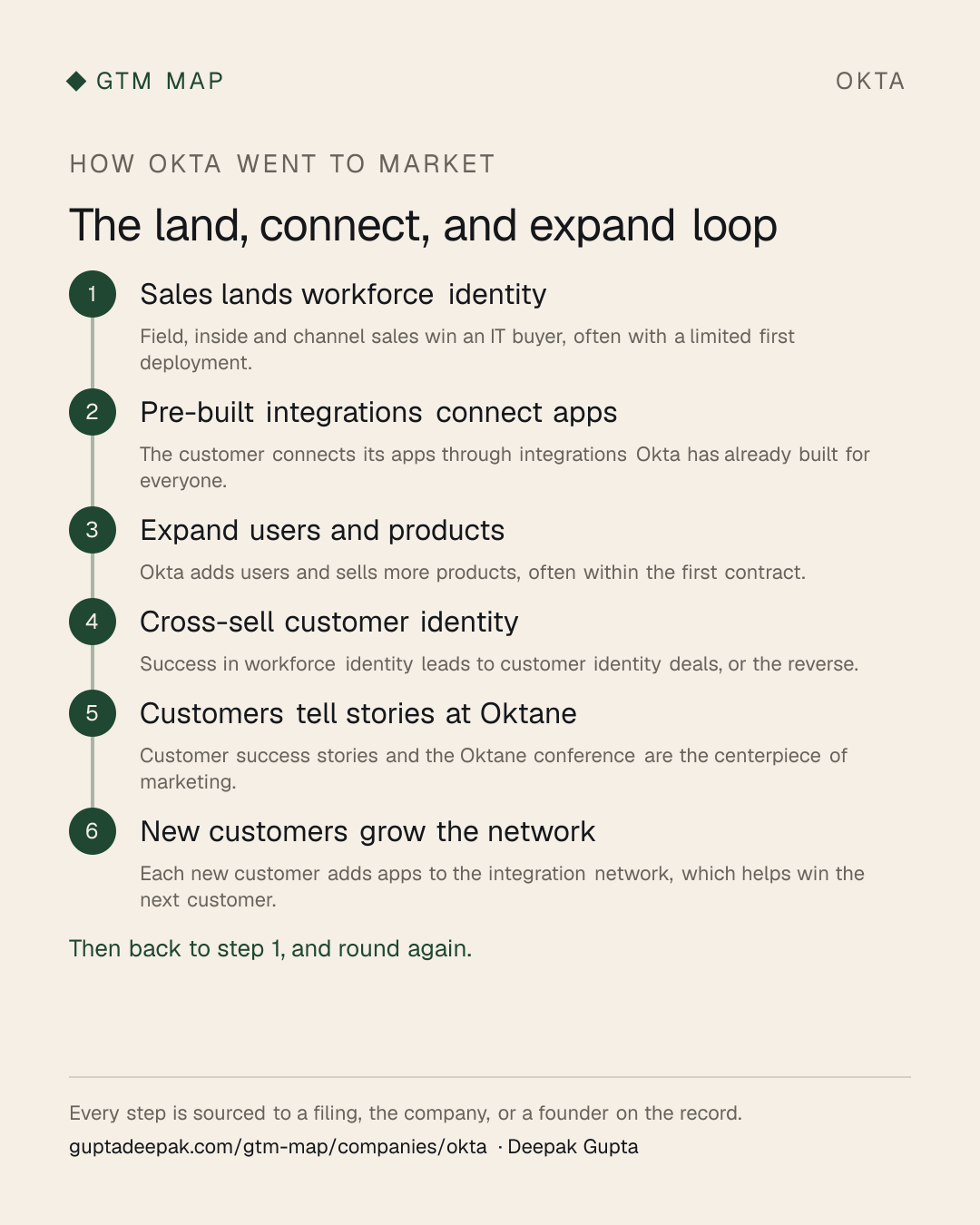
Sales lands workforce identity
Field, inside and channel sales win an IT buyer, often with a limited first deployment.[1]
Pre-built integrations connect apps
The customer connects its apps through integrations Okta has already built for everyone.[1]
Expand users and products
Okta adds users and sells more products, often within the first contract.[1]
Cross-sell customer identity
Success in workforce identity leads to customer identity deals, or the reverse.[7]
Customers tell stories at Oktane
Customer success stories and the Oktane conference are the centerpiece of marketing.[1]
New customers grow the network
Each new customer adds apps to the integration network, which helps win the next customer.[1]
Back to step 1, and round again
01The phases
PrimarySupportingTried, then dropped
2009 to 2013
Cloud SSO and enterprise sales from day one
Okta was founded in 2009 and launched its first product, Single Sign-On, in 2010, with Universal Directory and provisioning following in 2013. Todd McKinnon describes years as a lonely category creator before the market turned.
- Sales-led
Okta sold to IT buyers through field and inside sales, with cloud Single Sign-On for employees as the first product. McKinnon names go-to-market as the area he knew least.[1],[15]
- Category creation
The S-1 says Okta "pioneered identity in the cloud" with a "category defining platform". McKinnon describes the early years as being a lonely category creator, and says the marketing people thought was bad suddenly worked once the category flipped.[1],[15]
- Partner channel
Pre-built integrations with cloud apps, the Okta Application Network, were built in parallel with the product, so every new app integration became available to every customer.[1]
- Sales-led
2014 to 2017
Platform, land and expand, and the IPO
Okta added Mobility Management and open APIs in 2014, Adaptive MFA in 2015, and Lifecycle Management and API Access Management in 2016. By the 2017 S-1 it sold six products to more than 2,900 customers.
- Land and expand
After the first sale, Okta adds users and sells more products, often within the term of the first contract. Large enterprises often start with a limited deployment before going broader.[1]
- Sales-led
The sales team is divided by geography, customer size, use case and industry vertical. Sales and marketing spend was 120% of revenue in FY2015 and 91% in FY2016.[1]
- Partner channel
Nearly all leading cloud application providers are customers or partners, and many co-sell Okta or build it into their products. Okta also sells through channel partners, and the S-1 calls its investment in partnerships a force multiplier.[1]
- Owned events
Customer stories are the centerpiece of Okta's marketing, and its annual customer conference, Oktane, drew over 1,600 registrations in 2016.[1]
- Inbound content
Okta publishes a Businesses @ Work report analysing software usage trends from the daily interactions between users and applications on its own platform.[1]
- Developer-led
Okta opened its APIs in 2014 so organisations could build customer, supplier and partner apps on it, and the S-1 says it must convince developers to build external portals on the platform. This sat next to workforce identity as a secondary use case.[1]
- Land and expand
2017 to 2021
Public scale-up of the workforce engine
After the April 2017 IPO, revenue grew from $260.0M in FY2018 to $835.4M in FY2021, and the integration network passed 7,000 integrations, all before the Auth0 deal closed.
- Sales-led
Customers above $100K in annual contract value rose from 691 at January 2018 to 1,950 at January 2021. The FY2021 10-K names land and expand with a focus on customer size and key verticals, including highly regulated sectors.[2],[3]
- Land and expand
The FY2018 10-K says dollar-based retention consistently exceeded 120%, driven by more users and up-selling products. It was 121%, 119% and 120% in the trailing periods reported in the FY2021 10-K.[2],[3]
- Partner channel
The renamed Okta Integration Network grew from over 5,500 integrations in the FY2018 10-K to over 7,000 in the FY2021 10-K, which calls it an extensive partner ecosystem.[2],[3]
- Owned events
Oktane continued, Okta Showcase was added for product and feature announcements, and Oktane20 moved to a virtual-only conference in the spring of 2020.[3]
- Sales-led
2021 to 2024
Auth0, two clouds, and security incidents
Okta closed the Auth0 acquisition on May 3, 2021 and kept it as an independent business unit. Two incidents followed, in January 2022 at a third-party provider and in October 2023 in its support system.
- Developer-led
Okta bought Auth0, a developer-centric identity platform, in a stock deal valued at about $6.5B. The 10-K frames Auth0 as the customizable option for developers, next to Okta's own low-code customer identity.[8],[4]
- Land and expand
Expansion now includes moving from workforce identity into customer identity. Dollar-based net retention peaked at 124% in FY2022.[4]
- Sales-led
Customer counts still exclude customers on self-service arrangements only, and customers above $100K in annual contract value grew from 1,950 to 3,930 between FY2021 and FY2023.[5]
- Brand narrative
The 10-K says the two incidents harmed Okta's reputation, customer relations and financial results. Okta published a root cause for the October 2023 breach, which touched 134 customers, and McKinnon launched the Okta Secure Identity Commitment in February 2024.[6],[11],[10]
- Developer-led
2024 to now
Specialized sales, profitability and AI agents
Okta turned GAAP profitable in FY2025, split its sellers by buying center at the start of FY2026, and began positioning its platforms as the identity control plane for AI agents, while net retention slowed to 106%.
- Sales-led
Okta sellers cover IT and security buyers, including Okta Customer Identity, while Auth0 sellers focus on developers, with a hunter-farmer model in some regions. The stated strategy is to drive growth with large customers.[7]
- Product-led
Developers can sign up for free trials, free plans or paid developer plans of the Auth0 Platform, which may move to paid enterprise plans.[7]
- Land and expand
Cross-sell runs from workforce to customer identity or the reverse, and new products led by Okta Identity Governance add growth. Net retention fell to 106% in FY2026, and the 10-K warns that customer workforce cuts can reduce revenue.[7],[9]
- Partner channel
Okta chose to accelerate the shift of professional services to partners, at a cost of about one point of revenue growth. The integration network now lists 8,000+ integrations.[9],[12]
- Category creation
The 10-K sees a long-term opportunity to serve as an independent control plane for non-human identities and AI agents, and the Businesses at Work 2026 report is framed around agentic AI readiness.[7],[9],[13]
- Owned events
Oktane remains a centerpiece of marketing, with customer stories, product announcements and labs, plus Oktane on the Road city events. The next Oktane is set for September 28 to 30, 2027 in Las Vegas.[7],[14]
- Sales-led
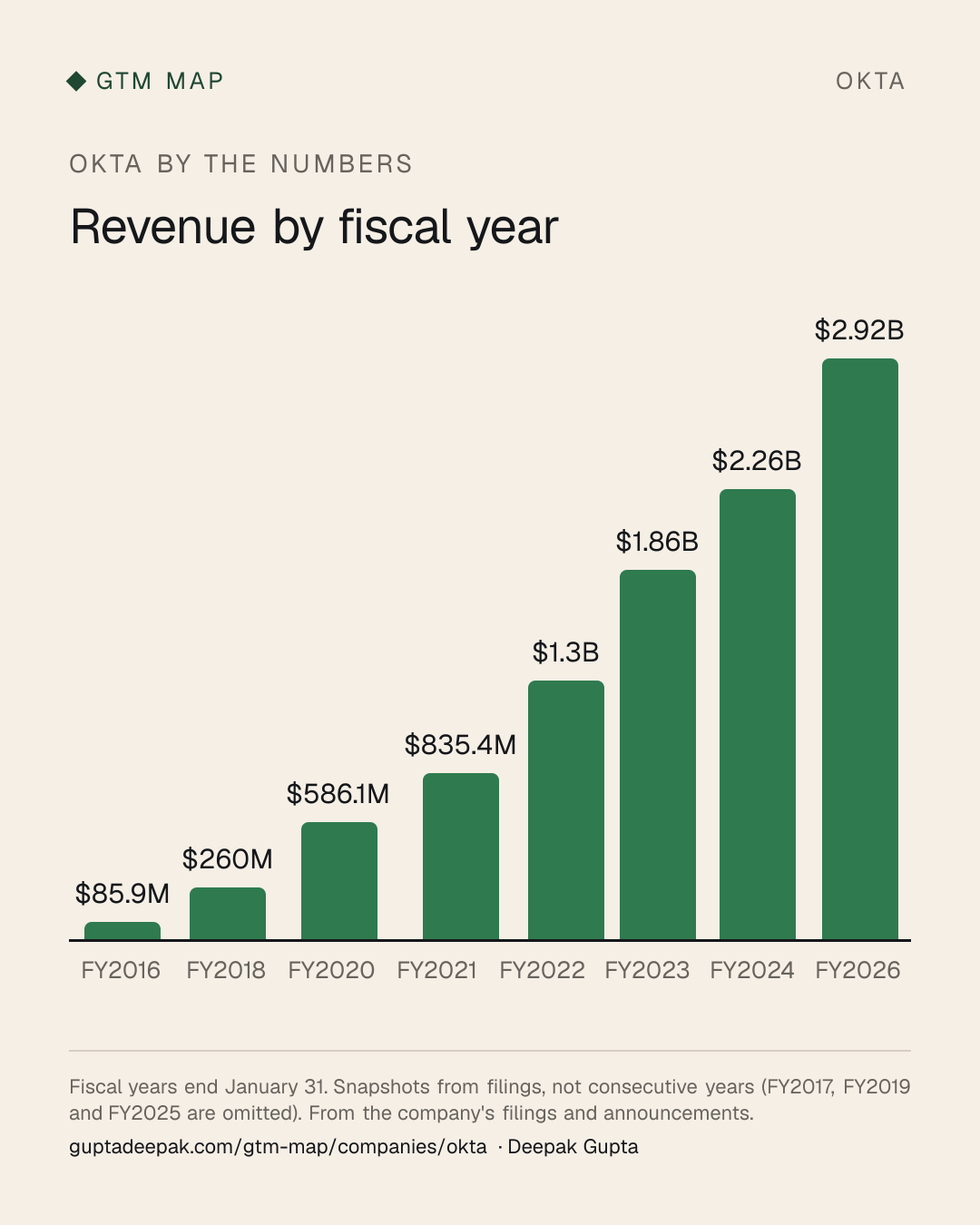
02The numbers
Show the data
| FY2016 | $85.9M | From a filing |
|---|---|---|
| FY2018 | $260M | From a filing |
| FY2020 | $586.1M | From a filing |
| FY2021 | $835.4M | From a filing |
| FY2022 | $1.3B | From a filing |
| FY2023 | $1.86B | From a filing |
| FY2024 | $2.26B | From a filing |
| FY2026 | $2.92B | From a filing |
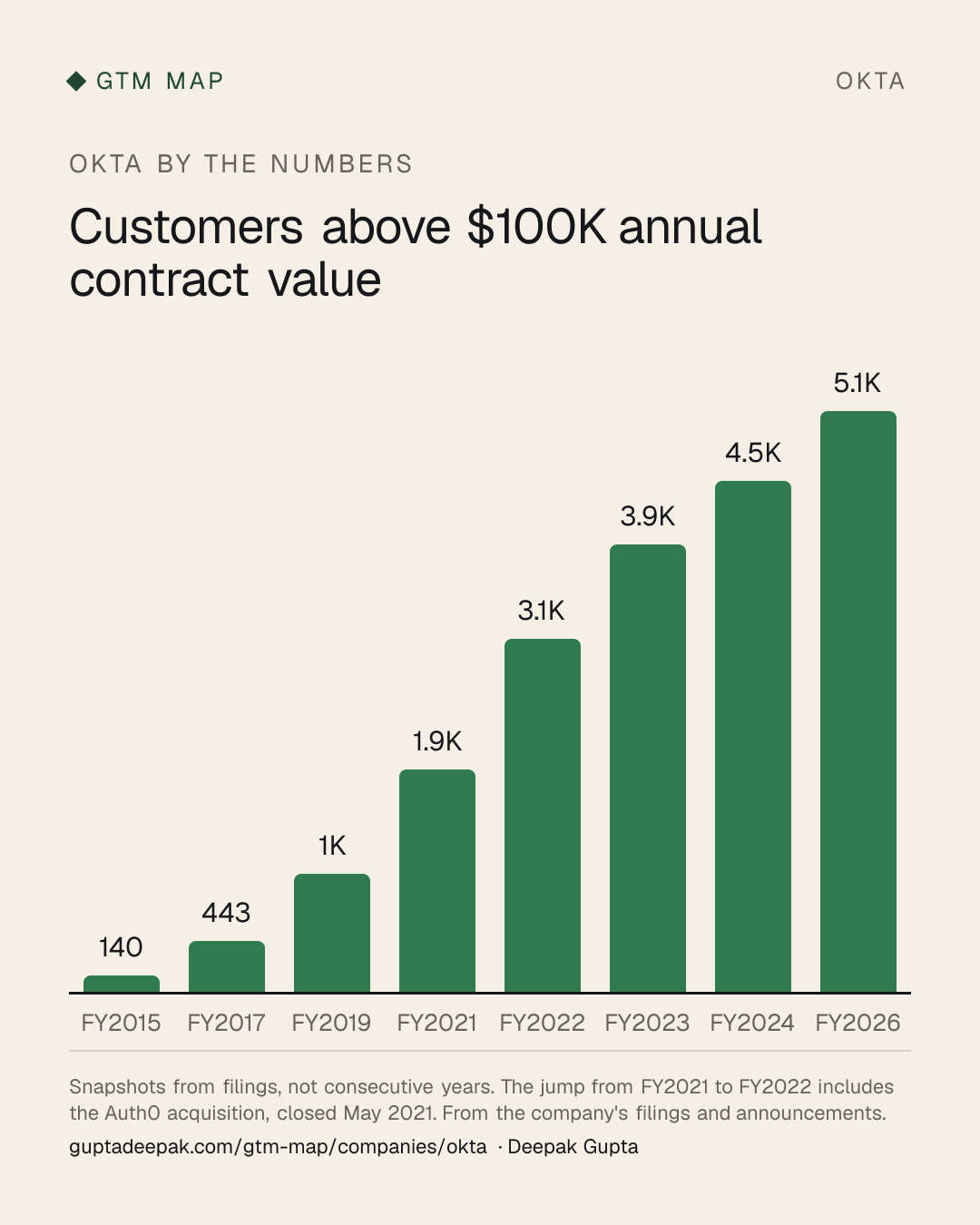
Show the data
| FY2015 | 140 | From a filing |
|---|---|---|
| FY2017 | 443 | From a filing |
| FY2019 | 1K | From a filing |
| FY2021 | 1.9K | From a filing |
| FY2022 | 3.1K | From a filing |
| FY2023 | 3.9K | From a filing |
| FY2024 | 4.5K | From a filing |
| FY2026 | 5.1K | From a filing |
| Metric | Value | As of | Basis |
|---|---|---|---|
| Revenue, fiscal 2016 | $85.9M, up 109%[1] | January 31, 2016 | From a filing |
| Sales and marketing as a share of revenue, fiscal 2015 and 2016 | 120%, 91%[1] | January 31, 2016 | From a filing |
| Contribution margin of the 2015 customer cohort, years one to three | (92)%, 52%, 64%[1] | January 31, 2017 | From a filing |
| Dollar-based retention rate, fiscal 2015 and 2016 | 129%, 120%[1] | January 31, 2016 | From a filing |
| Auth0 acquisition, announced value | About $6.5B in stock[8] | March 3, 2021 | From a filing |
| Dollar-based net retention rate, fiscal 2022 | 124%[4] | January 31, 2022 | From a filing |
| Dollar-based net retention rate, fiscal 2024 to 2026 | 111%, 107%, 106%[7] | January 31, 2026 | From a filing |
| Revenue, fiscal 2026 | $2,919M, up 12%[7] | January 31, 2026 | From a filing |
| Net income, fiscal 2025 and 2026 | $28M, $235M[7] | January 31, 2026 | From a filing |
| Sales and marketing as a share of revenue, fiscal 2024 to 2026 | 46%, 37%, 35%[7] | January 31, 2026 | From a filing |
| Customers, fiscal 2026 | More than 20,000, including 5,100 above $100K ACV[7] | January 31, 2026 | From a filing |
| Integrations in the Okta Integration Network | Over 7,000[7] | January 31, 2026 | From a filing |
| Revenue from outside the United States, fiscal 2026 | 20%[7] | January 31, 2026 | From a filing |
| Revenue and subscription backlog (RPO), Q2 fiscal 2027 | $805M revenue, up 11%; RPO $4.858B, up 17%[9] | July 31, 2026 | From a filing |
“Reported” figures come from trade press, not the company, and are shown with their date.
03Myth checks
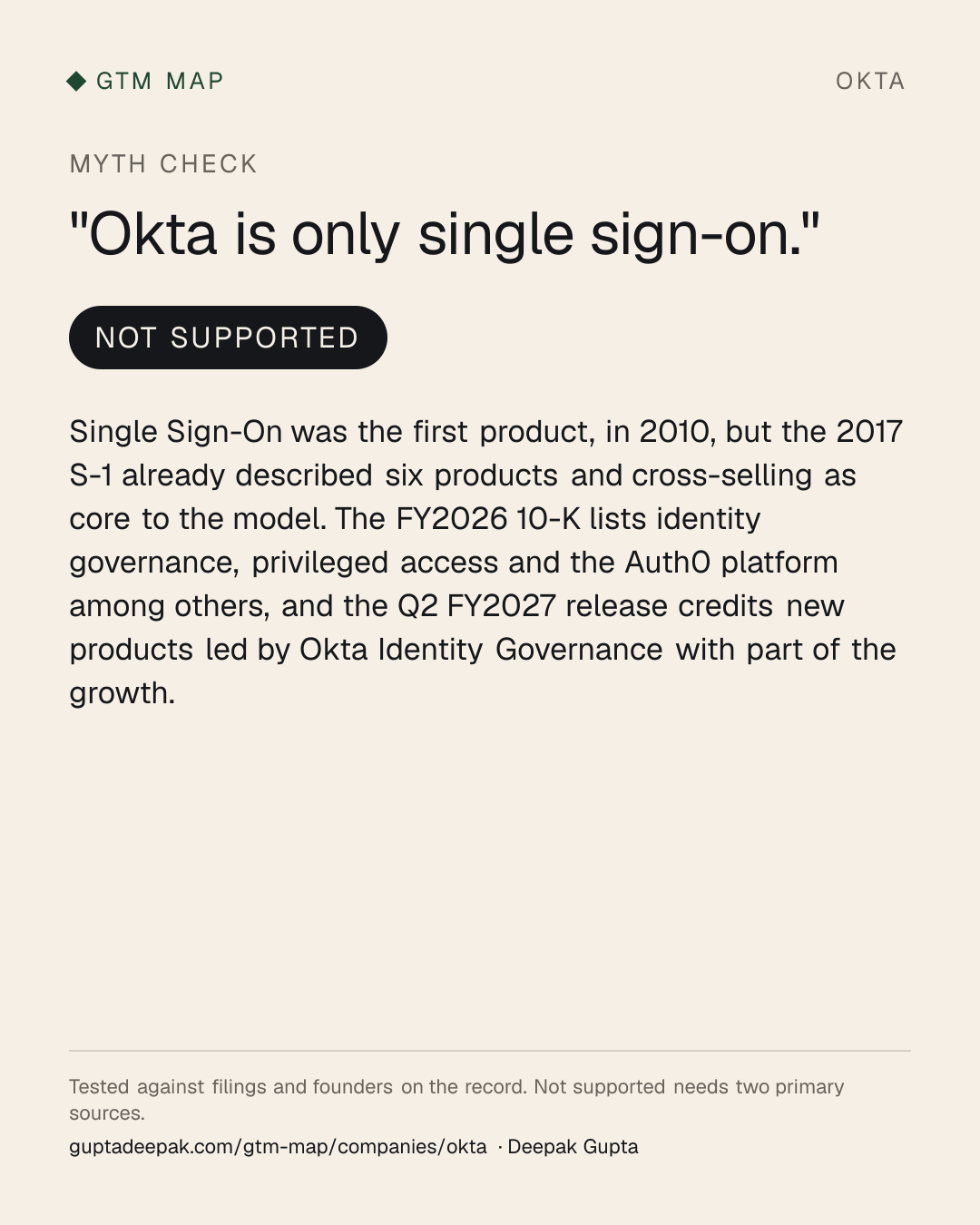
“Okta is only single sign-on.”
Not supportedSingle Sign-On was the first product, in 2010, but the 2017 S-1 already described six products and cross-selling as core to the model. The FY2026 10-K lists identity governance, privileged access and the Auth0 platform among others, and the Q2 FY2027 release credits new products led by Okta Identity Governance with part of the growth.[1],[7],[9]
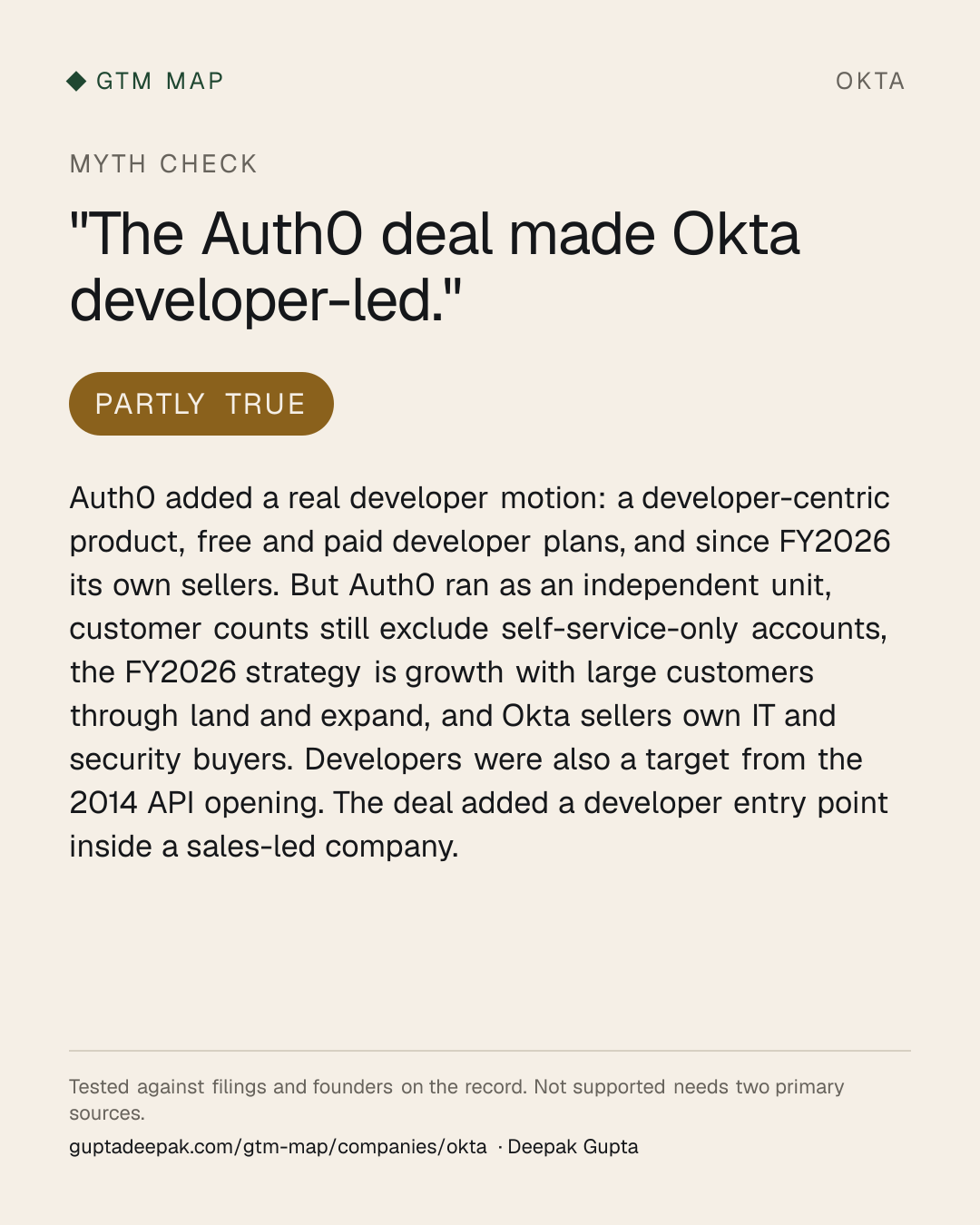
“The Auth0 deal made Okta developer-led.”
Partly trueAuth0 added a real developer motion: a developer-centric product, free and paid developer plans, and since FY2026 its own sellers. But Auth0 ran as an independent unit, customer counts still exclude self-service-only accounts, the FY2026 strategy is growth with large customers through land and expand, and Okta sellers own IT and security buyers. Developers were also a target from the 2014 API opening. The deal added a developer entry point inside a sales-led company.[8],[4],[7],[1]
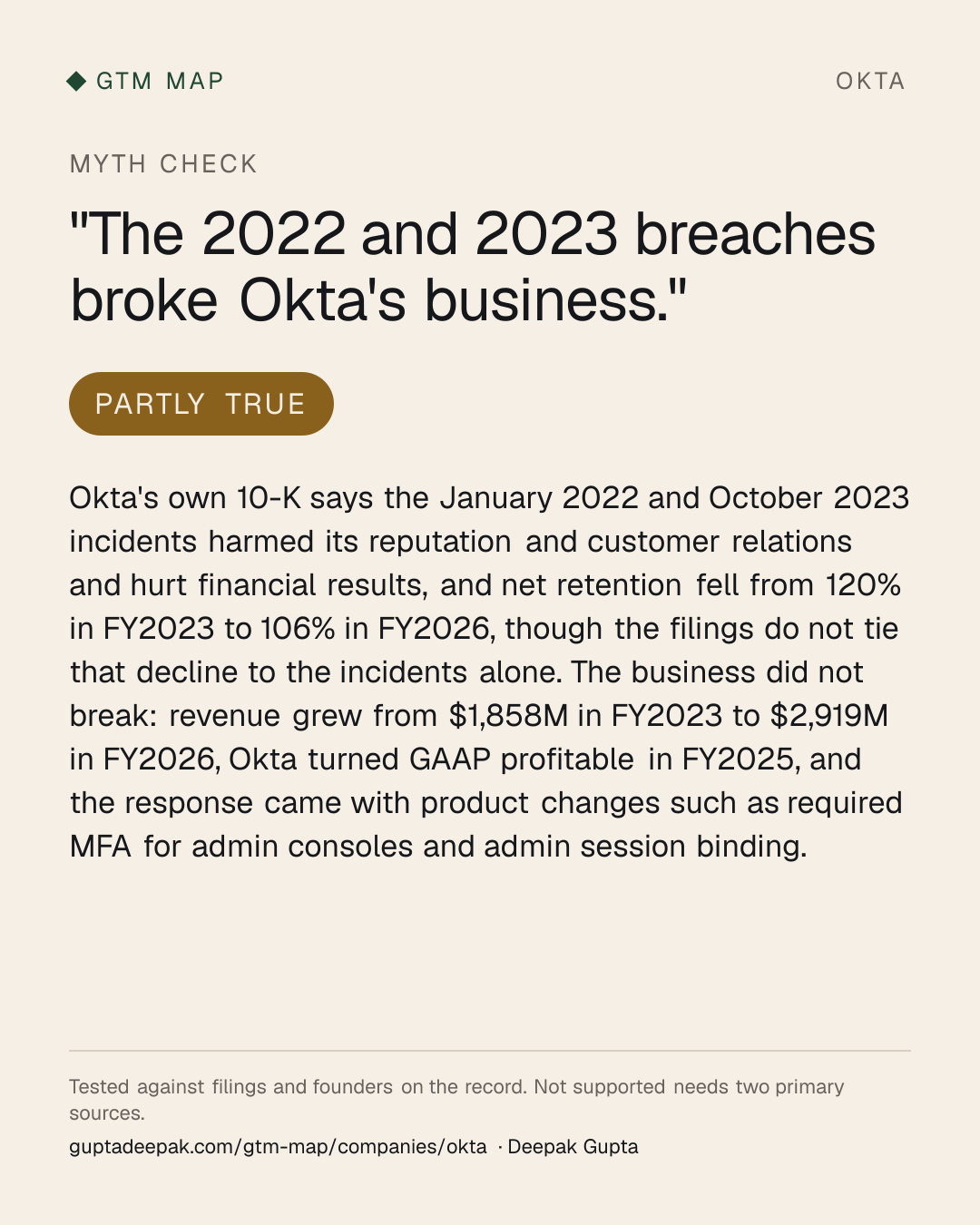
“The 2022 and 2023 breaches broke Okta's business.”
Partly trueOkta's own 10-K says the January 2022 and October 2023 incidents harmed its reputation and customer relations and hurt financial results, and net retention fell from 120% in FY2023 to 106% in FY2026, though the filings do not tie that decline to the incidents alone. The business did not break: revenue grew from $1,858M in FY2023 to $2,919M in FY2026, Okta turned GAAP profitable in FY2025, and the response came with product changes such as required MFA for admin consoles and admin session binding.[6],[7],[10],[11]
On the record
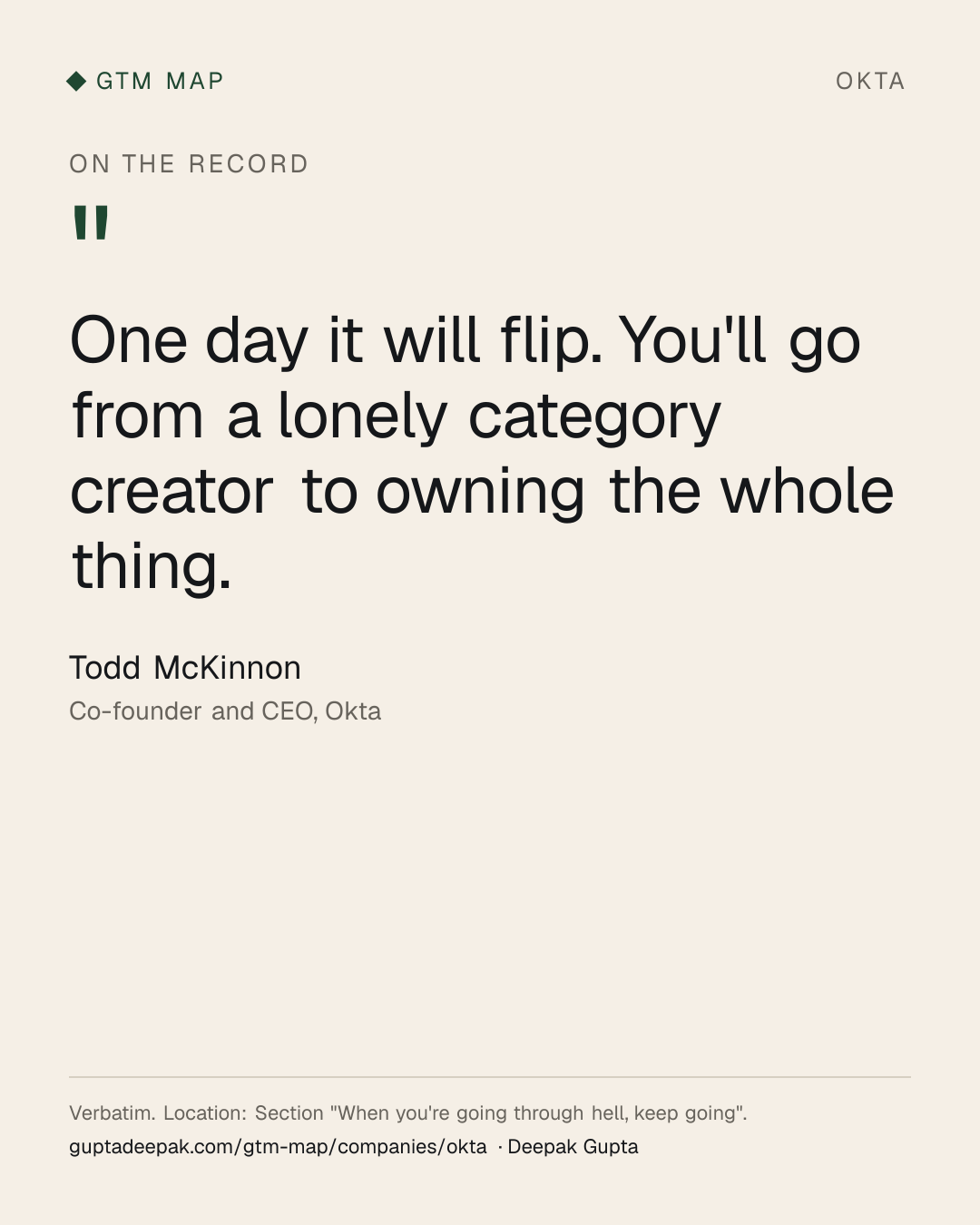
“One day it will flip. You’ll go from a lonely category creator to owning the whole thing.”
Todd McKinnon, Co-founder and CEO, Okta[15]
Section "When you're going through hell, keep going"
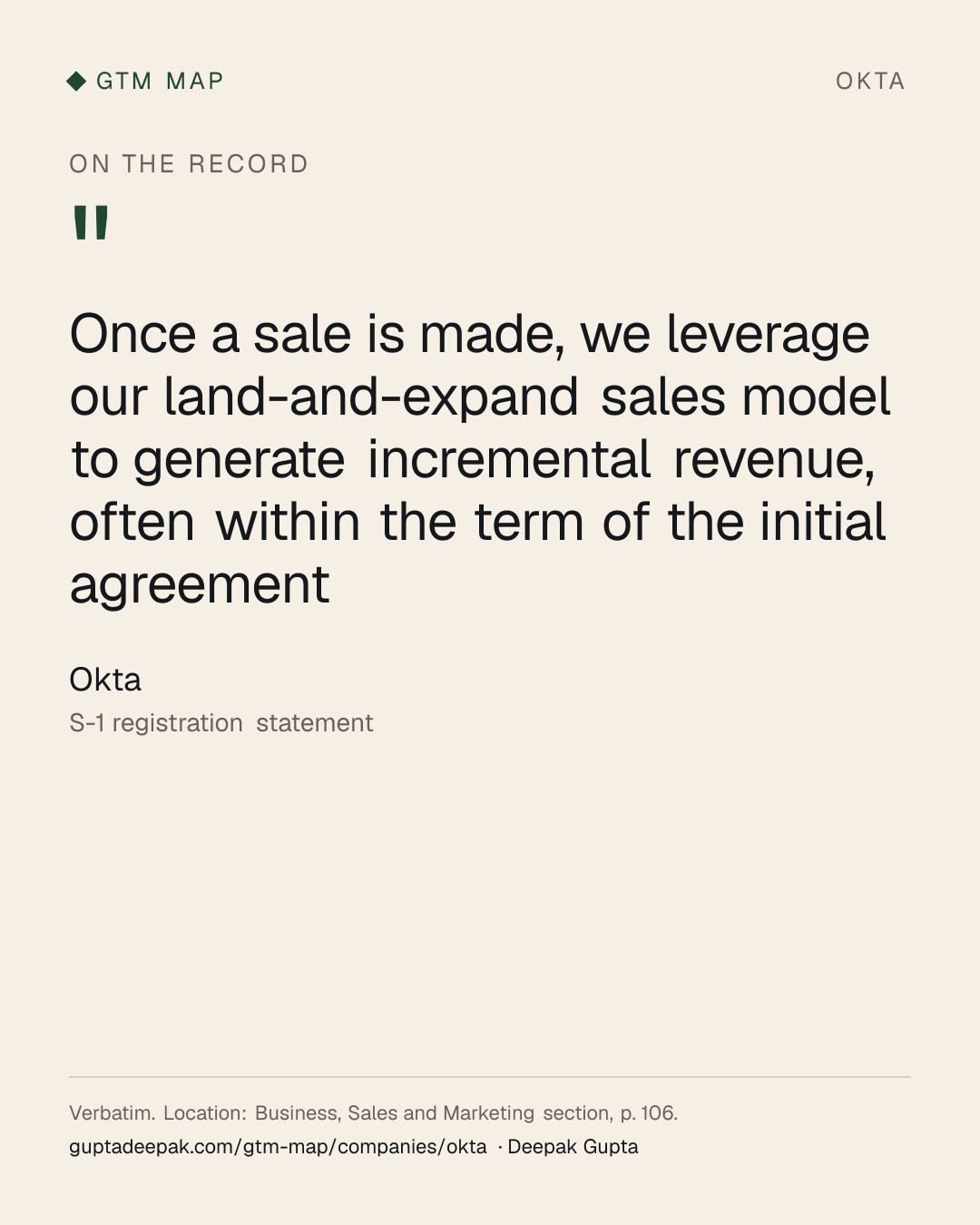
“Once a sale is made, we leverage our land-and-expand sales model to generate incremental revenue, often within the term of the initial agreement”
Okta, S-1 registration statement[1]
Business, Sales and Marketing section, p. 106
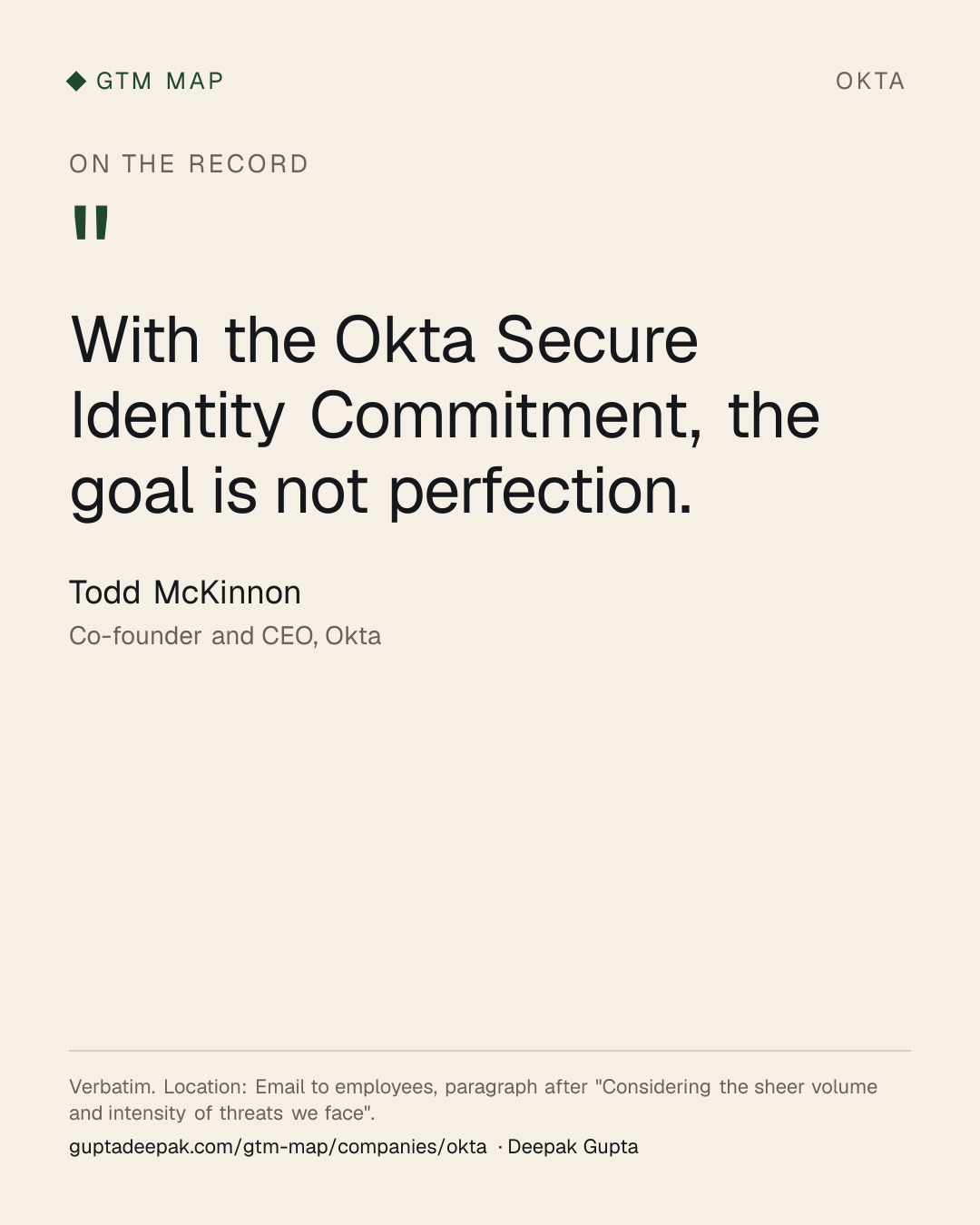
“With the Okta Secure Identity Commitment, the goal is not perfection.”
Todd McKinnon, Co-founder and CEO, Okta[10]
Email to employees, paragraph after "Considering the sheer volume and intensity of threats we face"
04What other companies can take from it
Pre-build the integrations your buyer needs, so every customer adds value for the next.
Works when: The product connects to many third-party systems the buyer already owns (apps, data sources, tools), and an integration built once can be reused by every customer.
Backfires when: Integrations are bespoke per customer, or a platform vendor bundles the same connector set for free.
Based on: Cloud SSO and enterprise sales from day one, Partner channel; Public scale-up of the workforce engine, Partner channel
Price on identities and sell more products to the same account.
Works when: Customers are growing headcount or end users, and you have a second and third product to sell into the same buyer.
Backfires when: Customers shrink their workforce, or the next product needs a different buyer you have no sales relationship with.
Based on: Platform, land and expand, and the IPO, Land and expand; Specialized sales, profitability and AI agents, Land and expand
Buy a developer motion, but keep it separate from the enterprise sales machine.
Works when: The second buyer (developers) has a different buying process from the first (IT and security), and self-service can feed enterprise deals.
Backfires when: You force one sales team to serve both buyers, or you expect a bought developer brand to change how the parent sells.
Based on: Auth0, two clouds, and security incidents, Developer-led; Specialized sales, profitability and AI agents, Sales-led; Specialized sales, profitability and AI agents, Product-led
For a security vendor, the incident response is part of the go-to-market.
Works when: You sell trust (identity, security, payments, data), so a breach goes straight to the buying decision.
Backfires when: The response is a slogan without product changes the customer can switch on and verify.
Based on: Auth0, two clouds, and security incidents, Brand narrative
05 · GTM Now
What changes in the AI era, and what to do now
Analysis by Deepak Gupta. This is opinion built on the sourced record above, not part of it.[7],[13]
Still works
- Pre-built integrations sold through enterprise sales and partners. AI agents need access to the same apps, and Okta's 10-K describes Cross App Access, a standards-based protocol to govern AI agents and app-to-app connections.
Breaks
- Pricing on human identities, if AI slows customer headcount growth. The FY2026 10-K already names workforce reduction as a revenue risk, with net retention at 106%.
What replaces it
- Identity for non-human identities and AI agents, which is Okta's filed bet through Okta for AI Agents and Auth0 for AI Agents, with its research report reframed around agent readiness.
- Analysis: the expansion unit may shift from employees to agents and machine credentials, and an owned research report is a way to claim that category early. The sources do not say whether agent identities are priced separately.
Apply it now
If you are
A Series A to C B2B security or IT infrastructure company selling to IT and security buyers at $25K to $250K ACV, where the product connects to many third-party apps
- Build and publish a catalog of pre-built integrations for the apps your target buyers already own, and count it as product, not services.
- Recruit the platform vendors you integrate with into co-selling and co-marketing, starting with the largest one your buyers already use.
- Price on a unit that grows with the customer (users, identities, agents) and plan a second product for the same buyer before year two.
- Run one owned customer event and one annual research report from your own usage data, built on customer stories.
You will know it works when: Net dollar retention (Okta's filed figures were 120% to 129% in its early years) and the count of customers above $100K ACV.
Based on Okta's Cloud SSO and enterprise sales from day one, Platform, land and expand, and the IPO, Platform, land and expand, and the IPO, Platform, land and expand, and the IPO, Platform, land and expand, and the IPO
If you are
A later-stage enterprise vendor adding a developer or self-service product line, or recovering from a security incident
- Give the developer product its own self-service path (free plan, paid developer plan) and its own sellers, instead of routing developers through enterprise sales.
- Report self-service and enterprise customers separately, as Okta does by excluding self-service-only accounts from its customer count.
- After an incident, publish a dated root cause with completed remediation steps, and ship at least one control customers can turn on.
- Turn the response into a long-term, named program with product, customer, industry and internal pillars.
You will know it works when: Self-service to enterprise conversions per quarter, and net retention plus growth in $100K-plus customers in the four quarters after an incident.
Based on Okta's Specialized sales, profitability and AI agents, Specialized sales, profitability and AI agents, Auth0, two clouds, and security incidents
Motions in this record
Compare with every other company on the GTM matrix.
Share the visuals
Every card is drawn from the sourced record above and sized 1080 by 1350 for LinkedIn and X. Free to share with a link back to this page.
Sources
- [1]SEC filingOkta, Inc. Form S-1 Registration Statement (March 13, 2017)
- [2]SEC filingForm 10-K, fiscal year ended January 31, 2018 (March 12, 2018)
- [3]SEC filingForm 10-K, fiscal year ended January 31, 2021 (March 4, 2021)
- [4]SEC filingForm 10-K, fiscal year ended January 31, 2022 (March 7, 2022)
- [5]SEC filingForm 10-K, fiscal year ended January 31, 2023 (March 3, 2023)
- [6]SEC filingForm 10-K, fiscal year ended January 31, 2024 (March 1, 2024)
- [7]SEC filingForm 10-K, fiscal year ended January 31, 2026 (March 5, 2026)
- [8]SEC filingOkta Signs Definitive Agreement to Acquire Auth0 to Provide Customer Identity for the Internet (8-K exhibit) (March 3, 2021)
- [9]EarningsOkta Announces Second Quarter Fiscal Year 2027 Financial Results (8-K exhibit) (August 26, 2026)
- [10]CompanyIntroducing the Okta Secure Identity Commitment (Todd McKinnon email to employees) (February 28, 2024)
- [11]CompanyUnauthorized Access to Okta's Support Case Management System: Root Cause and Remediation (David Bradbury) (November 3, 2023)
- [12]CompanyOkta Integration Network (October 18, 2026)
- [13]CompanyBusinesses at Work Report 2026 (2026)
- [14]CompanyOktane: The Future of Identity, from AI to Human (October 18, 2026)
- [15]Founder interviewOkta CEO Todd McKinnon on powering through your darkest days until, finally, the category is born (Bessemer Venture Partners) (Todd McKinnon, August 26, 2021, at sections "When you're going through hell, keep going" and "Accept advice, but have your own backbone and vision")
Every phase, motion, and myth verdict cites a filing, the company's own pages, or a founder speaking on the record. See the methodology.