
Classic SaaS · public
How Atlassian went to market
Atlassian made its software cheap enough to buy on its website without a salesperson, then let word of mouth, a $10 starter license, and later free cloud editions land small teams. Marketplace apps and partners did the high-touch work, and a sales team was added to expand the largest accounts, not to land them.
- Buyer:
- Developers, Small business, Mid-market, Enterprise
- Contract size:
- Mixed
- Checked:
- October 18, 2026
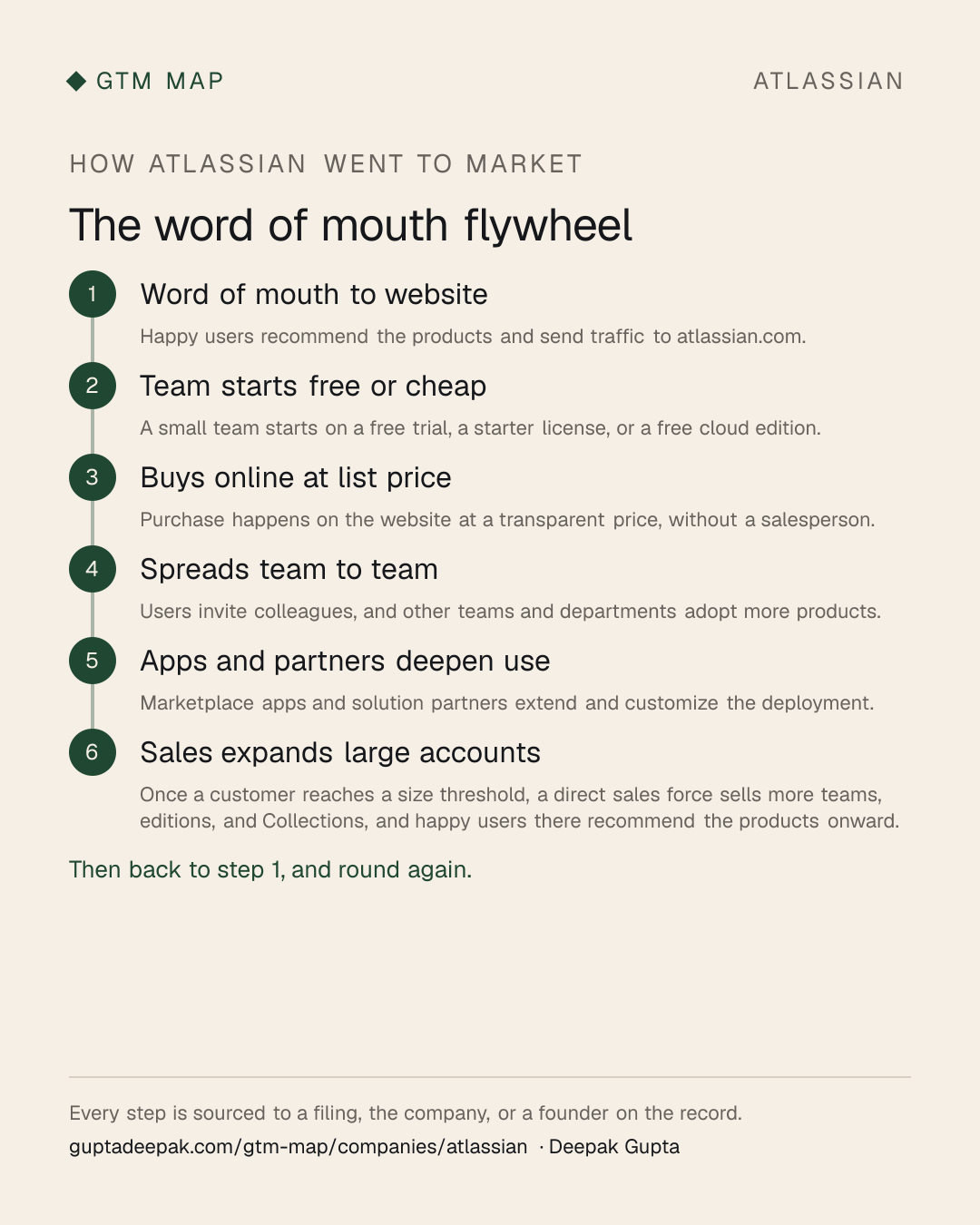
Word of mouth to website
Happy users recommend the products and send traffic to atlassian.com.[2]
Buys online at list price
Purchase happens on the website at a transparent price, without a salesperson.[2]
Spreads team to team
Users invite colleagues, and other teams and departments adopt more products.[2]
Apps and partners deepen use
Marketplace apps and solution partners extend and customize the deployment.[12]
Back to step 1, and round again
01The phases
PrimarySupportingTried, then dropped
2002 to 2009
Software that sells itself
Two founders with no money and no way to reach customers in person priced downloadable software low enough to buy without a salesperson. Scott Farquhar says the model came from that constraint, not from a plan.
- Product-led
Downloadable software priced under about $10,000, with the price on the website, so it could be bought anywhere without a sales call. Farquhar ties it to the founders being 22 year olds who could not afford a sales team.[15],[2]
- Sales-led
An attempt at OEM sales through one expensive, experienced enterprise salesperson failed. Farquhar calls OEM selling the antithesis of a word of mouth business model.[15]
- Brand narrative
Constant low-cost guerrilla marketing at developer conferences under the rule "always be marketing", such as paying about $3,000 for the beer at a conference instead of sponsoring a booth.[15]
- Product-led
2009 to 2019
Starter licenses, Marketplace and Experts
A $10 starter license opened the funnel, team products spread on their own, and an add-on marketplace plus value-added resellers covered what a sales team would have done. The filings still said Atlassian did not employ a commissioned direct sales team.
- Product-led
In 2009 the entry price for core products fell from over $1,000 to $10, giving up short-term revenue for the long-term funnel. Every product had a free trial and a transparent list price, and over 98% of transactions ran through the website.[11],[2]
- Viral loop
Team products spread as users invite colleagues, and the prospectus describes natural network effects that carry them across teams and departments by word of mouth.[2]
- Land and expand
Land a small team, then grow through seats, renewals, and more products. The fiscal 2009 to 2011 cohorts spent seven times their first purchase over the next five years, helped by an internal Atlassian Engagement Engine that promoted products to users in context.[2]
- Partner channel
Two channels: the Atlassian Marketplace for third-party add-ons from 2012, and value-added resellers called Atlassian Experts who handled local language, currency, and customization. Indirect sales were about 25% of fiscal 2015 revenue, and Marketplace purchases passed $300 million in fiscal 2019.[2],[5]
- Community
Atlassian sponsored community-led user group meetups, and the Atlassian Answers forum had over 400,000 users at the IPO.[2],[5]
- Owned events
Atlassian Summit, a two-day user conference with over 2,500 users, and AtlasCamp, a developer conference for Marketplace vendors and Experts.[2]
- Sales-assist
No commissioned direct sales team, but a small sales function and a customer service team supported enterprise customers, channel partners, and evaluators. The FY2016 filing says Atlassian does not employ such a team; from FY2017 the wording becomes does not rely on one.[2],[3],[4],[5]
- Paid acquisition
Marketing included advertising, direct marketing, and online lead generation from the IPO onward.[2]
- Product-led
2019 to 2022
Free cloud editions and the server sunset
Free cloud editions replaced the starter license as the top of the funnel, and Atlassian stopped selling new server licenses to push its base into the cloud. A sales team now focused on expanding the largest customers.
- Product-led
Free cloud editions of Jira Software, Confluence, and Jira Service Desk rolled out from October 2019 for teams of up to 10 users. After Atlassian accelerated the rollout in March 2020, new sign-ups rose about 125% in a few weeks.[10],[11],[13],[12]
- Sales-assist
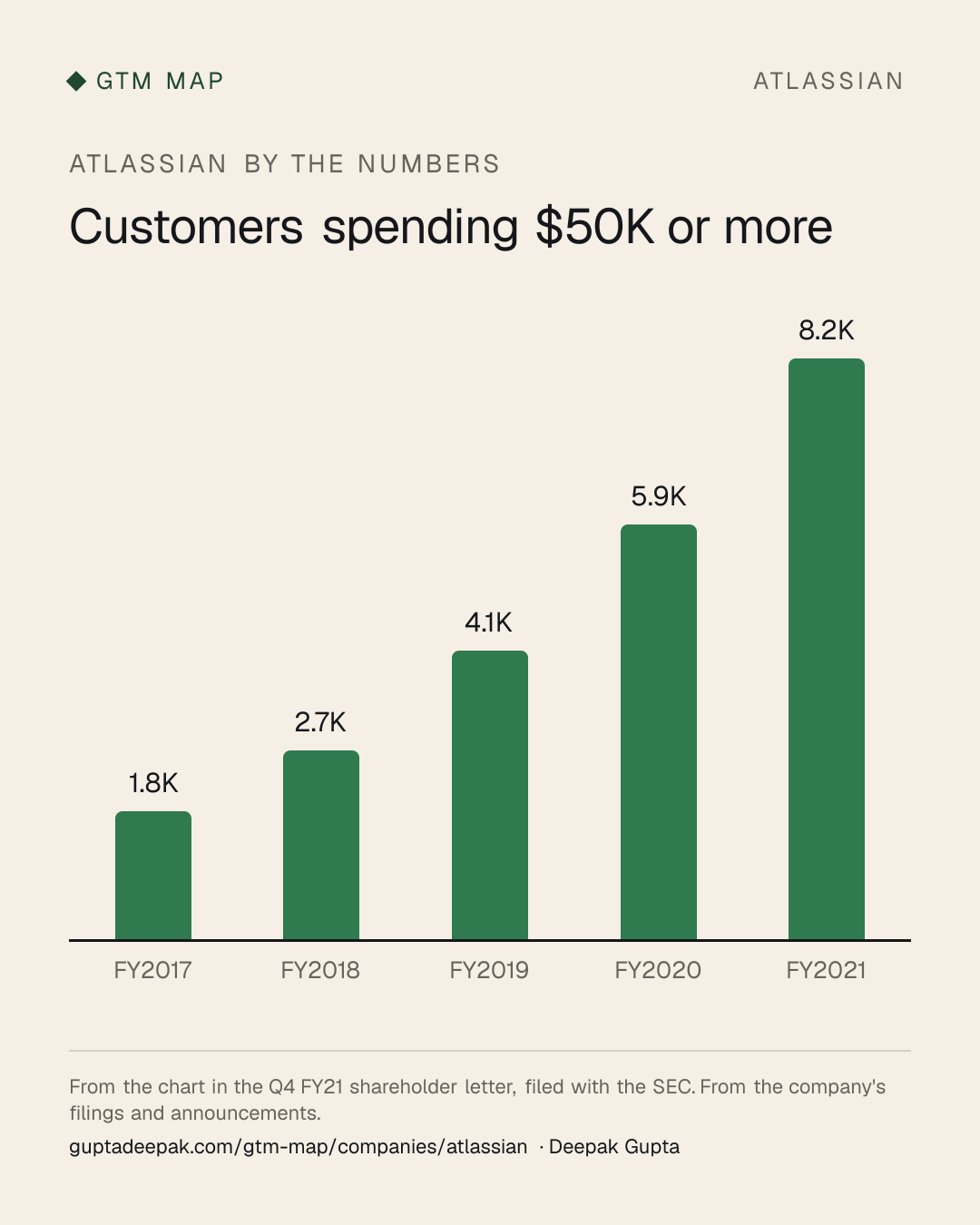
The FY2021 20-F describes a sales team focused on expanding relationships with the largest customers, next to an automated self-serve funnel. Customers spending $50K or more grew from 1,817 in FY2017 to 8,246 in FY2021.[6],[12]
- Partner channel
Over 700 Solution Partners and Global Alliance Partners drove more than a third of revenue. Marketplace purchases passed $500 million in fiscal 2021, and a customer using a Marketplace app showed about half the dollar churn.[12],[6]
- Land and expand
The cloud migration: no new server licenses from February 2021 and the end of server support in February 2024, with loyalty discounts for large on-premises customers who moved.[6],[11]
- Community
The Community site drew over 19 million visitors in FY2021, and 80% of attendees at community-led events started a cloud trial within 30 days.[12]
- Inbound content
The co-CEOs name a "top-notch SEO and performance marketing machine" as part of the go-to-market engine.[12]
- Owned events
Summit moved online in 2020 with over 16,000 unique viewers from 126 countries, and the flagship event later became Atlassian Team.[11],[6]
- Product-led
2022 to now
Enterprise sales on a cloud-only platform
Self-serve still lands customers, but a direct sales force now runs a named enterprise sales motion, and over 90% of FY2026 revenue came from existing accounts. Data Center is being retired to move the base into the cloud.
- Sales-led
A direct sales force of field sales and solution sales expands the largest enterprise customers. The FY2026 10-K warns that the enterprise sales motion brings higher costs, longer sales cycles, and less predictability.[8],[9]
- Product-led
The self-serve flywheel of word of mouth and low-touch demand generation still drives trial, adoption, and first expansion. Free plans cover up to 10 users, and commissioned sales enters once a customer reaches a specific size.[9],[14]
- Land and expand
Over 90% of FY2026 revenue came from accounts that existed a year earlier, driven by paid seat expansion and price increases. Data Center stopped selling to new customers in March 2026.[9]
- Partner channel
Solution partners and a Marketplace of more than 6,000 third-party apps and integrations continue, and marketplace revenue rose $21.4 million in FY2026.[9]
- Paid acquisition
Marketing now targets enterprise customers in particular, with advertising, in-person customer events, and industry analyst relations.[9]
- Sales-led
02The numbers
Show the data
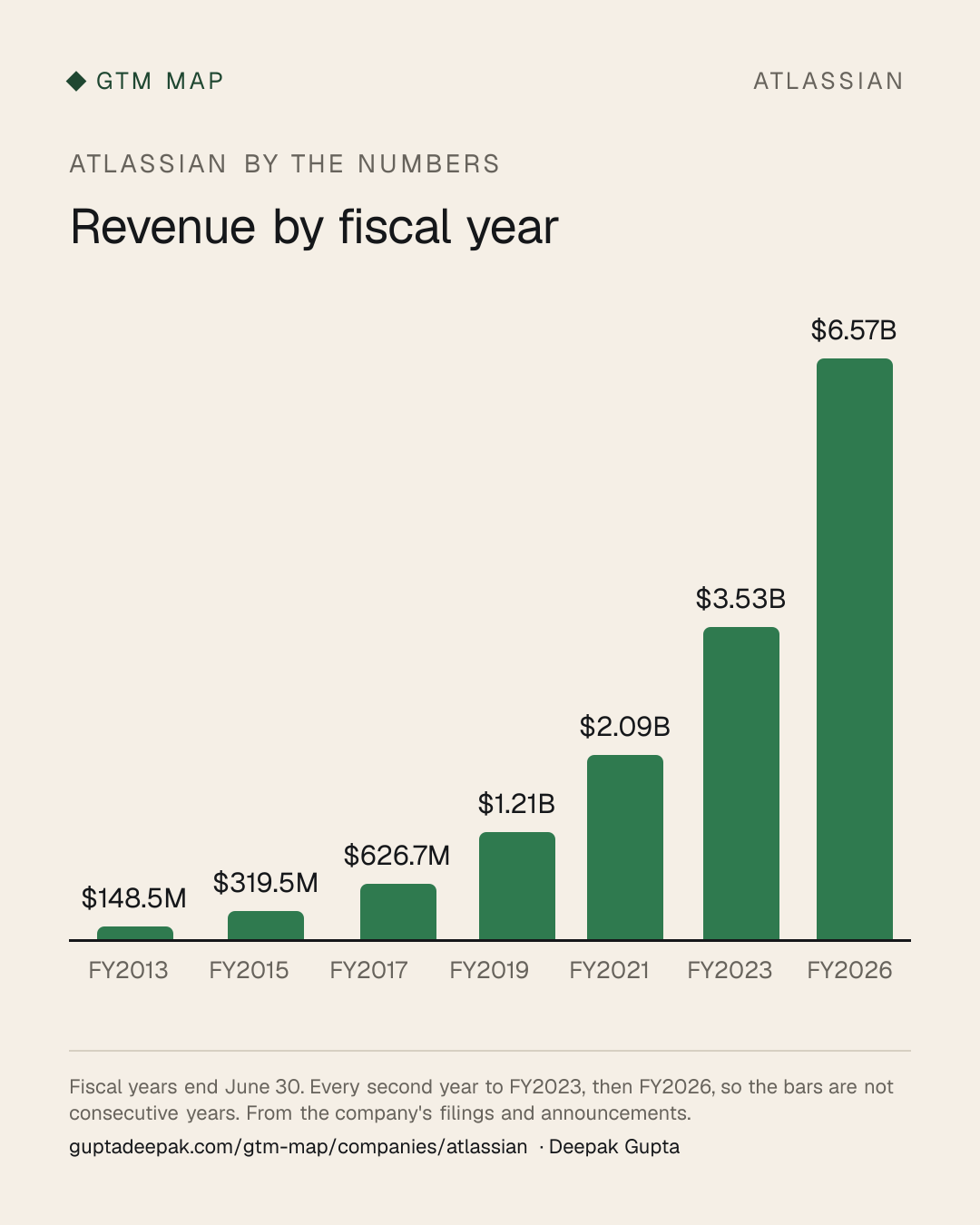
| FY2013 | $148.5M | From a filing |
|---|---|---|
| FY2015 | $319.5M | From a filing |
| FY2017 | $626.7M | From a filing |
| FY2019 | $1.21B | From a filing |
| FY2021 | $2.09B | From a filing |
| FY2023 | $3.53B | From a filing |
| FY2026 | $6.57B | From a filing |
Show the data
| FY2017 | 1.8K | Company-stated |
|---|---|---|
| FY2018 | 2.7K | Company-stated |
| FY2019 | 4.1K | Company-stated |
| FY2020 | 5.9K | Company-stated |
| FY2021 | 8.2K | Company-stated |
| Metric | Value | As of | Basis |
|---|---|---|---|
| Revenue, fiscal 2015 | $319.5M, from $148.5M in fiscal 2013[2] | June 30, 2015 | From a filing |
| Marketing and sales expense, fiscal 2015 | $68.0M, about 21% of revenue[2] | June 30, 2015 | From a filing |
| Research and development as a share of revenue, fiscal 2015 | 44%[2] | June 30, 2015 | From a filing |
| Paying customers at the IPO | 51,636[2] | September 30, 2015 | From a filing |
| Organizations using the products, including free and starter | More than 450,000[2] | September 30, 2015 | From a filing |
| Website visitors and free evaluations per typical business day | 70,000+ visitors, 6,500+ evaluations[2] | September 2015 | From a filing |
| Share of transactions on the website | Over 98%[2] | September 30, 2015 | From a filing |
| Indirect channel share of revenue, fiscal 2015 | About 25%[2] | June 30, 2015 | From a filing |
| Cohort spend over five years (fiscal 2009 to 2011 cohorts) | 7x initial purchase[2] | 2015 | From a filing |
| IPO price | $21.00 per Class A share[2] | December 10, 2015 | From a filing |
| Marketplace purchases, fiscal 2021 | Over $500M[6] | June 30, 2021 | From a filing |
| Revenue driven by channel partners | Over one-third, 700+ partners[12] | June 30, 2021 | Company-stated |
| Total customers, fiscal 2021 | 236,118[12] | June 30, 2021 | Company-stated |
| Revenue, fiscal 2026 | $6.57B, up 26%[9] | June 30, 2026 | From a filing |
| Revenue from accounts existing a year earlier, fiscal 2026 | Over 90%[9] | June 30, 2026 | From a filing |
| Marketing and sales vs research and development, fiscal 2026 | 24% vs 50% of revenue[9] | June 30, 2026 | From a filing |
| Customers with more than $10K in Cloud ARR | 57,334, from 45,842 in fiscal 2024[9] | June 30, 2026 | From a filing |
| Customers with two or more seats, fiscal 2026 (new definition, not comparable to earlier counts) | More than 350,000[9] | June 30, 2026 | From a filing |
“Reported” figures come from trade press, not the company, and are shown with their date.
03Myth checks
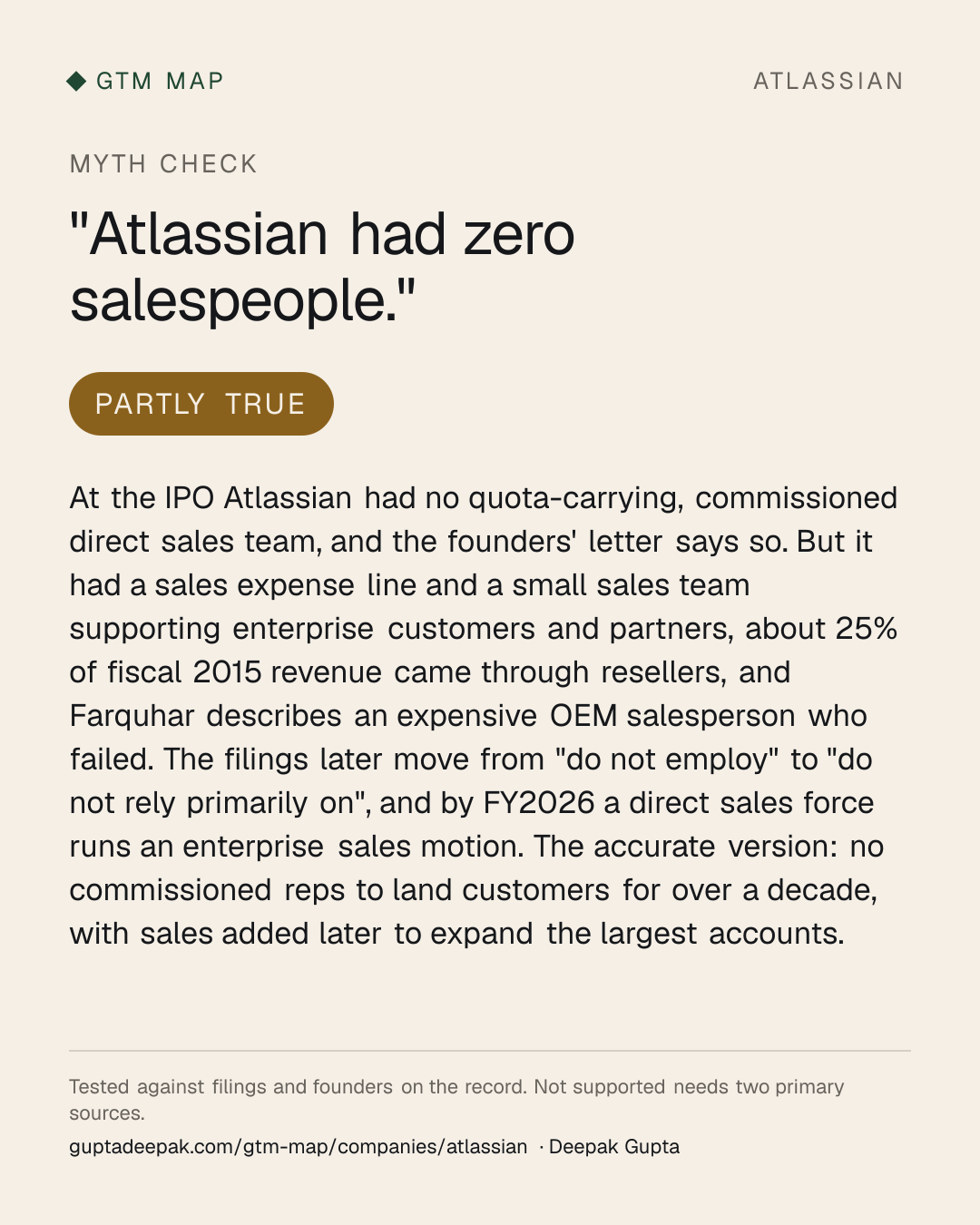
“Atlassian had zero salespeople.”
Partly trueAt the IPO Atlassian had no quota-carrying, commissioned direct sales team, and the founders' letter says so. But it had a sales expense line and a small sales team supporting enterprise customers and partners, about 25% of fiscal 2015 revenue came through resellers, and Farquhar describes an expensive OEM salesperson who failed. The filings later move from "do not employ" to "do not rely primarily on", and by FY2026 a direct sales force runs an enterprise sales motion. The accurate version: no commissioned reps to land customers for over a decade, with sales added later to expand the largest accounts.[2],[3],[15],[4],[5],[6],[9]
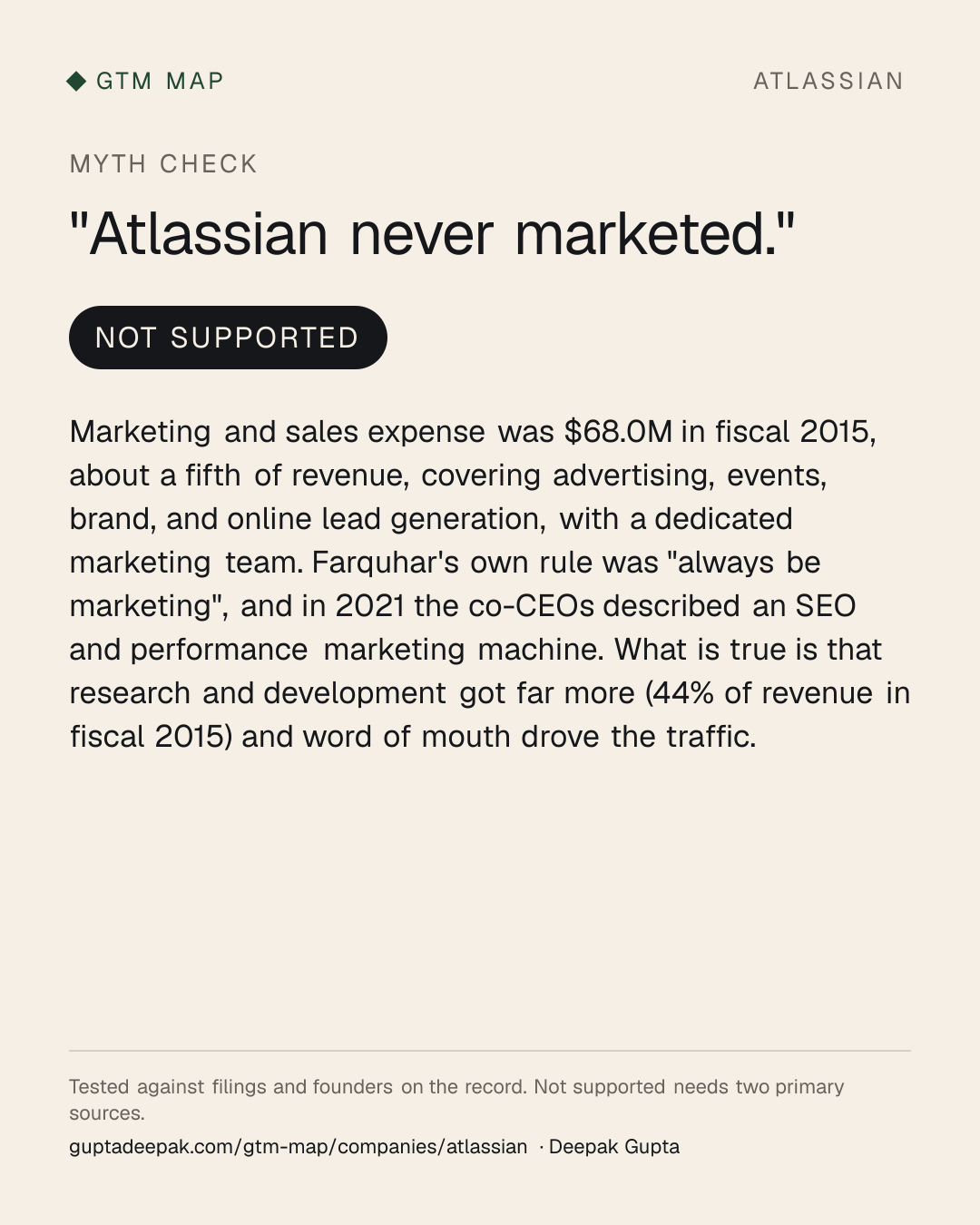
“Atlassian never marketed.”
Not supportedMarketing and sales expense was $68.0M in fiscal 2015, about a fifth of revenue, covering advertising, events, brand, and online lead generation, with a dedicated marketing team. Farquhar's own rule was "always be marketing", and in 2021 the co-CEOs described an SEO and performance marketing machine. What is true is that research and development got far more (44% of revenue in fiscal 2015) and word of mouth drove the traffic.[2],[15],[12]
On the record
“We believe software is bought, not sold. [...] We don't have quota-carrying sales reps that focus on reaching and servicing a handful of customers.”
Mike Cannon-Brookes and Scott Farquhar, Co-founders and co-CEOs, Atlassian F-1 founders' letter[1]
Founders' letter, Our Beliefs section
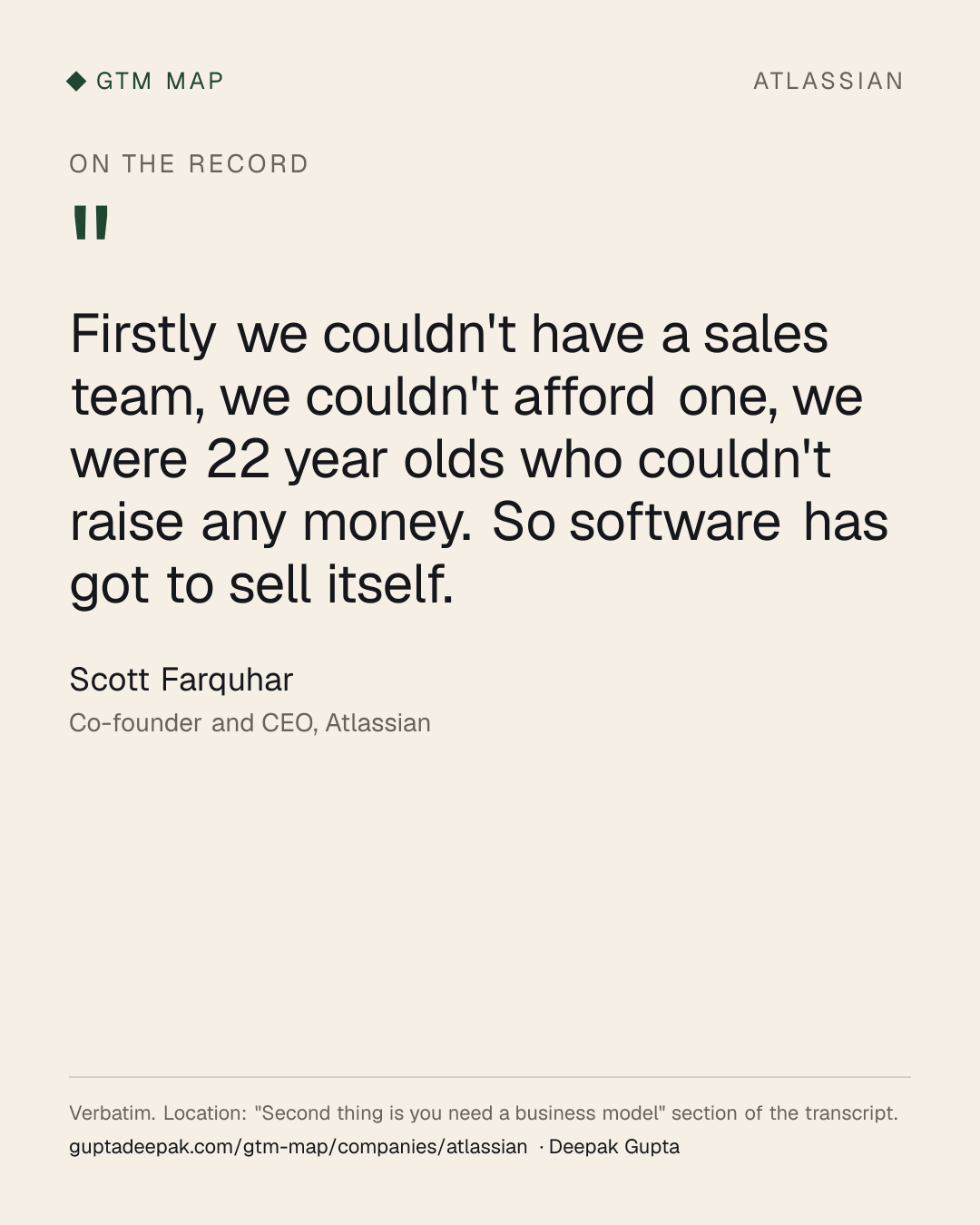
“Firstly we couldn't have a sales team, we couldn't afford one, we were 22 year olds who couldn't raise any money. So software has got to sell itself.”
Scott Farquhar, Co-founder and CEO, Atlassian[15]
"Second thing is you need a business model" section of the transcript
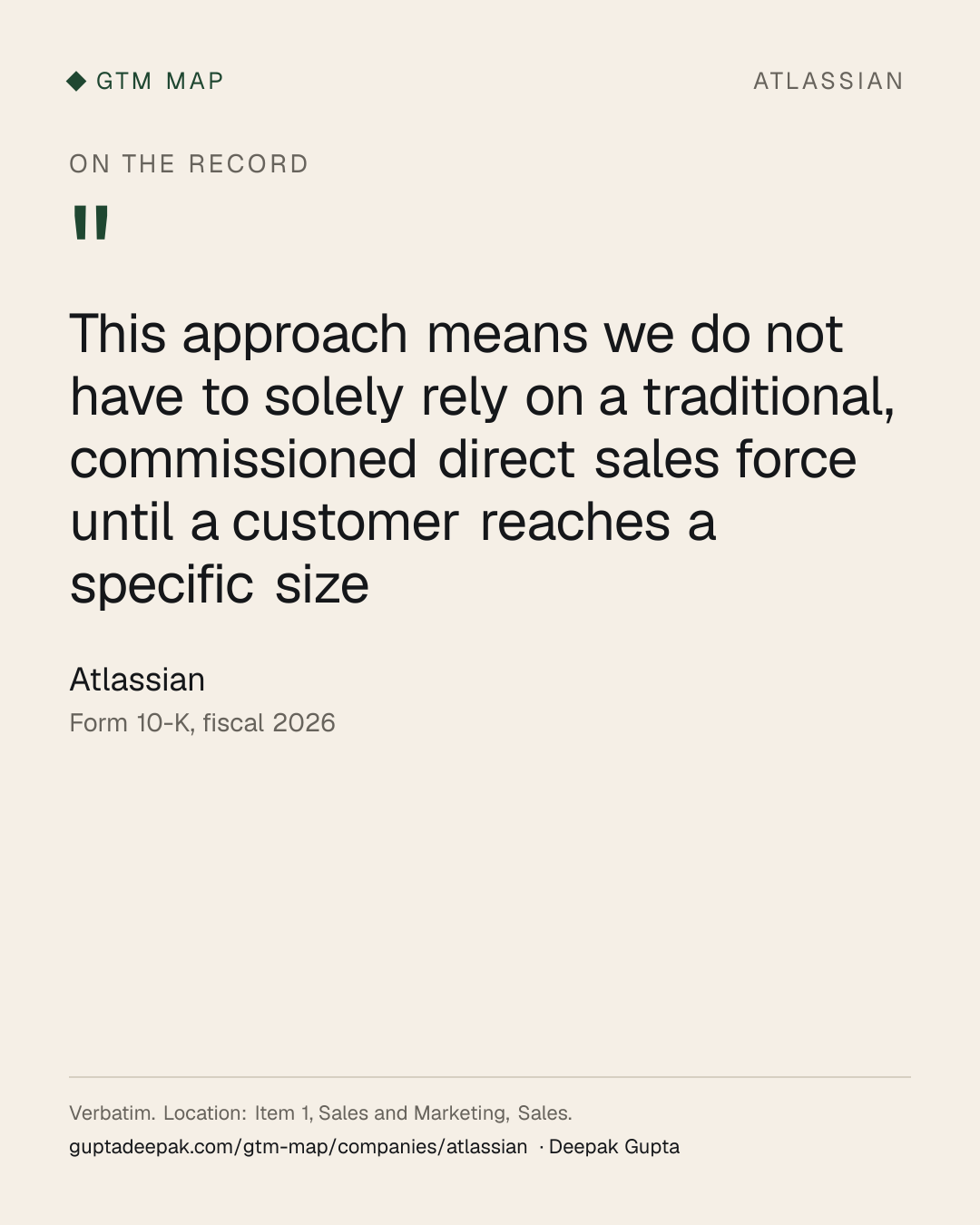
“This approach means we do not have to solely rely on a traditional, commissioned direct sales force until a customer reaches a specific size”
Atlassian, Form 10-K, fiscal 2026[9]
Item 1, Sales and Marketing, Sales
04What other companies can take from it
Make the price low enough that no salesperson is needed, then put it on the website.
Works when: The product is adopted by a team without IT procurement, deploys in minutes, and the first purchase is a credit-card amount.
Backfires when: The buyer is a central security or procurement function that requires a contract and a security review before any use, or the product needs services to deploy.
Based on: Software that sells itself, Product-led; Starter licenses, Marketplace and Experts, Product-led
Use the entry price as a funnel lever, not a revenue line.
Works when: Expansion inside customers is strong (7x over five years at Atlassian), so the lifetime value of a small team is high.
Backfires when: Small customers rarely grow, or support cost per free team is high. Farquhar ran a five-day $5 test first because the support load was unknown.
Based on: Starter licenses, Marketplace and Experts, Product-led; Free cloud editions and the server sunset, Product-led
Let an ecosystem do the high-touch work you will not staff.
Works when: The product is extensible and customers need local services, customization, or integrations you do not want to build.
Backfires when: The product is closed or simple enough that partners cannot earn a living around it.
Based on: Starter licenses, Marketplace and Experts, Partner channel; Free cloud editions and the server sunset, Partner channel
Add sales to expand, not to land.
Works when: Self-serve already lands accounts that later reach enterprise size, and you can see which ones are crossing the threshold.
Backfires when: The large deals require a top-down first sale, so there is no self-serve footprint to expand.
Based on: Free cloud editions and the server sunset, Sales-assist; Enterprise sales on a cloud-only platform, Sales-led
05 · GTM Now
What changes in the AI era, and what to do now
Analysis by Deepak Gupta. This is opinion built on the sourced record above, not part of it.[9],[12],[11],[2]
Still works
- The self-serve land with a free edition and a transparent price. An AI agent can sign a team up to a free plan with no salesperson involved.
- The Marketplace and partner model, as integration surfaces multiply. The FY2026 10-K lists integrations with Anthropic, Cursor, and OpenAI.
Breaks
- Seat-based expansion is exposed if AI agents do work that used to need more human seats. FY2026 growth still came from paid seat expansion and price increases.
- Word of mouth and SEO as the top of the funnel weaken when AI answers replace search clicks, and the 10-K now lists AI-native development platforms and general-purpose AI assistants and agents as competitors.
What replaces it
- AI bundled into paid editions, which is Atlassian's own move: Rovo at no additional cost for standard, premium, and enterprise customers, and Collections with pooled Rovo credits, so expansion can come from bundles and credits rather than seats alone. Whether credits replace seat growth is not shown in the filings.
Apply it now
If you are
A seed to Series B tool for technical or operational teams, bought by team leads, under $10K first-year ACV, and extensible by third parties
- Publish full pricing and let a team of 10 buy or start free without talking to anyone.
- Instrument expansion by account (seats, products, teams) and review cohort spend every year.
- Open an app or integration marketplace early and share revenue with the developers who build on it.
- Recruit local partners for languages, currencies, and customization before hiring field sales.
- Add a small sales team only for accounts that cross a spend threshold, focused on expansion.
You will know it works when: The share of revenue from accounts that started on a free or starter plan, and a cohort's spend multiple after three to five years (Atlassian's filed figure was 7x over five years).
Based on Atlassian's Starter licenses, Marketplace and Experts, Starter licenses, Marketplace and Experts, Starter licenses, Marketplace and Experts
If you are
A later-stage self-serve company whose largest customers now want security reviews, contracts, and multi-year deals
- Keep self-serve as the landing motion and state the size at which sales takes over, as the FY2026 10-K does.
- Build an enterprise edition with data residency, an SLA, and central admin before pushing sales, as Atlassian did with Cloud Enterprise in 2020.
- If you are retiring a self-managed product, announce a multi-year timeline with migration tools and loyalty pricing.
- Report $10K-plus and $50K-plus customer counts separately so the sales motion has its own scoreboard.
You will know it works when: Growth in customers above $10K of cloud ARR (45,842 to 57,334 from FY2024 to FY2026 at Atlassian) while marketing and sales stays well below research and development as a share of revenue.
Based on Atlassian's Enterprise sales on a cloud-only platform, Enterprise sales on a cloud-only platform, Free cloud editions and the server sunset
Motions in this record
Compare with every other company on the GTM matrix.
Share the visuals
Every card is drawn from the sourced record above and sized 1080 by 1350 for LinkedIn and X. Free to share with a link back to this page.
![Mike Cannon-Brookes and Scott Farquhar: We believe software is bought, not sold. [...] We don't have quota-carrying sales reps that focus on reaching and servicing a handful of customers.](/gtm-map/companies/atlassian/cards/quote-1.png)
Sources
- [1]SEC filingAtlassian Corporation Plc Form F-1 Registration Statement (November 9, 2015)
- [2]SEC filingAtlassian Corporation Plc final prospectus (Form 424B4) (December 10, 2015)
- [3]SEC filingForm 20-F, fiscal year ended June 30, 2016 (August 18, 2016)
- [4]SEC filingForm 20-F, fiscal year ended June 30, 2017 (September 1, 2017)
- [5]SEC filingForm 20-F, fiscal year ended June 30, 2019 (August 23, 2019)
- [6]SEC filingForm 20-F, fiscal year ended June 30, 2021 (August 13, 2021)
- [7]SEC filingForm 20-F, fiscal year ended June 30, 2022 (August 19, 2022)
- [8]SEC filingForm 10-K, fiscal year ended June 30, 2023 (August 18, 2023)
- [9]SEC filingForm 10-K, fiscal year ended June 30, 2026 (August 14, 2026)
- [10]EarningsAtlassian Shareholder Letter, Q2 FY20 (6-K exhibit) (January 23, 2020)
- [11]EarningsAtlassian Shareholder Letter, Q3 FY20 (6-K exhibit) (April 30, 2020)
- [12]EarningsAtlassian Shareholder Letter, Q4 FY21 (6-K exhibit) (July 29, 2021)
- [13]CompanyAtlassian remote-friendly software: available for FREE (Atlassian Community announcement) (March 18, 2020)
- [14]CompanyExplore Jira Cloud plans (October 18, 2026)
- [15]Founder interviewFrom $0-100million with no sales people. The Atlassian 10 commandments for startups (Business of Software 2010, transcript) (Scott Farquhar, September 15, 2011, at numbered points "Second thing is you need a business model" and "ABM- always be marketing")
Every phase, motion, and myth verdict cites a filing, the company's own pages, or a founder speaking on the record. See the methodology.