
Product-led · acquired by Salesforce (2021)
How Slack went to market
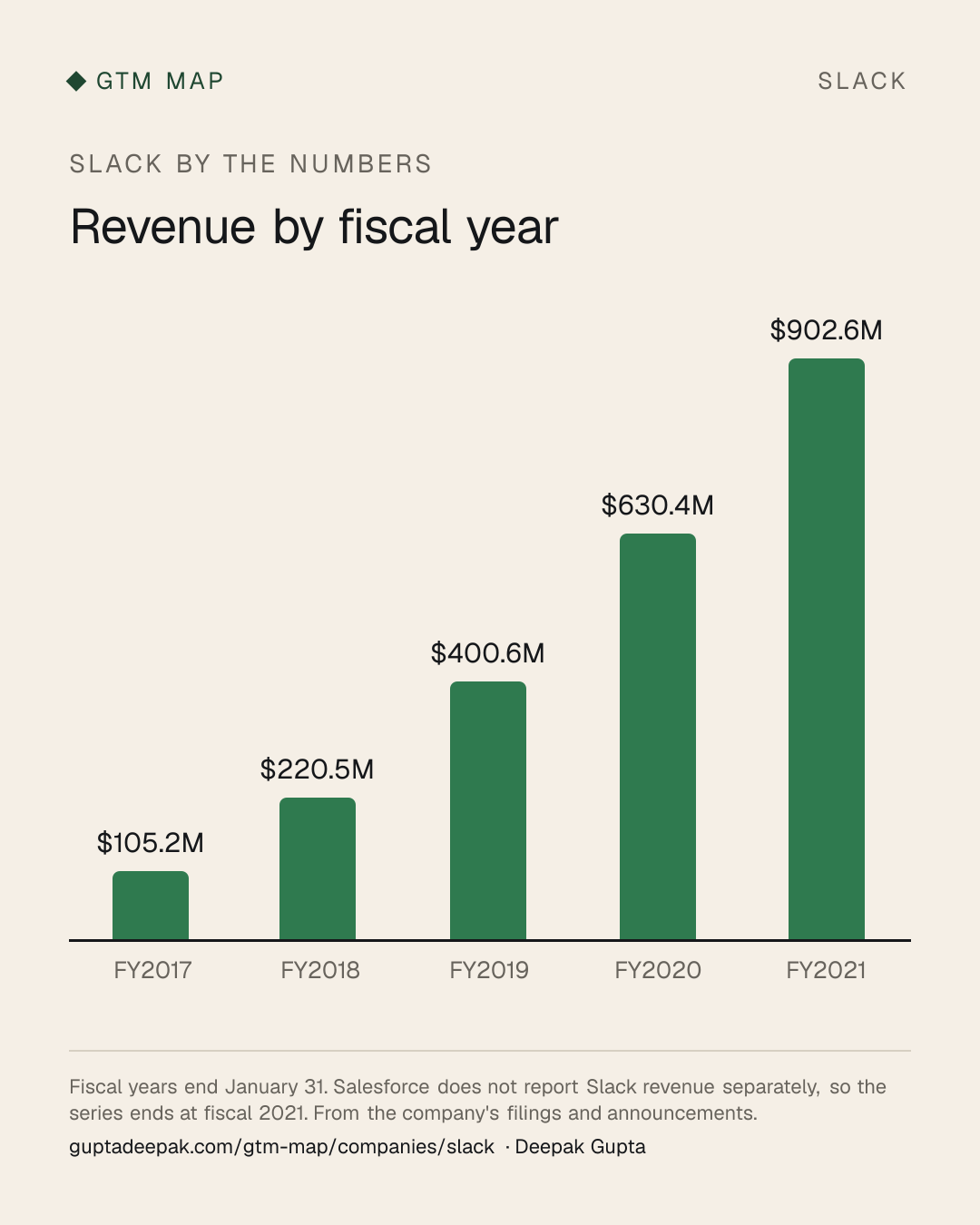
Slack let any team start free and spread inside its own company, then hired a direct sales force to turn that bottom-up usage into enterprise contracts. Shared channels later carried it across company lines. Revenue grew from $105.2M in fiscal 2017 to $902.6M in fiscal 2021, and Salesforce bought it in 2021.
- Buyer:
- Small business, Mid-market, Enterprise
- Contract size:
- Mixed
- Checked:
- October 18, 2026
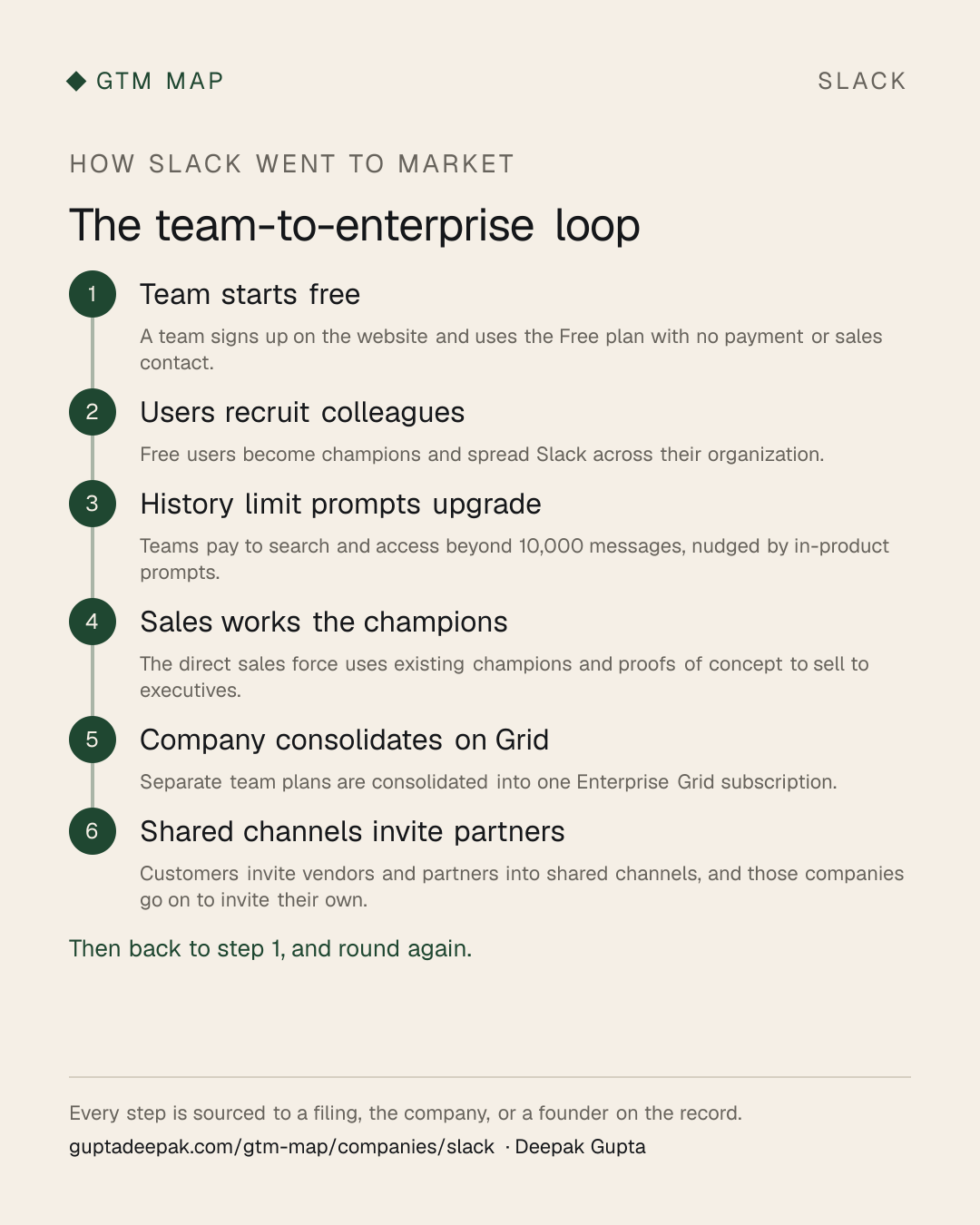
Team starts free
A team signs up on the website and uses the Free plan with no payment or sales contact.[1]
Users recruit colleagues
Free users become champions and spread Slack across their organization.[1]
History limit prompts upgrade
Teams pay to search and access beyond 10,000 messages, nudged by in-product prompts.[1]
Sales works the champions
The direct sales force uses existing champions and proofs of concept to sell to executives.[1]
Company consolidates on Grid
Separate team plans are consolidated into one Enterprise Grid subscription.[1]
Shared channels invite partners
Customers invite vendors and partners into shared channels, and those companies go on to invite their own.[12]
Back to step 1, and round again
01The phases
PrimarySupportingTried, then dropped
2014 to 2015
Free for teams, spread by word of mouth
Slack publicly launched its product in 2014, five years after incorporating as Tiny Speck. Teams started free, spread it to colleagues, and account managers helped big companies buy, with no outbound.
- Product-led
Any team can start on the Free plan from the website with no payment or sales contact, and teams upgrade on the website as they use it more. Butterfield describes the plan as doing business software in a consumer way: viral, freemium, and A/B tested.[1],[15]
- Viral loop
Adoption starts with end users, and free users spread Slack to colleagues inside their organization. The S-1 says its marketing strategy depends on free users convincing others to use Slack and to drive the conversion to paid plans.[1]
- Sales-assist
Account managers handled buyers at large companies who had already decided to buy, with no outbound and no commissions. Butterfield described it as midwifing the sale through procurement rather than selling.[15]
- Product-led
2016 to 2019
Direct sales layered on self-serve, then Enterprise Grid
From May 2016, when Slack hired a VP of Sales and Customer Success from Salesforce, a direct sales force worked the accounts where Slack was already in use. Enterprise Grid followed in 2017.
- Sales-assist
The direct sales force uses internal champions and self-serve proofs of concept as leads, then sells to C-suite executives and business unit leaders. The S-1 says enterprise decision-makers often adopt Slack after noticing organic use inside the company.[1]
- Product-led
Self-service still brought in most new organizations. The S-1 names search and access beyond 10,000 messages, the Free plan limit, and single sign-on on the Plus plan as main reasons free organizations convert, helped by in-product prompts.[1]
- Land and expand
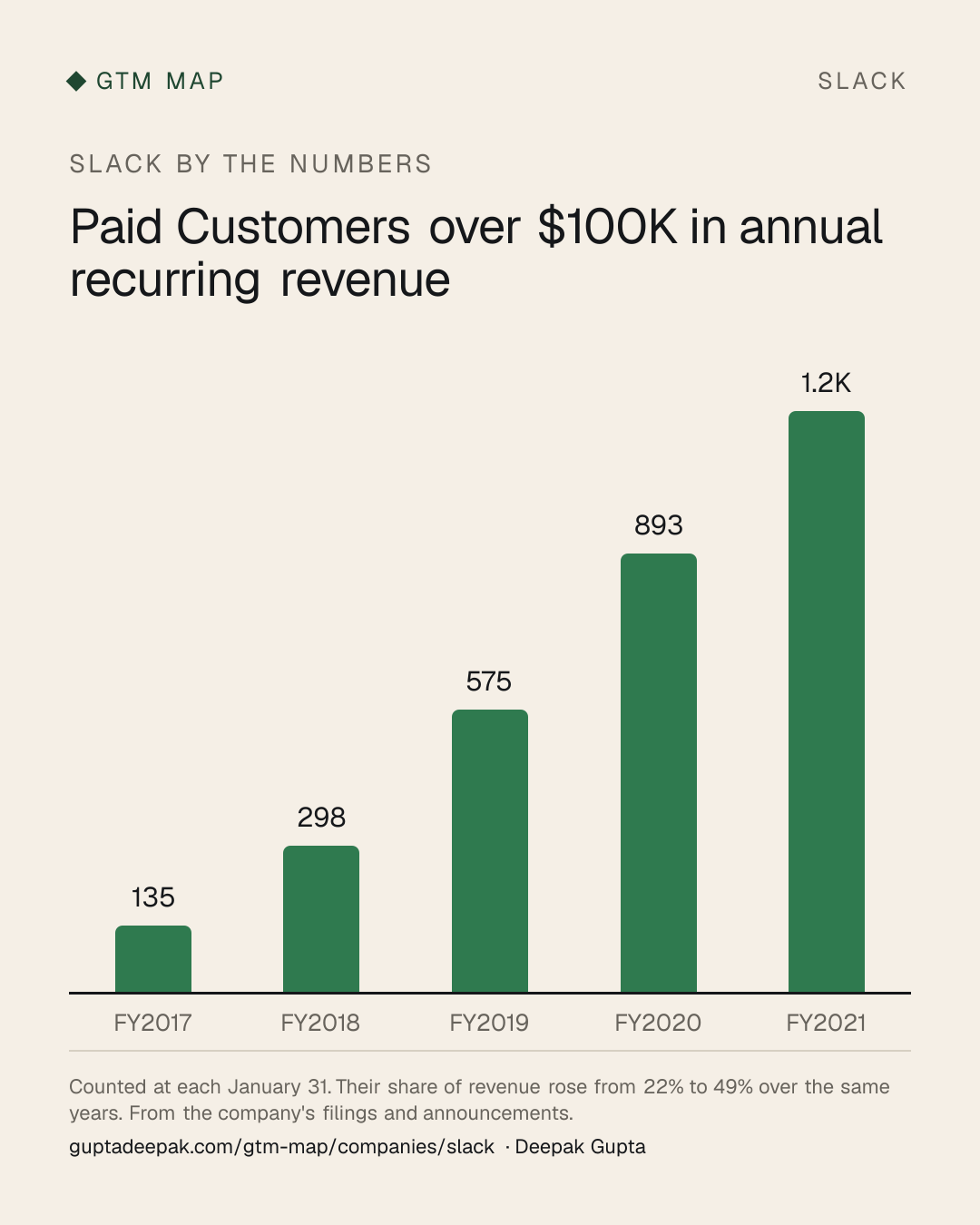
Revenue growth came mainly from expansion inside paying customers: Net Dollar Retention of 171%, 152%, and 143% across fiscal 2017 to 2019. Customers paying over $100,000 went from 22% to 40% of revenue, and Enterprise Grid let a company consolidate workspaces into one plan.[1]
- Sales-led
A globally distributed field sales force, solutions engineering, demand generation, webinars, analyst relations, and C-suite events. Sales and marketing headcount grew 86% and then 77% in consecutive years.[1]
- Paid acquisition
Advertising cost $39.3M, $35.5M, and $61.7M in fiscal 2017 to 2019, and fiscal 2019 marketing rose $34.9M on advertising, brand marketing, and promotion.[1]
- Owned events
Frontiers, the annual user conference, is part of the sales and marketing program.[1]
- Partner channel
More than 1,500 apps were listed in the App Directory by January 2019, and the Slack Fund had invested $10.1M in 46 companies building on Slack.[1]
- Sales-assist
2019 to 2021
Shared channels, the pandemic, and the sale to Salesforce
Shared channels, later called Slack Connect, linked workspaces across companies. The work-from-home surge brought record new customers but also higher churn, and Salesforce agreed to buy Slack in December 2020.
- Viral loop
Shared channels connect the workspaces of different companies, so a customer invites its vendors and partners, who then invite theirs. Paid Customers using them went from more than 32,000 in January 2020 to more than 74,000 in January 2021, and Butterfield credited Slack Connect with driving viral growth.[12],[2],[3],[6]
- Product-led
The free and self-serve funnel absorbed the work-from-home surge: a record 12,000 net new Paid Customers and over 90,000 net new organizations in the quarter ending April 2020. The 10-K also records higher paid churn and less expansion that year.[5],[3]
- Sales-led
Customers paying more than $100,000 rose to 49% of revenue in fiscal 2021, and customers above $1M in annual recurring revenue reached 108, up 54%. Butterfield said the largest companies were choosing to standardize on Slack.[3],[7],[4]
- Land and expand
Expansion inside existing customers was still the main revenue driver, but Net Dollar Retention fell from 143% to 132% to 123% between fiscal 2019 and 2021.[2],[3]
- Paid acquisition
Self-service marketing listed brand advertising, PR, digital campaigns, and free trials of paid plans. Advertising was $38.1M in fiscal 2020 and $45.7M in fiscal 2021.[3]
- Partner channel
Partners such as enterprise software companies, security providers, and systems integrators supplied enterprise leads and co-sold.[3]
- Viral loop
2021 to now
Sold by Salesforce, free tier tightened, repositioned for AI agents
Salesforce completed the acquisition on July 21, 2021. Slack is now sold alongside Salesforce's products, its free plan keeps less history, and Salesforce positions it as the interface for its AI agents.
- Sales-led
Slack became part of Salesforce, which sells primarily through its direct sales force and cited synergies from combining the two companies' enterprise customer bases.[9],[10]
- Product-led
Self-service continues, but from September 2022 the free limit moved from 10,000 messages and 5 GB to 90 days of history, and the live plans page says free content older than a year is deleted. Salesforce still reports Slack self-service as its own attrition segment.[13],[14],[11]
- Land and expand
Salesforce describes Slack as integrated with every Salesforce offering, including Agentforce, and as the conversational interface where people and agents work together, with a built-in Slackbot agent.[11]
- Sales-led
02The numbers
| Metric | Value | As of | Basis |
|---|---|---|---|
| Revenue, fiscal 2017 to 2019 | $105.2M, $220.5M, $400.6M[1] | January 31, 2019 | From a filing |
| Sales and marketing as a share of revenue, fiscal 2017 to 2019 | 99%, 63%, 58%[1] | January 31, 2019 | From a filing |
| Revenue from free organizations that converted that year, fiscal 2019 | About 8%[1] | January 31, 2019 | From a filing |
| Organizations with three or more users | More than 600,000 (88,000 paid)[1] | January 31, 2019 | From a filing |
| Daily active users, quarter ending January 2019 | More than 10M[1] | January 31, 2019 | From a filing |
| Direct listing opening price | $38.50 vs $26 reference, $19.5B market cap[17] | June 20, 2019 | Reported |
| Revenue, fiscal 2021 | $902.6M, up 43%[3] | January 31, 2021 | From a filing |
| Paid Customers | 156,000[3] | January 31, 2021 | From a filing |
| Revenue share from customers paying over $100K, fiscal 2021 | 49%[3] | January 31, 2021 | From a filing |
| Net Dollar Retention Rate | 123%, from 171% in fiscal 2017[3] | January 31, 2021 | From a filing |
| Sales and marketing, fiscal 2021 | $460.7M, 51% of revenue[3] | January 31, 2021 | From a filing |
| Slack Connect connected endpoints | Over 660,000, up over 245%[7] | January 31, 2021 | Company-stated |
| Acquisition enterprise value at signing | About $27.7B[8] | December 1, 2020 | From a filing |
| Acquisition-date fair value of consideration | About $27.1B[10] | July 21, 2021 | From a filing |
“Reported” figures come from trade press, not the company, and are shown with their date.
03Myth checks
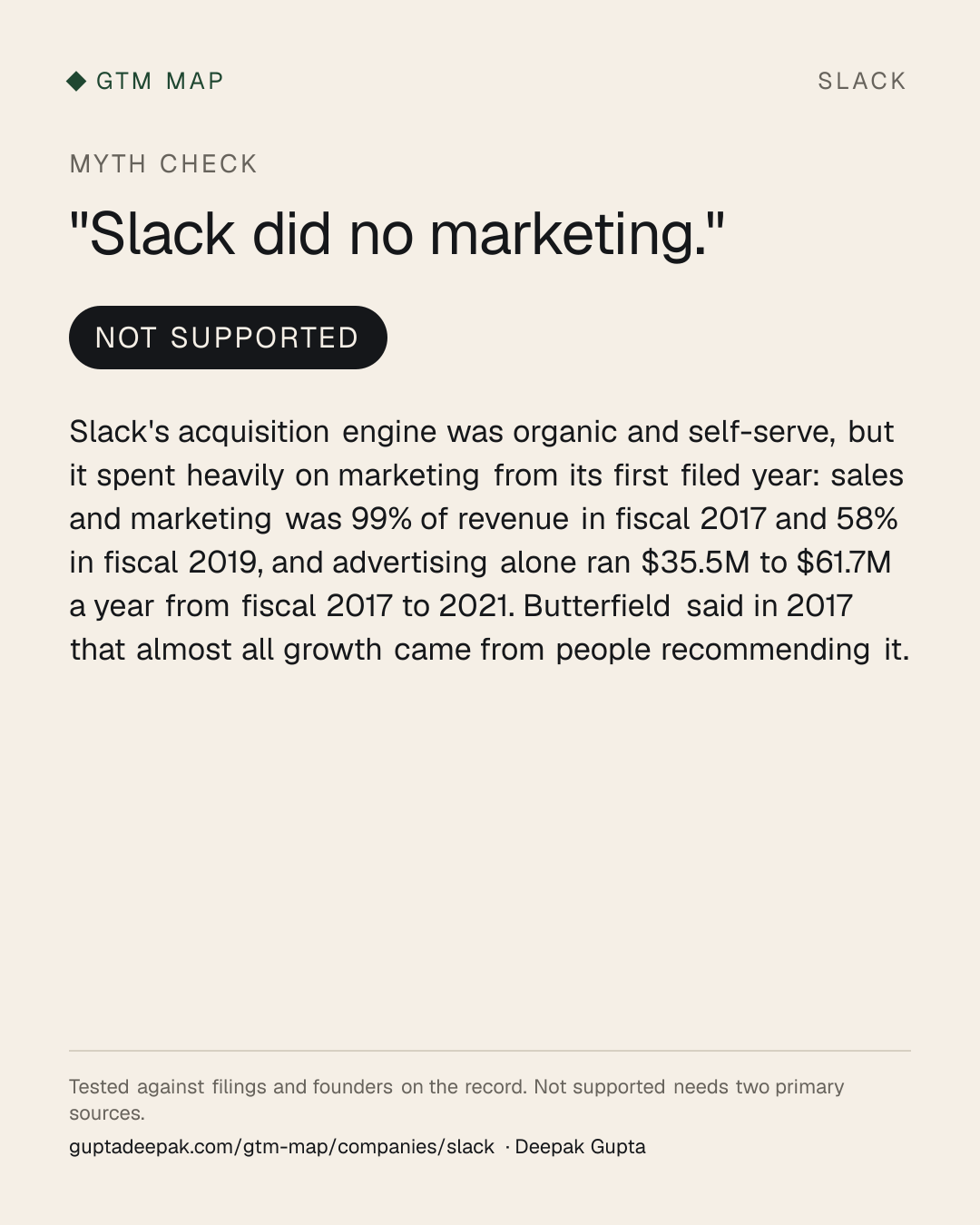
“Slack did no marketing.”
Not supportedSlack's acquisition engine was organic and self-serve, but it spent heavily on marketing from its first filed year: sales and marketing was 99% of revenue in fiscal 2017 and 58% in fiscal 2019, and advertising alone ran $35.5M to $61.7M a year from fiscal 2017 to 2021. Butterfield said in 2017 that almost all growth came from people recommending it.[1],[3],[16]
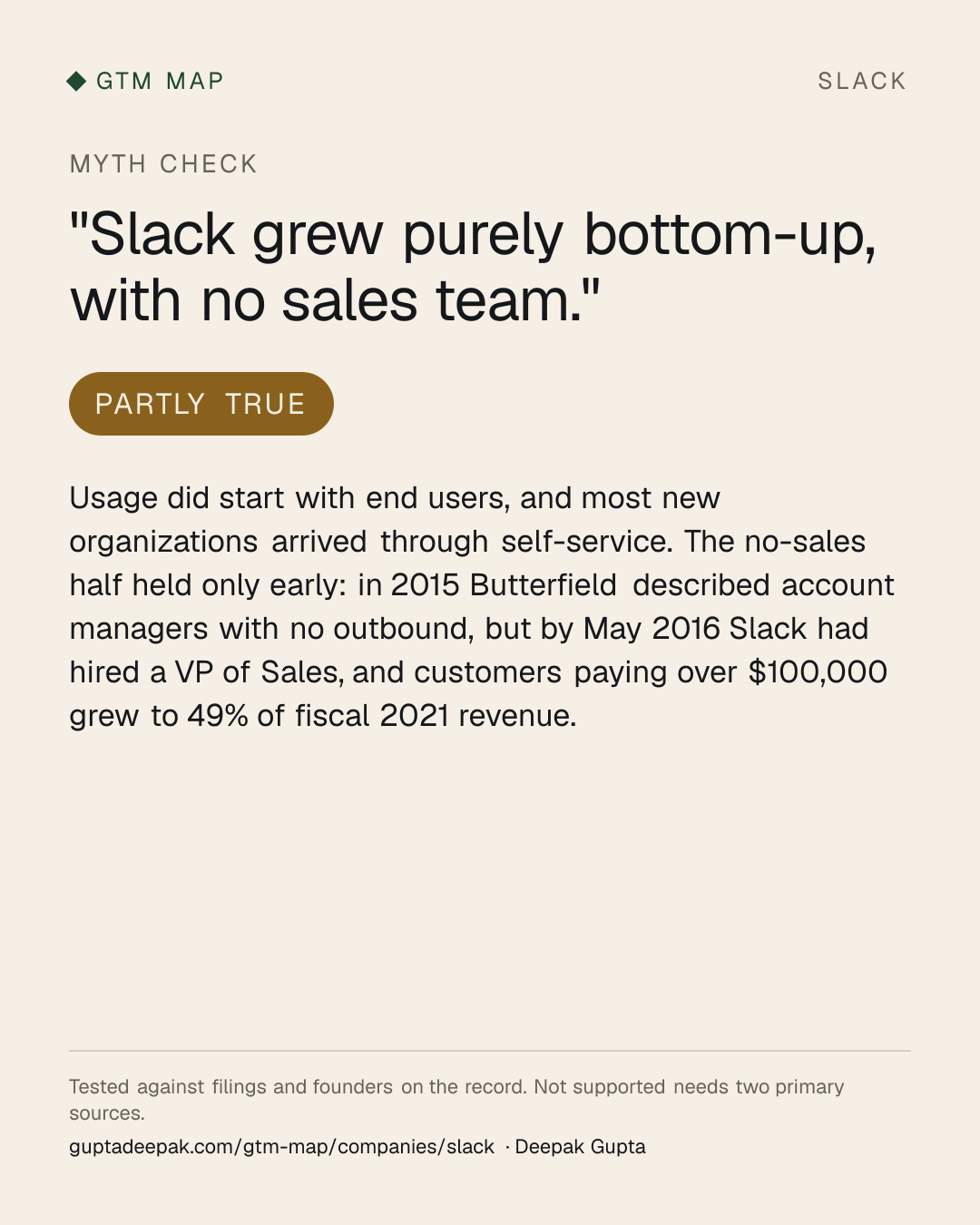
“Slack grew purely bottom-up, with no sales team.”
Partly trueUsage did start with end users, and most new organizations arrived through self-service. The no-sales half held only early: in 2015 Butterfield described account managers with no outbound, but by May 2016 Slack had hired a VP of Sales, and customers paying over $100,000 grew to 49% of fiscal 2021 revenue.[1],[3],[15]
On the record
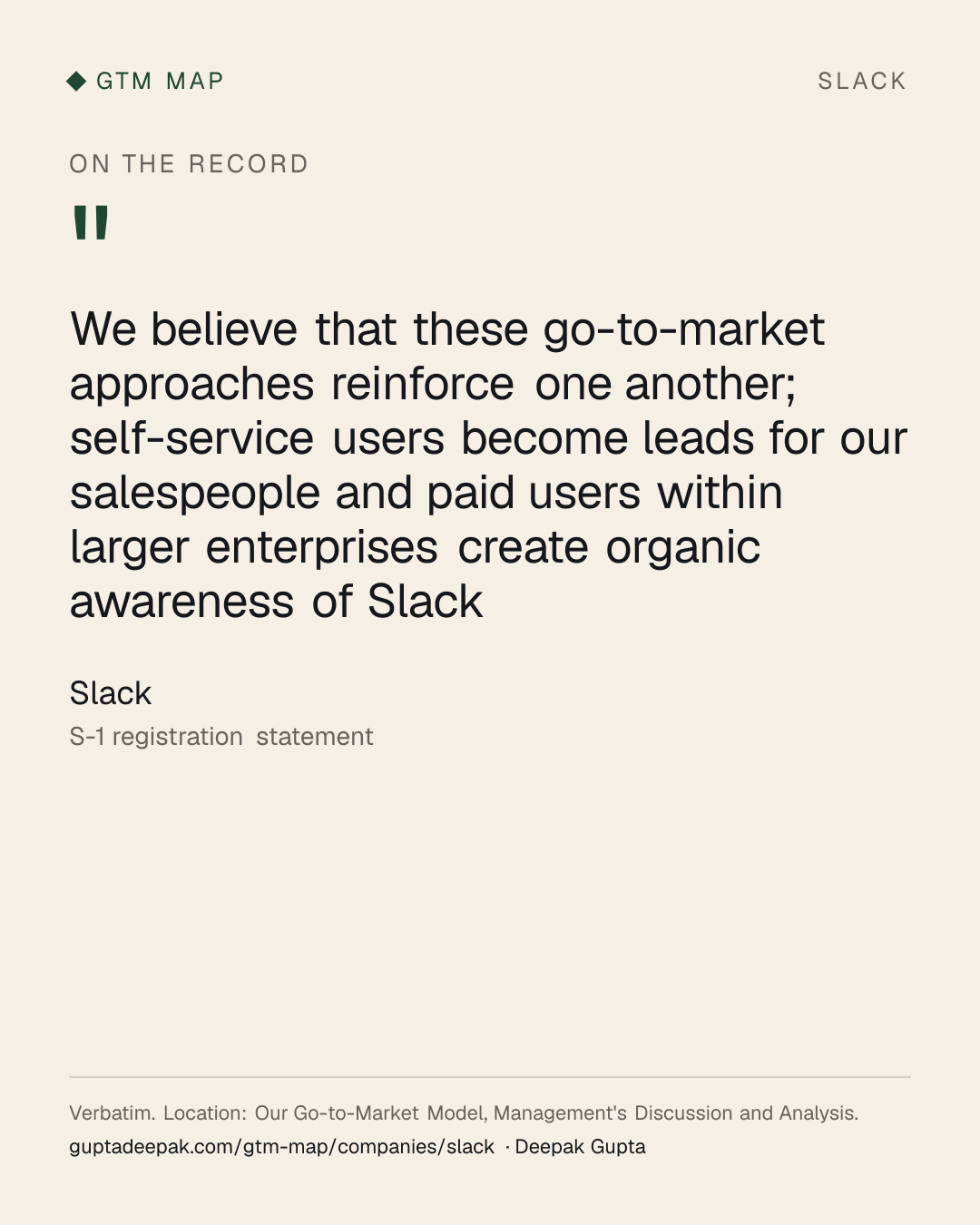
“We believe that these go-to-market approaches reinforce one another; self-service users become leads for our salespeople and paid users within larger enterprises create organic awareness of Slack”
Slack, S-1 registration statement[1]
Our Go-to-Market Model, Management's Discussion and Analysis
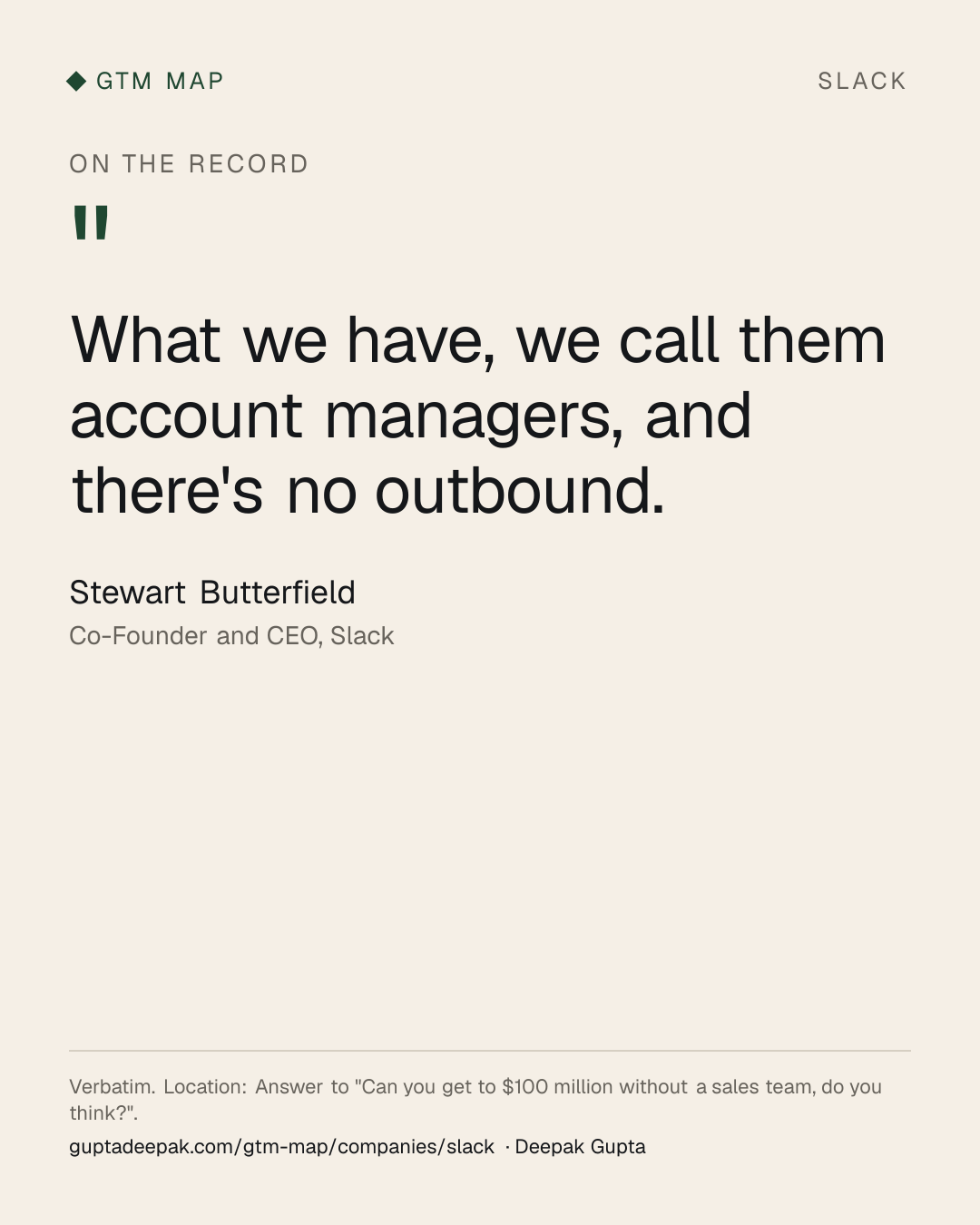
“What we have, we call them account managers, and there's no outbound.”
Stewart Butterfield, Co-Founder and CEO, Slack[15]
Answer to "Can you get to $100 million without a sales team, do you think?"
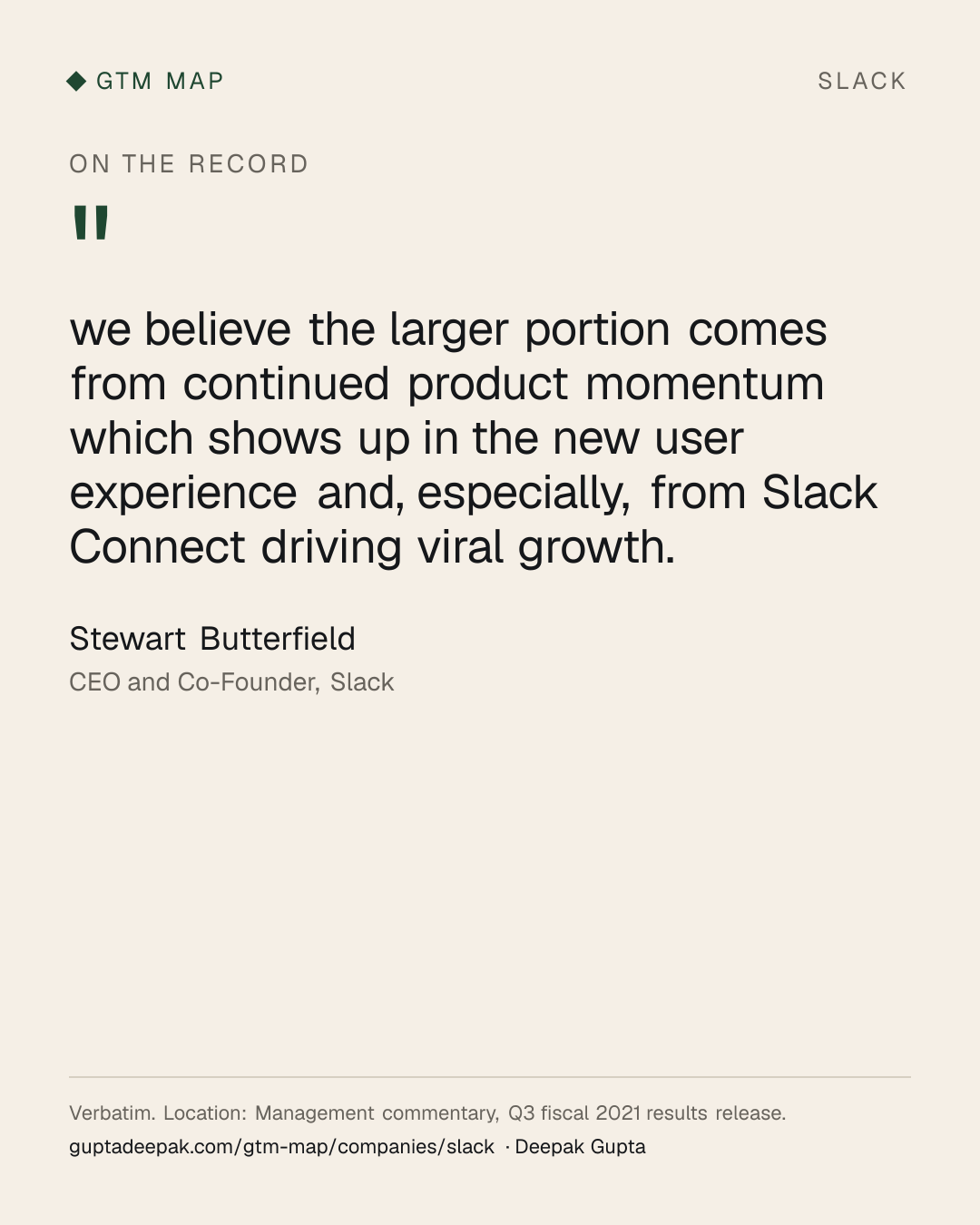
“we believe the larger portion comes from continued product momentum which shows up in the new user experience and, especially, from Slack Connect driving viral growth.”
Stewart Butterfield, CEO and Co-Founder, Slack[6]
Management commentary, Q3 fiscal 2021 results release
04What other companies can take from it
Put the upgrade trigger on accumulated value, not on a feature the team needs on day one.
Works when: The product's value grows with use (history, files, knowledge), so a team that has used it for months hits the limit right when the product matters most, and the buyer is an SMB or mid-market team with a card.
Backfires when: Value is immediate and does not accumulate, so a history limit never bites, or the buyer needs procurement and security review before any team can try it.
Based on: Direct sales layered on self-serve, then Enterprise Grid, Product-led; Free for teams, spread by word of mouth, Product-led
Let usage pick the accounts, then hire sales to work them.
Works when: Several teams inside one large company adopt on their own and you can see it by email domain or workspace count, and an enterprise version adds admin, security, and consolidation that IT will pay for.
Backfires when: Free usage is mostly small teams with no large parent, so a sales team has nobody to work.
Based on: Free for teams, spread by word of mouth, Sales-assist; Direct sales layered on self-serve, then Enterprise Grid, Sales-assist; Direct sales layered on self-serve, then Enterprise Grid, Land and expand
A cross-company feature turns customers into a distribution network.
Works when: Customers already work with outside parties (agencies, vendors, clients) over email, and the invited party gets value without buying first.
Backfires when: The work is internal only, or legal and security rules block outside access, so the loop never starts.
Based on: Shared channels, the pandemic, and the sale to Salesforce, Viral loop
Expansion rates fade as the base matures, so plan the next product before retention falls.
Works when: Pricing is per seat and early customers expanded fast from small starts.
Backfires when: A company reads an early net dollar retention above 150% as permanent and sizes its spending to it.
Based on: Direct sales layered on self-serve, then Enterprise Grid, Land and expand; Shared channels, the pandemic, and the sale to Salesforce, Land and expand
05 · GTM Now
What changes in the AI era, and what to do now
Analysis by Deepak Gupta. This is opinion built on the sourced record above, not part of it.[11],[13],[1],[2],[3]
Still works
- The team-first self-serve start and the champion-led sales handoff. AI search does not change the fact that a team can sign up and invite colleagues with no sales contact.
- Cross-company channels still pull outside parties in through an invite, which is not a search channel at all.
Breaks
- A message-history limit as the upgrade trigger is weaker when AI summaries and search are the value. Slack itself moved the free limit from a message count to 90 days, which makes the free tier a shorter trial rather than a permanent home.
- Seat-based expansion weakens if AI agents do work that used to need more seats. This is analysis; no source here measures it for Slack.
What replaces it
- Slack's own move inside Salesforce: positioned as the conversational interface where people and agents work together, with a built-in Slackbot agent.
- For a new product, an agent that works across company boundaries: when one company's agent posts into a shared space, the other side sees the product working, the way a shared channel invite once showed it.
Apply it now
If you are
A seed to Series B collaboration or workflow tool sold per seat to teams inside SMB and mid-market companies, under $10K a year at first, where usage builds up a history the team relies on
- Make the free plan fully usable for a team, with a ceiling tied to accumulated value (history, search depth, retention), not to core features.
- Track organizations by email domain and flag companies where three or more separate teams are active.
- Before hiring quota-carrying reps, put inbound account managers on those flagged companies to help with security review and procurement, with no outbound.
- Build one admin and consolidation product (single sign-on, central controls, merged workspaces) that IT will pay for once several teams are on it.
You will know it works when: The share of new paid revenue from organizations that started free (Slack's filed figure was about 8% to 10% of a year's revenue from same-year conversions) and the count of customers over $100K a year.
Based on Slack's Free for teams, spread by word of mouth, Free for teams, spread by word of mouth, Direct sales layered on self-serve, then Enterprise Grid
If you are
A Series B or later B2B product whose customers already work with outside vendors, clients, or partners over email
- Ship a shared space that lets an outside company join from an invite, with value on their side before they pay.
- Show the host's brand and a path to set up their own workspace to every invited party.
- Count invited organizations that later create their own paid account, and report it as its own funnel.
- Give admins controls over external access so security teams approve the feature instead of blocking it.
You will know it works when: The number of paying customers using the cross-company feature (Slack went from more than 32,000 to more than 74,000 Paid Customers in a year) and the share of new paid organizations whose first touch was an invite.
Based on Slack's Shared channels, the pandemic, and the sale to Salesforce
Motions in this record
Compare with every other company on the GTM matrix.
Share the visuals
Every card is drawn from the sourced record above and sized 1080 by 1350 for LinkedIn and X. Free to share with a link back to this page.
Sources
- [1]SEC filingSlack Technologies, Inc. Form S-1 Registration Statement (direct listing) (April 26, 2019)
- [2]SEC filingForm 10-K, fiscal year ended January 31, 2020 (March 12, 2020)
- [3]SEC filingForm 10-K, fiscal year ended January 31, 2021 (March 19, 2021)
- [4]EarningsSlack Announces Fourth Quarter and Fiscal Year 2020 Results (8-K exhibit) (March 12, 2020)
- [5]EarningsSlack Announces Record First Quarter Fiscal Year 2021 Results (8-K exhibit) (June 4, 2020)
- [6]EarningsSlack Announces Strong Third Quarter Fiscal Year 2021 Results (8-K exhibit) (December 1, 2020)
- [7]EarningsSlack Announces Strong Fourth Quarter and Fiscal Year 2021 Results (8-K exhibit) (March 4, 2021)
- [8]SEC filingSalesforce Signs Definitive Agreement to Acquire Slack (joint press release, Slack 8-K exhibit) (December 1, 2020)
- [9]SEC filingSlack Technologies Form 8-K, Completion of Acquisition (July 21, 2021)
- [10]SEC filingsalesforce.com Form 10-K, fiscal year ended January 31, 2022 (March 11, 2022)
- [11]SEC filingSalesforce Form 10-K, fiscal year ended January 31, 2026 (March 2, 2026)
- [13]CompanyPricing changes for the Pro plan and updates to the free plan (help center, read via Internet Archive) (2022)
- [14]CompanySlack plans and features (help center) (October 18, 2026)
- [15]Founder interviewStewart Butterfield and David Sacks with Jason Lemkin, SaaStr Annual 2015 (session transcript) (Stewart Butterfield, February 2015, at answers to "Can you get to $100 million without a sales team, do you think?" and on the backstory)
- [16]Founder interviewSlack, The First 1000 Employees: Stewart Butterfield with Alex Konrad, SaaStr Annual 2017 (session transcript) (Stewart Butterfield, 2017, at answer to the opening question about fans, "Is that a surprise for you, or is this something you've gotten used to?")
- [17]Trade pressSlack shares surge 48% over reference price in market debut (CNBC, June 20, 2019)
Every phase, motion, and myth verdict cites a filing, the company's own pages, or a founder speaking on the record. See the methodology.