
Developer and enterprise · public
How Twilio went to market
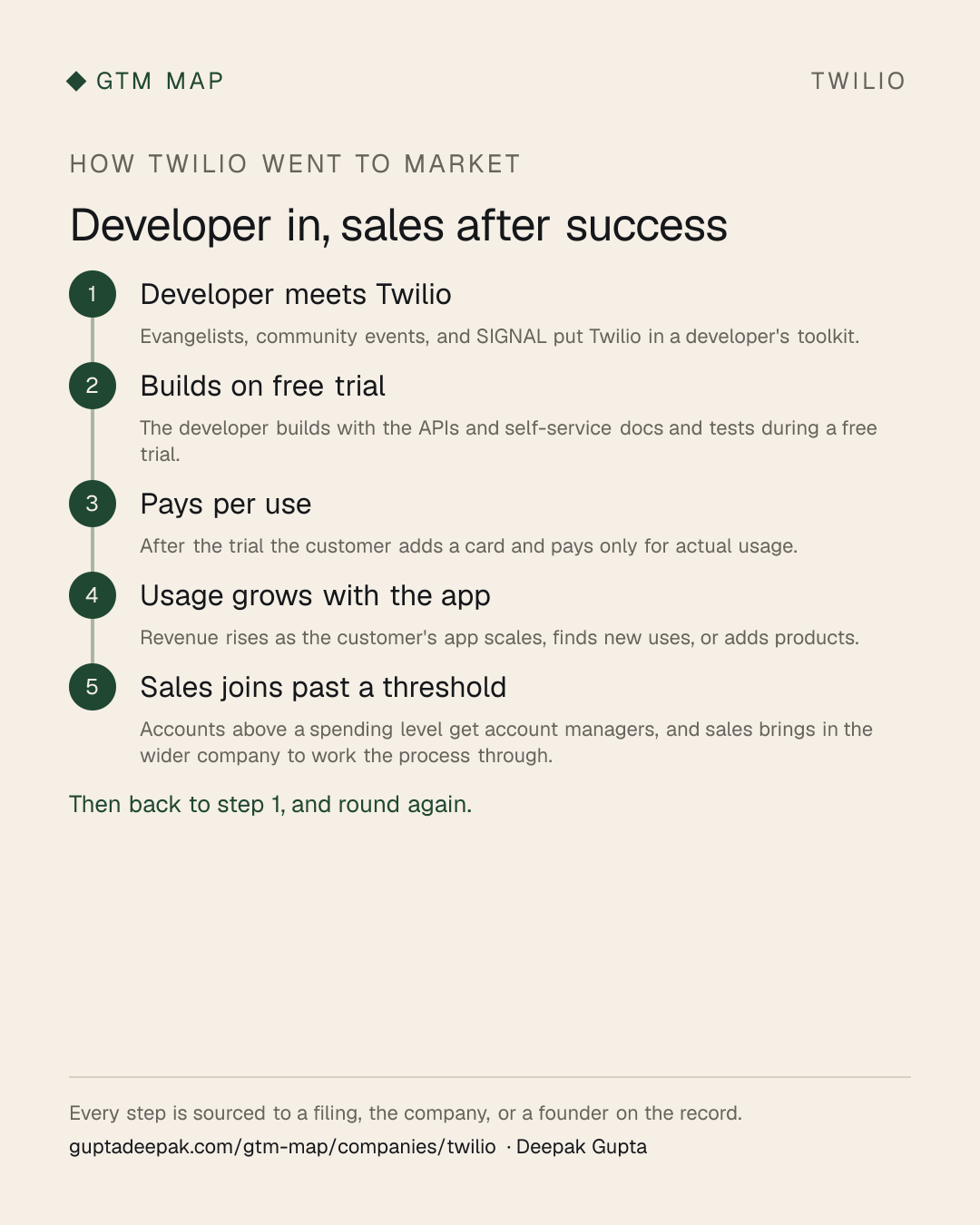
Twilio sold APIs to developers first: self-serve signup, a free trial, and pay-as-you-go pricing, with sales arriving after a customer was already succeeding. Usage growth pushed net expansion to 161% in 2016, then acquisitions widened the platform, growth slowed, and Twilio now runs self-service, sales-led, and partner-led motions side by side.
- Buyer:
- Developers, Small business, Mid-market, Enterprise
- Contract size:
- Mixed
- Checked:
- October 18, 2026
Developer meets Twilio
Evangelists, community events, and SIGNAL put Twilio in a developer's toolkit.[1]
Builds on free trial
The developer builds with the APIs and self-service docs and tests during a free trial.[1]
Pays per use
After the trial the customer adds a card and pays only for actual usage.[1]
Usage grows with the app
Revenue rises as the customer's app scales, finds new uses, or adds products.[1]
Back to step 1, and round again
01The phases
PrimarySupportingTried, then dropped
2008 to 2015
Developer-first self-service and pay as you go
Twilio was incorporated in 2008. Developers found the APIs, built on a free trial, and paid for usage, and Active Customer Accounts grew from 6,410 at the end of 2012 to 28,648 by March 2016.
- Developer-led
Developers are the entry buyer: they find the APIs, try them, and build them into their own applications. Jeff Lawson describes developers as the route into a market, not the market itself.[1],[17]
- Product-led
Self-service signup with a free trial, self-service documentation, and customer support. The S-1 says the substantial majority of customers historically came in this way.[1]
- Usage pricing
Once the trial proves the product, customers pay based on usage, with prices that Lawson says start at a penny. The S-1 sums it up as acquiring developers like consumers and letting them spend like enterprises.[1],[17]
- Community
Developer evangelism is a named sales and marketing cost, and international growth leaned on international developer evangelism programs and a London roadshow event.[1]
- Owned events
SIGNAL, an owned developer conference, was first held in May 2015, and the S-1 says Twilio planned to host it annually.[1],[12]
- Developer-led
2015 to 2018
Inverting the enterprise sales model
Twilio layered sales on top of self-service rather than in front of it. Expansion was strong but concentrated: WhatsApp was 17% of 2015 revenue, and when Uber cut usage in 2017 net expansion fell from 161% to 128%.
- Sales-assist
Accounts past a spending level get account managers or customer success advocates, and the commercial transaction comes after the customer is already succeeding. The S-1 calls this inverting the traditional enterprise sales model.[1]
- Land and expand
Revenue grew as customers' apps scaled, found new uses, or added products. Dollar-Based Net Expansion Rate was 155% in 2015 and 161% in 2016, then 128% in 2017 after Uber, the largest Base Customer, reduced its usage.[1],[2],[3]
- Sales-led
An enterprise sales effort with sales development, inside sales, and field sales targeted larger customers. Lawson says developers bring Twilio in first and build the prototype, then the sales force works the process through.[1],[17]
- Brand narrative
An "Ask your developer" billboard on Highway 101 was, in Lawson's words, air cover for developers inside their companies. Twilio's docs team later called it the face of a company by developers, for developers.[17],[16]
- Partner channel
Customers without developer resources were referred to Solution Partners, who embed Twilio in contact center, sales force, and marketing automation software they sell to other businesses.[1]
- Owned events
SIGNAL continued as an annual customer and developer conference, with talks that tell stories with code given priority.[13]
- Sales-assist
2019 to 2021
Platform by acquisition and the enterprise push
Twilio bought SendGrid in February 2019 and Segment in November 2020, and grew sales and marketing spend from $175.6M in 2018 to $567.4M in 2020 while still describing a developer-focused go-to-market model.
- Land and expand
Expansion shifted from more usage of one API to more products per account: email through SendGrid and customer data through Segment, the latter valued at about $3.2 billion in stock. Net expansion stayed at 135% to 137%.[5],[14]
- Sales-led
A direct sales effort for larger customers, backed by enterprise marketing such as the Twilio Engage roadshow, which brought business leaders and developers together. Sales and marketing spend more than tripled from 2018 to 2020.[5],[4],[6]
- Developer-led
The 10-K still says the go-to-market model is primarily focused on reaching and serving developers, through evangelism, education, community events, and SIGNAL.[5]
- Usage pricing
Self-serve pricing stayed public with tiered discounts. Larger customers moved to negotiated contracts with minimum revenue commitments, and Flex added per-user, per-month pricing.[5]
- Brand narrative
Lawson published Ask Your Developer in January 2021, a book that tells business leaders to act on what their developers can build.[15]
- Land and expand
2022 to 2023
Slowdown, split, and refocus
Revenue growth fell from 61% in 2021 to 35% in 2022. Twilio cut its workforce by about 11% in September 2022 and about 17% in February 2023, and split selling between Communications and Data & Applications.
- Product-led
For Communications, Twilio shifted from field sales to digital inside sales, self-service, and product-led growth, and said it would rely more on self-service for customers that do not need direct account coverage.[6]
- Sales-led
Data & Applications got a strategic, solution-oriented sales model. A December 2023 memo filed as an 8-K says the bet on Segment go-to-market ahead of growth had not paid off, and folds Flex selling into Communications.[6],[8]
- Land and expand
Expansion slowed: Dollar-Based Net Expansion Rate fell from 137% in 2020 to 131% in 2021 and 121% in 2022.[6]
- Product-led
2024 to now
Three motions, ISVs, and AI
Jeff Lawson stepped down as CEO on January 8, 2024, and Khozema Shipchandler took over. The 10-K now names three motions, self-service, sales-led, and partner-led, and net expansion recovered to 108% in 2025 and 116% in Q2 2026.
- Product-led
Self-service is the first of the three named motions. Self-serve customers now make an upfront prepayment drawn down with use, or subscribe to a plan, depending on the product.[7]
- Sales-led
A direct sales motion for complex, high-scale enterprises, supported by sales development, field marketing, and solution engineers. Twilio had 2,265 sales and marketing employees at the end of 2025.[7]
- Partner channel
ISV partners build on the APIs and resell Twilio inside their own software, and the 10-K lists ISV and other partner relationships among its efficiency priorities.[7]
- Owned events
SIGNAL is named as a lever for the go-to-market motions, and it was where Twilio unveiled a revamped platform in 2026.[7],[11]
- Land and expand
Cross-selling is an explicit priority. Net expansion went from 103% in 2023 to 108% in 2025 and 116% in the second quarter of 2026.[7],[11]
- Developer-led
Developers still enter through the APIs and self-service docs, and Twilio now partners with AI companies that build on its communications capabilities.[7]
- Product-led
02The numbers
Show the data
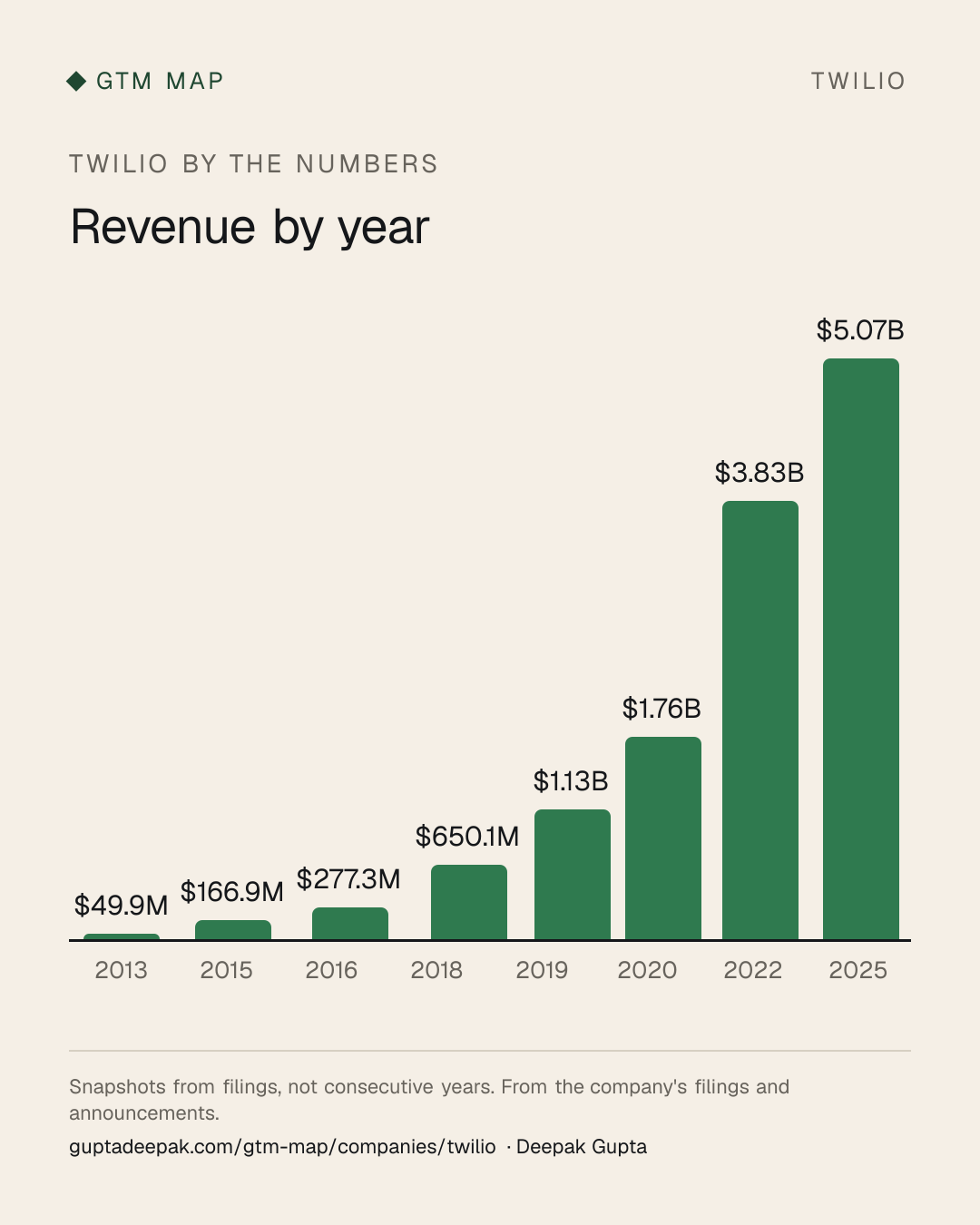
| 2013 | $49.9M | From a filing |
|---|---|---|
| 2015 | $166.9M | From a filing |
| 2016 | $277.3M | From a filing |
| 2018 | $650.1M | From a filing |
| 2019 | $1.13B | From a filing |
| 2020 | $1.76B | From a filing |
| 2022 | $3.83B | From a filing |
| 2025 | $5.07B | From a filing |
Show the data
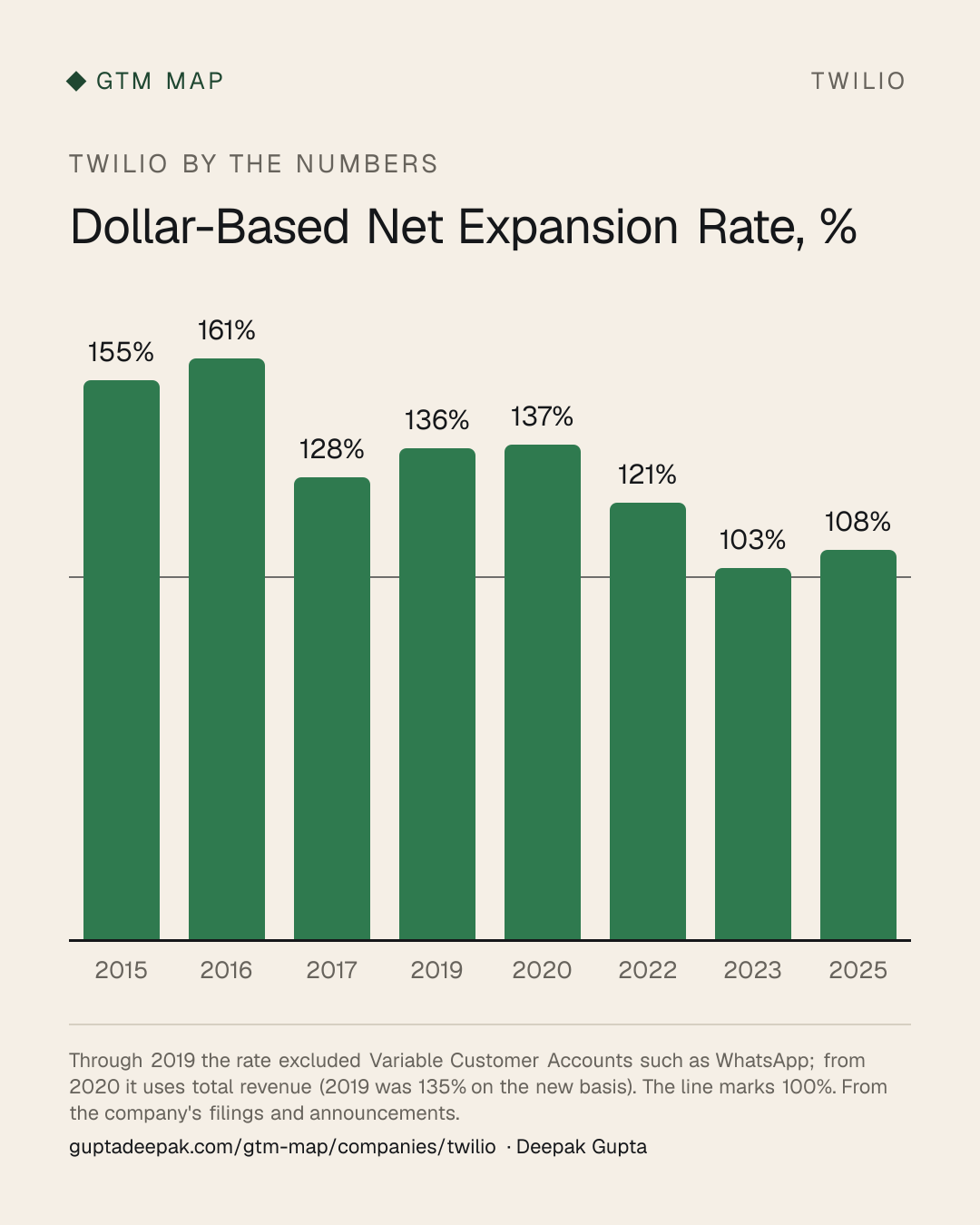
| 2015 | 155% | From a filing |
|---|---|---|
| 2016 | 161% | From a filing |
| 2017 | 128% | From a filing |
| 2019 | 136% | From a filing |
| 2020 | 137% | From a filing |
| 2022 | 121% | From a filing |
| 2023 | 103% | From a filing |
| 2025 | 108% | From a filing |
| Metric | Value | As of | Basis |
|---|---|---|---|
| Revenue, 2013 to 2015 | $49.9M, $88.8M, $166.9M[1] | December 31, 2015 | From a filing |
| Net loss, 2013 to 2015 | $26.9M, $26.8M, $35.5M[1] | December 31, 2015 | From a filing |
| Sales and marketing as a share of revenue, 2013 to 2015 | 44%, 38%, 30%[1] | December 31, 2015 | From a filing |
| Active Customer Accounts | 6,410 (Dec 2012) to 28,648 (Mar 2016)[1] | March 31, 2016 | From a filing |
| WhatsApp and top 10 accounts' share of revenue, 2015 | 17% and 32%[1] | December 31, 2015 | From a filing |
| Revenue and net expansion, 2016 | $277.3M; 161%[2] | December 31, 2016 | From a filing |
| IPO first-day close | $28.79, up nearly 92%[18] | June 23, 2016 | Reported |
| Uber share of revenue and net expansion, 2017 | Uber 14% to 8%; net expansion 128%[3] | December 31, 2017 | From a filing |
| Revenue, 2018 and 2019 | $650.1M, $1,134.5M[4] | December 31, 2019 | From a filing |
| Revenue and Active Customer Accounts, 2020 | $1,761.8M, up 55%; over 221,000 accounts[5] | December 31, 2020 | From a filing |
| Revenue, growth, and net expansion, 2022 | $3,826.3M; up 35%; 121%[6] | December 31, 2022 | From a filing |
| Workforce reductions | About 11% (Sep 2022), about 17% (Feb 2023)[6] | February 2023 | From a filing |
| Segment share of 2023 revenue | 7%; more than 8,000 customers[10] | March 5, 2024 | Company-stated |
| Revenue, growth, net expansion, and accounts, 2025 | $5,067.2M; up 14%; 108%; 402,000[7] | December 31, 2025 | From a filing |
| Sales and marketing spend, 2023 to 2025 | $1,023.0M, $860.8M, $873.2M[7] | December 31, 2025 | From a filing |
| Income from operations, 2025 | $157.8M (2024: loss of $53.7M)[7] | December 31, 2025 | From a filing |
| Revenue and net expansion, Q2 2026 | $1.50B, up 22% (17% organic); 116%[11] | June 30, 2026 | From a filing |
“Reported” figures come from trade press, not the company, and are shown with their date.
03Myth checks
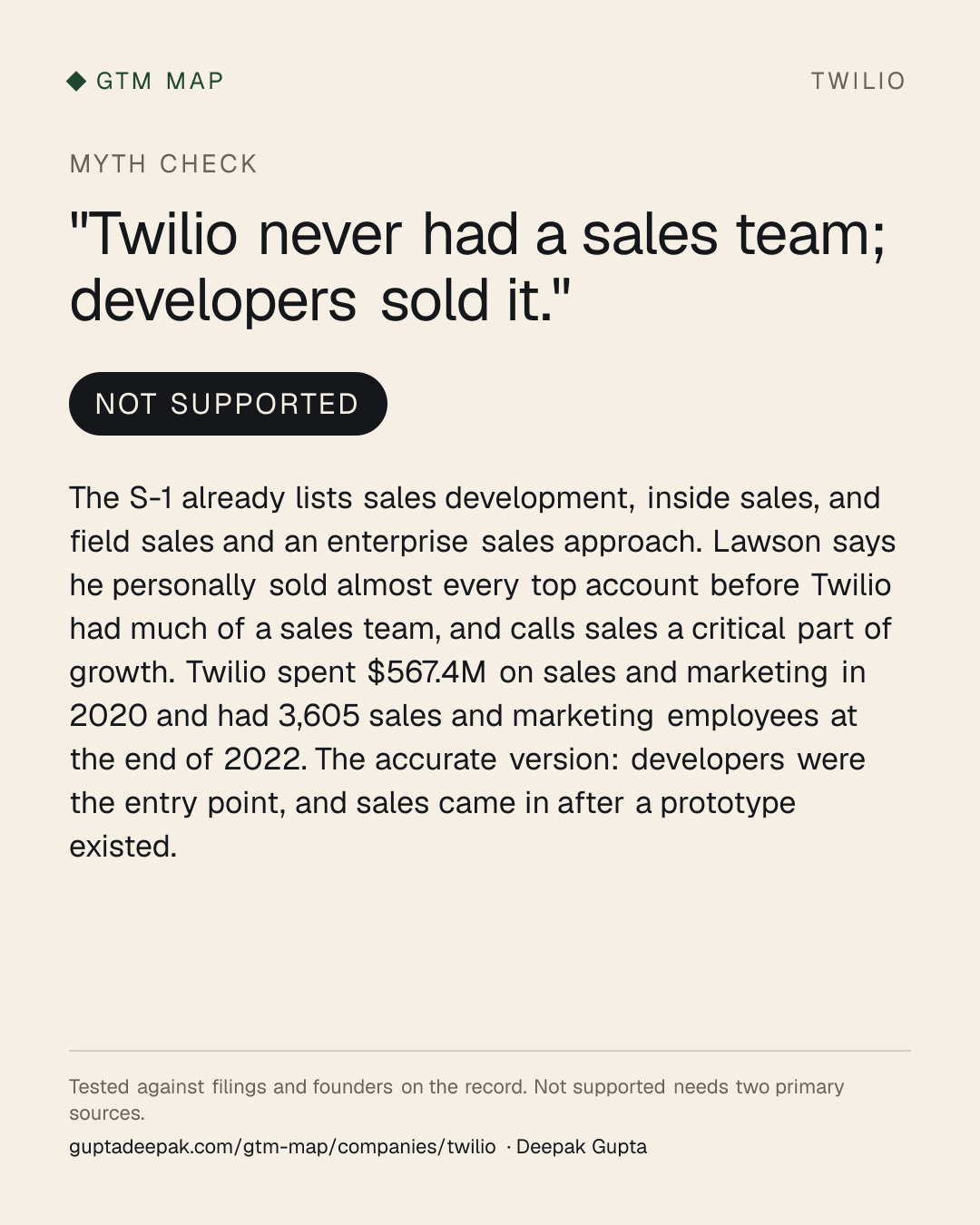
“Twilio never had a sales team; developers sold it.”
Not supportedThe S-1 already lists sales development, inside sales, and field sales and an enterprise sales approach. Lawson says he personally sold almost every top account before Twilio had much of a sales team, and calls sales a critical part of growth. Twilio spent $567.4M on sales and marketing in 2020 and had 3,605 sales and marketing employees at the end of 2022. The accurate version: developers were the entry point, and sales came in after a prototype existed.[1],[17],[6]
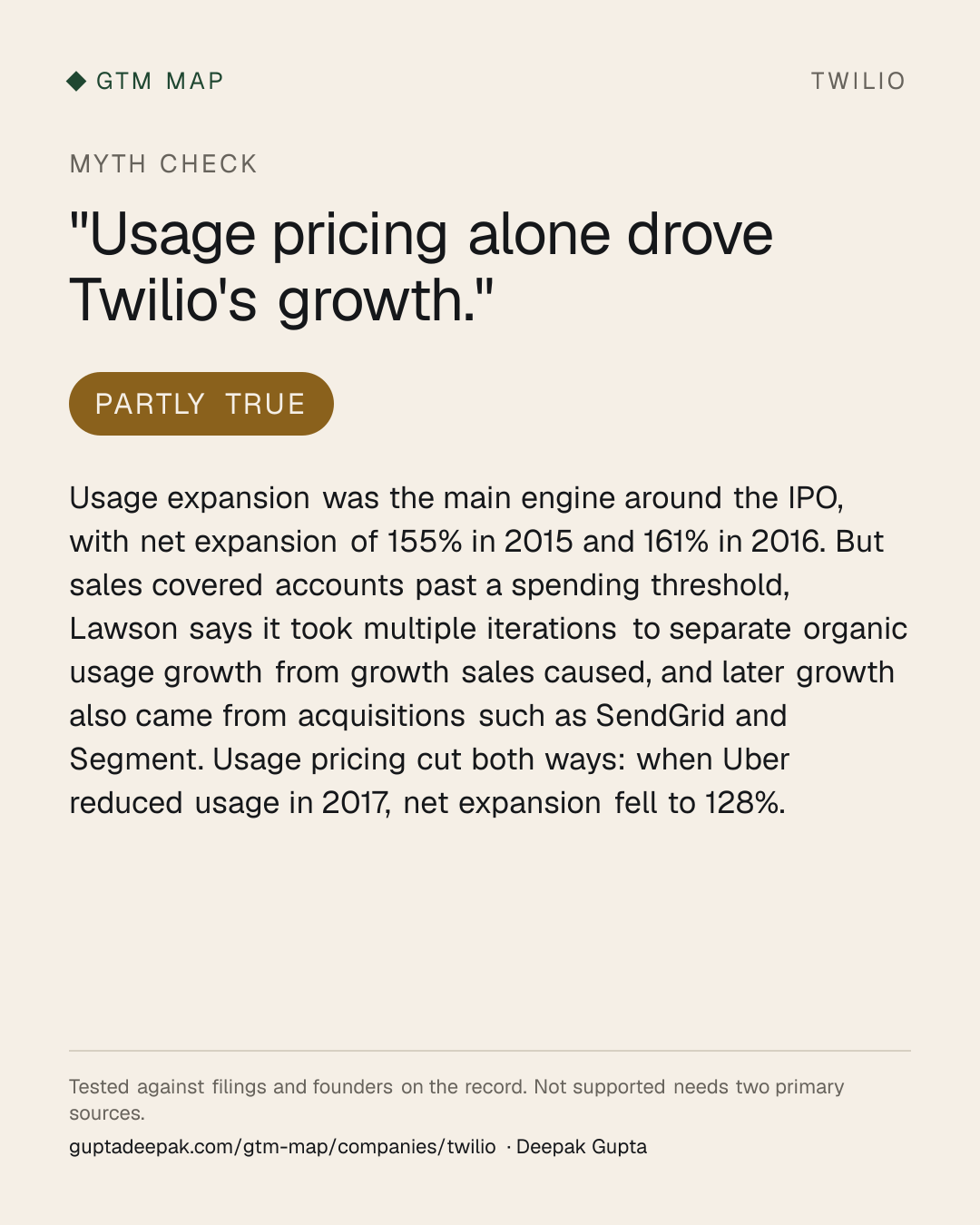
“Usage pricing alone drove Twilio's growth.”
Partly trueUsage expansion was the main engine around the IPO, with net expansion of 155% in 2015 and 161% in 2016. But sales covered accounts past a spending threshold, Lawson says it took multiple iterations to separate organic usage growth from growth sales caused, and later growth also came from acquisitions such as SendGrid and Segment. Usage pricing cut both ways: when Uber reduced usage in 2017, net expansion fell to 128%.[1],[2],[3],[5],[7],[17]
On the record
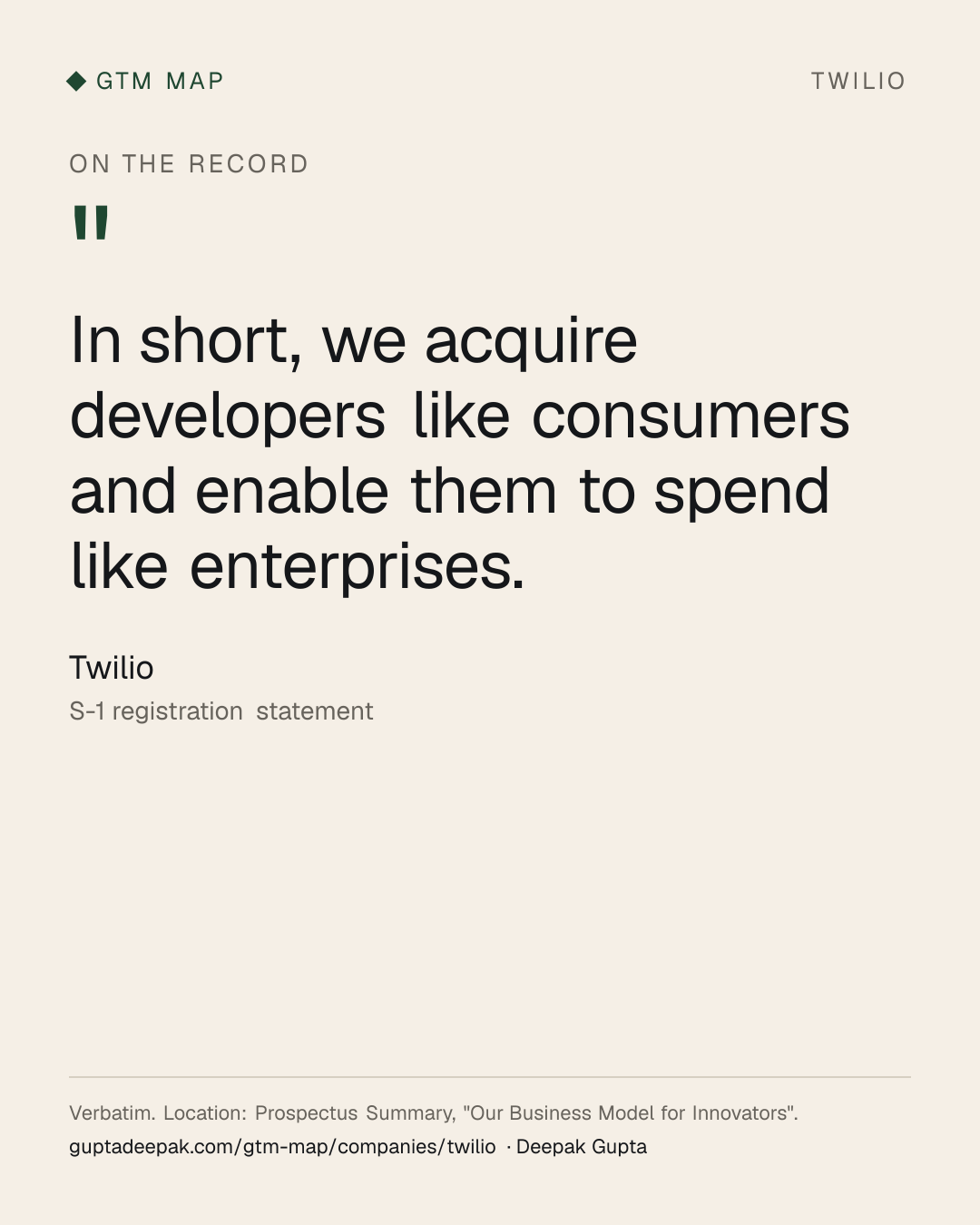
“In short, we acquire developers like consumers and enable them to spend like enterprises.”
Twilio, S-1 registration statement[1]
Prospectus Summary, "Our Business Model for Innovators"
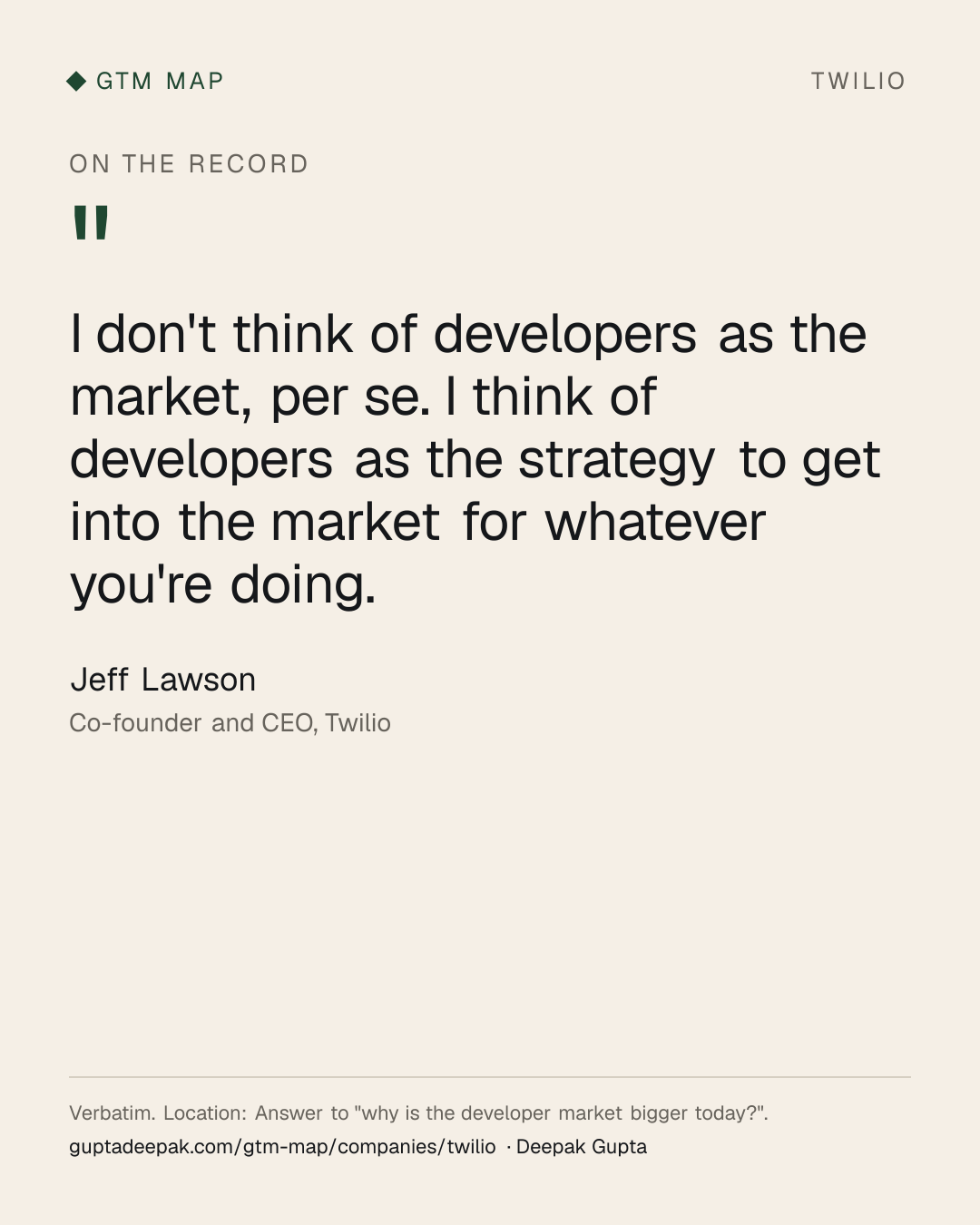
“I don't think of developers as the market, per se. I think of developers as the strategy to get into the market for whatever you're doing.”
Jeff Lawson, Co-founder and CEO, Twilio[17]
Answer to "why is the developer market bigger today?"
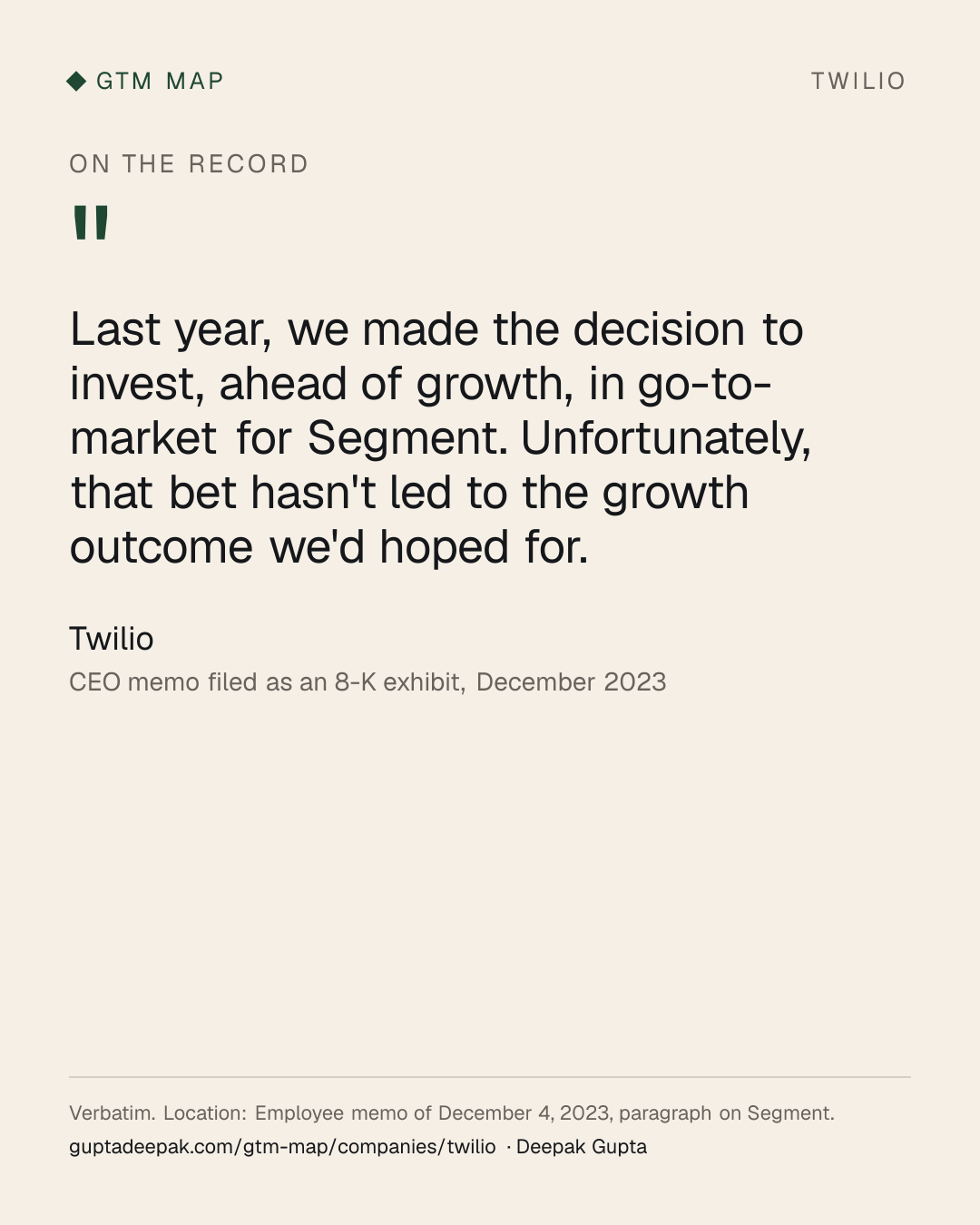
“Last year, we made the decision to invest, ahead of growth, in go-to-market for Segment. Unfortunately, that bet hasn't led to the growth outcome we'd hoped for.”
Twilio, CEO memo filed as an 8-K exhibit, December 2023[8]
Employee memo of December 4, 2023, paragraph on Segment
04What other companies can take from it
Treat developers as the route into the buyer, not the buyer.
Works when: The product is an API or building block that one engineer can wire into a real app quickly, and the value is visible to non-technical stakeholders once it ships.
Backfires when: Integration needs a long security review or data migration before anything works, or the buyer has no in-house developers, so the prototype never happens and partners have to carry the deal.
Based on: Developer-first self-service and pay as you go, Developer-led; Inverting the enterprise sales model, Sales-led
Usage pricing gives big expansion and big exposure in the same line item.
Works when: Customers' own end-user volume grows, so revenue rises without a new sale.
Backfires when: Revenue sits in a few large accounts that can move volume in-house or to a cheaper provider, as WhatsApp at 17% of revenue and Uber's 2017 cut showed.
Based on: Developer-first self-service and pay as you go, Usage pricing; Inverting the enterprise sales model, Land and expand
Put the sales touch after success, and trigger it with a spending threshold.
Works when: Self-serve starts tiny and grows continuously, so there is no natural sale moment for reps to own.
Backfires when: The enterprise tier is just a paywall on basics, which pushes developers away before the account grows.
Based on: Inverting the enterprise sales model, Sales-assist; Developer-first self-service and pay as you go, Usage pricing
Acquired products need their own buyer and their own proof before a big sales build.
Works when: You buy a product sold to a different buyer (marketers, not developers) and the existing developer motion cannot reach that buyer.
Backfires when: The sales team is scaled before the acquired product has repeatable wins inside your base, so cost runs ahead of pipeline, as with Segment go-to-market in 2023.
Based on: Platform by acquisition and the enterprise push, Land and expand; Slowdown, split, and refocus, Sales-led
05 · GTM Now
What changes in the AI era, and what to do now
Analysis by Deepak Gupta. This is opinion built on the sourced record above, not part of it.[16],[7],[9],[11]
Still works
- Developer entry through APIs and docs. AI coding assistants read documentation and code samples, so a well-structured docs site with runnable samples, which Twilio rebuilt in 2024, is still the front door for both people and tools.
- Usage pricing still fits AI workloads whose volume scales with end users.
Breaks
- Developer evangelism as in-person persuasion matters less when an assistant picks the API for the developer.
- The billboard's air cover weakens when a stakeholder asks an AI assistant, not a colleague, whether they have heard of a vendor.
What replaces it
- Partnering with AI companies that build on its communications capabilities, which is Twilio's own move under Khozema Shipchandler, CEO since January 2024.
- Being the default tool an AI agent calls: machine-readable docs, OpenAPI specs, copy-paste samples, and pricing an agent can reason about.
Apply it now
If you are
A seed to Series B API or developer-infrastructure company, usage-priced, selling to developers at small companies and engineering teams at larger ones, under $10K starting ACV
- Make the first working call possible in minutes from public docs, with a free trial and published per-unit pricing.
- Publish docs and samples in forms AI coding assistants can use (OpenAPI specs, runnable snippets, a plain-text docs index), and test that popular assistants produce working code for your API.
- Set a spend threshold at which an account gets a named account manager, plus an enterprise add-on (SSO, compliance) that tells sales which accounts to work.
- Report net dollar expansion and top-10 customer share together every quarter, so concentration risk shows before a large customer cuts usage.
You will know it works when: The share of new paying accounts with no sales touch before first spend, and net dollar expansion with and without the top 10 accounts.
Based on Twilio's Developer-first self-service and pay as you go, Inverting the enterprise sales model
If you are
A later-stage developer platform that has bought or built a second product sold to a non-developer buyer (marketing, CX, data), with growth slowing
- Cross-sell the new product to current API customers before hiring a separate sales team, as Twilio's 2025 priorities do.
- Set a payback gate (pipeline per rep, win rate inside the base) before scaling dedicated go-to-market, the step Twilio reversed for Segment in 2023.
- Move the mature product toward self-service and ISV partners to fund the newer one, as Twilio did for Communications.
- Keep one owned event where developers and business buyers of both products meet.
You will know it works when: Net dollar expansion back above 110% while sales and marketing falls as a share of revenue (Twilio: 25% in 2023 to 17% in 2025).
Based on Twilio's Slowdown, split, and refocus, Three motions, ISVs, and AI
Motions in this record
Compare with every other company on the GTM matrix.
Share the visuals
Every card is drawn from the sourced record above and sized 1080 by 1350 for LinkedIn and X. Free to share with a link back to this page.
Sources
- [1]SEC filingTwilio Inc. Form S-1 Registration Statement (May 26, 2016)
- [2]SEC filingForm 10-K, fiscal year ended December 31, 2016 (February 22, 2017)
- [3]SEC filingForm 10-K, fiscal year ended December 31, 2017 (March 1, 2018)
- [4]SEC filingForm 10-K, fiscal year ended December 31, 2019 (March 2, 2020)
- [5]SEC filingForm 10-K, fiscal year ended December 31, 2020 (February 26, 2021)
- [6]SEC filingForm 10-K, fiscal year ended December 31, 2022 (February 27, 2023)
- [7]SEC filingForm 10-K, fiscal year ended December 31, 2025 (February 24, 2026)
- [8]SEC filing8-K Exhibit 99.1: Organizational changes to better support our growth and profitability needs (employee memo) (December 4, 2023)
- [9]SEC filing8-K Exhibit 99.1: Twilio Announces CEO Transition (January 8, 2024)
- [10]SEC filing8-K Exhibit 99.1: Twilio Concludes Operational Review of Segment Business (March 5, 2024)
- [11]EarningsTwilio Announces Second Quarter 2026 Results (8-K exhibit) (August 6, 2026)
- [12]CompanyTwilio Signal Day Two Recap: Breaking Down $bash, Bringing On The Builders and They Might Be Giants (May 20, 2015)
- [13]CompanyTwilio Presents SIGNAL, fourth annual customer and developer conference (June 29, 2018)
- [14]CompanyTwilio Completes Acquisition of Segment, the Market-leading Customer Data Platform (November 2, 2020)
- [15]CompanyAsk Your Developer, a playbook for unleashing developer power, from Twilio CEO Jeff Lawson, available now (January 11, 2021)
- [16]CompanyTransforming Developer Experience: A New Era for Twilio's Documentation (July 8, 2024)
- [17]Founder interviewTwilio: The First $100m+ ARR with Jeff Lawson, CEO/Co Founder (SaaStr Annual 2017, video and transcript) (Jeff Lawson, June 15, 2021, at text transcript, no timestamps: answers on the developer market, the enterprise plan, the brand, and sales)
- [18]Trade pressTwilio soars almost 92% in first day of trading (CNBC, June 23, 2016)
Every phase, motion, and myth verdict cites a filing, the company's own pages, or a founder speaking on the record. See the methodology.