
Product-led · public
How Asana went to market
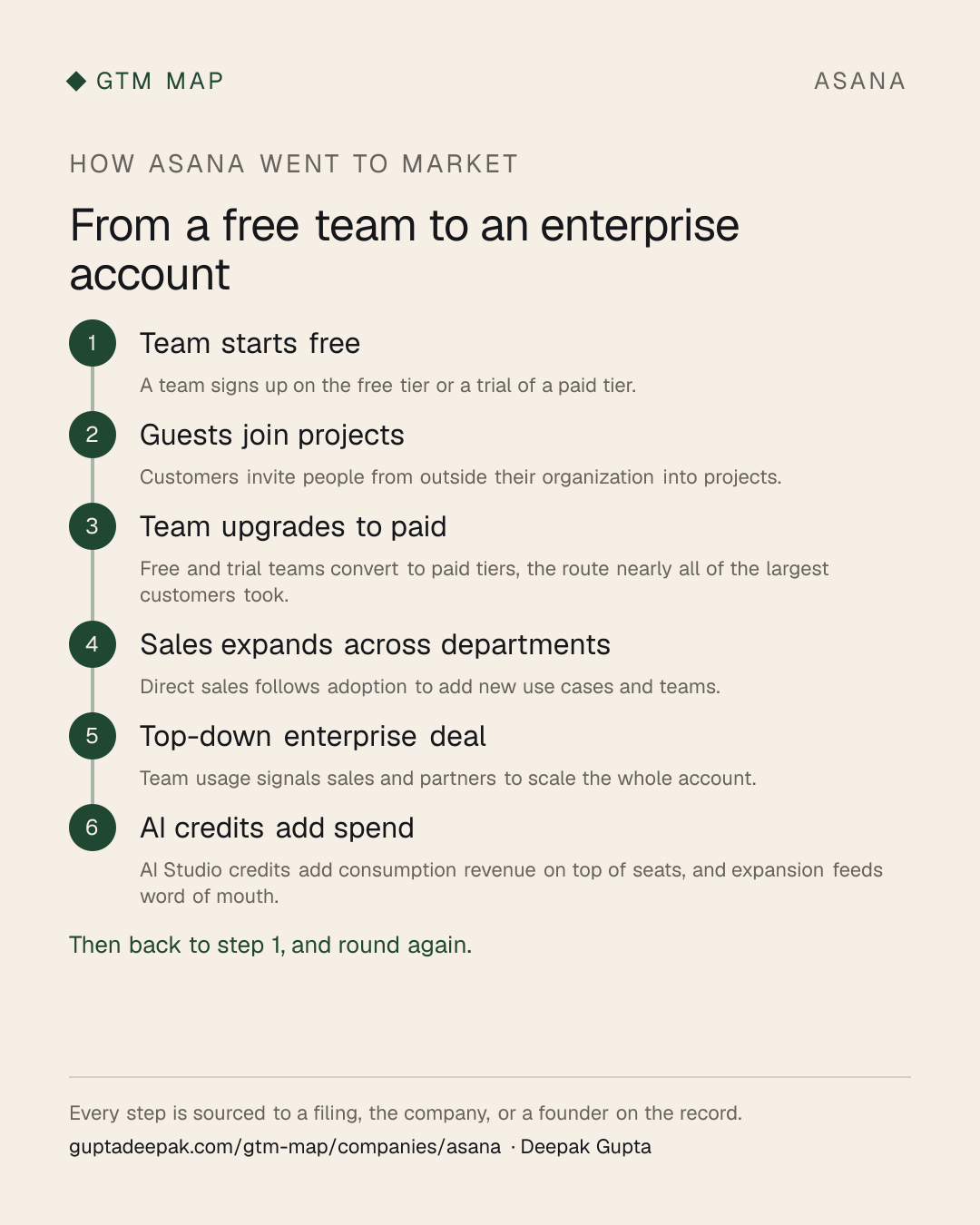
Asana let teams start free or on a trial and invite outside guests, then sent a direct sales team in to expand accounts that had already adopted it. From FY2024 it shifted toward top-down enterprise deals and partners, and it now adds AI Studio credits on top of seats while net retention sits just under 100%.
- Buyer:
- Small business, Mid-market, Enterprise
- Contract size:
- Mixed
- Checked:
- October 18, 2026
Team starts free
A team signs up on the free tier or a trial of a paid tier.[1]
Guests join projects
Customers invite people from outside their organization into projects.[1]
Team upgrades to paid
Free and trial teams convert to paid tiers, the route nearly all of the largest customers took.[1]
Sales expands across departments
Direct sales follows adoption to add new use cases and teams.[1]
Top-down enterprise deal
Team usage signals sales and partners to scale the whole account.[7]
Back to step 1, and round again
01The phases
PrimarySupportingTried, then dropped
2008 to 2016
Free teams and the guest invite
Asana was founded in 2008. Teams started free or on a trial, and the Enterprise tier only arrived in December 2016, eight years later. Moskovitz says the focus on larger organizations came as the field got crowded. The S-1 describes the free tier and guest invites as the standing model without dating their start.
- Product-led
A free Basic tier for teams of fewer than 15 people and 30-day trials of paid tiers were the way in. At the S-1, virtually all of the 100 largest customers had started on a trial or the free tier. Moskovitz says the early aim was a consumer-style product that would cross over into business.[1],[18]
- Viral loop
Customers can invite guests from outside their organization into projects, which the S-1 says seeds the market with Asana users and supports viral adoption. No filing gives a share of signups that came from invites.[1]
- Product-led
2017 to 2023
Self-serve first, sales to expand
Moskovitz announced a head of global sales hired from Dropbox at SaaStr Annual 2017, the Business tier followed in November 2018, and the direct sales team more than doubled after January 2019. No filing dates when direct sales began, so the 2017 start is approximate.
- Sales-assist
Self-serve adoption came first, and the direct sales team then followed up inside the account to expand across the organization. Sales and marketing ran at 68% of revenue in FY2019, 74% in FY2020, and 78% in FY2021.[1],[19],[2]
- Land and expand
Customers typically landed with one use case in one department and expanded to others. Dollar-based net retention was over 120% overall at January 2022, over 130% for customers spending over $5,000, and over 145% for those spending over $50,000.[1],[3]
- Community
Asana Together ran a forum, in-person events, Asana Ambassadors who promote adoption in their own networks, and Certified Pros, independent consultants who charge for help.[1]
- Paid acquisition
Paid acquisition sat alongside owned properties, media coverage, and word of mouth. Advertising expenses for marketing programs rose $13.7 million in FY2020.[1]
- Sales-assist
2023 to 2025
Up-market and top-down sales
The FY2024 10-K is the first to describe landing large enterprise accounts with a top-down motion, and the FY2025 10-K says a partner program was established. Self-serve stayed, with a smaller free tier, while overall net retention fell below 100%.
- Sales-led
Asana moved capacity toward sales-led, top-down deals with corporate and enterprise buyers, including large deals in accounts with no prior Asana use, while keeping its product-led motion.[5],[6]
- Partner channel
A partner program of value-added resellers, managed service providers, and technology partners across more than 50 countries was set up to strengthen the enterprise motion.[6]
- Product-led
Free trials and a free tier continued, but the free tier went from teams of up to 15 people in the FY2023 10-K to teams of up to 10 in the FY2024 10-K.[4],[5]
- Land and expand
Expansion slowed sharply: overall dollar-based net retention went from over 115% at January 2023 to over 100% at January 2024 and 96% at January 2025.[5],[6]
- Owned events
The Work Innovation Summit became a global first-party event series, and its largest edition yet was held in New York City in late 2024.[8],[6]
- Sales-led
2024 to now
AI Studio, credits, and the agentic platform
AI Studio launched in 2024 on a consumption model, sold as credits on top of the seat-based core product. Dan Rogers succeeded Moskovitz as CEO in July 2025, and the free tier narrowed again to one or two people.
- Usage pricing
AI Studio is consumption-based: each paid tier includes a monthly credit allotment, and more credits can be bought. Moskovitz describes a platform fee with tokens and a la carte use after that. Aziz Megji, CFO since March 2026, frames consumption and outcome-based revenue as an expansion path alongside seats.[6],[17],[18],[12],[15]
- Sales-led
The FY2026 10-K calls it a bottom-up and top-down model: team adoption signals when direct sales and partners should step in to scale strategic enterprise accounts. Dan Rogers, previously CEO of LaunchDarkly, became CEO in July 2025 and chair in September 2026, and a new CRO was named to align product-led and sales-led growth.[7],[11],[13],[14],[16]
- Product-led
The free Personal tier is now for one or two people. AI features sit in the free product, with a freemium version of Studio, and AI Teammates, AI Studio, and Asana Dash come to every paid tier.[7],[17],[12],[18]
- Land and expand
Dollar-based net retention was 96% at January 2026 and 97% overall in Q2 FY2027, improving in every reported cohort. Rogers says customers using AI Studio and AI Teammates retain better and expand faster.[7],[12]
- Cloud marketplace
Asana is listed in the AI Agents and Tools storefront in the AWS Marketplace, where AWS customers can discover, buy, and deploy it.[10]
- Partner channel
The reseller, managed service, and technology partner ecosystem across more than 50 countries continues, and an expanded Mastercard partnership gives small businesses a discounted rate.[7],[10]
- Usage pricing
02The numbers
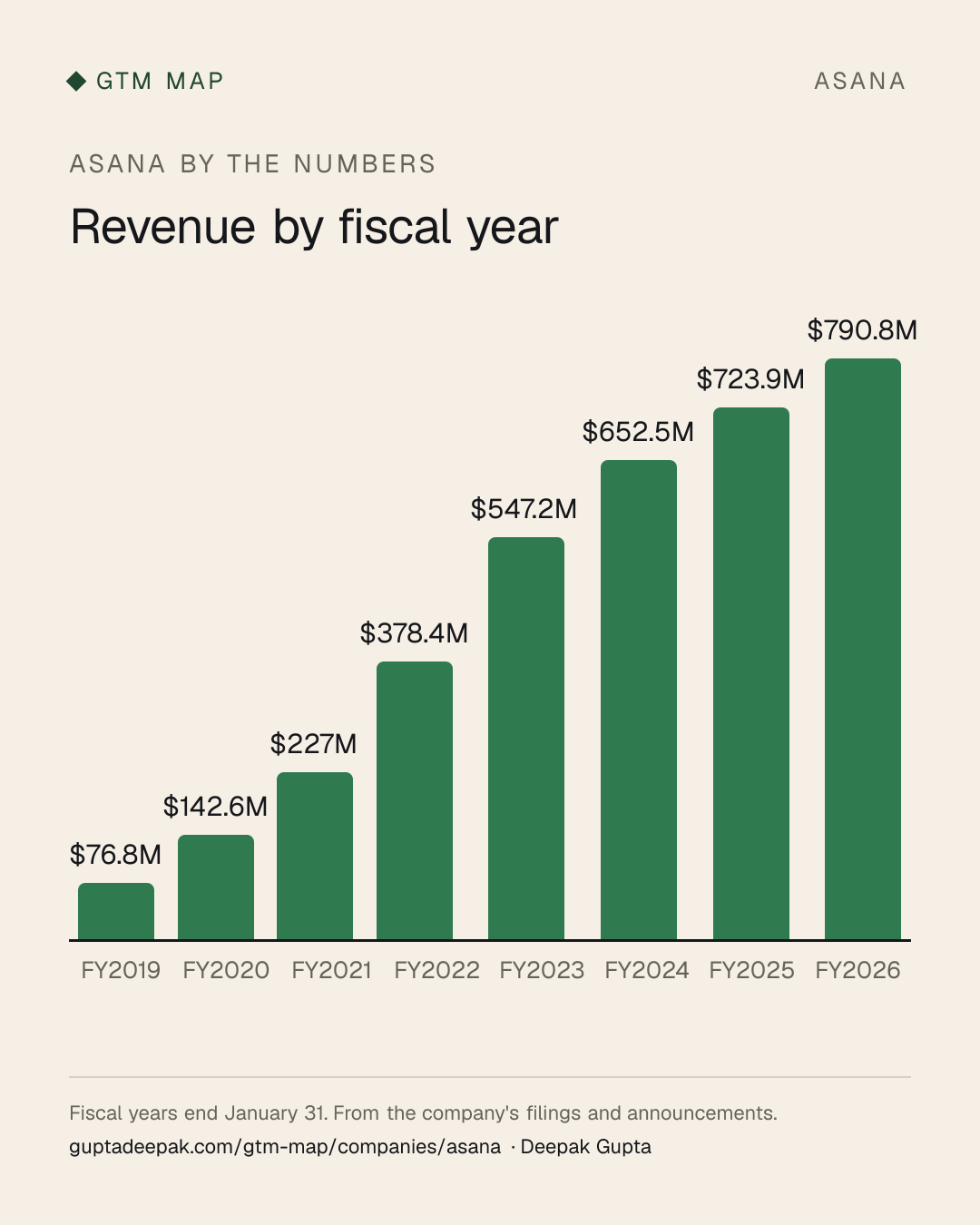
Show the data
| FY2019 | $76.8M | From a filing |
|---|---|---|
| FY2020 | $142.6M | From a filing |
| FY2021 | $227M | From a filing |
| FY2022 | $378.4M | From a filing |
| FY2023 | $547.2M | From a filing |
| FY2024 | $652.5M | From a filing |
| FY2025 | $723.9M | From a filing |
| FY2026 | $790.8M | From a filing |
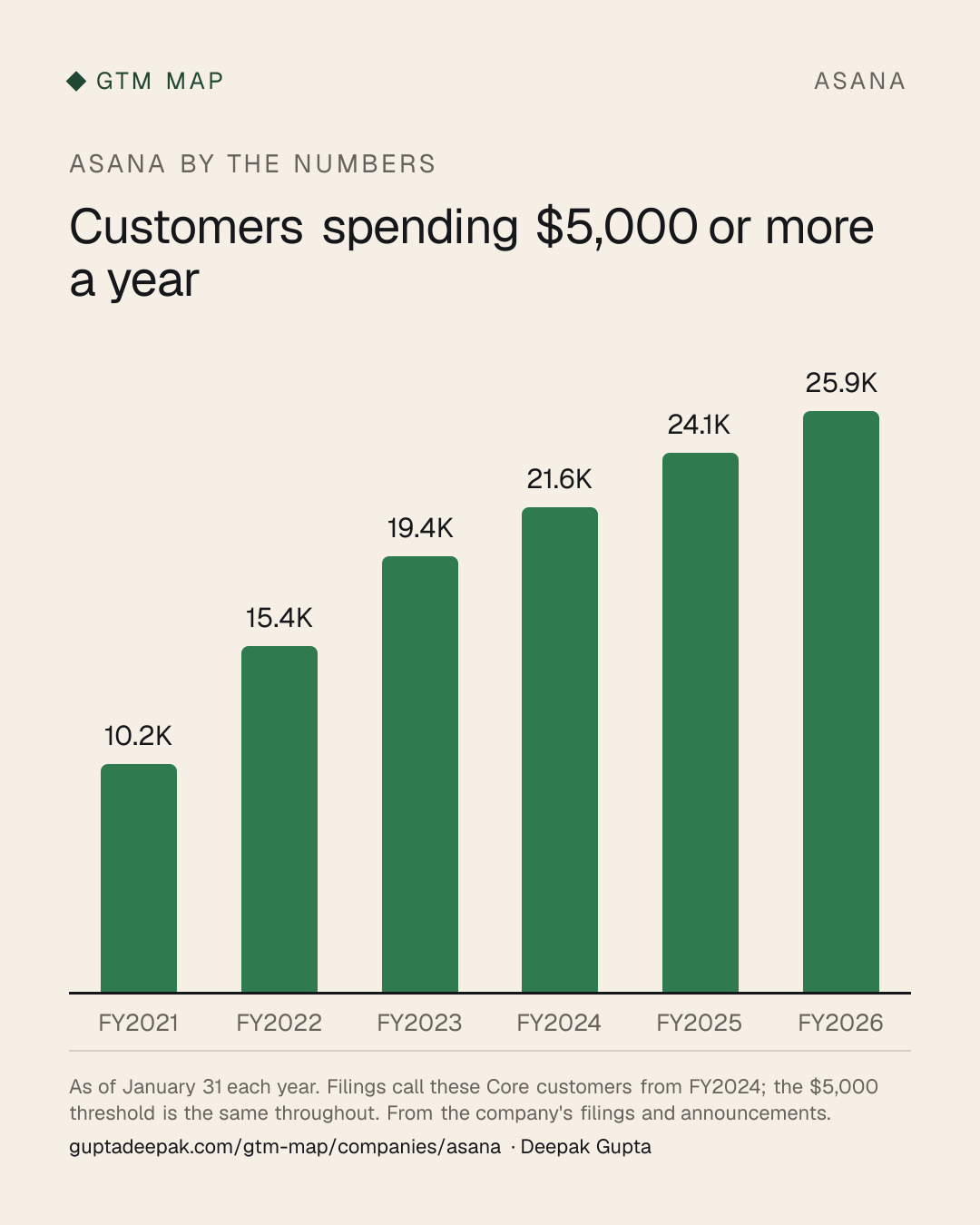
Show the data
| FY2021 | 10.2K | From a filing |
|---|---|---|
| FY2022 | 15.4K | From a filing |
| FY2023 | 19.4K | From a filing |
| FY2024 | 21.6K | From a filing |
| FY2025 | 24.1K | From a filing |
| FY2026 | 25.9K | From a filing |
| Metric | Value | As of | Basis |
|---|---|---|---|
| Revenue and net loss, FY2020 | $142.6M, up 86%; net loss $118.6M[1] | January 31, 2020 | From a filing |
| Free-to-paid conversion of registered users | 3.6% (Jan 2018) to 4.7% (Jul 2020)[1] | July 31, 2020 | From a filing |
| Registered and paid users | Over 27M registered, over 1.3M paid[1] | July 31, 2020 | From a filing |
| Share of revenue from subscriptions of $5K and over | 56%, from 45% a year earlier (six months to July)[1] | July 31, 2020 | From a filing |
| Dollar-based net retention, FY2020 | Over 120% overall; over 125% at $5K+; over 140% at $50K+[1] | January 31, 2020 | From a filing |
| Sales and marketing payback, FY2020 | 10.6 months[1] | January 31, 2020 | From a filing |
| Revenue from outside the US, FY2020 | 41%[1] | January 31, 2020 | From a filing |
| Sales and marketing as a share of revenue, FY2019 to FY2021 | 68%, 74%, 78%[2] | January 31, 2021 | From a filing |
| Sales and marketing as a share of revenue, FY2022 to FY2024 | 75%, 79%, 60%[5] | January 31, 2024 | From a filing |
| Sales and marketing as a share of revenue, FY2025 and FY2026 | 58%, 51%[7] | January 31, 2026 | From a filing |
| Paying customers | Over 180,000; 25,928 Core ($5K+); 817 at $100K+[7] | January 31, 2026 | From a filing |
| Dollar-based net retention, FY2026 | 96% overall; 97% Core; 96% at $100K+[7] | January 31, 2026 | From a filing |
| Revenue and profit, FY2026 | $790.8M, up 9%; GAAP net loss $189.0M; non-GAAP operating income $56.7M[11] | January 31, 2026 | From a filing |
| Net retention and $100K+ customers, Q2 FY2027 | 97% overall; 890 customers at $100K+, up 16%[12] | July 31, 2026 | From a filing |
“Reported” figures come from trade press, not the company, and are shown with their date.
03Myth checks
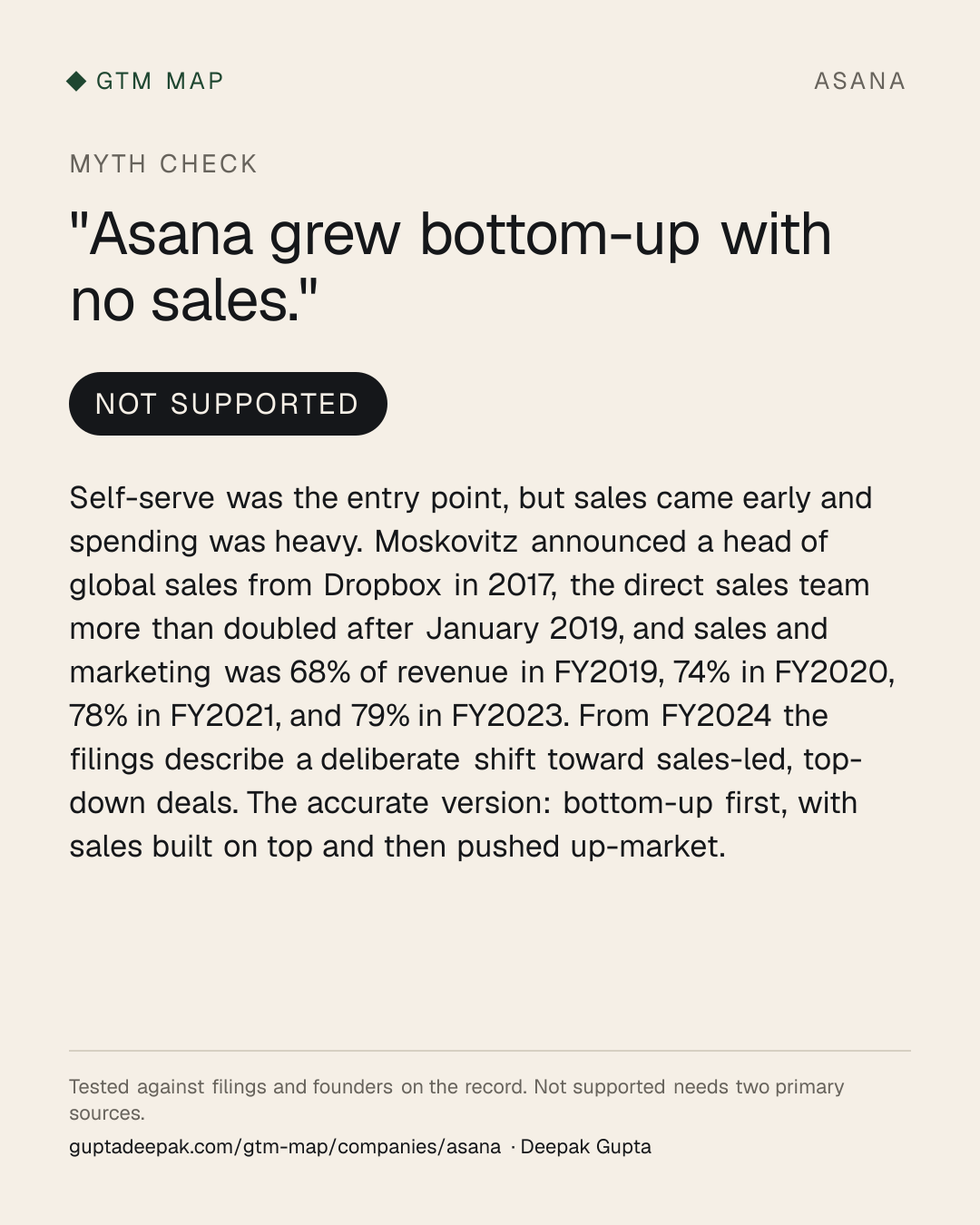
“Asana grew bottom-up with no sales.”
Not supportedSelf-serve was the entry point, but sales came early and spending was heavy. Moskovitz announced a head of global sales from Dropbox in 2017, the direct sales team more than doubled after January 2019, and sales and marketing was 68% of revenue in FY2019, 74% in FY2020, 78% in FY2021, and 79% in FY2023. From FY2024 the filings describe a deliberate shift toward sales-led, top-down deals. The accurate version: bottom-up first, with sales built on top and then pushed up-market.[1],[2],[5],[19]
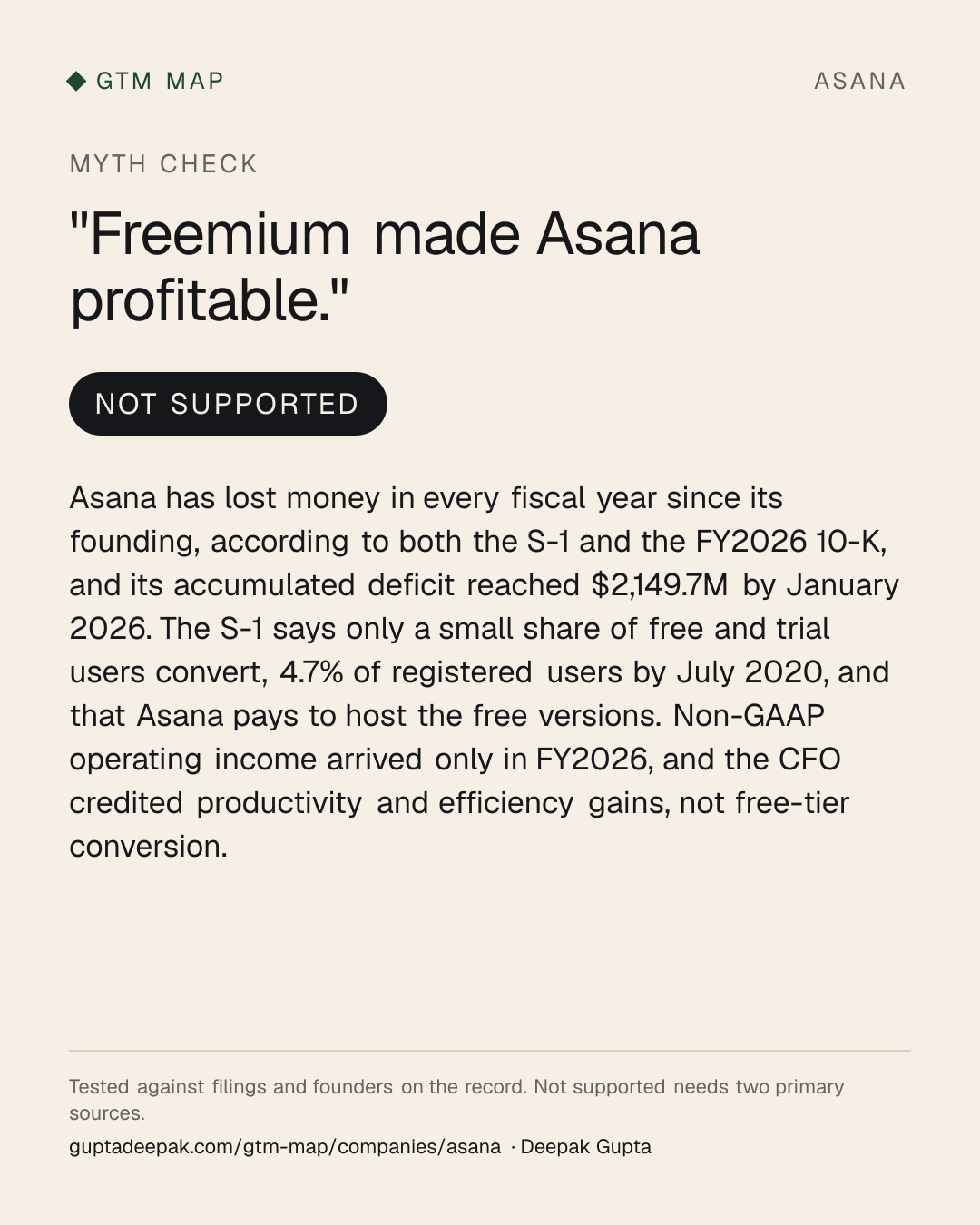
“Freemium made Asana profitable.”
Not supportedAsana has lost money in every fiscal year since its founding, according to both the S-1 and the FY2026 10-K, and its accumulated deficit reached $2,149.7M by January 2026. The S-1 says only a small share of free and trial users convert, 4.7% of registered users by July 2020, and that Asana pays to host the free versions. Non-GAAP operating income arrived only in FY2026, and the CFO credited productivity and efficiency gains, not free-tier conversion.[1],[7],[11],[9]
On the record
“the typical enterprise sales model causes leaders to make purchase decisions based on the description of features without ever trying the experience of using them.”
Dustin Moskovitz and Justin Rosenstein, Co-founders, letter in the Asana S-1[1]
Letter from Our Co-Founders, "Creating products customers love"
“By providing a free version of Asana, a free trial option, and a feature where customers can invite guests outside of their organizations to use Asana, we are able to seed the market with Asana users.”
Asana, S-1 registration statement[1]
MD&A, "Our Go-To-Market Approach"
“we have people paying tens of thousands of dollars, but they only have 10 seats and so the platform fee is just totally swapping that seat revenue already.”
Dustin Moskovitz, Co-founder and former CEO, Asana[18]
Answer on whether some companies might need fewer people, after the CEO-switch remark
04What other companies can take from it
Let team adoption pick the accounts, then send sales.
Works when: A team tool is used by groups inside larger companies, usage by email domain shows which accounts are spreading, and contract size can grow from a few thousand dollars to six figures.
Backfires when: Buyers are individuals or tiny businesses with no department to expand into, or the product needs central IT approval before any team can use it.
Based on: Free teams and the guest invite, Product-led; Self-serve first, sales to expand, Sales-assist; AI Studio, credits, and the agentic platform, Sales-led
Net retention by spend cohort tells you where to point sales.
Works when: You can split customers by annual spend and the larger cohorts clearly expand faster than the rest.
Backfires when: Expansion in every cohort stalls at once, so moving up-market alone cannot hold the number. Asana pushed up-market and its overall net retention still went from over 115% to 96% in two years.
Based on: Self-serve first, sales to expand, Land and expand; Up-market and top-down sales, Sales-led; Up-market and top-down sales, Land and expand
A free tier can shrink without removing the free way in.
Works when: Trials of a paid tier and free guest access still expose new teams to the product, so the free plan does not carry the whole funnel.
Backfires when: Spread depends on whole teams working free for months, and a cap of one or two people stops that before a department forms around the product.
Based on: Free teams and the guest invite, Product-led; Up-market and top-down sales, Product-led; AI Studio, credits, and the agentic platform, Product-led
Add a usage meter on top of seats rather than replacing them.
Works when: A new capability does work on behalf of users, such as automation or agents, so value tracks volume rather than headcount.
Backfires when: Buyers want price certainty and anchor on the bundled allotment. Moskovitz says many customers anchor on the first token allotment, which still causes friction.
Based on: AI Studio, credits, and the agentic platform, Usage pricing
05 · GTM Now
What changes in the AI era, and what to do now
Analysis by Deepak Gupta. This is opinion built on the sourced record above, not part of it.[17],[6],[7],[18],[12]
Still works
- The guest invite. Bringing outside collaborators into a project still exposes non-users, and the pricing page still offers unlimited free guests.
- Team adoption as the sales signal. The FY2026 10-K keeps it at the center of the model, now feeding direct sales and channel partners.
Breaks
- Seat-based expansion is exposed if AI slows hiring at customers (analysis). Asana's own dollar-based net retention has been 96% to 97% since January 2025.
- A wide free tier costs more when each free user runs AI features with real inference cost (analysis). Asana still puts AI features in its free product.
- Bottom-up buying of AI is hard to turn into large deals. Moskovitz says the CIO sale is pretty hard right now.
What replaces it
- A credit budget bundled into every paid tier, with extra credits for purchase, sold both self-serve and top-down. This is Asana's own move.
- Consumption and outcome-based revenue alongside seats, as the CFO now describes it. Whether this restores retention above 100% is not yet filed; Q2 FY2027 was 97%.
Apply it now
If you are
A seed to Series B team collaboration or workflow tool selling to SMB and mid-market buyers under $10K a year, used by groups that work with people outside their company
- Offer a free tier and a trial of the top self-serve tier, and make inviting outside guests free so every project shows the product to non-users.
- Track usage by company domain and flag accounts where a second team or department starts using the product.
- Hire a small sales team whose first job is expansion inside those flagged accounts, not cold new logos.
- Report net retention by spend cohort from the start, so you can see which customer size expands fastest.
- Review the free tier's limits each year against how often free teams pull in a second team.
You will know it works when: The share of your 100 largest customers that started free or on a trial (Asana's filed figure was virtually all), and net retention in the top spend cohort.
Based on Asana's Free teams and the guest invite, Free teams and the guest invite, Self-serve first, sales to expand, Self-serve first, sales to expand
If you are
A later-stage seat-based SaaS company whose net retention has slipped toward or below 100% and which is adding AI agents or automation
- Sell the AI capability on credits or usage, with an allotment bundled into each paid tier and more credits for sale.
- Keep a rate-limited free version of the AI feature so self-serve teams can still try it.
- Let large customers buy one credit budget at the top and split it across departments.
- Give one revenue leader the job of aligning the product-led and sales-led motions.
You will know it works when: Net retention in your largest cohort back above 100%, and the share of expansion revenue that comes from credits rather than seats.
Based on Asana's AI Studio, credits, and the agentic platform, AI Studio, credits, and the agentic platform, AI Studio, credits, and the agentic platform
Motions in this record
Compare with every other company on the GTM matrix.
Share the visuals
Every card is drawn from the sourced record above and sized 1080 by 1350 for LinkedIn and X. Free to share with a link back to this page.
Sources
- [1]SEC filingAsana, Inc. Form S-1/A registration statement (direct listing) (September 18, 2020)
- [2]SEC filingForm 10-K, fiscal year ended January 31, 2021 (March 30, 2021)
- [3]SEC filingForm 10-K, fiscal year ended January 31, 2022 (March 24, 2022)
- [4]SEC filingForm 10-K, fiscal year ended January 31, 2023 (March 24, 2023)
- [5]SEC filingForm 10-K, fiscal year ended January 31, 2024 (March 14, 2024)
- [6]SEC filingForm 10-K, fiscal year ended January 31, 2025 (March 18, 2025)
- [7]SEC filingForm 10-K, fiscal year ended January 31, 2026 (March 13, 2026)
- [8]EarningsAsana Announces Third Quarter Fiscal 2025 Results (8-K exhibit) (December 5, 2024)
- [9]EarningsAsana Announces Fourth Quarter and Fiscal Year 2025 Results (8-K exhibit) (March 10, 2025)
- [10]EarningsAsana Announces Second Quarter Fiscal 2026 Results (8-K exhibit) (September 3, 2025)
- [11]EarningsAsana Announces Fourth Quarter and Fiscal Year 2026 Results (8-K exhibit) (March 2, 2026)
- [12]EarningsAsana Announces Second Quarter Fiscal 2027 Results (8-K exhibit) (September 3, 2026)
- [13]SEC filingAsana Announces CEO Succession Plan (8-K exhibit) (March 10, 2025)
- [14]SEC filingAsana Names Dan Rogers as Chief Executive Officer (8-K exhibit) (June 25, 2025)
- [15]SEC filingAsana to Appoint Aziz Megji to the Role of Chief Financial Officer (8-K exhibit) (March 2, 2026)
- [16]SEC filingForm 8-K, Item 5.02, Board Chair Transition (September 28, 2026)
- [17]CompanyAsana Pricing: Personal, Starter, Advanced, and Enterprise plans (undated)
- [18]Founder interviewAn Interview with Asana Founder Dustin Moskovitz about AI, SaaS, and Safety (Stratechery, transcript) (Dustin Moskovitz, October 20, 2025, at answers to the go-to-market question, "How do you charge?", the freemium and AI cost question, and the seat-tension question)
- [19]Founder interviewDustin Moskovitz, Asana: Fast Growth, Mindful Business (SaaStr Annual 2017, transcript) (Dustin Moskovitz, 2017, at opening company update, before the "hyper growth phase or an adolescent phase" question)
Every phase, motion, and myth verdict cites a filing, the company's own pages, or a founder speaking on the record. See the methodology.