
Security · public
How Zscaler went to market
Zscaler sold security as a cloud service to replace on-premises appliances, carried into accounts by telecom carriers and integrators while its sales force owned the senior relationship. Customers landed with one product and cross-bought more. From 2020 it rebranded the platform around zero trust, a term its own pages credit to Forrester, and now expands through Z-Flex spend pools.
- Buyer:
- Mid-market, Enterprise
- Contract size:
- Mixed
- Checked:
- October 18, 2026
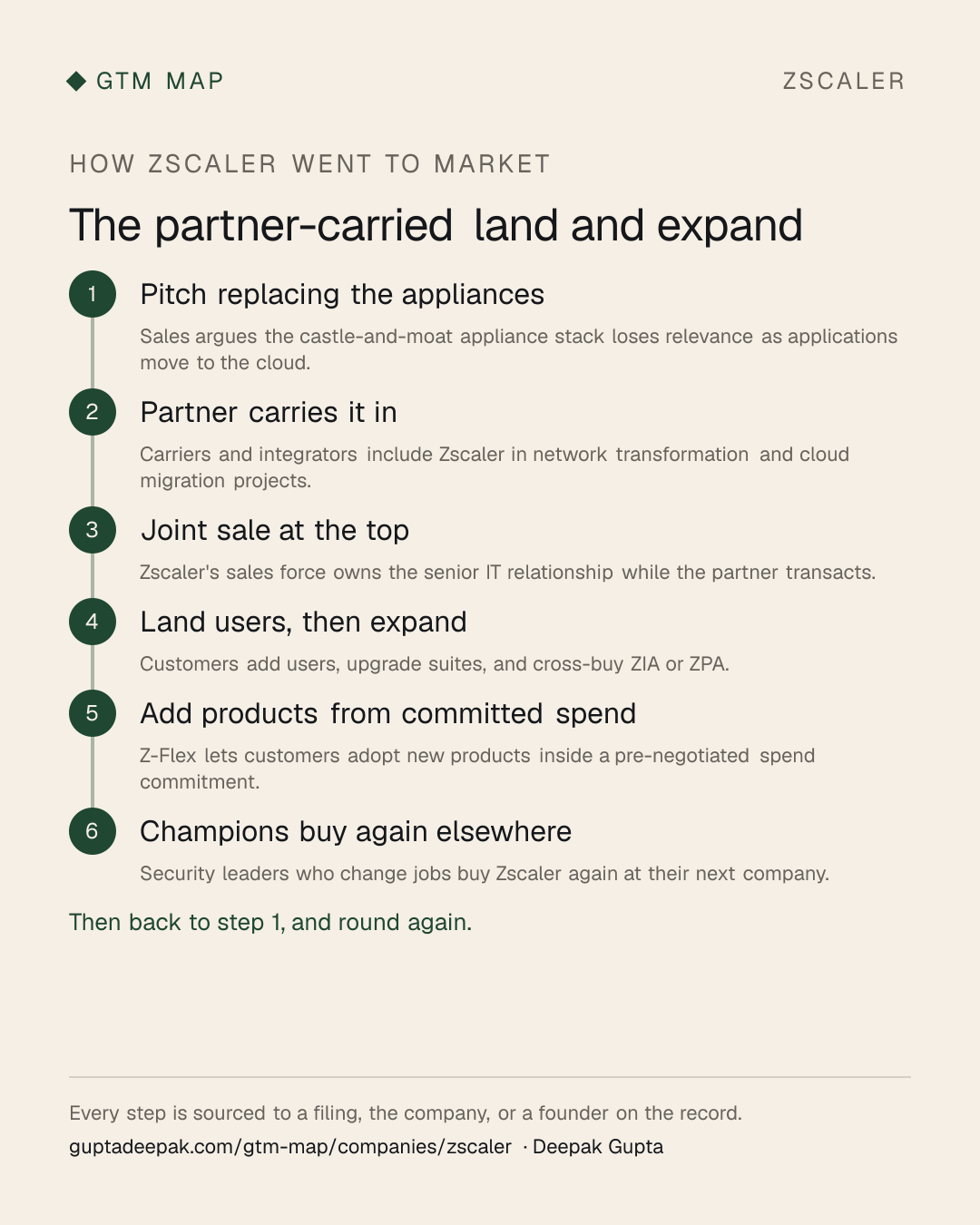
Pitch replacing the appliances
Sales argues the castle-and-moat appliance stack loses relevance as applications move to the cloud.[1]
Partner carries it in
Carriers and integrators include Zscaler in network transformation and cloud migration projects.[1]
Joint sale at the top
Zscaler's sales force owns the senior IT relationship while the partner transacts.[1]
Land users, then expand
Customers add users, upgrade suites, and cross-buy ZIA or ZPA.[1]
Add products from committed spend
Z-Flex lets customers adopt new products inside a pre-negotiated spend commitment.[10]
Champions buy again elsewhere
Security leaders who change jobs buy Zscaler again at their next company.[23]
Back to step 1, and round again
01The phases
PrimarySupportingTried, then dropped
2008 to 2016
Cloud security instead of appliances, sold with carriers
Incorporated in 2007 as SafeChannel and renamed Zscaler in 2008, the company sold security delivered from its cloud to large organizations, mostly through telecom carriers, integrators, and resellers.
- Sales-led
A sales force builds relationships with senior IT buyers in large organizations, in a joint model where a partner usually transacts the deal. The S-1 counts over 200 of the Forbes Global 2000 as customers.[1]
- Partner channel
Carriers such as BT, Deutsche Telekom, Orange, and Verizon include Zscaler in network transformation projects, and integrators bring it into cloud migrations. The top five channel partners were 40% of fiscal 2015 revenue.[1]
- Category creation
Zscaler pitched replacing the castle-and-moat stack of on-premises appliances with security as a cloud service, and says it pioneered that approach. The S-1 never uses the phrase zero trust.[1],[23]
- Brand narrative
ThreatLabZ, an internal research team analyzing threats across Zscaler's cloud, is presented as a differentiator and publishes reports on emerging security issues.[1]
- Sales-led
2016 to 2020
Second product, land and expand, IPO
Zscaler Private Access launched in April 2016 as a second product. The company went public in March 2018 and held its first Zenith Live user conference that June.
- Land and expand
Customers start with some users, then add users, upgrade to richer suites, and cross-buy ZIA or ZPA. Dollar-based net retention ran from 115% to 120% across fiscal 2017 to 2020.[1],[18],[4]
- Partner channel
Most revenue comes through the channel, and the S-1 says the sales team is focused on increasing sales through partners rather than direct sales.[1]
- Sales-led
Sales and marketing ran at 60% to 70% of revenue in fiscal 2015 to 2017, with account-based marketing aimed at new enterprise accounts, and FedRAMP authorization for ZPA-Government opened the U.S. federal market.[1],[11]
- Owned events
Zenith Live, Zscaler's own user conference, started in June 2018 and was named as a driver of higher sales and marketing spend in fiscal 2020.[11],[4]
- Land and expand
2020 to 2023
The Zero Trust Exchange reframing
The FY2020 10-K is the first Zscaler 10-K to use the phrase zero trust. The platform became the Zero Trust Exchange, a third product joined, and net retention peaked at 128% in fiscal 2021.
- Brand narrative
Zscaler renamed its platform the Zero Trust Exchange and moved its public story onto zero trust and away from castle-and-moat security, with ThreatLabz reports supplying the data. Its own pages credit the term zero trust to Forrester and analyst John Kindervag in 2010.[4],[12],[13],[14],[19],[20]
- Category creation
Zscaler claims to have pioneered a cloud-delivered zero trust platform and the first cloud-delivered zero trust solution, not the zero trust term itself, which came from an analyst.[4],[20],[23]
- Land and expand
Zscaler Digital Experience (ZDX) joined ZIA and ZPA, and dollar-based net retention rose to 128% in fiscal 2021 before easing to 121% in fiscal 2023.[4],[5],[7]
- Owned events
Zenith Live ran as a virtual two-day summit across the Americas, Europe, and Asia Pacific in 2021, built around training sessions to help organizations adopt zero trust.[13]
- Cloud marketplace
Public cloud marketplaces first appear in the 10-K's list of channel partners in fiscal 2022.[6]
- Sales-led
Sales and marketing stayed the largest cost, at 68% of revenue in fiscal 2021 and 59% in fiscal 2023, and the 10-K says Zscaler sells to enterprises of all sizes.[5],[7]
- Brand narrative
2023 to now
Platform, flexible spend, and AI security
Net retention fell to 114% by fiscal 2025, and the FY2026 10-K switched to ARR as its key expansion figure while leaning on Z-Flex, non-seat products, and marketplaces.
- Land and expand
Expansion now runs through more products, non-seat pricing, and Z-Flex, a pre-committed spend pool customers draw on for new products. Net retention was 114% in fiscal 2025, and the FY2026 10-K reports ARR of $3,771M instead of a net retention rate.[9],[10],[17]
- Partner channel
Most revenue still comes through the channel. The top five partners went from 25% of revenue in fiscal 2024 to 31% in fiscal 2026, alongside joint go-to-market work with global systems integrators.[10]
- Sales-led
The sales organization is account-centric, with dedicated sales and customer success resources, and sales and marketing fell to 45% of revenue in fiscal 2026.[10]
- Cloud marketplace
AWS Marketplace passed $1B in cumulative Zscaler software sales, and public sector sales through it grew 68% in fiscal 2025.[21],[10]
- Owned events
The 10-K names Zenith Live and a Public Sector Summit as programs to build the brand and engage new enterprise accounts. Zenith Live 2026 launched AI agent security products and carried partner sponsorship tiers.[10],[22]
- Brand narrative
Annual ThreatLabz reports feature in earnings releases, and the FY2026 10-K points ThreatLabz research at risks from enterprise adoption of AI applications and AI agents.[15],[16],[10]
- Land and expand
02The numbers
Show the data
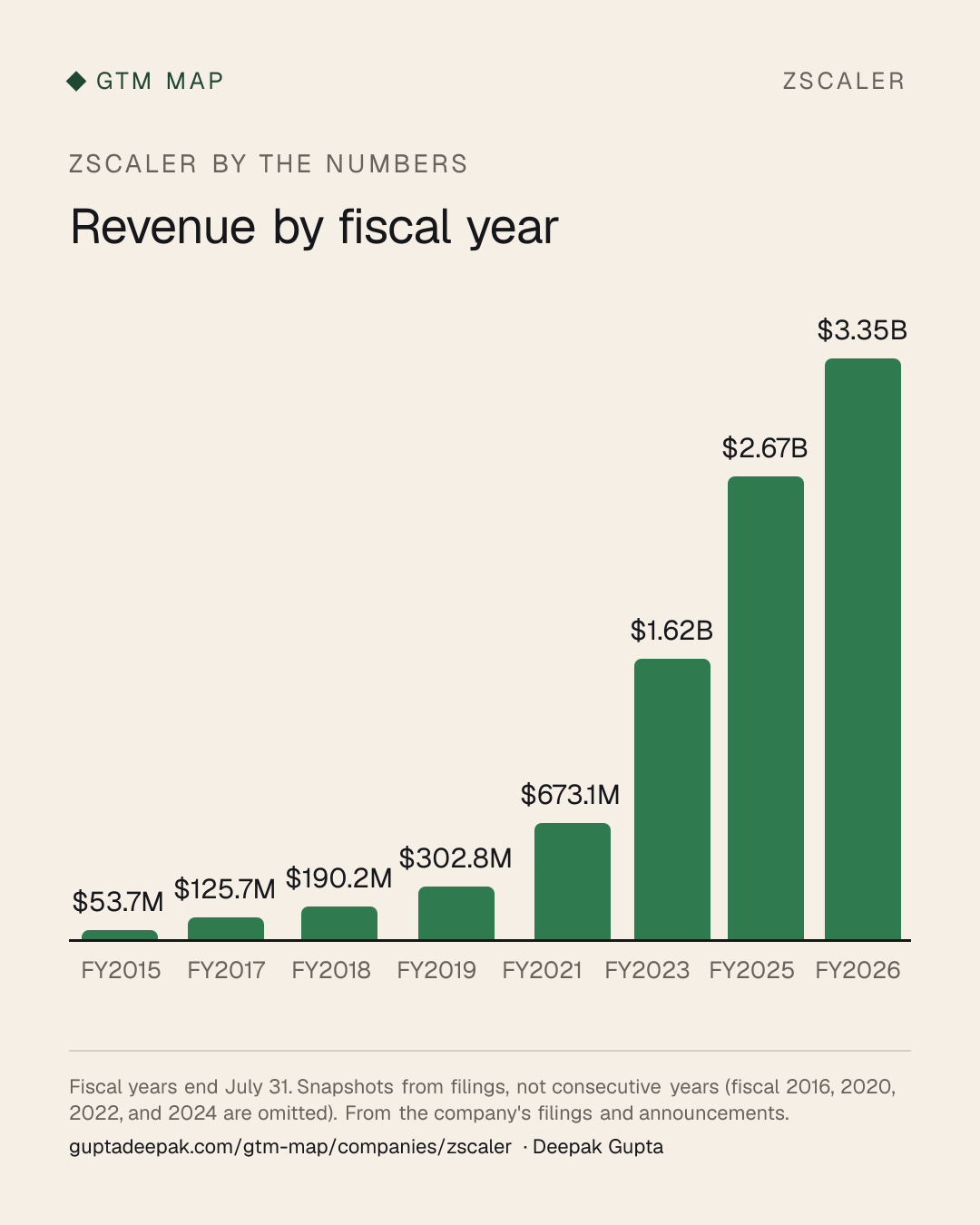
| FY2015 | $53.7M | From a filing |
|---|---|---|
| FY2017 | $125.7M | From a filing |
| FY2018 | $190.2M | From a filing |
| FY2019 | $302.8M | From a filing |
| FY2021 | $673.1M | From a filing |
| FY2023 | $1.62B | From a filing |
| FY2025 | $2.67B | From a filing |
| FY2026 | $3.35B | From a filing |
Show the data
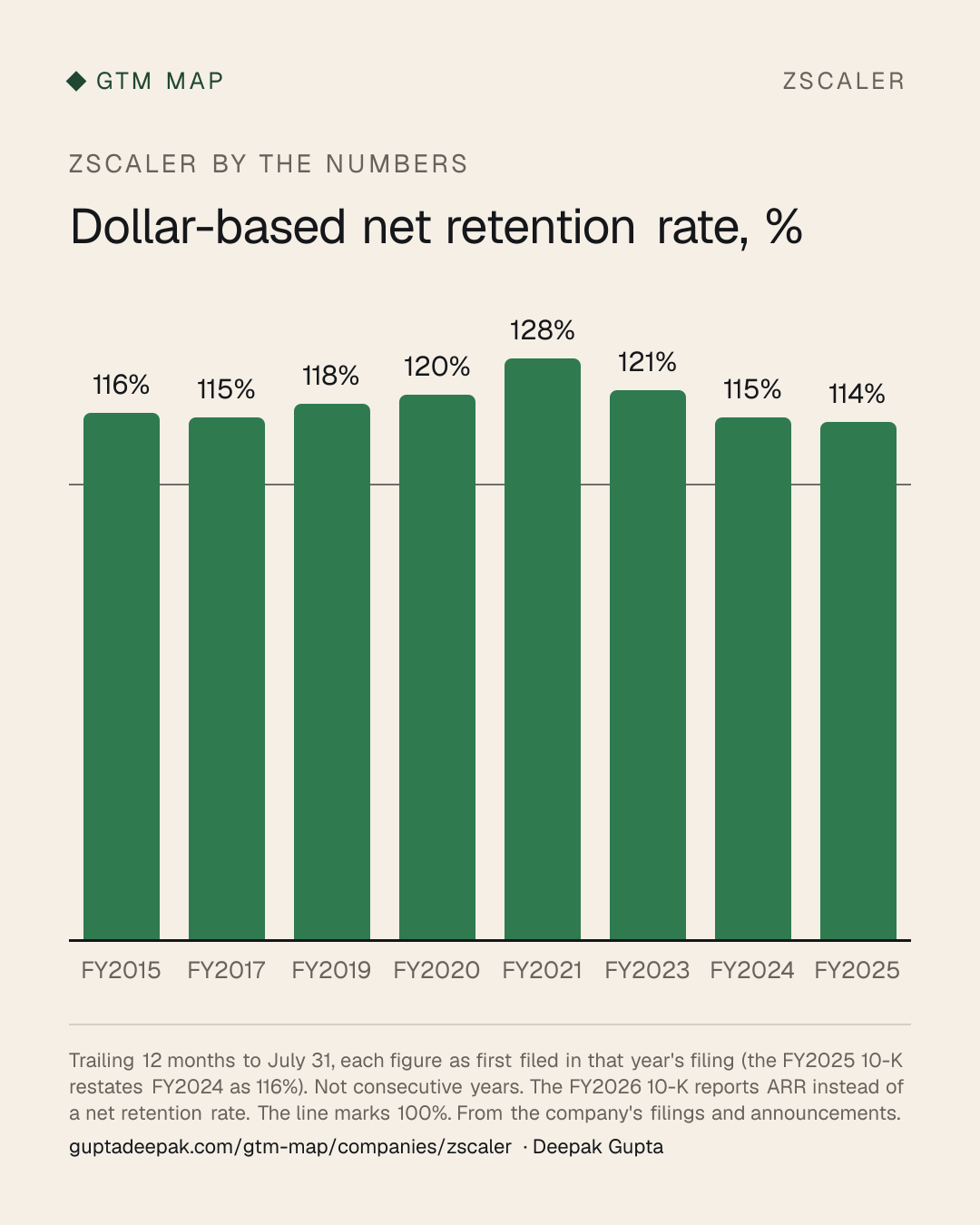
| FY2015 | 116% | From a filing |
|---|---|---|
| FY2017 | 115% | From a filing |
| FY2019 | 118% | From a filing |
| FY2020 | 120% | From a filing |
| FY2021 | 128% | From a filing |
| FY2023 | 121% | From a filing |
| FY2024 | 115% | From a filing |
| FY2025 | 114% | From a filing |
| Metric | Value | As of | Basis |
|---|---|---|---|
| Revenue, fiscal 2015 to 2017 | $53.7M, $80.3M, $125.7M[1] | July 31, 2017 | From a filing |
| Customers, fiscal 2015 to 2017 | Over 2,050 to over 2,800[1] | July 31, 2017 | From a filing |
| Sales and marketing as a share of revenue, fiscal 2015 to 2017 | 60%, 70%, 63%[1] | July 31, 2017 | From a filing |
| Revenue through the top five channel partners, fiscal 2015 to 2017 | 40%, 46%, 47%[1] | July 31, 2017 | From a filing |
| IPO first day | Priced at $16, closed at $34, raised $192M[24] | March 16, 2018 | Reported |
| Revenue, fiscal 2021 | $673.1M, up 56%[5] | July 31, 2021 | From a filing |
| Dollar-based net retention rate, fiscal 2021 | 128%[5] | July 31, 2021 | From a filing |
| Revenue, fiscal 2026 | $3,352.5M, up 25%[10] | July 31, 2026 | From a filing |
| ARR | $3,771M, from $3,015M a year earlier[10] | July 31, 2026 | From a filing |
| Customers, fiscal 2026 | About 11,000, including over 40% of the Forbes Global 2000[10] | July 31, 2026 | From a filing |
| Customers among organizations with over 1,500 employees | Over 4,600 of an estimated 20,000[10] | July 31, 2026 | Company-stated |
| Sales and marketing as a share of revenue, fiscal 2026 | 45%, from 51% in fiscal 2024[10] | July 31, 2026 | From a filing |
| Revenue through the top five channel partners, fiscal 2026 | 31%[10] | July 31, 2026 | From a filing |
| AWS Marketplace cumulative sales | Over $1B[21] | November 6, 2025 | Company-stated |
“Reported” figures come from trade press, not the company, and are shown with their date.
03Myth checks
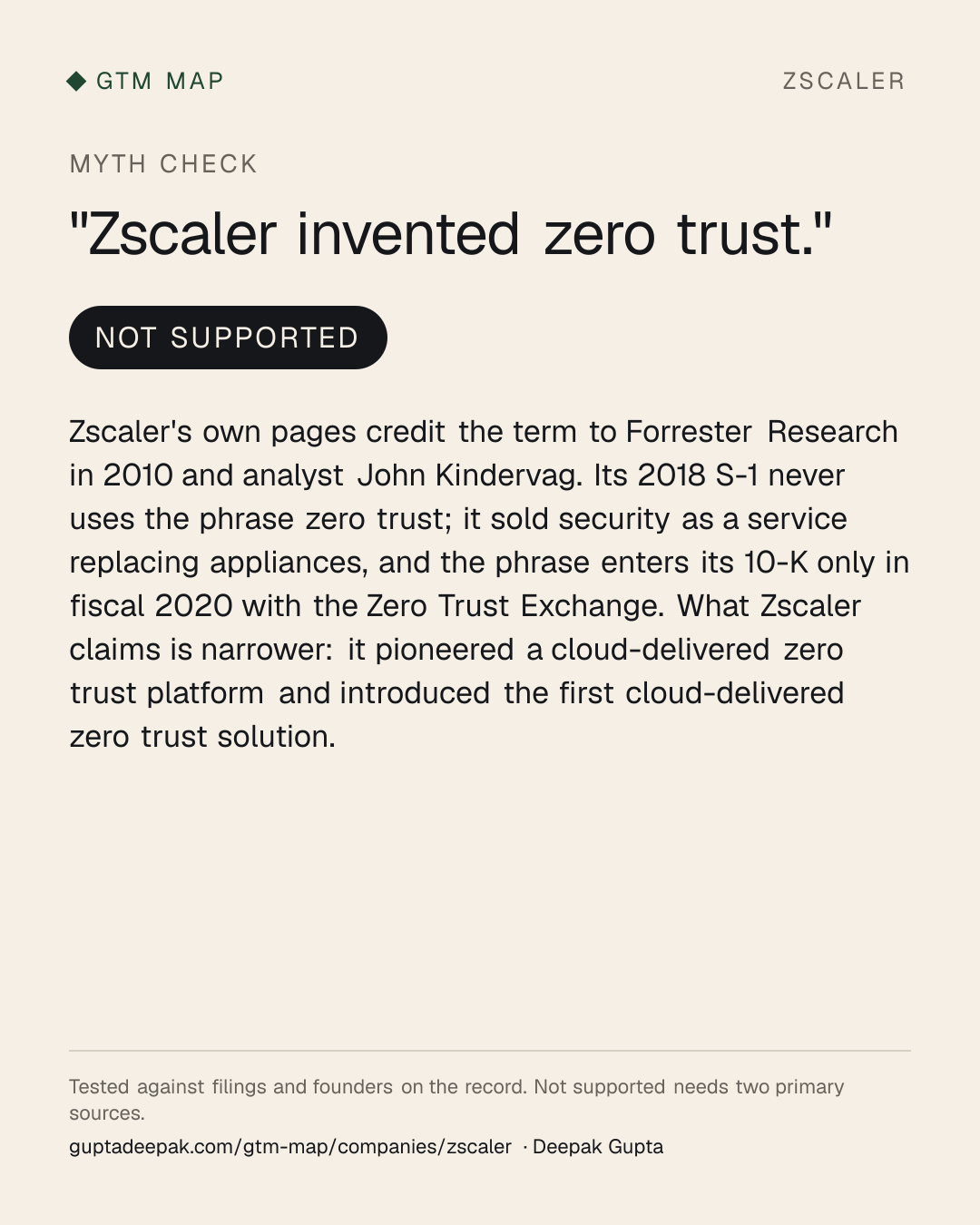
“Zscaler invented zero trust.”
Not supportedZscaler's own pages credit the term to Forrester Research in 2010 and analyst John Kindervag. Its 2018 S-1 never uses the phrase zero trust; it sold security as a service replacing appliances, and the phrase enters its 10-K only in fiscal 2020 with the Zero Trust Exchange. What Zscaler claims is narrower: it pioneered a cloud-delivered zero trust platform and introduced the first cloud-delivered zero trust solution.[19],[20],[1],[4],[23]
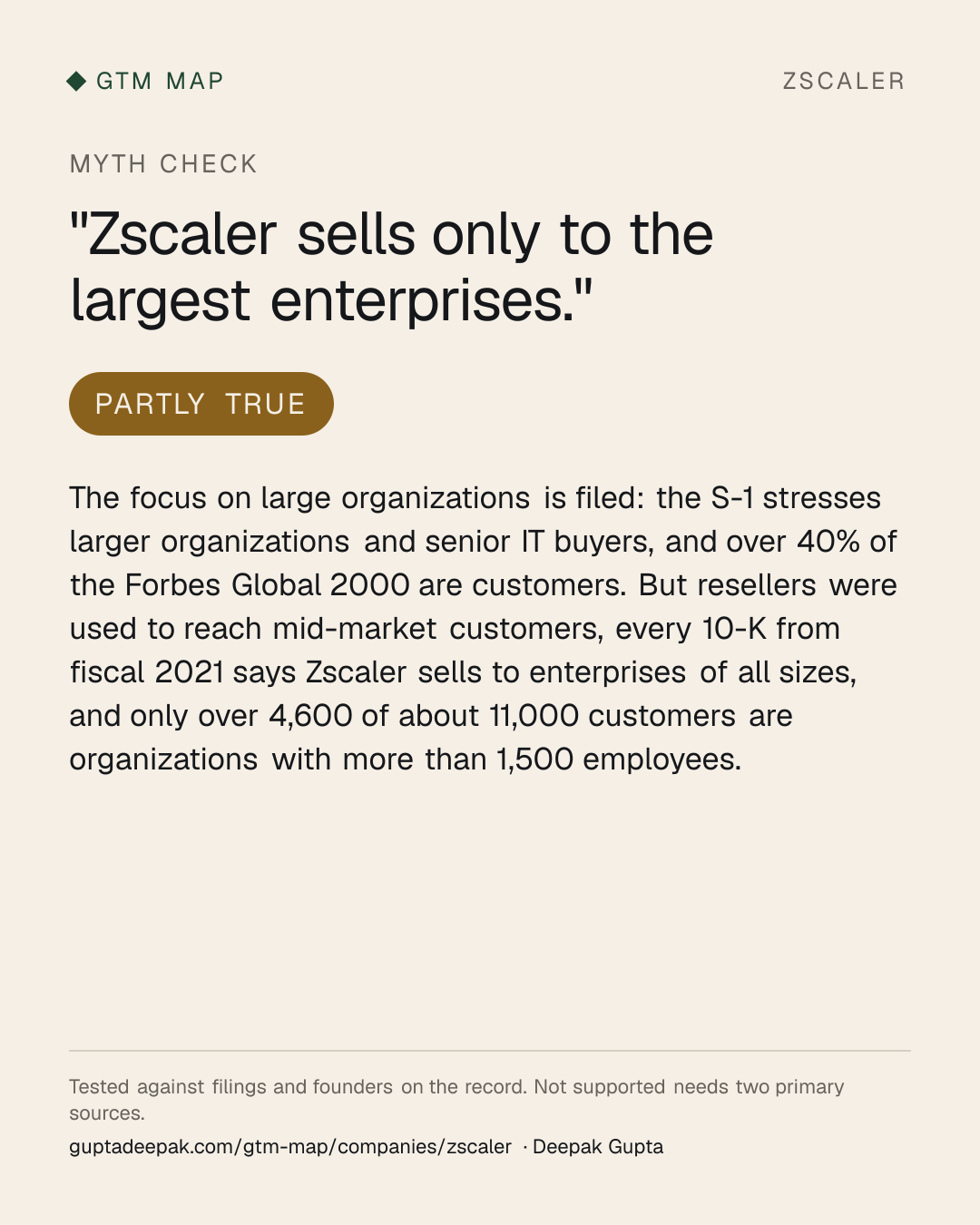
“Zscaler sells only to the largest enterprises.”
Partly trueThe focus on large organizations is filed: the S-1 stresses larger organizations and senior IT buyers, and over 40% of the Forbes Global 2000 are customers. But resellers were used to reach mid-market customers, every 10-K from fiscal 2021 says Zscaler sells to enterprises of all sizes, and only over 4,600 of about 11,000 customers are organizations with more than 1,500 employees.[1],[5],[10]
On the record
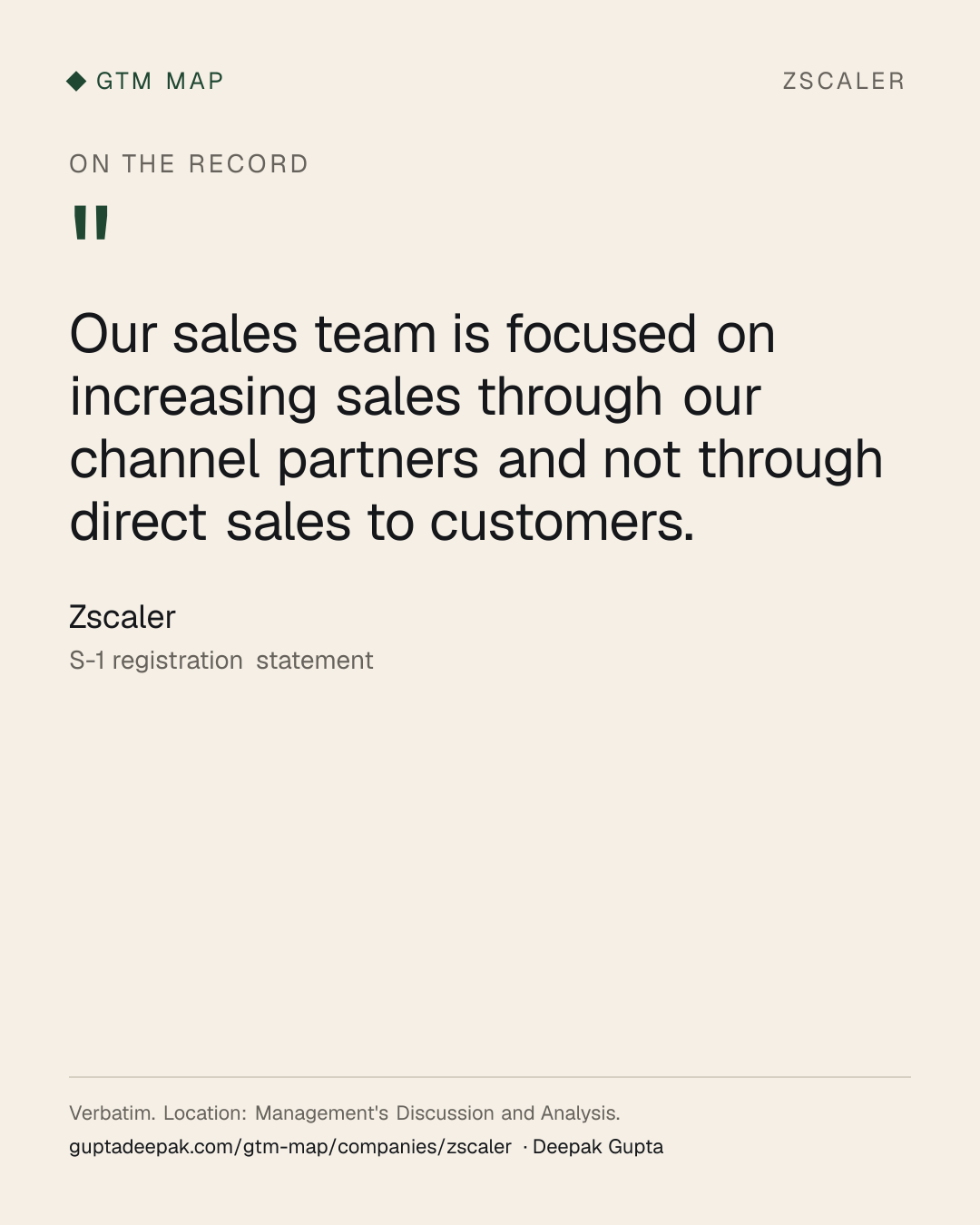
“Our sales team is focused on increasing sales through our channel partners and not through direct sales to customers.”
Zscaler, S-1 registration statement[1]
Management's Discussion and Analysis
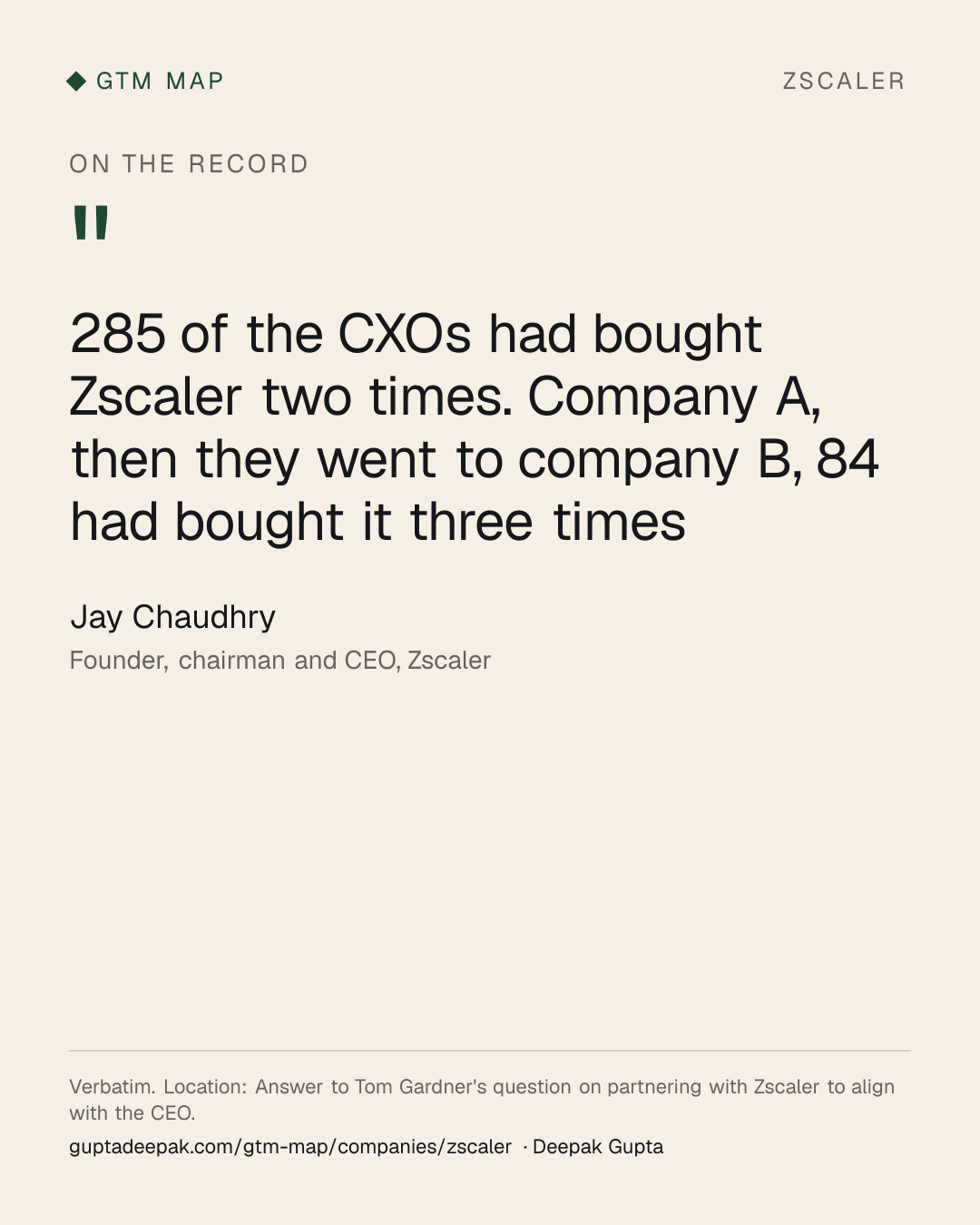
“285 of the CXOs had bought Zscaler two times. Company A, then they went to company B, 84 had bought it three times”
Jay Chaudhry, Founder, chairman and CEO, Zscaler[23]
Answer to Tom Gardner's question on partnering with Zscaler to align with the CEO
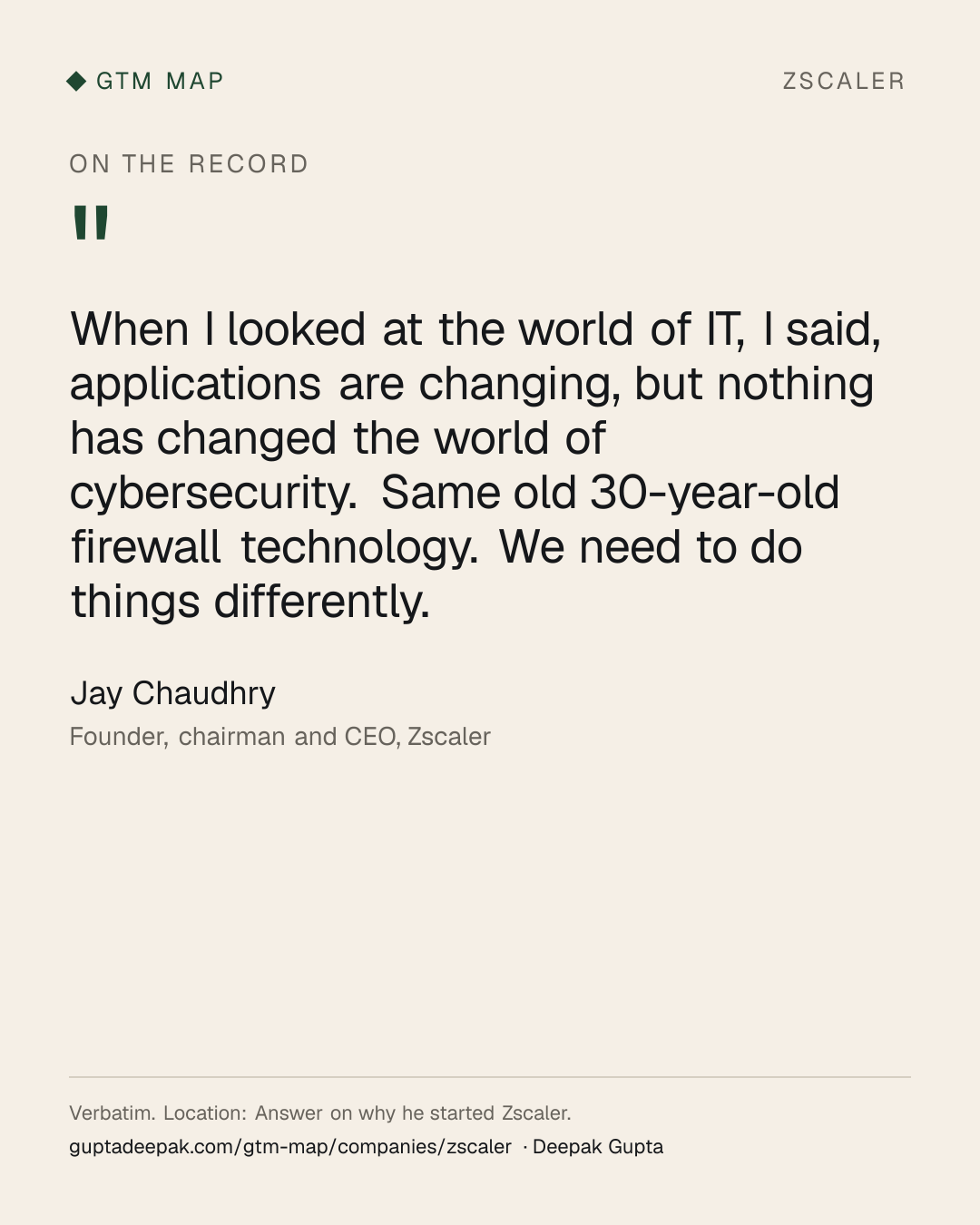
“When I looked at the world of IT, I said, applications are changing, but nothing has changed the world of cybersecurity. Same old 30-year-old firewall technology. We need to do things differently.”
Jay Chaudhry, Founder, chairman and CEO, Zscaler[23]
Answer on why he started Zscaler
04What other companies can take from it
Borrow distribution from whoever already owns the network project.
Works when: Your product replaces infrastructure bought as part of a bigger project someone else already sells (network, cloud migration, ERP), and those partners gain from attaching you.
Backfires when: Buyers purchase you standalone or self-serve, or partner margin eats a low ACV. Channel concentration also becomes a risk the filing has to disclose.
Based on: Cloud security instead of appliances, sold with carriers, Partner channel; Second product, land and expand, IPO, Partner channel; Platform, flexible spend, and AI security, Partner channel
Sell the architecture change first, then adopt the market's name for it.
Works when: An analyst or government term is gaining buyer pull, and your product genuinely implements it rather than touching one part of it.
Backfires when: The term is already a crowded buzzword, which Zscaler's own blog says happened to zero trust, so the label adds no separation.
Based on: Cloud security instead of appliances, sold with carriers, Category creation; The Zero Trust Exchange reframing, Brand narrative
Land and expand needs new products once seats saturate.
Works when: Customers are large and already standardized on your platform, so each new product sells to the same buyer with no new procurement.
Backfires when: Products are bolted on rather than sharing one policy engine and console, or the buyer has no budget pool to draw from.
Based on: Second product, land and expand, IPO, Land and expand; The Zero Trust Exchange reframing, Land and expand; Platform, flexible spend, and AI security, Land and expand
Your champions change jobs; let them take you with them.
Works when: The buyer is a senior security or IT leader whose reputation rests on the architecture they install, and satisfaction is high.
Backfires when: Procurement or a committee with no single owner buys the product, or the category churns faster than executive tenure.
Based on: Cloud security instead of appliances, sold with carriers, Sales-led; Platform, flexible spend, and AI security, Sales-led
05 · GTM Now
What changes in the AI era, and what to do now
Analysis by Deepak Gupta. This is opinion built on the sourced record above, not part of it.[10],[23],[19],[17],[22]
Still works
- Channel attachment to big transformation projects. The FY2026 10-K frames the platform around connecting AI agents to applications; treating AI rollouts as the next such project is analysis.
- Repeat-buying security leaders still carry a vendor between jobs; Chaudhry counts 285 who bought Zscaler at two companies.
- Analysis: marketplace buying against committed cloud spend still shortens procurement.
Breaks
- A borrowed category name loses pull once every vendor uses it, which Zscaler's own blog says happened to zero trust.
- Seat-based expansion weakens when headcount growth slows and agents do work people did; Zscaler's CFO already points to non-seat-based solutions.
- Analysis: threat research as content is easier to copy and summarize in AI answers, so the report alone carries less distinction than the telemetry behind it.
What replaces it
- Securing AI agents and models, launched at Zenith Live 2026 with AI Broker for Agents, which is Zscaler's own move.
- Z-Flex spend pools that let customers try new products inside an existing commitment.
- Analysis: live, data-backed research from your own telemetry rather than annual PDFs. How much revenue any of these produce is not sourced.
Apply it now
If you are
A Series A to C infrastructure security company selling $100K-plus deals to enterprises, replacing appliances or legacy on-premises tools
- Map the two or three partner types already selling the larger project your product fits into, and build a joint motion where your rep owns the customer relationship and the partner transacts.
- Write the architecture argument in plain buyer language first, and adopt the analyst or government term only where your product implements it fully.
- Publish research from your own telemetry on a fixed annual cadence, and reuse it in every earnings or customer update.
- Track every champion who changes companies and give sales a play for their new employer.
You will know it works when: The share of new logos sourced or co-sold by partners, and the count of new logos whose buyer had bought you before (Chaudhry's figure: 285 security leaders bought Zscaler at two companies).
Based on Zscaler's Cloud security instead of appliances, sold with carriers, Cloud security instead of appliances, sold with carriers, The Zero Trust Exchange reframing
If you are
A later-stage multi-product security platform whose net retention is sliding toward the low 110s
- Add a pre-committed spend pool that lets customers adopt new products without a new contract, as Z-Flex does.
- Price at least one new product on something other than users, such as workloads, data volume, or agents.
- List on the cloud marketplaces where your largest customers hold committed spend, and report marketplace sales as a tracked number.
- Use your owned flagship event to launch the new products and give partners sponsorship roles.
You will know it works when: The share of net new ARR from non-seat products and from customers adding a product within an existing commitment.
Based on Zscaler's Platform, flexible spend, and AI security, Platform, flexible spend, and AI security, Platform, flexible spend, and AI security
Motions in this record
Compare with every other company on the GTM matrix.
Share the visuals
Every card is drawn from the sourced record above and sized 1080 by 1350 for LinkedIn and X. Free to share with a link back to this page.
Sources
- [1]SEC filingZscaler, Inc. Form S-1 Registration Statement (February 16, 2018)
- [2]SEC filingForm 10-K, fiscal year ended July 31, 2018 (September 13, 2018)
- [3]SEC filingForm 10-K, fiscal year ended July 31, 2019 (September 18, 2019)
- [4]SEC filingForm 10-K, fiscal year ended July 31, 2020 (September 17, 2020)
- [5]SEC filingForm 10-K, fiscal year ended July 31, 2021 (September 16, 2021)
- [6]SEC filingForm 10-K, fiscal year ended July 31, 2022 (September 15, 2022)
- [7]SEC filingForm 10-K, fiscal year ended July 31, 2023 (September 14, 2023)
- [8]SEC filingForm 10-K, fiscal year ended July 31, 2024 (September 12, 2024)
- [9]SEC filingForm 10-K, fiscal year ended July 31, 2025 (September 11, 2025)
- [10]SEC filingForm 10-K, fiscal year ended July 31, 2026 (September 3, 2026)
- [11]EarningsZscaler Reports Fourth Quarter and Fiscal 2018 Financial Results (8-K exhibit) (September 5, 2018)
- [12]EarningsZscaler Reports Fourth Quarter and Fiscal 2020 Financial Results (8-K exhibit) (September 9, 2020)
- [13]EarningsZscaler Reports Fourth Quarter and Fiscal 2021 Financial Results (8-K exhibit) (September 9, 2021)
- [14]EarningsZscaler fourth quarter and fiscal 2023 results press release (8-K exhibit) (September 5, 2023)
- [15]EarningsZscaler Reports Fourth Quarter and Fiscal 2024 Financial Results (8-K exhibit) (September 3, 2024)
- [16]EarningsZscaler Reports Fourth Quarter and Fiscal 2025 Financial Results (8-K exhibit) (September 2, 2025)
- [17]EarningsZscaler Announces Strong Fourth Quarter and Fiscal 2026 Financial Results (8-K exhibit) (September 3, 2026)
- [18]CompanyZscaler Private Access: Remote Access without the Security Risks of VPNs (April 26, 2016)
- [19]CompanyWhy Is Zero Trust Cybersecurity So Essential Today? (Jacob Serpa) (September 16, 2024)
- [20]CompanyA brief history of zero trust from the whiteboard to the White House (infographic) (2022)
- [21]CompanyZscaler surpasses $1B in AWS Marketplace sales (David Garcia) (November 6, 2025)
- [22]CompanyZenith Live 2026 Recap (2026)
- [23]Founder interviewThe Motley Fool Interviews Zscaler Founder and CEO Jay Chaudhry (transcript, interviewer Tom Gardner) (Jay Chaudhry, January 22, 2026, at text transcript: answers on why he started Zscaler, on partnering with the CEO, and on AI threats)
- [24]Trade pressZscaler soars 106% on first day of trading (TechCrunch, March 16, 2018)
Every phase, motion, and myth verdict cites a filing, the company's own pages, or a founder speaking on the record. See the methodology.