
Product-led · public
How monday.com went to market
monday.com sold a horizontal work tool through a self-serve trial fed by performance ads that had to pay back within months, with paying teams inviting other teams. From mid-2018 it layered sales, customer success and partners on top, split the platform into products, and by 2026 ran a hybrid, sales-led motion with AI credits.
- Buyer:
- Small business, Mid-market, Enterprise
- Contract size:
- Mixed
- Checked:
- October 18, 2026
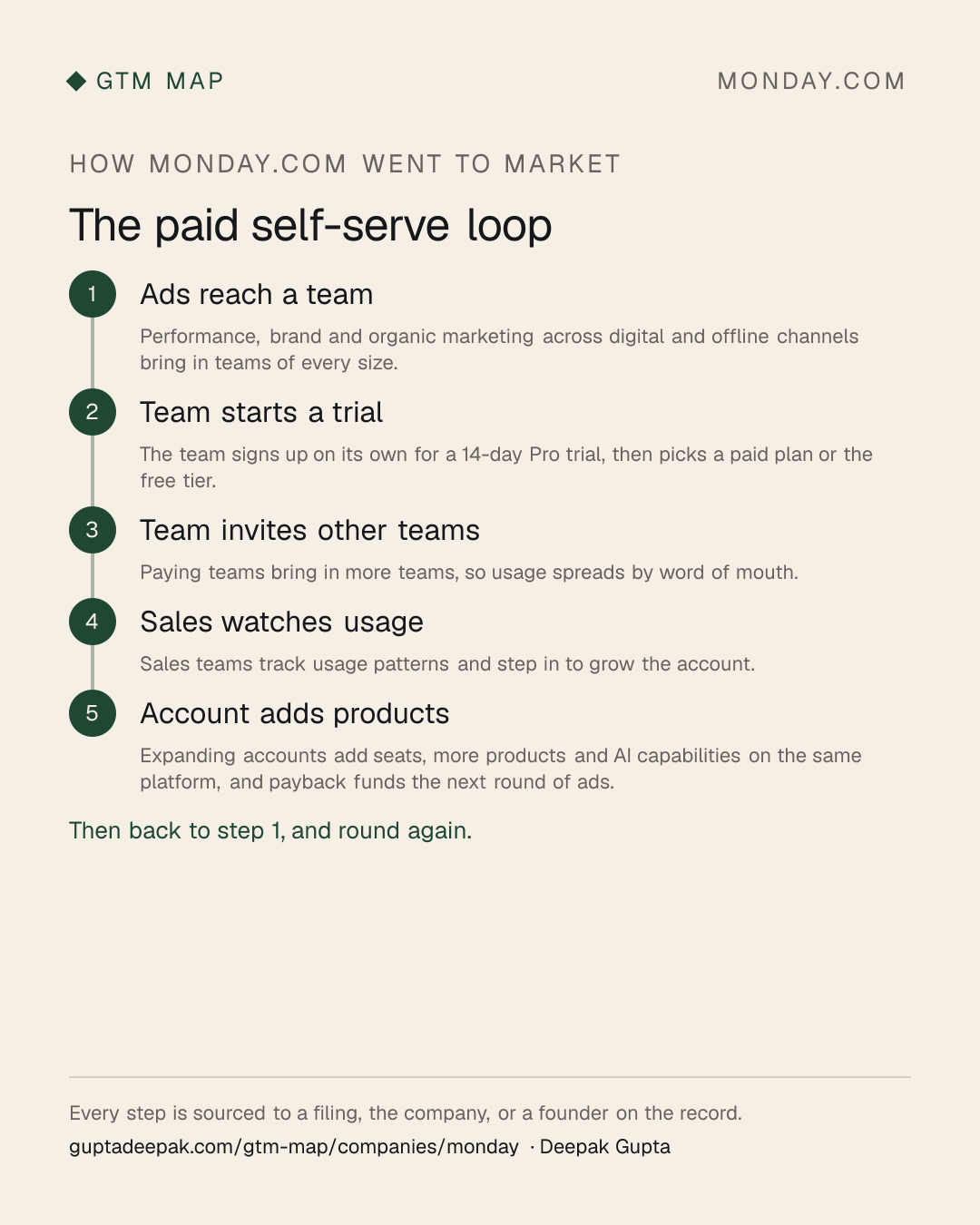
Ads reach a team
Performance, brand and organic marketing across digital and offline channels bring in teams of every size.[1]
Team starts a trial
The team signs up on its own for a 14-day Pro trial, then picks a paid plan or the free tier.[1]
Team invites other teams
Paying teams bring in more teams, so usage spreads by word of mouth.[1]
Sales watches usage
Sales teams track usage patterns and step in to grow the account.[1]
Back to step 1, and round again
01The phases
PrimarySupportingTried, then dropped
2014 to 2018
Self-serve trial and payback-gated ads
From the 2014 launch until mid-2018, the self-serve funnel was the only go-to-market engine, fed by online ads that were judged on payback rather than held to a budget.
- Product-led
The only engine was the self-serve funnel plus customer experience: anyone could sign up without help, starting on a 14-day trial of the Pro plan, with per-seat pricing.[1]
- Paid acquisition
Online ads were the main demand source, run with no fixed budget: spend scaled as long as each dollar paid back inside a set window, 8 to 9 months in 2019. The company says it began with DIY social media ads on a $50 budget.[16],[13]
- Viral loop
Paying teams invite other teams, so word of mouth carries the product into new parts of the company.[1],[16]
- Product-led
2018 to 2021
Sales, partners and the Work OS
From mid-2018 monday.com added sales, customer success and partner teams on top of the self-serve base, named a new category, Work OS, and went public in June 2021.
- Paid acquisition
Advertising costs of $98.4M in 2019 were larger than that year's $78.1M revenue, and sales and marketing was 152% of revenue. Mann put YouTube at 15 to 20% of the online effort. Marketing mixed performance ads, brand ads and organic channels.[1],[16]
- Sales-assist
Sales and customer success were layered onto the self-serve base: sales teams watch usage patterns and step in to grow accounts, and the sales and customer success team grew from 154 people at the end of 2019 to 365 in March 2021.[1]
- Land and expand
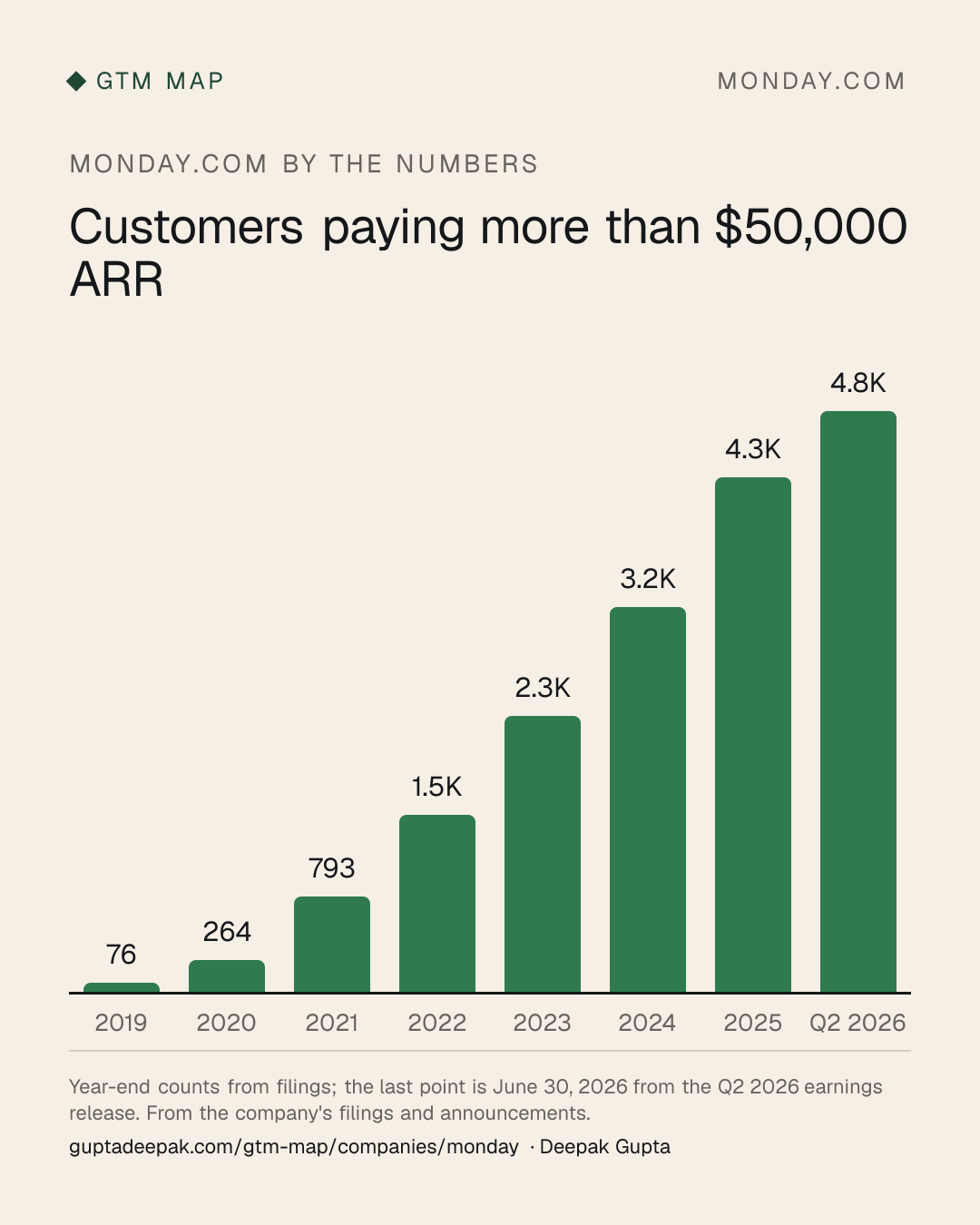
Large accounts start with a small team and spread. Customers over $50,000 ARR went from 76 to 264 in 2020, net dollar retention for customers with more than 10 users reached 121%, and the 2016 and 2017 cohorts expanded faster once sales and customer success worked them.[1]
- Partner channel
Channel partners were paid commissions on referred customers, 112 channel partners were recruited, and an apps marketplace opened to outside developers in 2019 and 2020.[1]
- Category creation
The IPO story named a new category, Work OS, and monday 2.0 relaunched the product as a work operating system for building custom apps.[1],[11]
- Brand narrative
Brand spend ran alongside performance spend as an experiment rather than on payback, and offline money went to subway ads, which left room for a more complex message.[16]
- Owned events
The first global conferences, Elevate, Unplugged and Global Partners Summit, launched in 2019.[11]
- Product-led
Self-serve stayed the front door. The prospectus calls the Free plan for up to two users a recent addition and warns it may not drive paid subscriptions.[1]
- Paid acquisition
2021 to 2024
More products and the move upmarket
After the IPO the platform was split into separate products so accounts could expand by product, not only by seat, while 2024 shifted emphasis to mid-market and trained sales for a sales-led motion.
- Land and expand
Work management, sales CRM, dev and later service were sold on one platform. Customers over $50,000 ARR reached 3,201 at the end of 2024. Net dollar retention for customers with more than 10 users was over 135% at the end of 2021 and 115% at the end of 2023, which the company tied to slower expansion.[2],[4],[5],[8]
- Brand narrative
The first Super Bowl spot, Work without Limits, in February 2022 was called the company's most comprehensive campaign, with billboards and subway ads in nine markets. Out-of-home campaigns stay in the mix in later filings.[13],[4]
- Paid acquisition
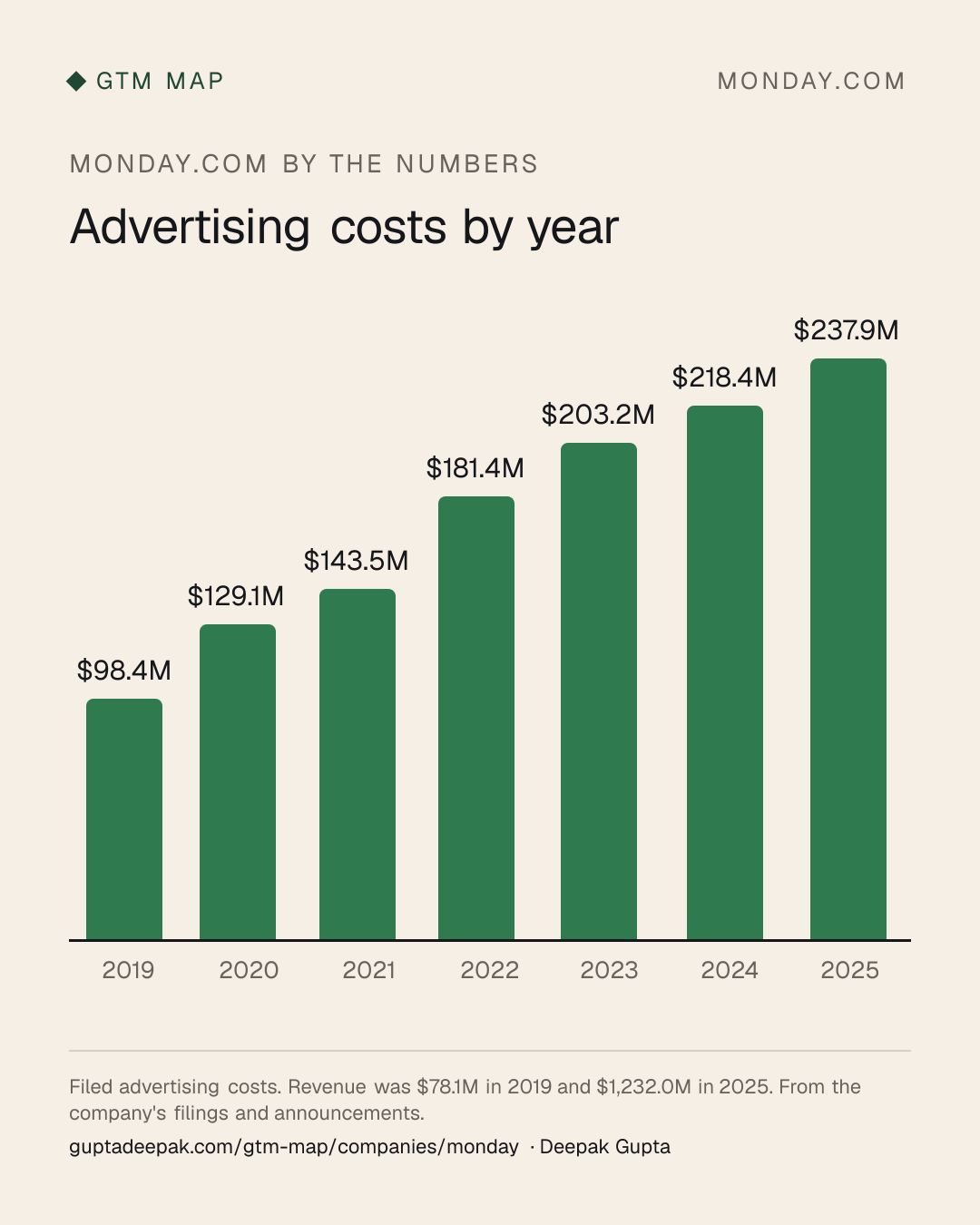
Advertising kept rising in dollars while revenue grew faster: $143.5M against revenue of $308.2M in 2021, then $218.4M against revenue of $972.0M in 2024. Marketing targeted both teams and managers, bottom-up and top-down.[2],[3],[4],[5]
- Sales-led
In 2024 the company emphasized mid-market customers, added account-based marketing and top-down selling, and trained sales for a sales-led strategy it said would arrive in full force in 2025.[5]
- Product-led
The self-serve funnel remained the base layer, now described as complemented by an expanding sales-led motion.[5]
- Land and expand
2025 to now
Hybrid sales-led GTM and the AI Work Platform
From 2025 the company describes a hybrid of marketing, sales and partners, with spend moving from online channels to enterprise sales and brand. In 2026 it relaunched as an AI Work Platform with seats-plus-credits pricing and cut about 20% of its workforce.
- Sales-led
The company says its GTM shifted from performance marketing to a hybrid approach, hired a CRO, put more sellers on the ground, and rebalanced spend away from certain online channels. In July 2026 it filed a restructuring plan cutting about 20% of the workforce as part of the ongoing transformation of its product, marketing and go-to-market strategy.[14],[6],[7]
- Land and expand
Expansion runs through seat penetration, more products and AI adoption. Customers over $500,000 ARR rose from 50 to 87 in 2025, and net dollar retention for customers over $50,000 ARR was 116%.[6]
- Usage pricing
In May 2026 the company launched the AI Work Platform with native AI agents and a seats-plus-credits pricing model, which it calls a shift to consumption-based pricing. AI products were 17% of net new ARR in Q2 2026.[9],[10],[12]
- Product-led
Self-serve signup and the free plan for up to two seats continue, with AI features pitched as faster time to value.[6],[12]
- Paid acquisition
Performance marketing stays in the mix, but the 20-F reports declines in web traffic from Google searches, primarily due to AI-generated search updates and algorithm updates.[6]
- Partner channel
300 channel partners in about 50 countries and territories, with some onboarding and training shifted from monday-led to partner-led, and 280 monetized partner apps on the marketplace.[6]
- Sales-led
02The numbers
Show the data
| 2019 | $98.4M | From a filing |
|---|---|---|
| 2020 | $129.1M | From a filing |
| 2021 | $143.5M | From a filing |
| 2022 | $181.4M | From a filing |
| 2023 | $203.2M | From a filing |
| 2024 | $218.4M | From a filing |
| 2025 | $237.9M | From a filing |
Show the data
| 2019 | 76 | From a filing |
|---|---|---|
| 2020 | 264 | From a filing |
| 2021 | 793 | From a filing |
| 2022 | 1.5K | From a filing |
| 2023 | 2.3K | From a filing |
| 2024 | 3.2K | From a filing |
| 2025 | 4.3K | From a filing |
| Q2 2026 | 4.8K | Company-stated |
| Metric | Value | As of | Basis |
|---|---|---|---|
| Revenue, 2019 and 2020 | $78.1M and $161.1M, up 143% and 106%[1] | December 31, 2020 | From a filing |
| Advertising costs, 2019 | $98.4M, against revenue of $78.1M[1] | December 31, 2019 | From a filing |
| Sales and marketing as a share of revenue, 2019, 2020, Q1 2021 | 152%, 119%, 107%[1] | March 31, 2021 | From a filing |
| Paid customers | 127,974[1] | March 31, 2021 | From a filing |
| Net dollar retention, customers with more than 10 users | 121%[1] | March 31, 2021 | From a filing |
| Capital efficiency before the IPO | More than $2 of ARR per $1 of capital used[1] | March 31, 2021 | From a filing |
| IPO | $155.00 per share, $573.5M gross[1] | June 9, 2021 | From a filing |
| Annual recurring revenue | Surpassed $1B[8] | December 31, 2024 | Company-stated |
| Revenue, 2025 | $1,232.0M, up 27%[6] | December 31, 2025 | From a filing |
| Advertising costs, 2025 | $237.9M, against revenue of $1,232.0M[6] | December 31, 2025 | From a filing |
| Sales and marketing as a share of revenue, 2023 to 2025 | 60%, 55%, 51%[6] | December 31, 2025 | From a filing |
| Customers over $50K ARR and their share of ARR | 4,281, 41% of ARR[6] | December 31, 2025 | From a filing |
| Customers over $500K ARR | 114, up from 68 a year earlier[10] | June 30, 2026 | Company-stated |
| Workforce reduction in the 2026 restructuring | About 20%[7] | July 22, 2026 | From a filing |
“Reported” figures come from trade press, not the company, and are shown with their date.
03Myth checks
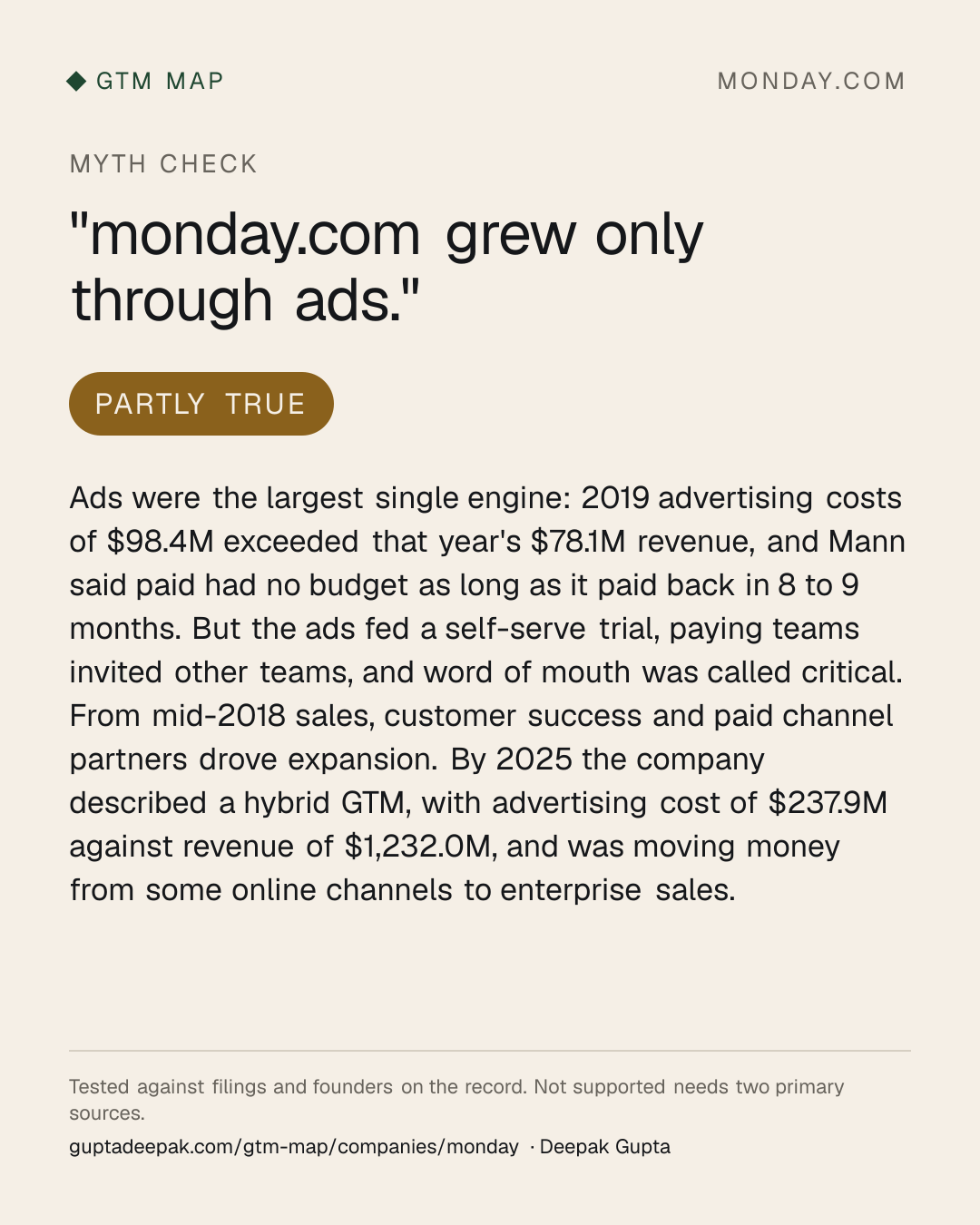
“monday.com grew only through ads.”
Partly trueAds were the largest single engine: 2019 advertising costs of $98.4M exceeded that year's $78.1M revenue, and Mann said paid had no budget as long as it paid back in 8 to 9 months. But the ads fed a self-serve trial, paying teams invited other teams, and word of mouth was called critical. From mid-2018 sales, customer success and paid channel partners drove expansion. By 2025 the company described a hybrid GTM, with advertising cost of $237.9M against revenue of $1,232.0M, and was moving money from some online channels to enterprise sales.[1],[16],[6],[14]
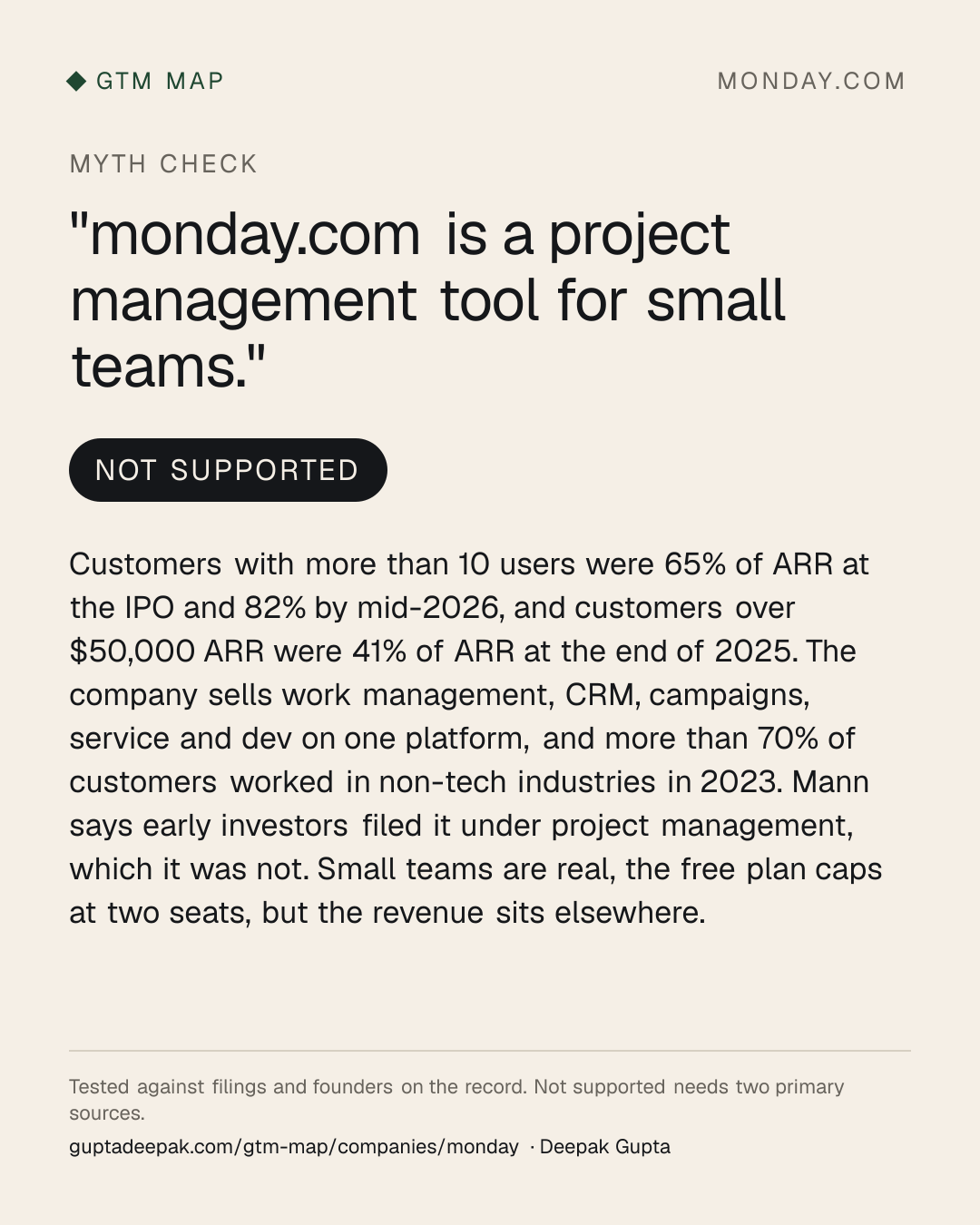
“monday.com is a project management tool for small teams.”
Not supportedCustomers with more than 10 users were 65% of ARR at the IPO and 82% by mid-2026, and customers over $50,000 ARR were 41% of ARR at the end of 2025. The company sells work management, CRM, campaigns, service and dev on one platform, and more than 70% of customers worked in non-tech industries in 2023. Mann says early investors filed it under project management, which it was not. Small teams are real, the free plan caps at two seats, but the revenue sits elsewhere.[1],[4],[6],[10],[17]
On the record
“Paid is measured really really well. so it has no budget [...] we can pay as much as we can as long as we get to a certain level of performance.”
Roy Mann, Co-founder and CEO, monday.com[16]
Answer on the blend of paid vs organic budgets when launching a new brand
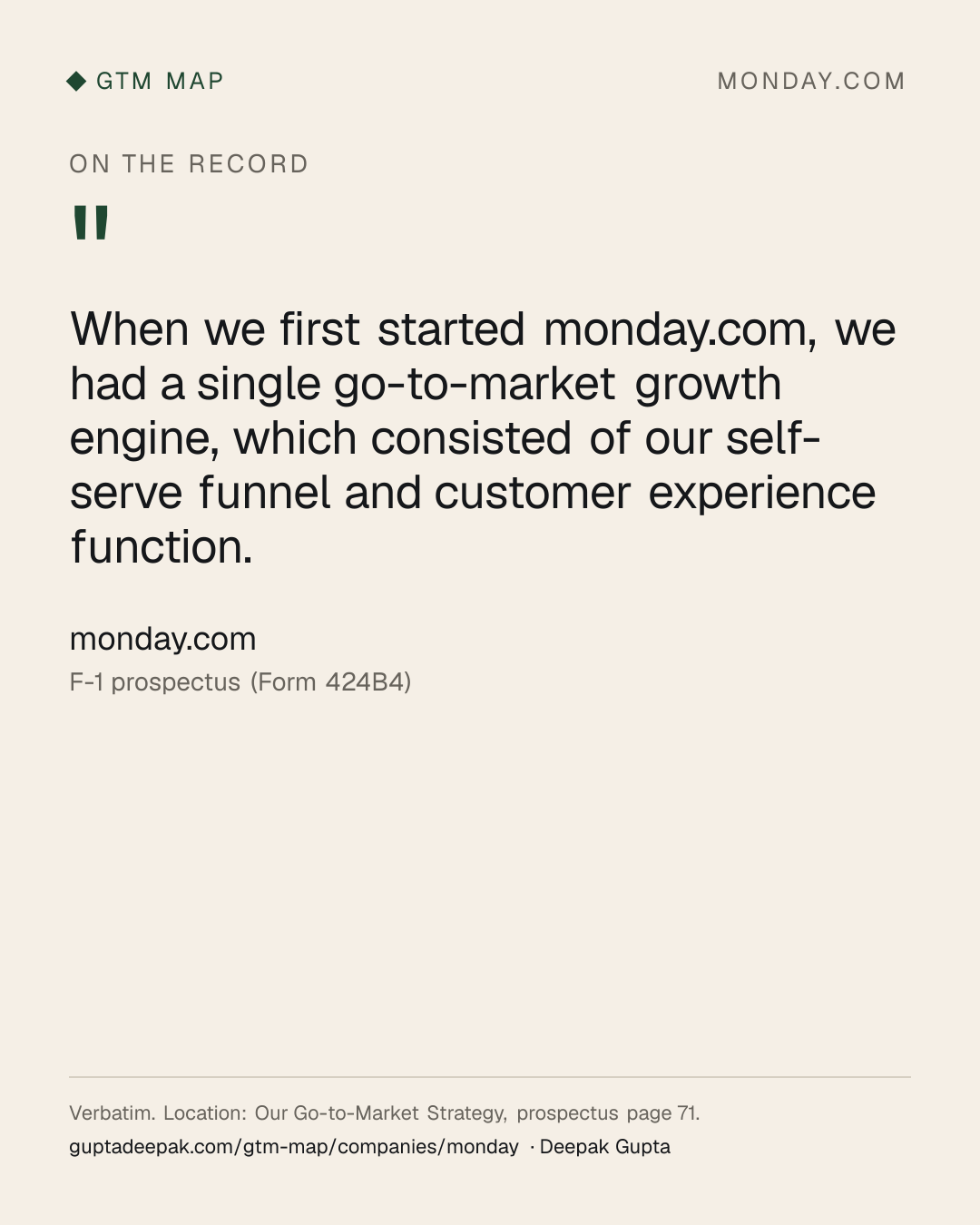
“When we first started monday.com, we had a single go-to-market growth engine, which consisted of our self-serve funnel and customer experience function.”
monday.com, F-1 prospectus (Form 424B4)[1]
Our Go-to-Market Strategy, prospectus page 71
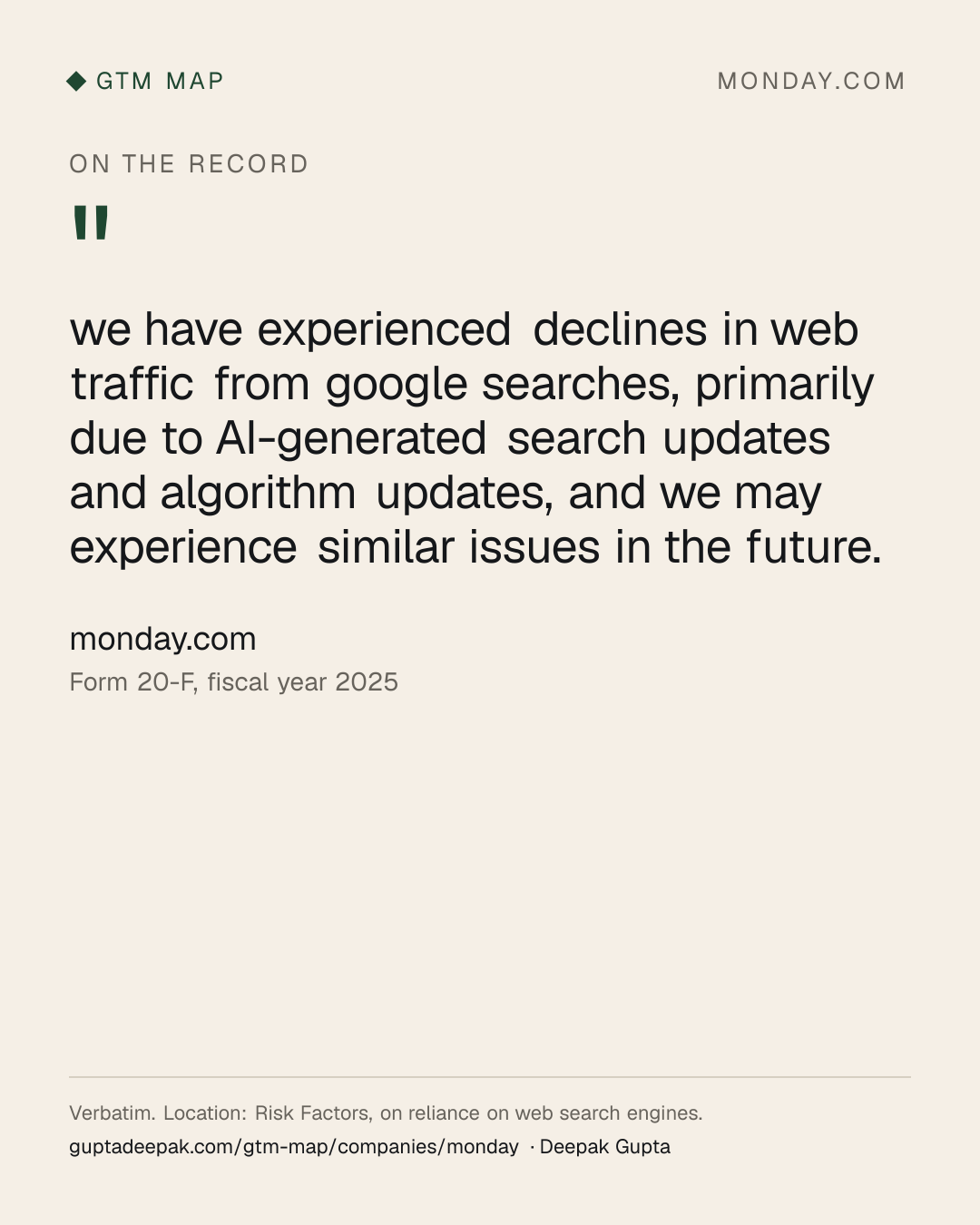
“we have experienced declines in web traffic from google searches, primarily due to AI-generated search updates and algorithm updates, and we may experience similar issues in the future.”
monday.com, Form 20-F, fiscal year 2025[6]
Risk Factors, on reliance on web search engines
04What other companies can take from it
Run paid acquisition as a payback rule, not a budget.
Works when: The product is horizontal with a very large audience, a self-serve trial converts within days, billing is per seat, and attribution is clean enough to compute cash payback per campaign.
Backfires when: The buyer is narrow, sales cycles run for months, or the main click source changes its layout so the same spend buys less traffic, which the FY2025 20-F reports happening.
Based on: Self-serve trial and payback-gated ads, Paid acquisition; Sales, partners and the Work OS, Paid acquisition
Layer sales onto the paid funnel once teams start spreading inside accounts.
Works when: Usage data shows which accounts are adding teams, and a small team can grow to hundreds of seats.
Backfires when: Most accounts stay at one or two seats, so the sales cost exceeds what expansion can return.
Based on: Sales, partners and the Work OS, Sales-assist; Sales, partners and the Work OS, Land and expand
Turn one platform into several products so expansion does not depend only on seats.
Works when: The products share one data layer and admin, so a second product is a toggle, not a new implementation.
Backfires when: Each product needs its own buyer, sales team and category-leading depth to beat specialists.
Based on: More products and the move upmarket, Land and expand; Hybrid sales-led GTM and the AI Work Platform, Land and expand
Rebalance off the dominant paid channel before the channel does it for you.
Works when: A company that grew on search and social ads now has enough large accounts to fund field sales and partners.
Backfires when: The business is still mostly small, low-ACV accounts, so cutting paid cuts the top of the funnel with nothing to replace it.
Based on: Hybrid sales-led GTM and the AI Work Platform, Sales-led; Hybrid sales-led GTM and the AI Work Platform, Paid acquisition
05 · GTM Now
What changes in the AI era, and what to do now
Analysis by Deepak Gupta. This is opinion built on the sourced record above, not part of it.[6],[9],[10],[15]
Still works
- A self-serve trial and free tier that show value without a salesperson, plus account managers who expand teams already using the product. Customers with more than 10 users reached 82% of ARR in mid-2026, so the land and expand engine under the ads survives changes in how people find software.
Breaks
- Search-led acquisition. The company reports declines in web traffic from Google searches, primarily due to AI-generated search updates. Analysis: any GTM that turns search clicks into trials loses volume when answers replace clicks.
- Analysis: pure per-seat pricing weakens if AI agents do work that used to need seats. The company's own response is consumption pricing.
What replaces it
- monday.com's own moves: native AI agents and seats-plus-credits pricing so revenue grows with work done, sales-led enterprise and partner-led onboarding instead of more performance spend, and connectors into AI assistants such as Claude, Microsoft 365 Copilot and ChatGPT. Whether presence inside those assistants replaces search as a discovery channel is not measured in any source.
Apply it now
If you are
A seed to Series B horizontal SaaS tool for business teams, SMB to mid-market, under $10K ACV, with a self-serve trial and seat pricing
- Set paid spend by cash payback per channel (pick a window, for example 8 to 12 months) rather than a fixed budget, and cut any channel that misses it.
- Split reporting into paid search, paid social and video, and track the share of trials that come from search clicks, since that share is what AI answers erode.
- Make inviting a second team part of onboarding, so each paid acquisition seeds word of mouth inside the account.
- Add account managers when usage data shows accounts adding teams, and measure their effect on cohort expansion.
You will know it works when: Blended cash payback on paid holding inside the window while the share of new trials from invites and direct traffic rises.
Based on monday.com's Self-serve trial and payback-gated ads, Self-serve trial and payback-gated ads, Sales, partners and the Work OS
If you are
A growth-stage seat-based SaaS company that grew on performance marketing and sees search traffic and net dollar retention slipping
- Report customers by ARR tier ($50K, $100K, $500K) and net dollar retention per tier, as monday.com's filings do, so upmarket progress is visible.
- Launch a second product on the same data layer and sell it to existing accounts before buying more top-of-funnel traffic.
- Move part of the online budget to field sales, partners and brand for larger accounts, and keep self-serve for the long tail.
- Add a usage or credits component for AI features so revenue tracks work done, not only seats.
You will know it works when: Share of ARR from customers over $50K rising (monday.com went from 36% to 41% in 2025) while sales and marketing as a share of revenue falls.
Based on monday.com's More products and the move upmarket, Hybrid sales-led GTM and the AI Work Platform, Hybrid sales-led GTM and the AI Work Platform
Motions in this record
Compare with every other company on the GTM matrix.
Share the visuals
Every card is drawn from the sourced record above and sized 1080 by 1350 for LinkedIn and X. Free to share with a link back to this page.
![Roy Mann: Paid is measured really really well. so it has no budget [...] we can pay as much as we can as long as we get to a certain level of performance.](/gtm-map/companies/monday/cards/quote-1.png)
Sources
- [1]SEC filingmonday.com Ltd. final prospectus (Form 424B4), File No. 333-256182 (June 11, 2021)
- [2]SEC filingForm 20-F, fiscal year ended December 31, 2021 (March 16, 2022)
- [3]SEC filingForm 20-F, fiscal year ended December 31, 2022 (March 14, 2023)
- [4]SEC filingForm 20-F, fiscal year ended December 31, 2023 (March 14, 2024)
- [5]SEC filingForm 20-F, fiscal year ended December 31, 2024 (March 17, 2025)
- [6]SEC filingForm 20-F, fiscal year ended December 31, 2025 (March 13, 2026)
- [7]SEC filingForm 6-K, restructuring plan (July 22, 2026)
- [8]Earningsmonday.com Announces Fourth Quarter and Fiscal Year 2024 Results (6-K exhibit) (February 10, 2025)
- [9]Earningsmonday.com Announces First Quarter 2026 Results (6-K exhibit) (May 11, 2026)
- [10]Earningsmonday.com Announces Second Quarter 2026 Results (6-K exhibit) (August 10, 2026)
- [11]CompanyOur Story (undated)
- [12]Companymonday.com pricing and plans (undated)
- [13]Companymonday.com Debuts First Big Game Commercial (February 10, 2022)
- [14]Companymonday.com Expands Global Leadership Team with Appointment of CRO (April 3, 2025)
- [15]Companymonday.com Goes All In on AI: From Work Management Platform to AI Work Platform (May 6, 2026)
- [16]Founder interviewRoy Mann Q&A Session (Online Geniuses, transcript) (Roy Mann, October 22, 2019, at answers on paid vs organic budgets, YouTube ads, offline marketing, and the number 1 growth tactic)
- [17]Founder interviewGrowth Gurus: CEO of monday.com (Insight Partners, written Q&A) (Roy Mann, June 10, 2019, at answer to "What was the fundraising process like for Monday.com?")
Every phase, motion, and myth verdict cites a filing, the company's own pages, or a founder speaking on the record. See the methodology.