
Developer and enterprise · public
How Snowflake went to market
Snowflake sold a cloud data warehouse to large organizations through direct sales, charging for consumption under prepaid capacity contracts. Growth came mostly from existing customers adding workloads, with net revenue retention of 169% the year before its IPO. It then named its category the Data Cloud, later the AI Data Cloud, and added marketplaces and partners as channels.
- Buyer:
- Enterprise, Developers
- Contract size:
- Mixed
- Checked:
- October 18, 2026
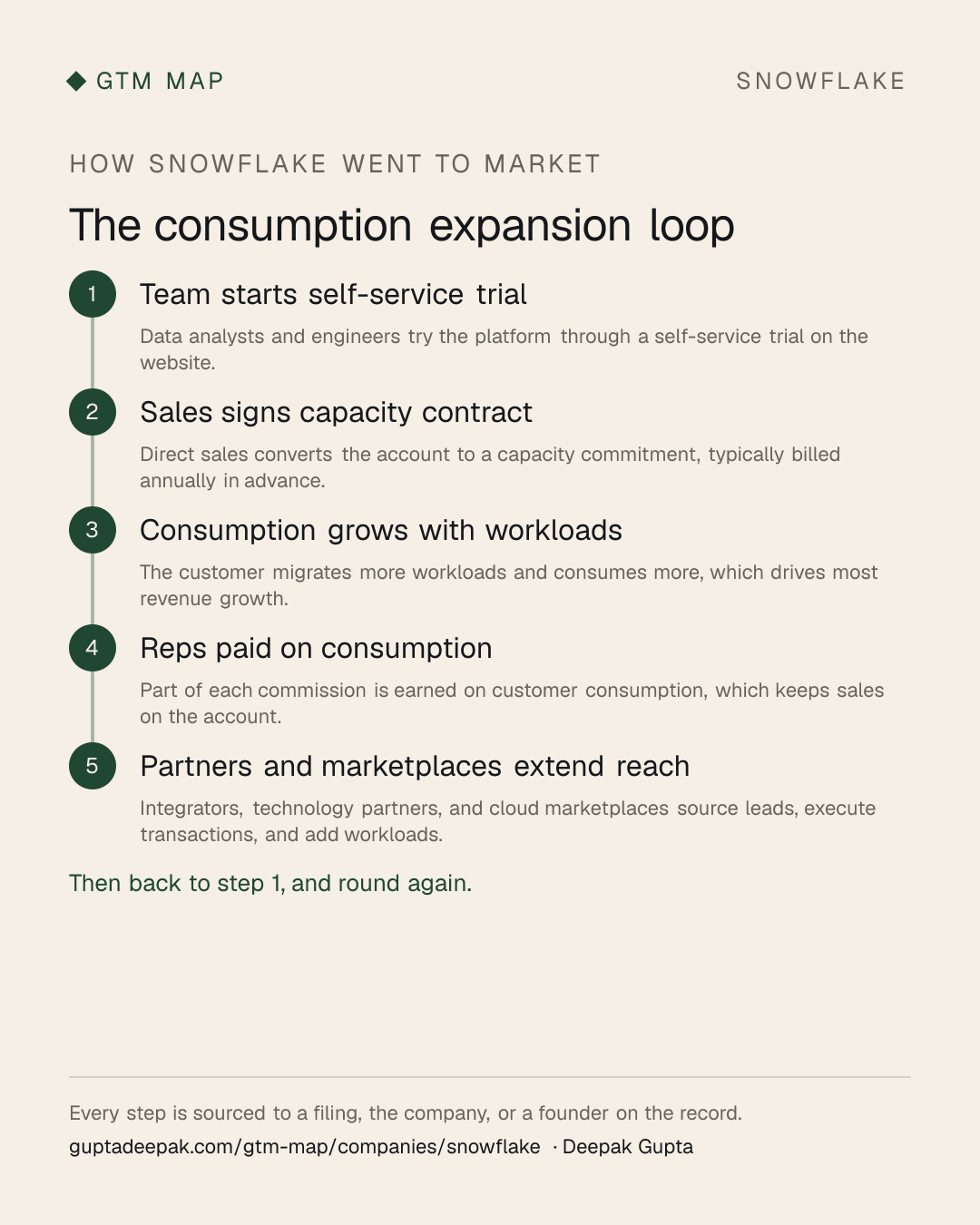
Team starts self-service trial
Data analysts and engineers try the platform through a self-service trial on the website.[1]
Sales signs capacity contract
Direct sales converts the account to a capacity commitment, typically billed annually in advance.[1]
Consumption grows with workloads
The customer migrates more workloads and consumes more, which drives most revenue growth.[5]
Reps paid on consumption
Part of each commission is earned on customer consumption, which keeps sales on the account.[5]
Partners and marketplaces extend reach
Integrators, technology partners, and cloud marketplaces source leads, execute transactions, and add workloads.[5]
Back to step 1, and round again
01The phases
PrimarySupportingTried, then dropped
2012 to 2018
Cloud data warehouse, sold on consumption
Snowflake was founded in 2012 and first offered its platform for sale in 2014, with data warehousing as the core use case. A direct sales force aimed at large organizations sold consumption, not seats.
- Sales-led
A direct sales force aimed at large organizations was the main route to revenue, and sales and marketing spend was 130% of revenue in fiscal 2019.[1]
- Usage pricing
Customers pay for the resources they consume, either from a capacity commitment at agreed prices or on demand billed monthly in arrears, instead of a fixed subscription.[1]
- Product-led
The S-1 says many organizations first adopt the platform through a self-service trial on the website, reaching analysts and engineers while direct sales reaches executives. It does not date when the trial began.[1]
- Sales-led
2019 to 2021
Land and expand, the IPO, and the Data Cloud
Frank Slootman became CEO in April 2019 and the company listed in September 2020. Almost all revenue came from existing customers consuming more, and Snowflake began selling itself as the Data Cloud.
- Land and expand
About 94% of revenue in the six months to July 31, 2020 came from existing capacity customers. Net revenue retention was 169% for fiscal 2020 and 158% at July 31, 2020.[1]
- Sales-led
The sales force was pointed at the world's largest organizations, and from 2020 part of each commission was earned on the rate of customer consumption rather than only on signature.[1]
- Usage pricing
Once a customer is live, the sales team's job is to expand its consumption. Capacity prices rose about 12% year over year through tighter discounting.[1]
- Category creation
Snowflake named and sold the Data Cloud, an ecosystem where customers, partners, and data providers share data, and pitched its network effects. Earnings releases opened with "the Data Cloud company".[1],[6]
- Partner channel
Channel partners, system integrators, and technology partners source leads and handle training, implementation, and migration.[1]
- Inbound content
Marketing combined inbound demand creation with direct marketing aimed at business and technology leaders.[1]
- Land and expand
2021 to 2024
Scaling through clouds, partners, and developers
From fiscal 2022 to fiscal 2024 expansion stayed the main growth source but slowed as customers optimized consumption. Marketplace listings, a joint Microsoft program, and developer tools widened the routes in. Slootman retired in February 2024.
- Land and expand
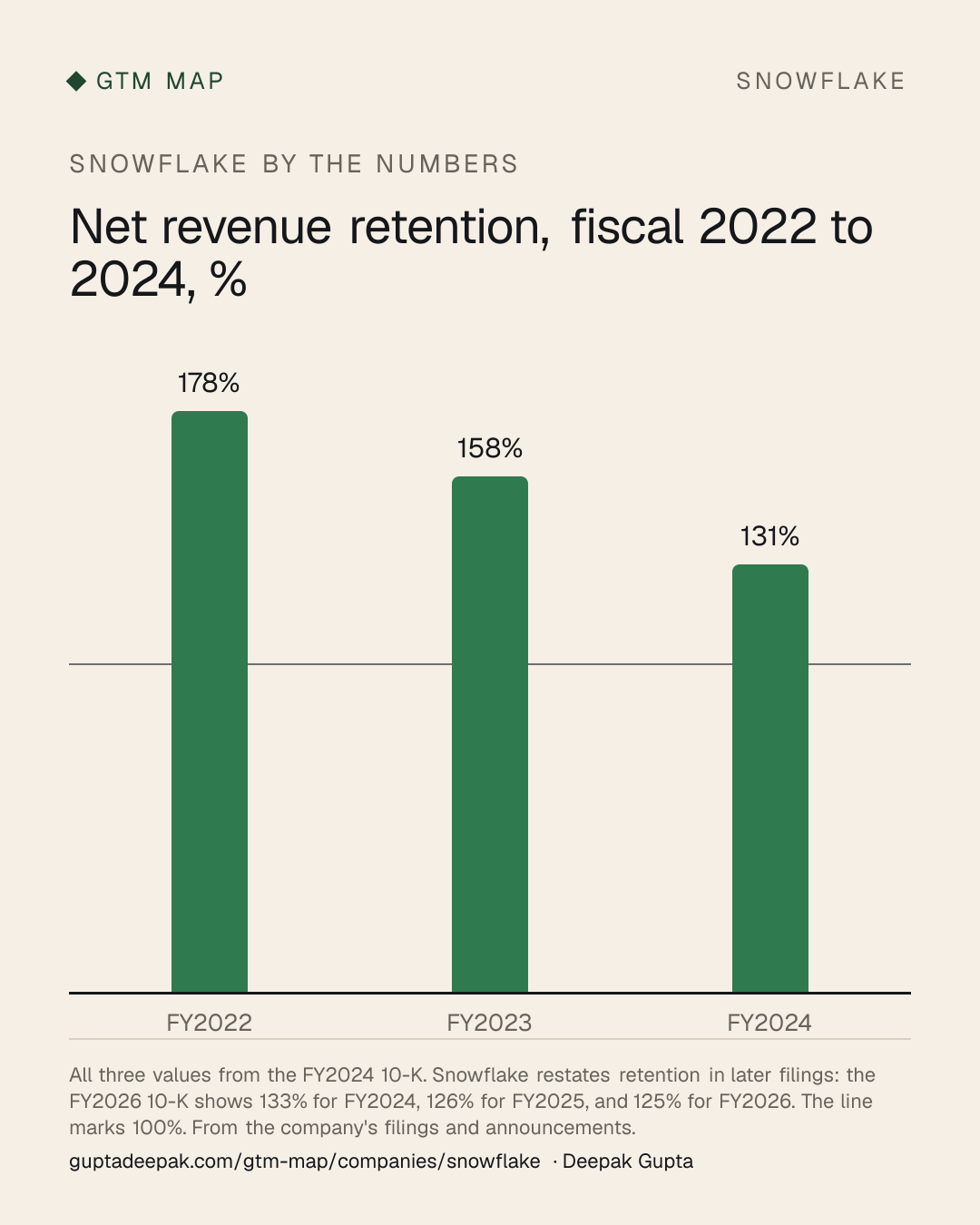
Net revenue retention went from 178% in fiscal 2022 to 158% in fiscal 2023 and 131% in fiscal 2024, per the FY2024 10-K, as customers cut storage and optimized consumption.[4],[7]
- Sales-led
Forbes Global 2000 customers became a reported key metric for the large-enterprise focus, reaching 691 by January 2024. Slootman described it as campaigning the largest enterprises globally.[4],[8]
- Cloud marketplace
Customers can contract through Snowflake's marketplace listings, which the 10-K names as a gross margin factor. In 2023 Microsoft and Snowflake agreed joint go-to-market programs and a larger Azure spend commitment.[3],[12]
- Developer-led
Snowpark for Java (2021) and Python (2022), plus the Powered by Snowflake program, extended the platform to developers building applications. The filings do not show developers as the entry buyer.[3]
- Category creation
The Data Cloud pitch moved toward listing and monetizing data and data products through the Marketplace.[3]
- Owned events
Snowflake Summit, the annual user conference, is where partner integrations were shown, including Microsoft's in 2023.[12]
- Land and expand
2023 to now
The AI Data Cloud and agents
Cortex, a managed AI service, was announced in November 2023, and Sridhar Ramaswamy replaced Slootman as CEO in February 2024. Direct sales still leads, while marketplaces, partners, and model providers carry more of the selling.
- Sales-led
Direct field and inside sales, segmented by industry, size, and region, is still the main route, with resellers and distributors added. 790 Forbes Global 2000 customers contributed about 43% of fiscal 2026 revenue.[5]
- Cloud marketplace
AWS Marketplace transactions doubled year over year to more than $2 billion in calendar 2025. The 10-K notes the same cloud providers are, in some cases, also competitors.[14],[5]
- Land and expand
The CFO calls landing and expanding customers the two fundamentals. Net revenue retention was 133%, 126%, and 125% for fiscal 2024 to 2026 in the FY2026 10-K's restated series, while 740 net new customers in the quarter was up 40%.[9],[5]
- Partner channel
Partners now source leads and execute transactions, and system integrators bring a small but increasing share of revenue. A $200 million Anthropic agreement set up a joint global go-to-market initiative.[5],[15]
- Usage pricing
AI features are consumed on the same platform and credited with new workloads and consumption. Capacity contracts run one to four years, and on-demand was about 1% of fiscal 2026 revenue.[10],[5]
- Category creation
The category name moved from the Data Cloud to the AI Data Cloud, with Cortex as the managed AI layer and Snowflake Intelligence for building data agents.[11],[5]
- Owned events
Summit 2025, the seventh annual, was billed as the largest in the company's history, with Sam Altman as keynote speaker.[13]
- Product-led
The self-service trial remains, lasting 30 days or until the free usage balance runs out, with AI features disabled until a credit card is added.[16],[5]
- Sales-led
02The numbers
Show the data
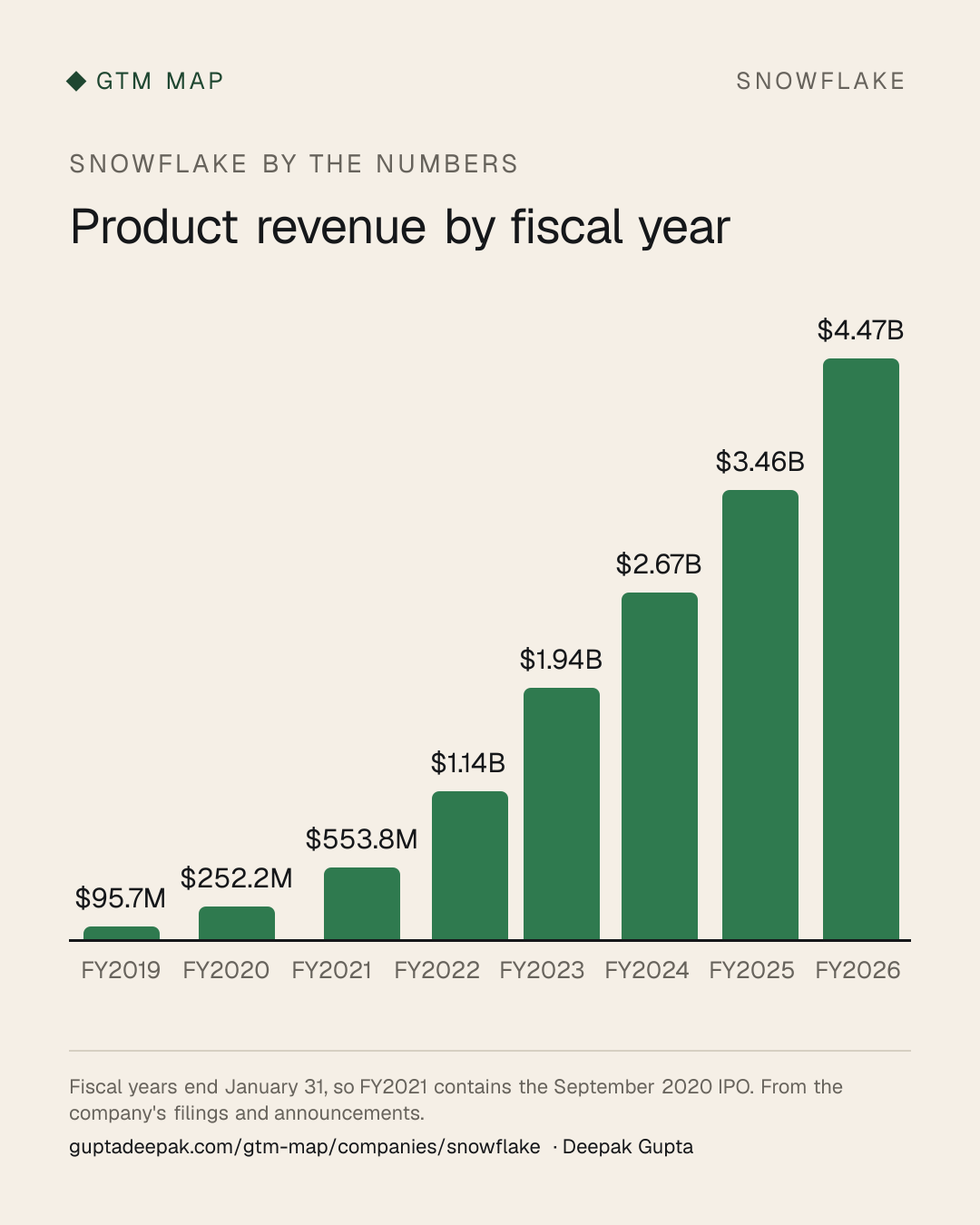
| FY2019 | $95.7M | From a filing |
|---|---|---|
| FY2020 | $252.2M | From a filing |
| FY2021 | $553.8M | From a filing |
| FY2022 | $1.14B | From a filing |
| FY2023 | $1.94B | From a filing |
| FY2024 | $2.67B | From a filing |
| FY2025 | $3.46B | From a filing |
| FY2026 | $4.47B | From a filing |
Show the data
| FY2022 | 178% | From a filing |
|---|---|---|
| FY2023 | 158% | From a filing |
| FY2024 | 131% | From a filing |
| Metric | Value | As of | Basis |
|---|---|---|---|
| Total revenue, fiscal 2020 | $264.7M, up 174%[1] | January 31, 2020 | From a filing |
| Sales and marketing as a share of revenue, fiscal 2019 and 2020 | 130%, 111%[1] | January 31, 2020 | From a filing |
| Net revenue retention, fiscal 2019 and 2020 (S-1) | 180%, 169%[1] | January 31, 2020 | From a filing |
| Revenue from existing capacity customers, six months to July 2020 | About 94%[1] | July 31, 2020 | From a filing |
| Customers at the S-1 | 3,117 total, 56 above $1M a year, 146 of the Fortune 500[1] | July 31, 2020 | From a filing |
| IPO first day | Up more than 111%, $70.4B market value, largest software IPO ever[18] | September 16, 2020 | Reported |
| Total revenue, fiscal 2021 | $592.0M, up 124%[2] | January 31, 2021 | From a filing |
| Total revenue, fiscal 2023 | $2.07B, up 69%[3] | January 31, 2023 | From a filing |
| Net revenue retention, fiscal 2022 to 2024 (FY2024 10-K) | 178%, 158%, 131%[4] | January 31, 2024 | From a filing |
| Total revenue, fiscal 2026 | $4.68B, up 29%[5] | January 31, 2026 | From a filing |
| Customers above $1M a year and Forbes Global 2000 customers | 733 and 790[5] | January 31, 2026 | From a filing |
| Remaining performance obligations | $9.8B, about 46% due within 12 months[5] | January 31, 2026 | From a filing |
| Sales and marketing as a share of revenue, fiscal 2024 to 2026 | 50%, 46%, 44%[5] | January 31, 2026 | From a filing |
| AWS Marketplace sales, calendar 2025 | More than $2B, doubled year over year[14] | December 3, 2025 | Company-stated |
| Latest quarter | Product revenue $1.49B, up 37%; net revenue retention 126%; 828 customers above $1M[10] | July 31, 2026 | From a filing |
| AI feature accounts | Cortex Code in 9,100+ accounts, CoWork in 5,800[10] | July 31, 2026 | Company-stated |
“Reported” figures come from trade press, not the company, and are shown with their date.
03Myth checks
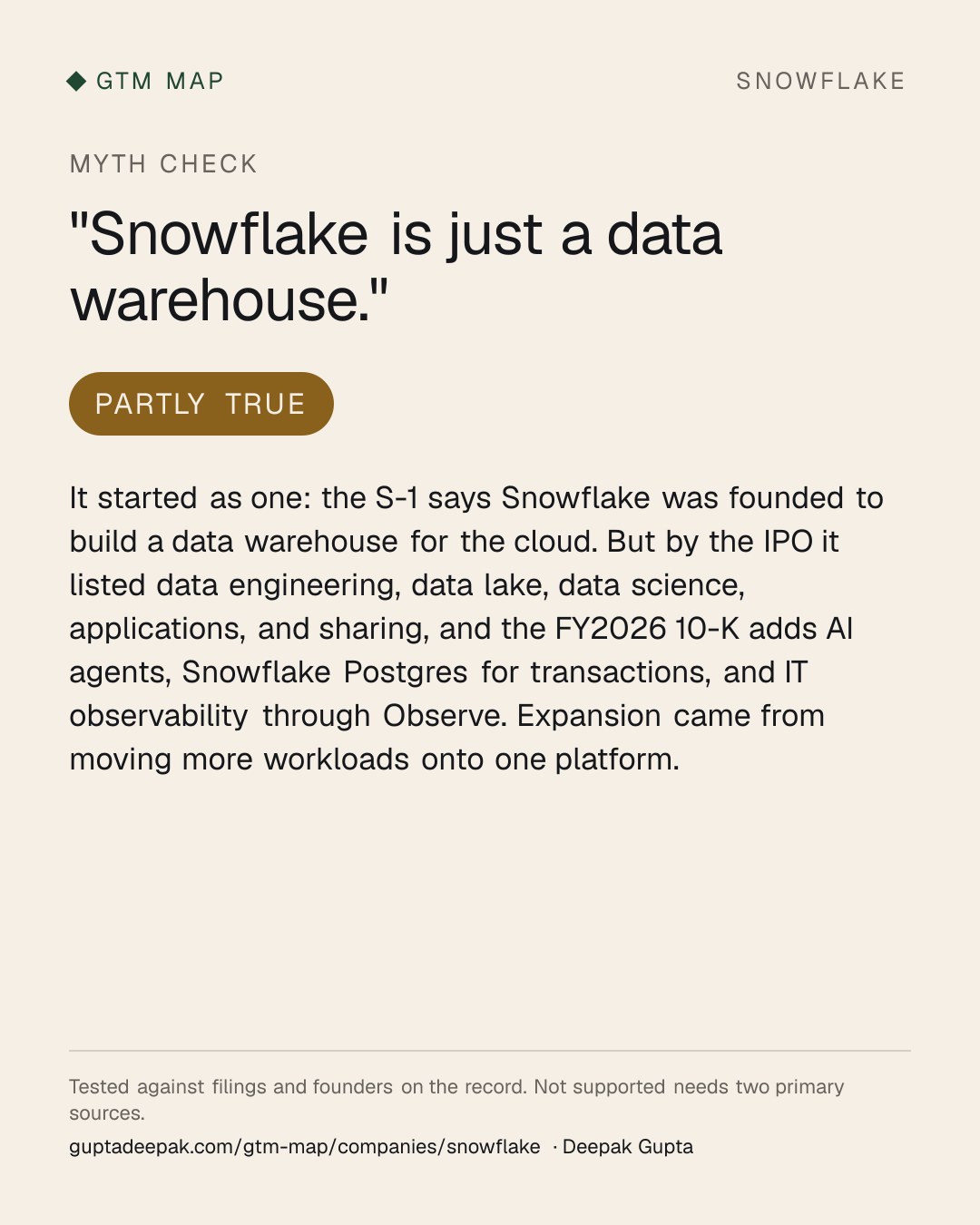
“Snowflake is just a data warehouse.”
Partly trueIt started as one: the S-1 says Snowflake was founded to build a data warehouse for the cloud. But by the IPO it listed data engineering, data lake, data science, applications, and sharing, and the FY2026 10-K adds AI agents, Snowflake Postgres for transactions, and IT observability through Observe. Expansion came from moving more workloads onto one platform.[1],[5],[9]
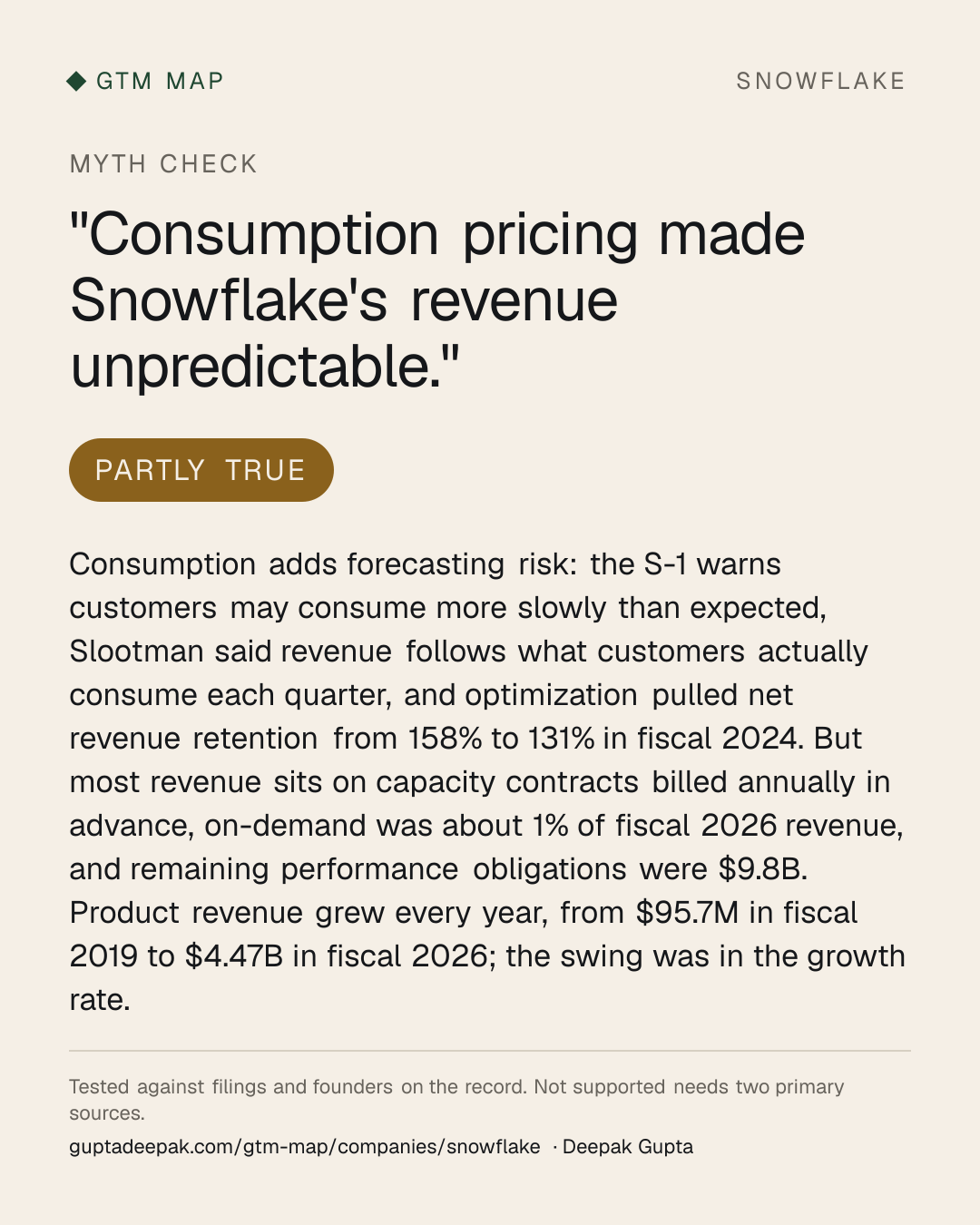
“Consumption pricing made Snowflake's revenue unpredictable.”
Partly trueConsumption adds forecasting risk: the S-1 warns customers may consume more slowly than expected, Slootman said revenue follows what customers actually consume each quarter, and optimization pulled net revenue retention from 158% to 131% in fiscal 2024. But most revenue sits on capacity contracts billed annually in advance, on-demand was about 1% of fiscal 2026 revenue, and remaining performance obligations were $9.8B. Product revenue grew every year, from $95.7M in fiscal 2019 to $4.47B in fiscal 2026; the swing was in the growth rate.[1],[17],[4],[5],[3]
On the record
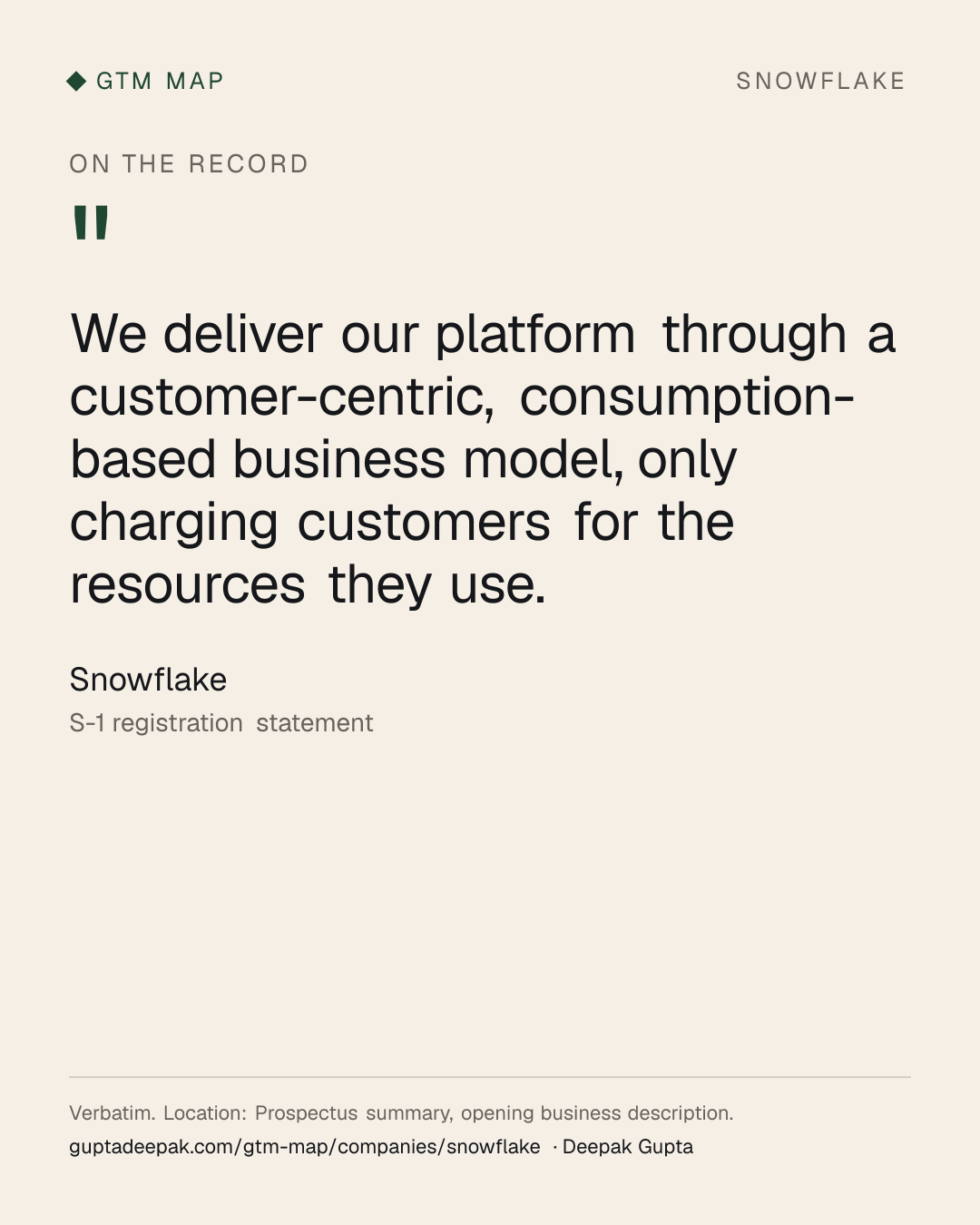
“We deliver our platform through a customer-centric, consumption-based business model, only charging customers for the resources they use.”
Snowflake, S-1 registration statement[1]
Prospectus summary, opening business description
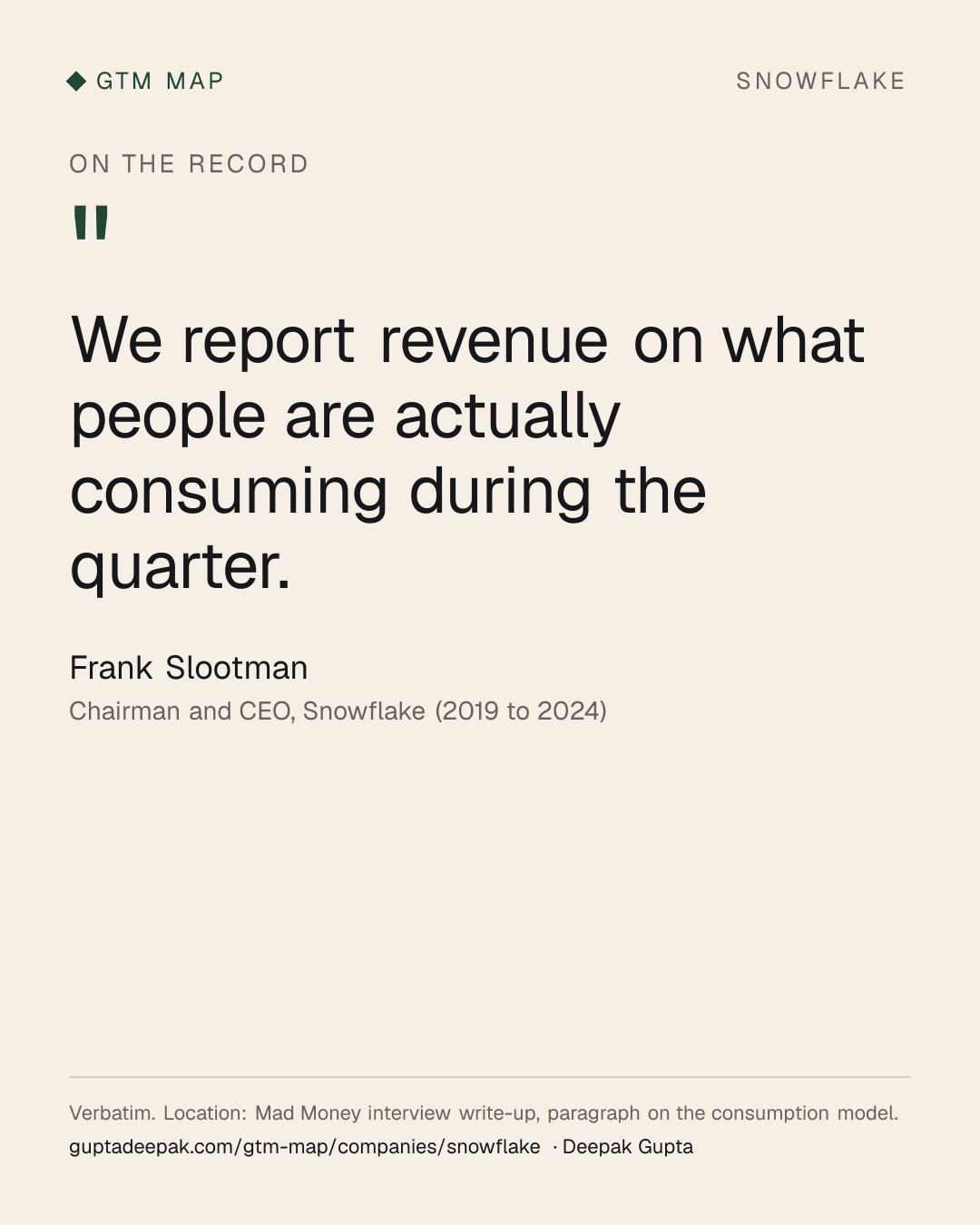
“We report revenue on what people are actually consuming during the quarter.”
Frank Slootman, Chairman and CEO, Snowflake (2019 to 2024)[17]
Mad Money interview write-up, paragraph on the consumption model
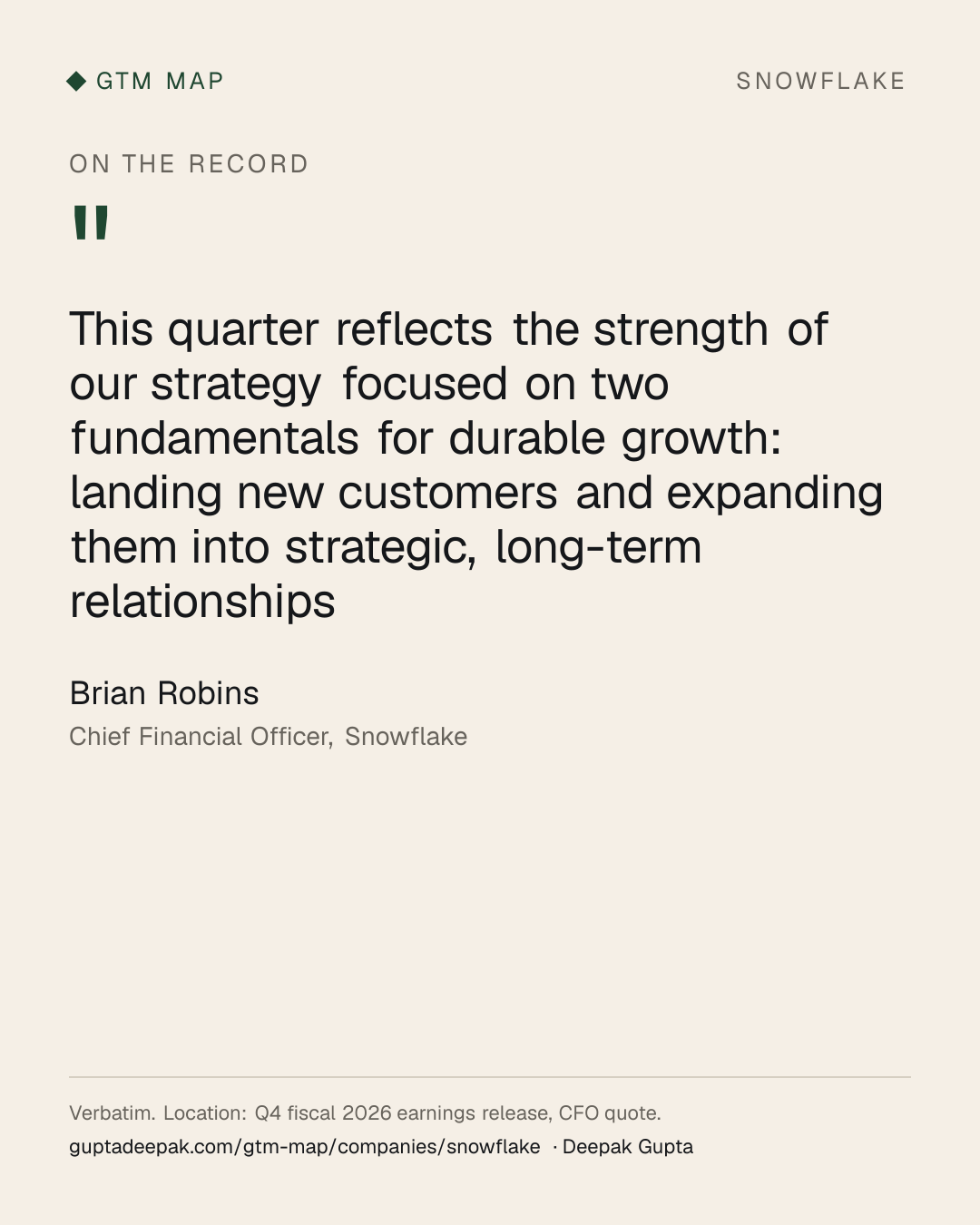
“This quarter reflects the strength of our strategy focused on two fundamentals for durable growth: landing new customers and expanding them into strategic, long-term relationships”
Brian Robins, Chief Financial Officer, Snowflake[9]
Q4 fiscal 2026 earnings release, CFO quote
04What other companies can take from it
Pay sales on consumption, not only on signature.
Works when: Revenue is recognized on usage and customers can add many workloads over time, so a rep can create revenue after the contract is signed.
Backfires when: Usage is capped by seats or a fixed scope, or adding a workload needs a new budget cycle, so consumption pay rewards luck.
Based on: Land and expand, the IPO, and the Data Cloud, Sales-led; Land and expand, the IPO, and the Data Cloud, Land and expand
Sell the commitment, recognize the usage.
Works when: Customers want price certainty and a discount for committing, and their usage grows with their data.
Backfires when: Customers can cut usage freely in a budget squeeze and there is no contracted floor, so growth swings with their cost-cutting, as fiscal 2024 showed.
Based on: Cloud data warehouse, sold on consumption, Usage pricing; Scaling through clouds, partners, and developers, Land and expand
Name the category after what customers do together, not what the product is.
Works when: The product connects several organizations through sharing, a marketplace, or partner apps, so a network backs the category claim.
Backfires when: Nothing is shared between customers, so the new name reads as marketing and buyers keep filing you under the old category.
Based on: Land and expand, the IPO, and the Data Cloud, Category creation; The AI Data Cloud and agents, Category creation
Turn the competitor's store into your channel.
Works when: Enterprise buyers hold committed cloud spend they can burn down through the marketplace of the cloud you run on.
Backfires when: Marketplace fees and the cloud's own competing product squeeze margin, or deals are too small to earn co-sell attention.
Based on: Scaling through clouds, partners, and developers, Cloud marketplace; The AI Data Cloud and agents, Cloud marketplace
05 · GTM Now
What changes in the AI era, and what to do now
Analysis by Deepak Gupta. This is opinion built on the sourced record above, not part of it.[10],[14],[4],[15],[5]
Still works
- Consumption on capacity commitments. AI features are billed as more consumption on the same contract, and Snowflake credits them with new workloads and platform consumption, so AI expands accounts without a new purchase.
- Cloud marketplaces. AWS Marketplace sales doubled in calendar 2025 to more than $2 billion.
Breaks
- Usage pricing is exposed when workloads get cheaper to run. Customer optimization already cut net revenue retention from 158% to 131% in fiscal 2024, and AI agents that write more efficient queries could do the same (analysis).
- The warehouse label weakens as AI answers make the query layer less visible to buyers (analysis, unsourced).
What replaces it
- Foundation model providers as a distribution channel. The $200 million Anthropic agreement set up a joint global go-to-market initiative, a role systems integrators once played for migrations (analysis on the comparison).
- Partner-built agents on Snowflake Intelligence as the new equivalent of partner apps, which the FY2026 10-K describes as a way for customers to create data agents.
Apply it now
If you are
A Series B to D data or infrastructure company selling to enterprise data teams at $100K-plus a year, with usage that grows as customers add workloads
- Offer a prepaid capacity contract at a discount, and keep on-demand for onboarding and overage.
- Pay part of each rep's commission on consumption so sales keeps working the account after signature.
- Report net revenue retention by cohort and watch for optimization drops after price-performance improvements.
- List on the marketplace of the cloud you run on so buyers can spend committed cloud budget on you.
- Recruit two or three systems integrators for migrations before building a broad partner program.
You will know it works when: Share of revenue from existing customers (Snowflake's filed figure was about 94%) and net revenue retention above 120% once the first cohort matures.
Based on Snowflake's Land and expand, the IPO, and the Data Cloud, Land and expand, the IPO, and the Data Cloud, The AI Data Cloud and agents
If you are
A later-stage platform company adding AI features to an existing data product, mostly for enterprise buyers
- Ship AI as metered consumption on existing contracts rather than a separate SKU, so adoption needs no new procurement.
- Publish AI feature account counts each quarter so adoption is visible before revenue is material.
- Sign joint go-to-market agreements with one or two model providers, with named field collaboration, not just an integration.
- Keep the self-serve trial but put costly AI features behind a credit card, as Snowflake's trial does.
You will know it works when: Accounts using AI features each quarter, with net revenue retention holding or rising as AI usage grows.
Based on Snowflake's The AI Data Cloud and agents, The AI Data Cloud and agents, The AI Data Cloud and agents
Motions in this record
Compare with every other company on the GTM matrix.
Share the visuals
Every card is drawn from the sourced record above and sized 1080 by 1350 for LinkedIn and X. Free to share with a link back to this page.
Sources
- [1]SEC filingSnowflake Inc. Form S-1 Registration Statement (August 24, 2020)
- [2]SEC filingForm 10-K, fiscal year ended January 31, 2021 (March 31, 2021)
- [3]SEC filingForm 10-K, fiscal year ended January 31, 2023 (March 29, 2023)
- [4]SEC filingForm 10-K, fiscal year ended January 31, 2024 (March 26, 2024)
- [5]SEC filingForm 10-K, fiscal year ended January 31, 2026 (March 20, 2026)
- [6]EarningsSnowflake Reports Financial Results for the Fourth Quarter and Full Year of Fiscal 2021 (8-K exhibit) (March 3, 2021)
- [7]EarningsSnowflake Reports Financial Results for the First Quarter of Fiscal 2024 (8-K exhibit) (May 24, 2023)
- [8]EarningsSnowflake Reports Financial Results for the Fourth Quarter and Full-Year of Fiscal 2024 (8-K exhibit) (February 28, 2024)
- [9]EarningsSnowflake Reports Financial Results for the Fourth Quarter and Full-Year of Fiscal 2026 (8-K exhibit) (February 25, 2026)
- [10]EarningsSnowflake Reports Financial Results for the Second Quarter of Fiscal 2027 (8-K exhibit) (September 2, 2026)
- [11]CompanySnowflake Puts Industry-Leading Large Language and AI Models in the Hands of All Users with Snowflake Cortex (November 1, 2023)
- [12]CompanySnowflake Expands Partnership with Microsoft to Bring Large-Scale Generative AI Models and Increased Machine Learning Capabilities to the Data Cloud (June 26, 2023)
- [13]CompanySam Altman to Keynote Seventh-Annual Snowflake Summit, Showcasing the Future of AI and Data Innovation (March 3, 2025)
- [14]CompanySnowflake Doubles AWS Marketplace Growth YoY, Eclipses $2 Billion in Sales as New Integrations Accelerate Enterprise Data and AI Adoption (December 3, 2025)
- [15]CompanySnowflake and Anthropic Announce $200 Million Partnership to Bring Agentic AI to Global Enterprises (December 3, 2025)
- [16]CompanyTrial accounts (Snowflake documentation) (October 18, 2026)
- [17]Founder interviewSnowflake CEO: Projecting revenue is challenging, so we prefer to give conservative guidance (Mad Money interview write-up) (Frank Slootman, March 2, 2022, at direct quotes in the article body)
- [18]Trade pressSnowflake more than doubles in market debut, largest ever software IPO (CNBC, September 16, 2020)
Every phase, motion, and myth verdict cites a filing, the company's own pages, or a founder speaking on the record. See the methodology.