
Pattern · 13 companies · 4 counter-examples
Shared work is the growth loop
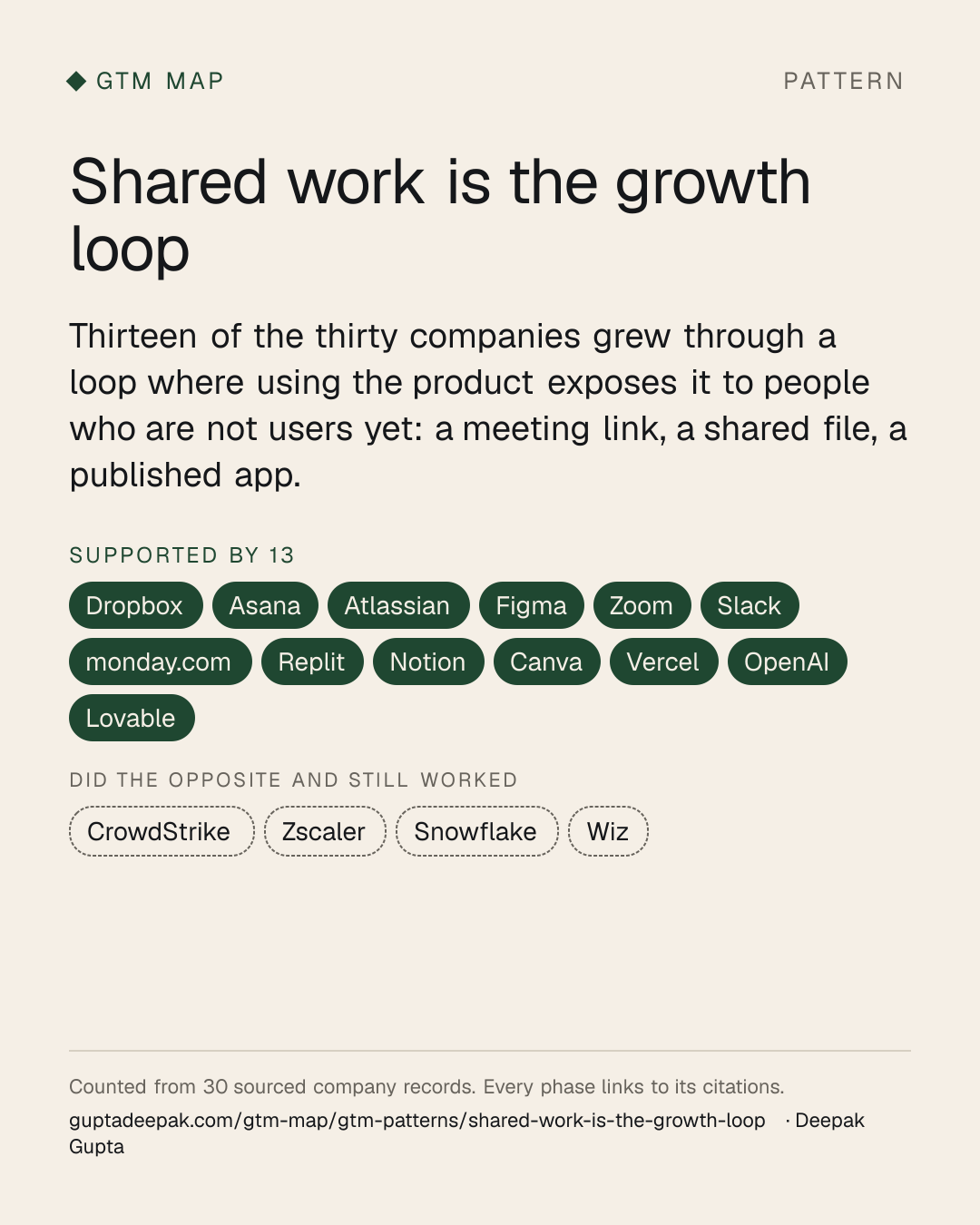
Thirteen of the thirty companies grew through a loop where using the product exposes it to people who are not users yet: a meeting link, a shared file, a published app.
How this was counted: A company counts when any phase contains a viral-loop motion. Counter-examples are companies with no viral-loop motion anywhere in the record that still scaled.
The evidence
Each row is a sourced phase in that company's record. Follow the link for the citations.
Dropbox · Free sync, shared folders, two-sided referral · 2008 to 2010
Viral loopPrimaryUsers share files and folders with people who are not registered, which pulls them into the product. Houston describes sharing and referral as one loop where every step of friction is worth removing.
Asana · Free teams and the guest invite · 2008 to 2016
Viral loopPrimaryCustomers can invite guests from outside their organization into projects, which the S-1 says seeds the market with Asana users and supports viral adoption. No filing gives a share of signups that came from invites.
Atlassian · Starter licenses, Marketplace and Experts · 2009 to 2019
Viral loopSupportingTeam products spread as users invite colleagues, and the prospectus describes natural network effects that carry them across teams and departments by word of mouth.
Figma · Browser multiplayer and the shared link · 2012 to 2016
Viral loopPrimaryA browser file is shared as a URL, so users invited collaborators into Figma, and those invites drove conversion once Figma began charging. Field says live collaboration was a launch requirement because a shared link without it was a poor experience.
Zoom · Free hosts and the invite loop · 2013 to 2016
Viral loopPrimaryThe S-1 says individuals typically start using Zoom when a colleague invites them to a meeting, and attendees who see the benefits often become paying customers.
Slack · Free for teams, spread by word of mouth · 2014 to 2015
Viral loopPrimaryAdoption starts with end users, and free users spread Slack to colleagues inside their organization. The S-1 says its marketing strategy depends on free users convincing others to use Slack and to drive the conversion to paid plans.
monday.com · Self-serve trial and payback-gated ads · 2014 to 2018
Viral loopSupportingPaying teams invite other teams, so word of mouth carries the product into new parts of the company.
Replit · Learn to code in the browser · 2016 to 2020
Viral loopSupportingA shared repl URL let anyone run an app, comment on it, and fork and remix it, so every shared project could bring in a new user.
Notion · Community, templates and a free personal plan · 2019 to 2021
Viral loopSupportingAnyone with a link could be given editing access, with a simpler signup for people arriving that way, and a Duplicate button let people copy a shared template straight into their own workspace.
Canva · Teams, classrooms and the workplace · 2020 to 2023
Viral loopPrimarySuggested Teams matched colleagues by work email, and anyone sent a design they could not open could click Request Access. The number of people collaborating on designs doubled between June and December 2020, and the co-founder credits users bringing in new users.
Vercel · Vercel for frontend teams: free tier, Git integration, Next.js Conf · 2020 to 2022
Viral loopSupportingEvery deployment gets a Preview URL that teams share for review; Vercel cites Airbnb using them as its unit of collaboration. This shows non-developers seeing the product, not a measured conversion loop.
OpenAI · ChatGPT goes free, then paid, then to work · 2022 to 2023
Viral loopSupportingShared links let a user send a whole conversation to anyone with the link, including through social networks. No source gives the feature's launch date or how many viewers become users.
Lovable · Launch, ship daily, and post it · 2024 to 2025
Viral loopSupportingApps published on the free plan carry an "Edit with Lovable" badge that only paid plans can hide, and users were asked to share builds with #BuiltWithLovable for reposts. Lovable-built sites drew half a billion visits in six months; no source measures how many signups the badge drives.
Counter-examples
Companies in the dataset that did the opposite and still worked.
CrowdStrike · Modules, trial-to-pay, marketplace and channel
Grew by selling more modules to the same security buyers; no viral-loop motion in the record.
Zscaler · Second product, land and expand, IPO
Grew through carriers, partners, and a second product; no viral-loop motion in the record.
Snowflake · Land and expand, the IPO, and the Data Cloud
Grew by consumption inside existing accounts; no viral-loop motion in the record.
Wiz · Agentless proof of value and the $100M sprint
Grew through top-down sales and referrals between security leaders; no viral-loop motion in the record.
What it means
Reading the pattern
Analysis by Deepak Gupta, built on the records above.
- Every supporting product is used with other people: meetings, files, designs, docs, or apps that someone else opens. The loop works because the non-user arrives already doing the job the product exists for.
- In the AI era the shared artifact is often generated: a published app, a shared chat, a preview link. The loop survives, and it no longer needs the sender to do much of the work.
- Products used by one team behind a firewall have nothing to share. For them the equivalent is a buyer telling another buyer, which is how Wiz describes its referrals between security leaders.
Motions in this pattern: Viral loop.
Share this pattern
 1080 by 1350, for LinkedIn and X