
Pattern · 14 companies · 4 counter-examples
Cloud marketplaces became a sales channel
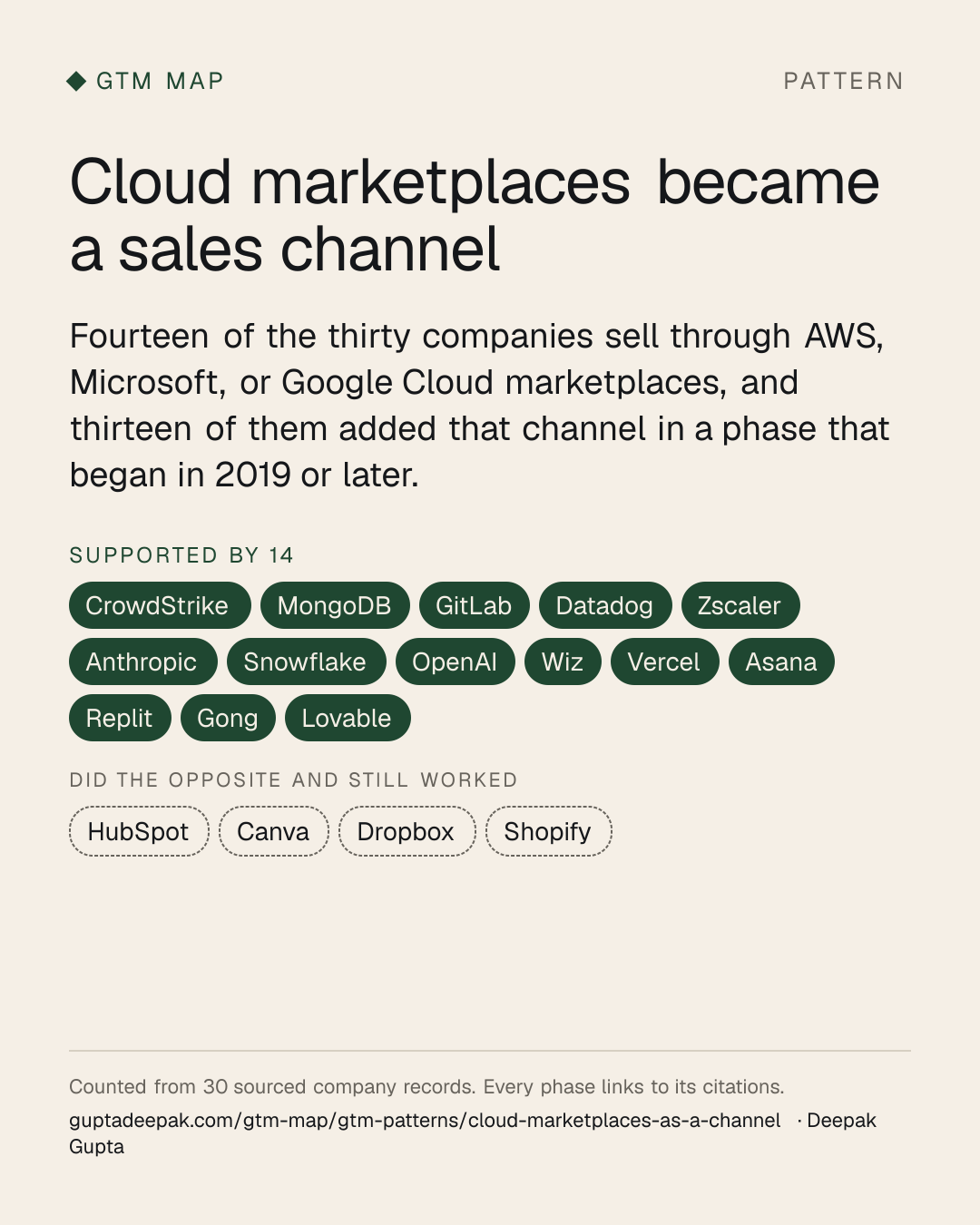
Fourteen of the thirty companies sell through AWS, Microsoft, or Google Cloud marketplaces, and thirteen of them added that channel in a phase that began in 2019 or later.
How this was counted: A company counts when any phase contains a cloud-marketplace motion. Counter-examples are companies with no cloud-marketplace motion anywhere in the record that still scaled.
The evidence
Each row is a sourced phase in that company's record. Follow the link for the citations.
CrowdStrike · Modules, trial-to-pay, marketplace and channel · 2017 to 2020
Cloud marketplaceSupportingFalcon Prevent became available for trial and purchase on AWS Marketplace in May 2018, and Falcon for AWS later offered metered pay-as-you-go billing there.
MongoDB · Atlas becomes the business, sold with the clouds · 2019 to now
Cloud marketplaceSupportingAtlas is sold on AWS Marketplace and Azure Marketplace, with unified billing on Google Cloud. The clouds co-market and co-sell, and per Ittycheria align their sellers' compensation, while also competing.
GitLab · Enterprise sales, partners, and the IPO · 2019 to 2021
Cloud marketplaceSupportingGoogle Cloud and AWS offer GitLab on their marketplaces, and the FY2024 10-K repeats this. No filing discloses marketplace revenue.
Datadog · Platform expansion and peak net retention · 2020 to 2022
Cloud marketplaceSupportingThe filings name cloud-provider marketplaces as a sales route, a pricing factor, and a margin risk. They do not disclose how much revenue flows through them.
Zscaler · The Zero Trust Exchange reframing · 2020 to 2023
Cloud marketplaceSupportingPublic cloud marketplaces first appear in the 10-K's list of channel partners in fiscal 2022.
Anthropic · Safety lab ships an API · 2021 to 2023
Cloud marketplaceSupportingBy September 2023 enterprises were building with Claude on Amazon Bedrock, and Anthropic said it was expanding that support based on AWS customer demand.
Snowflake · Scaling through clouds, partners, and developers · 2021 to 2024
Cloud marketplaceSupportingCustomers can contract through Snowflake's marketplace listings, which the 10-K names as a gross margin factor. In 2023 Microsoft and Snowflake agreed joint go-to-market programs and a larger Azure spend commitment.
OpenAI · ChatGPT goes free, then paid, then to work · 2022 to 2023
Cloud marketplaceSupportingFrom January 2023 OpenAI said it deployed its technology through its own API and Microsoft's Azure OpenAI Service, with Azure as the exclusive cloud for all its workloads. Microsoft's 10-K says it deploys OpenAI models across its own consumer and enterprise products.
Wiz · Platform, marketplaces and partners · 2023 to 2024
Cloud marketplacePrimaryWiz sold heavily through AWS Marketplace and, as a MACC-enabled ISV, through the Microsoft Commercial Marketplace to strategic Azure customers. It was named 2024 AWS Marketplace Partner of the Year and later said AWS Marketplace sales passed $1 billion lifetime in just over four years.
Vercel · Frontend Cloud for the enterprise: sales, partners, marketplaces · 2023 to 2024
Cloud marketplaceSupportingVercel listed on AWS Marketplace in April 2023, pitching streamlined procurement and consolidated billing for AWS customers.
Asana · AI Studio, credits, and the agentic platform · 2024 to now
Cloud marketplaceSupportingAsana is listed in the AI Agents and Tools storefront in the AWS Marketplace, where AWS customers can discover, buy, and deploy it.
Replit · Enterprise through the product, marketplaces, and partners · 2025 to now
Cloud marketplaceSupportingReplit can be bought through the Azure Marketplace (announced July 2025) and the Google Cloud Marketplace, where enterprises can use existing cloud credits.
Gong · Revenue AI OS, enterprise expansion, marketplace · 2025 to now
Cloud marketplaceSupportingIn July 2026 Gong listed on Microsoft Marketplace so enterprises can buy against Azure Consumption Commitments. No result is reported yet.
Lovable · Enterprise, partners, and marketplaces · 2025 to now
Cloud marketplaceSupportingLovable is listed on Microsoft Marketplace with private offers, alongside publishing apps into a customer's Microsoft tenant.
Counter-examples
Companies in the dataset that did the opposite and still worked.
HubSpot · Beyond search: owned media and answer engines
Scaled through inbound content, inside sales, and agency partners; no cloud-marketplace motion in the record.
Canva · Enterprise rebuilt, pro tools and AI distribution
Reached enterprise through usage inside companies; no cloud-marketplace motion in the record.
Dropbox · Multi-product, restructuring, and AI
Over 90% self-serve in every filing; no cloud-marketplace motion in the record.
Shopify · Enterprise push, merchant solutions and AI channels
Sells to merchants through partners and its own sales team; no cloud-marketplace motion in the record.
What it means
Reading the pattern
Analysis by Deepak Gupta, built on the records above.
- A marketplace listing lets a buyer spend money already committed to a cloud provider. That matters most where budgets are large and procurement is slow, which is why most of the supporting companies sell to engineering, data, security, or AI buyers.
- The newest entries (Replit, Lovable, Gong, Asana) added marketplaces in 2024 and 2025, at the same time as their enterprise push. The listing has become part of selling upmarket, not a separate strategy.
- Absence in the record is not proof a company never listed. The counter-examples show that companies selling to marketers, designers, and merchants scaled without making marketplaces part of their story.
Motions in this pattern: Cloud marketplace.
Share this pattern
 1080 by 1350, for LinkedIn and X