
Pattern · 17 companies · 6 counter-examples
Self-serve first, sales later
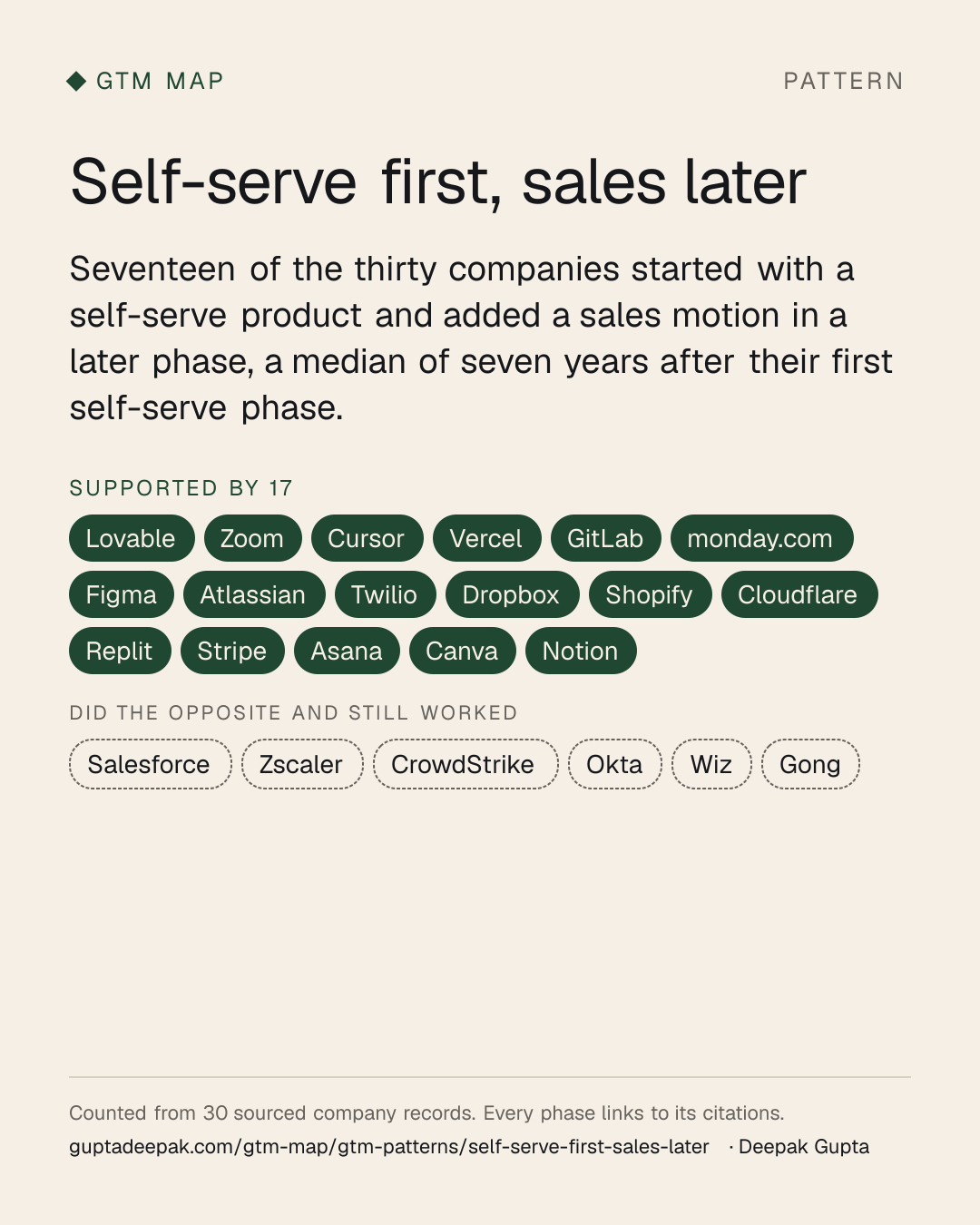
Seventeen of the thirty companies started with a self-serve product and added a sales motion in a later phase, a median of seven years after their first self-serve phase.
How this was counted: A company counts when its first phase with a product-led motion starts before its first phase with a sales-assist or sales-led motion. The gap is the difference between those phase start years, so it is approximate to the year.
Years from first self-serve phase to first sales phase
The evidence
Each row is a sourced phase in that company's record. Follow the link for the citations.
Lovable · Enterprise, partners, and marketplaces · 2025 to now
Sales-assistPrimaryIn late 2025 the Head of Growth described only a couple of sales people working hand-raisers who already want to buy. By October 2026 the enterprise page routes to an Account Executive and the careers page lists mid-market and strategic account executives and a deal desk.
Zoom · Sales routed by deal size, land and expand · 2016 to 2020
Sales-assistPrimarySales funnelled viral demand into the route that fit each deal: direct sales, online, resellers, or partners. In fiscal 2019, 55% of the 344 customers paying over $100,000 started with at least one free host.
Cursor · Enterprise push and consumption pricing · 2025 to now
Sales-assistPrimarySales was layered onto a product-led base. The CEO describes starting incredibly lean and product-led, then building out for larger customers. The enterprise page routes to Contact sales and lists SOC 2 Type II, SSO, and SCIM.
Vercel · Frontend Cloud for the enterprise: sales, partners, marketplaces · 2023 to 2024
Sales-assistPrimaryHobby is free and Pro is $20 a month with a free trial, while enterprise customers have account teams and buy through a demo or an enterprise product trial.
GitLab · Enterprise sales, partners, and the IPO · 2019 to 2021
Sales-ledPrimarySelling ran in three layers: self-service, high-velocity inside sales, and outbound enterprise sales for organizations over 2,000 employees. Enterprise customers were more than 60% of ARR in FY2021, and sales and marketing cost 122% of revenue in FY2020 and 101% in FY2021.
monday.com · Sales, partners and the Work OS · 2018 to 2021
Sales-assistPrimarySales and customer success were layered onto the self-serve base: sales teams watch usage patterns and step in to grow accounts, and the sales and customer success team grew from 154 people at the end of 2019 to 365 in March 2021.
Figma · Paid plans, first sales rep, Community and education · 2017 to 2020
Sales-assistPrimaryFigma added a direct sales model on top of bottom-up adoption to serve larger customers. It hired its first sales rep in 2018, the same year it launched the Organization plan with unlimited teams, shared libraries and centralized admin tools.
Atlassian · Starter licenses, Marketplace and Experts · 2009 to 2019
Sales-assistSupportingNo commissioned direct sales team, but a small sales function and a customer service team supported enterprise customers, channel partners, and evaluators. The FY2016 filing says Atlassian does not employ such a team; from FY2017 the wording becomes does not rely on one.
Twilio · Inverting the enterprise sales model · 2015 to 2018
Sales-assistPrimaryAccounts past a spending level get account managers or customer success advocates, and the commercial transaction comes after the customer is already succeeding. The S-1 calls this inverting the traditional enterprise sales model.
Dropbox · Focus on work, self-serve at scale, IPO · 2015 to 2019
Sales-assistSupportingA focused outbound sales effort targets organizations with existing organic adoption and works to widen the deployment. The S-1 says Dropbox does not have a significant outbound sales force, which kept sales and marketing spend efficient.
Shopify · Payments, paid search and the IPO · 2013 to 2015
Sales-ledSupportingShopify Plus launched on February 4, 2014 for higher-volume merchants, and Shopify began hiring sales staff to sell it.
Cloudflare · Enterprise sales layered on self-serve · 2016 to 2019
Sales-ledPrimaryInside and field sales sell the Enterprise plan, and a majority of 2018 revenue came from customers they acquired. Customers with Annualized Billings over $100,000 grew from 95 at the end of 2016 to 408 by mid-2019.
Replit · Agent pivot to non-developer builders · 2024 to 2025
Sales-assistSupportingReplit Teams went GA in July 2024 with SAML SSO, SOC 2 compliance, and dedicated support, at a time when over half of business signups were not engineers. The CEO said the B2B package was growing fast.
Stripe · March into the enterprise · 2020 to 2022
Sales-ledPrimaryThe 2020 chief revenue officer hire was to lead and grow a global sales organisation as Stripe accelerated its march into the enterprise. Stripe's own letter says its startup focus had been a drawback with incumbents, and that this later inverted.
Asana · Self-serve first, sales to expand · 2017 to 2023
Sales-assistPrimarySelf-serve adoption came first, and the direct sales team then followed up inside the account to expand across the organization. Sales and marketing ran at 68% of revenue in FY2019, 74% in FY2020, and 78% in FY2021.
Canva · Enterprise rebuilt, pro tools and AI distribution · 2024 to now
Sales-assistPrimaryCanva Enterprise, from May 2024, targets teams of more than 100 people with a dedicated Customer Success Manager, and invites companies to request a report on their existing Canva usage so it can be consolidated. A Chief Customer Officer runs sales and go-to-market, and the co-founder describes finding one decision maker to put thousands of existing users on one contract.
Notion · AI in the business plans, enterprise sales, agent credits · 2025 to now
Sales-assistPrimaryThe CEO says the founders once covered design, marketing, and closing deals themselves, and that moving upmarket meant learning to sell solutions rather than building blocks. The enterprise page routes to Request a demo.
Counter-examples
Companies in the dataset that did the opposite and still worked.
Salesforce · The End of Software, sold by phone
Sales-led from its first phase, selling small businesses by phone, and never ran a product-led motion in the record.
Zscaler · Cloud security instead of appliances, sold with carriers
Sold through its own reps and carrier partners from the start.
CrowdStrike · Intelligence, incident response, then one EDR product
Enterprise sales and a threat intelligence brand came first; a free trial came later.
Okta · Cloud SSO and enterprise sales from day one
Enterprise sales from the start; self-serve appears only in its latest phase.
Wiz · CISO conversations, pivot, first enterprise deals
Top-down sales to security leaders from its first phase, with no self-serve motion in the record.
Gong · Conversation intelligence, design partners, data content
Design partners paid from the start, and it has no self-serve motion in the record.
What it means
Reading the pattern
Analysis by Deepak Gupta, built on the records above.
- The counter-examples share one trait: a buyer who is not the user. Security and revenue tools are bought by a CISO or a CRO, so there is no individual user to win first. Where the user is also the buyer, self-serve came first almost every time.
- The gap is long. Seven years is a typical wait between the first self-serve phase and the first sales phase, which argues against hiring a sales team before usage shows you which accounts to call.
- The companies founded in the AI era (Cursor and Lovable) closed that gap in two or three years, while Replit, whose self-serve phase predates its AI pivot, took eight. When the product writes code or ships apps, the accounts worth calling seem to show up sooner.
Motions in this pattern: Sales-assist, Sales-led.
Share this pattern
 1080 by 1350, for LinkedIn and X