
Pattern · 9 companies · 4 counter-examples
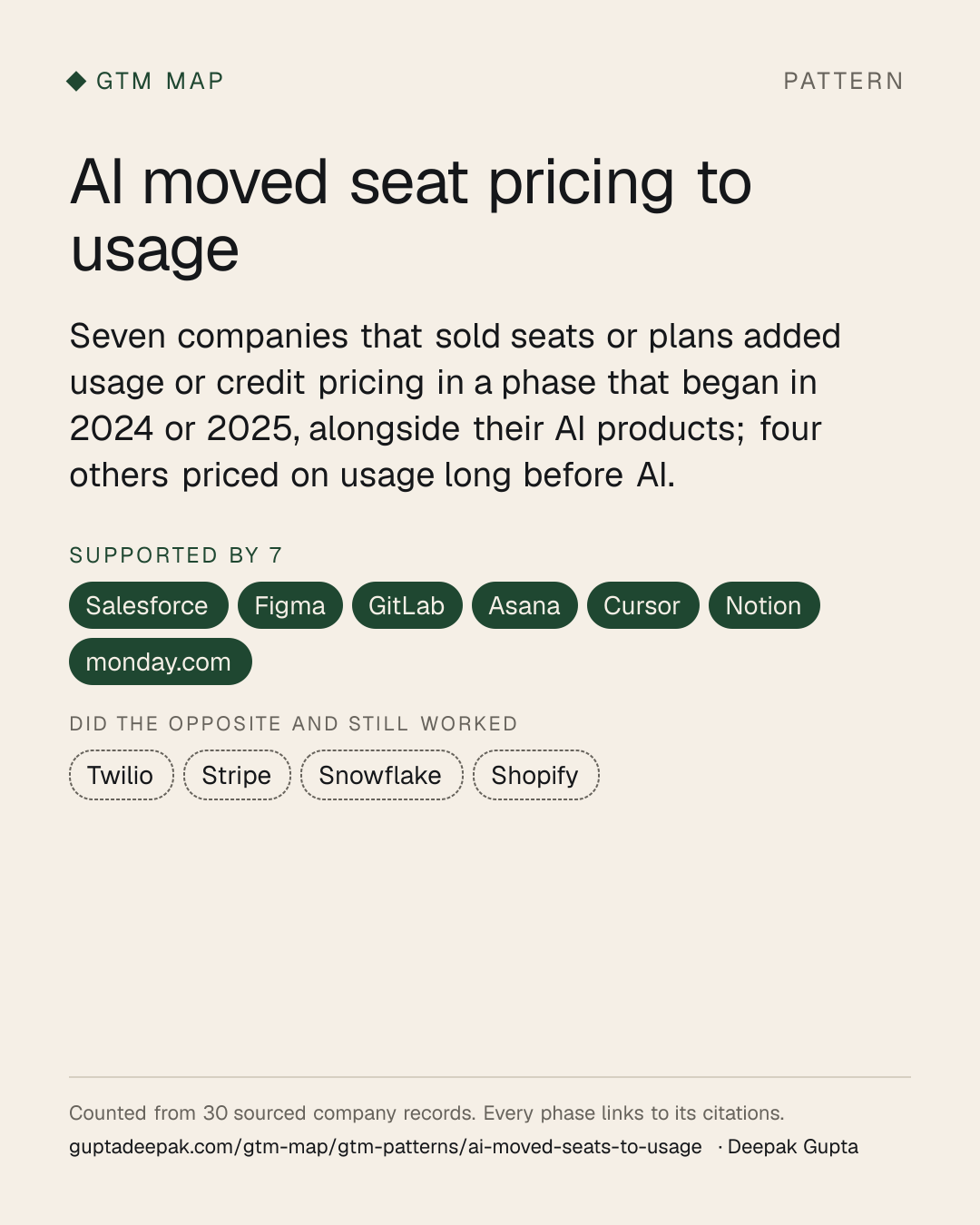
AI moved seat pricing to usage
Nine companies that sold seats or plans added usage or credit pricing in a phase that began in 2024 or 2025, alongside their AI products; four others priced on usage long before AI.
How this was counted: A company counts when its first phase with a usage-pricing motion begins in 2024 or 2025. In each of those records the new metered unit is AI work, and earlier phases sold seats or plans. Companies whose first usage-pricing phase began in 2014 or earlier are counter-examples.
The evidence
Each row is a sourced phase in that company's record. Follow the link for the citations.
Salesforce · Agentforce, digital labor and consumption pricing · 2024 to now
Usage pricingPrimaryAgents are priced on use: $2 per conversation at launch, then Flex Credits at $0.10 per action from May 2025, with a Flex Agreement that shifts spend between user licenses and digital labor. The 10-K admits limited experience pricing consumption contracts.
Figma · Platform seats, IPO and AI credits · 2024 to now
Usage pricingSupportingAI credits came to all seats in 2025, with limits enforced and add-on or pay-as-you-go plans from March 2026. The second quarter of 2026 was the first full quarter of AI credit monetization.
GitLab · AI agents and hybrid pricing · 2024 to now
Usage pricingSupportingSeat pricing covers the platform and usage-based GitLab Credits cover Duo Agent Platform capabilities. Premium and Ultimate include monthly credits, and GitLab Flex puts seats and credits under one annual commitment.
Asana · AI Studio, credits, and the agentic platform · 2024 to now
Usage pricingPrimaryAI Studio is consumption-based: each paid tier includes a monthly credit allotment, and more credits can be bought. Moskovitz describes a platform fee with tokens and a la carte use after that. Aziz Megji, CFO since March 2026, frames consumption and outcome-based revenue as an expansion path alongside seats.
Cursor · Enterprise push and consumption pricing · 2025 to now
Usage pricingPrimaryIn June 2025 Pro moved from request limits to compute limits with $20 of included usage, and a $200 Ultra tier was added. Cursor apologised that the change came as a surprise and offered refunds. The CEO later described the direction as a consumption model.
Notion · AI in the business plans, enterprise sales, agent credits · 2025 to now
Usage pricingSupportingCustom Agents launched in February 2026 on usage-based Notion credits sold on top of the seat price, which stayed the same with other AI features included. Paid credits went live in May 2026 at $10 per 1,000.
monday.com · Hybrid sales-led GTM and the AI Work Platform · 2025 to now
Usage pricingSupportingIn May 2026 the company launched the AI Work Platform with native AI agents and a seats-plus-credits pricing model, which it calls a shift to consumption-based pricing. AI products were 17% of net new ARR in Q2 2026.
Replit · Agent pivot to non-developer builders · 2024 to 2025
Usage pricingPrimaryAgent work was billed at $0.25 per checkpoint, then from June 2025 by the compute each request used, so simple requests cost less and complex ones could cost more. Replit said the rollout did not meet its standards and issued credits.
Lovable · Credits, giveaways, and a community at scale · 2025 to 2026
Usage pricingPrimaryAgent Mode, the default from 23 July 2025, charges less than one credit or several depending on complexity. Usage-based billing followed for hosting and AI in apps, then a single credit balance for building and running them. Plans are priced by credits, not seats.
Counter-examples
Companies in the dataset that did the opposite and still worked.
Twilio · Developer-first self-service and pay as you go
Pay-as-you-go pricing from its first phase in 2008.
Stripe · Payments for developers
Priced per successful charge from launch in 2011.
Snowflake · Cloud data warehouse, sold on consumption
Consumption pricing from its first phase in 2012.
Shopify · Payments, paid search and the IPO
Payments fees tied revenue to merchant sales from 2013.
What it means
Reading the pattern
Analysis by Deepak Gupta, built on the records above.
- Seats price the person; AI work is done by software that runs whether or not a person is watching. Every company in the supporting set kept a seat or plan price and added a metered layer on top, rather than replacing it outright.
- The counter-examples were infrastructure from the start: API calls, payments, and compute were always metered. Application companies are now learning what infrastructure companies already knew.
- Cursor's record shows the risk: its move to compute-based pricing came with an apology for unclear communication and refunds. Metering a habit people did not used to count needs more explanation than a price change.
Motions in this pattern: Usage pricing.
Share this pattern
 1080 by 1350, for LinkedIn and X