
Your Cold Email Inbox Is the Cheapest Positioning Audit You Will Ever Run
Eight out of ten cold emails now describe my company correctly. Eighteen months ago it was three. Nobody ran a rebrand.

Eight out of ten cold emails now describe my company correctly. Eighteen months ago it was closer to three.
Nobody ran a rebrand. No agency was hired. The change came from something quieter, and once I noticed it I started treating my spam folder as a diagnostic instrument instead of a nuisance.
TL;DR
- A cold email is an unprompted test of whether a stranger, working from your public pages under time pressure, can restate your category, buyer, problem, and proof.
- The same extraction that lets a rushed SDR summarise you is what ChatGPT, Claude, and Perplexity run when a buyer asks for options in your category.
- Tag inbound cold emails accurate or wrong, watch for clusters, then compare against what the models say about you. The four combinations point at four different fixes.
- G2's March 2026 survey of 1,076 B2B software buyers found 93% saying AI chatbots fundamentally changed how they research, and 51% now starting research in a chatbot.
- This measures legibility, not correctness. A stranger can describe a market you should not be serving.
Here is the email that made it click. An SDR I have never met, from a company I had never heard of, opened with this:
"We help you find cybersecurity companies looking to increase their AI visibility."
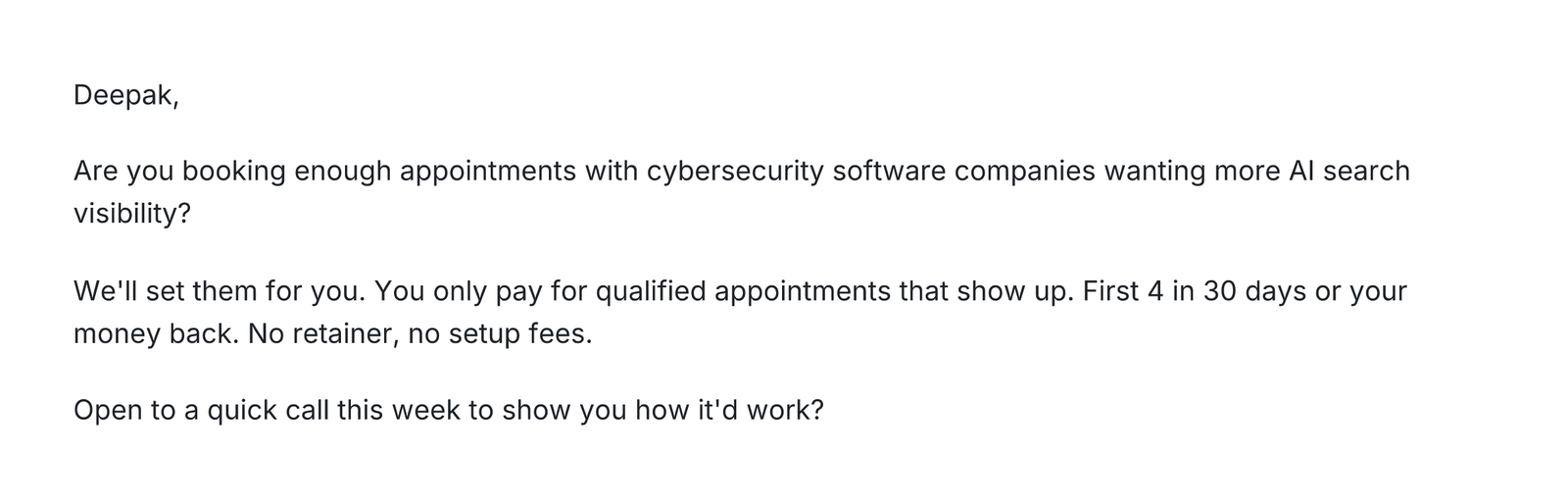
That is GrackerAI's ideal customer profile. Word for word. Written by a stranger who spent maybe ninety seconds on our site before firing a sequence at a list of a thousand people.
That sentence told me more than most messaging workshops I have sat through.
Cold outbound is the harshest reading comprehension test your website takes
Consider who is on the other end of that email.
They are not a buyer. They have no curiosity about your company. They are not going to read your manifesto page or watch your founder video. They have a quota, a scraping tool, and an AI summarizer. They skim your homepage, ask a model who you sell to, and paste the answer into a template.
Everything about that process is hostile to nuance. Which is exactly what makes it useful.
If a stranger operating under those conditions gets your category and your buyer right, your positioning is legible. If they pitch you something adjacent and wrong, your positioning is mush and you have been telling yourself otherwise.
Most founders never run this test because they never look. The email gets deleted in half a second. The signal was in the first line, and it was free.
The second-order effect most founders miss
Here is the part that matters more than the messaging lesson.
The same signals that let a rushed SDR summarize you in one sentence are the signals that ChatGPT, Claude, Gemini, and Perplexity use when a buyer asks for options in your category.
Both are running extraction. Both work from your public surface area. Both fail the same way.
When a model reads your homepage and finds "AI-powered growth platform for modern teams," it has nothing to anchor to. No category. No buyer. No problem. It cannot place you in a comparison set because you never told it which comparison set you belong to. So it recommends the three vendors who did.
An SDR who cannot describe you is a preview of a model that will not cite you.
The citation data supports this more strongly than most marketers realize. The XFunnel study of 768,000 AI citations I covered in Winning the AI Shortlist found product and reference content earning 46 to 70 percent of B2B citations, while editorial blog content earned under 6 percent. Product pages win because they are structurally extractable. They state what the thing is, who it is for, and what it costs. Blogs lose because they argue rather than declare.
Your homepage sits in the first category or the second. The SDR's email tells you which.
The four signals a stranger has to reconstruct
When I read a cold email that describes us, I check whether the sender rebuilt four things. These are the same four an AI model needs to place you in an answer.
| Signal | The question it answers | Works | Fails |
|---|---|---|---|
| Category | What kind of company are we? | "GEO platform" | "Growth intelligence layer" |
| Buyer | Who specifically? | "Cybersecurity companies" | "B2B teams" |
| Problem | What breaks without us? | "Not showing up in AI search results" | "Suboptimal digital presence" |
| Proof | Why believe it? | Numbers, named customers, published research | Adjectives |
Category has to be the one a buyer would actually type, not the aspirational one. Buyer has to be specific enough that a name comes to mind. Problem has to be a thing that breaks, not a state that is suboptimal. Proof has to be something a model can quote with a source attached.
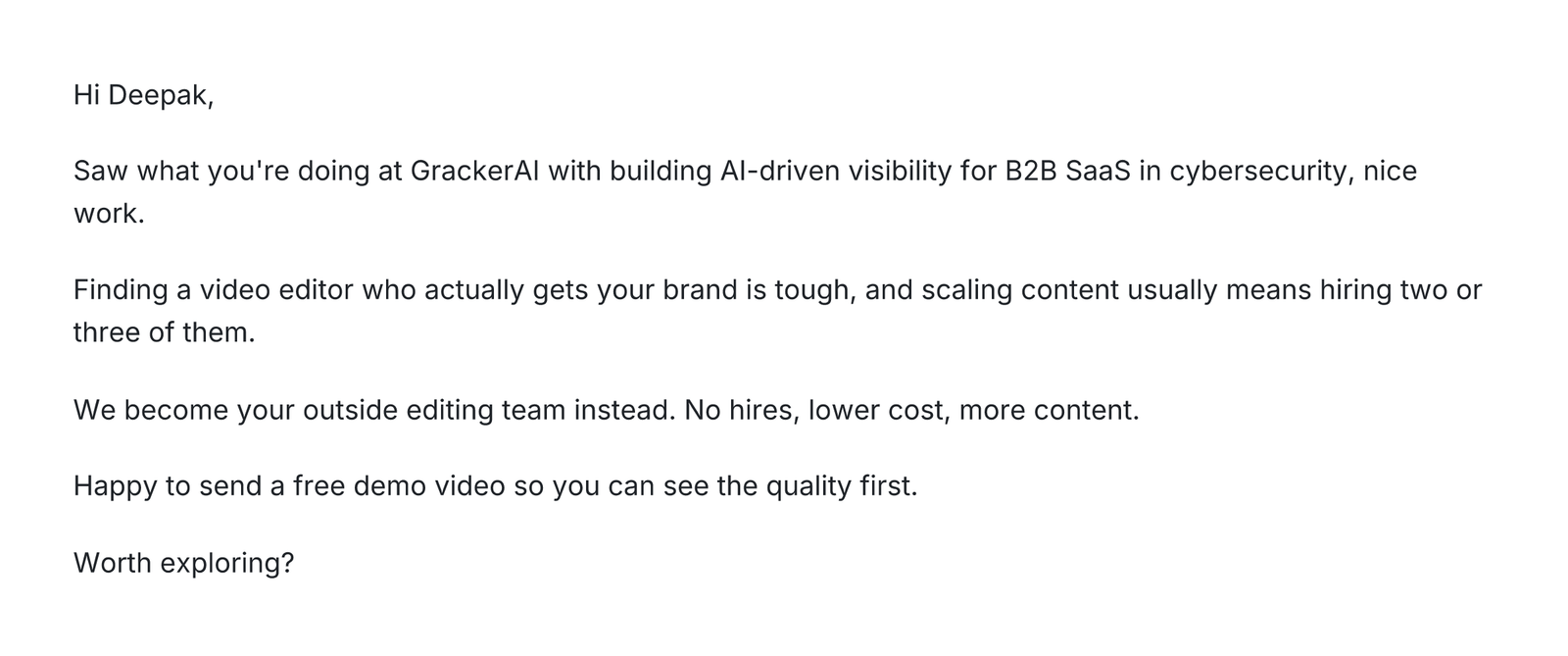
When an SDR gets all four, positioning is doing its job. When they get category and buyer but miss the problem, that usually means the homepage leads with what we are instead of what breaks without us. That is a fixable page, not a fixable brand.
The same four signals sit underneath entity authority for AI engines. Models build a representation of you from repeated, consistent claims across sources. Inconsistency at the category level is the fastest way to end up as a vague entity that nothing wants to cite.
How to actually run this audit
None of this requires tooling. It requires ten minutes a week and a habit.
Save every cold email that describes you. Create a folder. Tag each one accurate or wrong. Do not delete the wrong ones. They are the more valuable half of the dataset.
Watch for clustering. One wrong email is noise. Six wrong emails that all call you an SEO agency is a signal that something on your site produces that read. Eighteen months ago that was our cluster, and the cause was a homepage leading with content production instead of AI citation outcomes.
Track drift after site changes. If you ship a new homepage and accuracy drops over the following month, you broke a signal. This is a lagging indicator with a two to four week delay, which is roughly how long it takes for scrapers and models to re-read you.
Run the convergence test. Ask ChatGPT, Claude, and Perplexity the question a prospect would ask: what does this company do, and who is it for. Compare those answers to what the SDRs are writing. When human extraction and model extraction converge on the same sentence, positioning has landed.
That last step produces the most useful output, because the failure modes are diagnostic in opposite directions.
The divergence diagnostic
Four outcomes, and each one points somewhere different.
| SDRs | Models | What it means | The fix |
|---|---|---|---|
| Right | Right | Positioning is legible across owned and earned surfaces | Move on to differentiation, which this test does not measure |
| Right | Wrong | Owned pages are clear, off-site footprint is stale | Distribution, not copywriting |
| Wrong | Right | Scrapers hit page one and give up; models crawl further and find the real answer | Move your clearest sentence above the fold |
| Wrong | Wrong | Category-level problem. You have not told anyone what you are | Fix the category claim. Volume feeds both systems the same unusable raw material |
Two of these four failures look identical on a traffic dashboard. They require opposite responses. That is why the audit is worth running as a pair rather than as a single check.
What this test does not tell you
I want to be honest about the limits, because this is a diagnostic and not a strategy.
Outbound accuracy tells you whether your positioning is legible. It says nothing about whether that positioning is correct. A stranger can perfectly describe a market you should not be serving. Clarity is necessary and it is not sufficient.
It also skews toward whatever is most crawlable, usually your homepage and highest-traffic pages. A vendor can nail your ICP and still have no idea what separates you from three competitors, because differentiation tends to live deeper than a scraper goes. That gap shows up later, when buyers cannot articulate why they picked you.
And there is sampling bias. The SDRs writing to you sell into companies like yours, so they are unusually well calibrated on your category. A cold email from a generic outsourcing firm will get you wrong no matter how good your positioning is. Weight the emails from people who plausibly understand your space and discard the rest.
Why this test is sharper in 2026 than it was in 2020
Five years ago, a cold email that described your ICP correctly meant an SDR did their homework. Today it usually means a model read your site and produced a summary the SDR trusted enough to paste. The human has been partially removed from the loop, which is what makes the output such a clean reading of your public surface.
Meanwhile, buyers run the same extraction from the other direction. G2's March 2026 survey of 1,076 B2B software buyers and decision-makers found that 93 percent say AI chatbots have fundamentally changed how they conduct research. Seventy-one percent now rely on chatbots for software research, and 51 percent start the buying journey in a chatbot rather than a search engine.
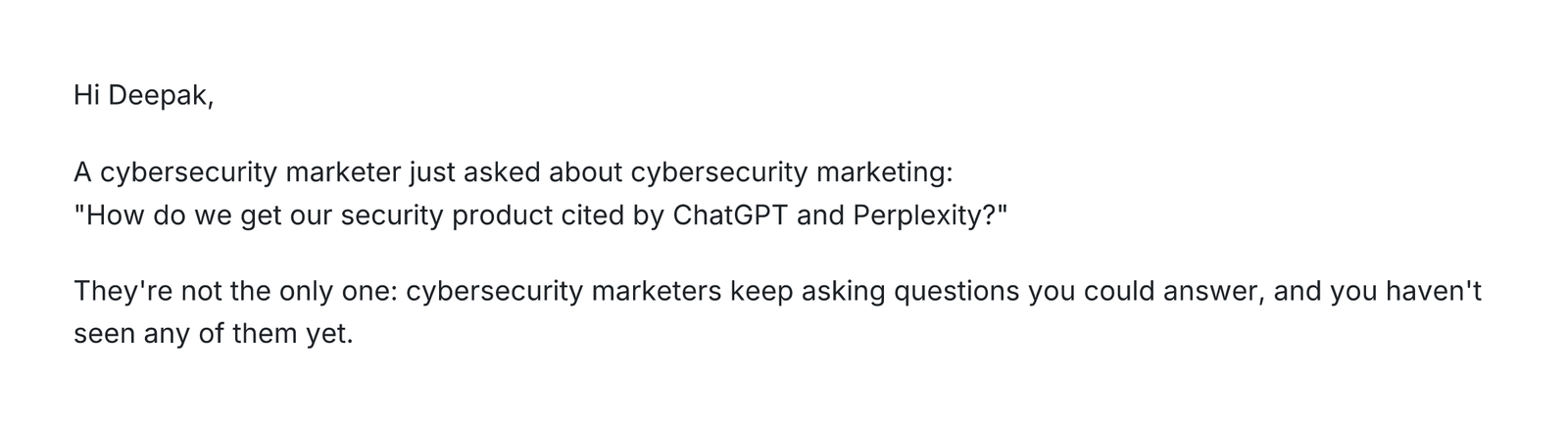
So one signal now serves two audiences that used to be separate. The SDR pitching you and the buyer evaluating you are both reading a machine-generated summary of your site. If that summary is wrong, you are losing deals you never knew were in play.
This is also why GEO for B2B SaaS behaves differently from consumer content marketing. B2B buyers ask comparative, constrained questions. Constrained questions reward declarative content. Declarative content is exactly what a rushed SDR can quote back at you.
The pattern holds at scale, too. When we run programmatic content for customers, the pages that earn citations are the ones that answer a single question completely on the page. The pages that fail are the ones that require the reader to assemble the answer. The same distinction shows up in messier categories where terminology is unsettled, which is why explaining something like Grok's actual capabilities requires stating the boundaries plainly rather than gesturing at them.
The one line worth stealing
A stranger with no interest in you, ninety seconds, and an AI summarizer should be able to write your ICP in one sentence.
If they can, you are legible to the systems that now decide which vendors get considered.
If they cannot, no amount of content volume will fix it. You are feeding those systems the wrong raw material.
The audit is free, it runs continuously, and it is already sitting in your inbox.
What does the last cold email you received say you do? And is it right?
The outbound accuracy figures here come from my own inbox and are directional, not research.
Deepak Gupta is the Co-founder and CEO of GrackerAI, a Generative Engine Optimization platform for B2B SaaS and cybersecurity companies. He previously co-founded and scaled a CIAM platform to serve over 1 billion users, and writes about AI, cybersecurity, and B2B growth at guptadeepak.com.
Frequently Asked Questions
What is a positioning audit?
A positioning audit tests whether your market category, target buyer, core problem, and proof are communicated clearly enough that an outsider can restate them accurately. Traditional audits run through consultant interviews and workshops. The cold email version uses inbound outbound messages as an unprompted sample of how strangers actually read your public materials.
How does cold outbound accuracy relate to AI search visibility?
Both depend on extraction from the same public surface area. An SDR using an AI summarizer and a language model answering a buyer question perform the same operation: read the site, produce a short description. If your pages lack a clear category, named buyer, specific problem, and verifiable proof, both outputs are vague or wrong.
How many cold emails do you need before the signal is reliable?
Roughly twenty to thirty tagged emails give a usable ratio. Below that, individual senders and their tooling introduce too much variance. Track the ratio monthly rather than reacting to any single message.
What does it mean if SDRs describe you correctly but AI models do not?
Your owned pages are clear and your off-site footprint is stale. Models draw heavily on third-party sources such as review platforms, directories, community discussion, and earned coverage. Those sources still carry an older version of your positioning. The fix is distribution rather than copywriting.
Can a cold email audit replace customer research?
No. This test measures legibility, not correctness. A stranger can perfectly describe a market you should not be serving. Use it to detect whether your message lands, and use customer interviews to decide whether it is the right message.
More like this
All GEO & AI Search- GEO & AI SearchNobody Knows How Big GEO IsAnalyst estimates of the GEO market disagree by a factor of six on the forecast and nearly seven on current size, with growth rates from…
- GEO & AI SearchWho Is Buying and Building AI Visibility: An Acquisition Map for the GEO CategoryAdobe paid $1.9B for Semrush. HubSpot acquired a startup under a year old. Wix, Squarespace, Optimizely, and Cloudflare built natively.…
- GEO & AI SearchThe GEO Measurement Vendor Landscape Is a Mess: A Buyer's Guide for 2026Eighteen vendors all claim to track AI engine visibility in 2026. Their methodologies differ enough that cross-vendor numbers don't…
Get new GEO & AI Search writing
Enjoyed this? Subscribe and tell us what you read most. GEO & AI Search is already ticked for you. No tracking pixels, unsubscribe with one click.