Microsoft's Defender team catalogued 31 companies across 14 industries embedding hidden instructions in "Summarize with AI" buttons to bias assistant recommendations. One sold web security software. After fifteen years in security, here is why AI visibility became a governance problem.
Google says llms.txt neither helps nor harms. John Mueller compared it to the meta keywords tag. Adoption sits near 10% of domains and correlation studies find no citation effect. Here is the honest version, including the one use case where the file genuinely earns its place.
Every GEO playbook assumes AI engines can read your site. Cloudflare flipped the default to blocked on new domains and serves roughly a fifth of the web. I look at the access layer nobody optimizes, why it usually sits with infrastructure teams, and how to audit yours.
Adobe paid $1.9B for Semrush. HubSpot acquired a startup under a year old. Wix, Squarespace, Optimizely, and Cloudflare built natively. I mapped every move in the AI visibility category, the build-versus-buy math behind each one, and which giants acquire next based on who has the data gap.
Most teams treat LLM output as deterministic. We measured 180,000 responses across four AI engines for 18 months and found the opposite: visibility drops 30% overnight, and the engines agree on 11%.
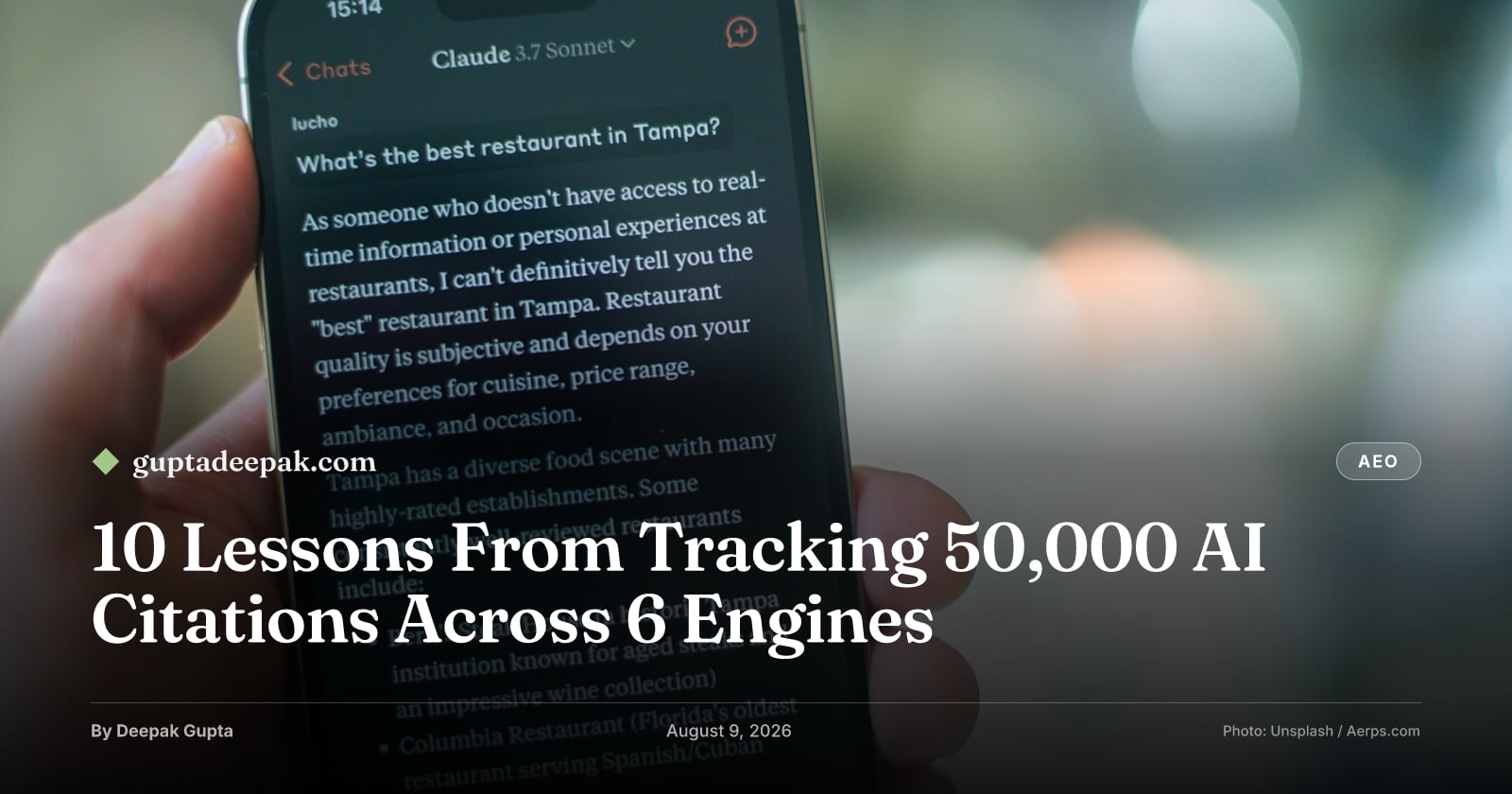
Over 90 days I tracked how six AI search engines cite sources across 50,000+ B2B software responses. The data broke several assumptions the GEO industry treats as settled, starting with the idea that AI visibility is one thing you can optimize for.
Traditional impressions on our properties fell 10-20% this year. AI search visibility rose 35%. That inversion is not a problem to fix; it is the new shape of B2B discovery, and the AI channel brings better-qualified buyers. Here is the data and what it means.
Eighteen vendors all claim to track AI engine visibility in 2026. Their methodologies differ enough that cross-vendor numbers don't compare. Here is how to actually evaluate them.