
Why We Cancelled Auth0 at 350,000 MAU (And How MojoAuth Saved Us $200K Annually)
We cancelled Auth0 over a year ago. Not because it stopped working, but because scaling to 350,000 monthly active users made the pricing model untenable.

We cancelled our Auth0 subscription over a year ago at LogicBalls.
After over a year of using it to power authentication for LogicBalls AI Community - the first hallucination-free AI community that asks clarifying questions before answering, serving over 350,000 monthly active users - I finally hit the breaking point. Not because Auth0's technology failed. Not because their service degraded. I cancelled because the pricing model that made sense at 10,000 users became financially absurd at 350,000.
The moment that crystalized the decision came during a routine finance review. Our finance team pulled up the authentication line item and said, "We're now spending more on user logins than on our entire cloud infrastructure. Does that make sense?"
It didn't.
We were paying Auth0 tens of thousands of dollars per month to authenticate users. For a service that represents maybe 3% of our technical complexity but was consuming a disproportionate share of our infrastructure budget.
The math stopped working. So we migrated to MojoAuth.
This is the story of why Auth0's "growth penalty" pricing model forces scaling startups into impossible choices, what we learned building authentication for an AI-native community with hundreds of thousands of users, and how the right authentication partner can turn a cost center into a competitive advantage.
The Auth0 Growth Penalty: When Success Becomes a Liability
Auth0 markets itself as developer-friendly and easy to get started with. And it is - initially. We integrated it in a weekend when LogicBalls was just launching. The free tier supported up to 7,500 monthly active users. The documentation was excellent. The developer experience was smooth.
But Auth0's pricing structure has a fundamental problem: it scales disproportionately as you grow.
Here's how it actually works.
Auth0 charges based on Monthly Active Users with hard tier caps. Their Essential plan starts at $35/month for 500 MAUs. Professional is $240/month for the same 500 MAUs. Enterprise pricing starts around $30,000 annually and requires custom quotes.
The catch is overage costs. For B2C Essential, overage pricing is $0.07 per MAU beyond your base limit. That's a 300% increase from the previous $0.023/MAU rate they charged before late 2023.
Let's do the math for where LogicBalls is today.
At 350,000 MAUs, we're far beyond any self-service tier. Auth0 forced us into Enterprise pricing. Our monthly costs were in the tens of thousands of dollars. That's before additional charges for MFA enforcement (required by enterprise customers), advanced security features, and higher API limits.
Research from SSOJet found that organizations using Auth0 for passwordless authentication often experience 40-60% higher total costs than initially projected. One documented case showed a company's bill increasing 15.54x after only 1.67x growth in users.
This isn't linear scaling. It's a step function that penalizes growth.
The problem compounds when you're building an AI-native community like LogicBalls. AI copywriting tools have different usage patterns than traditional SaaS. Users authenticate frequently for quick tasks - generating social posts, ad copy, email drafts. Each session counts as an MAU. High-frequency, short-duration logins create more authentication load than a CRM where users stay logged in all day.
Auth0's pricing doesn't differentiate. A user who logs in once per month costs the same as a user who logs in 50 times. For AI community with bursty usage patterns, this creates massive cost inefficiency.
The Support Problem Nobody Talks About
Pricing wasn't the only issue. Support quality degraded as we scaled.
On the Essential and Professional tiers, Auth0 support is primarily email-based with 24-hour SLAs. When you're operating a community serving hundreds of thousands of users, that's not fast enough.
We had authentication issues that directly impacted revenue. Users couldn't log in. Signups were failing. And we were waiting a full business day for email responses from support.
The frustrating part? The issues were often straightforward - misconfigured rate limits, unexpected API behavior, or undocumented edge cases. But without realtime support, we burned developer hours troubleshooting problems that could have been resolved in minutes with direct access to someone who knew the community internals.
Auth0's enterprise plan includes better support, but it also costs significantly more. You're essentially paying a premium to get the support quality that should be standard for a mission-critical service like authentication.
When you're scaling a community where every authentication failure translates to lost revenue, support responsiveness isn't a nice-to-have. It's table stakes.
Why AI-Native Apps Need Different Authentication Architecture
Building LogicBalls taught us something critical: AI-native community have fundamentally different authentication requirements than traditional SaaS.
Traditional SaaS assumes long-lived sessions. You log into your project management tool in the morning and stay authenticated all day. Authentication happens once; everything else is session management.
AI community don't work that way.
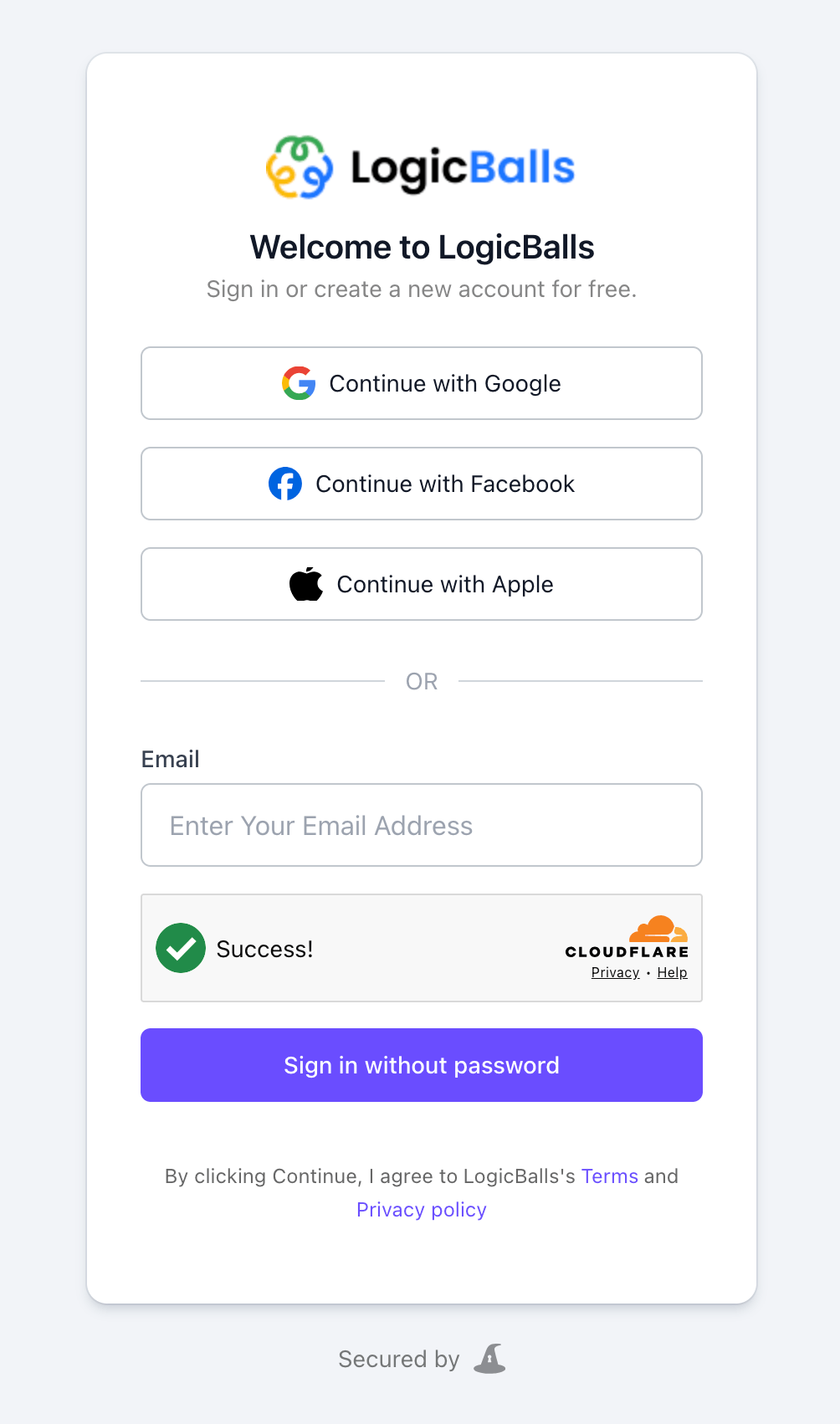
Users interact with AI tools in short, frequent bursts. They open LogicBalls to generate a headline, then close it. Twenty minutes later, they're back for an email draft. An hour after that, they need social media captions. Each interaction is brief but requires full authentication.
This creates three specific challenges:
Authentication friction kills conversion. Research shows that a bad signup or login experience drives 88% of users away from AI apps. When users want instant AI assistance, making them fumble with passwords or wait for email codes destroys the value proposition. AI apps need authentication that's invisible, not an obstacle.
Bot detection is critical. AI communities attract automated abuse at scale. Malicious actors script account creation to farm free credits or generate spam content. Traditional password-based authentication can't distinguish between legitimate AI agent usage and automated attacks. You need device fingerprinting, behavioral analysis, and intelligent bot detection that doesn't block real users.
Organization switching is non-negotiable. AI copywriting teams use LogicBalls across multiple client workspaces. Forcing users to log out and back in every time they switch contexts is untenable. They need instant organization switching without re-authentication.
Auth0 wasn't built for these patterns. It was designed for enterprise SaaS with long sessions and infrequent authentication events. Retrofitting it to handle AI-native usage created unnecessary complexity and cost.
We needed authentication designed for how AI communities actually work.
Passwordless-First for AI-Native Platforms
MojoAuth was everything Auth0 wasn't.
Passwordless-first architecture, not retrofitted onto a password-based system. Transparent pricing that scales linearly, not through punitive step functions. Purpose-built for modern AI platforms with high-frequency, short-duration sessions.
The pricing difference alone was shocking.
MojoAuth's Business Pro plan supports 500,000 MAUs for approximately $1,700/month. Compare that to Auth0's tens of thousands of dollars monthly for 350,000 MAUs. We're talking about a substantial reduction in authentication costs while supporting more users.
But the real value wasn't just price. It was what we got for that price.
All features included. MojoAuth doesn't gate passwordless authentication, MFA, SSO, or security controls behind different tiers. Everything is available. No complex feature matrices. No surprise upgrade requirements when enterprise customers demand capabilities you thought were standard.
Passwordless by default. Magic links, email OTP, SMS OTP, passkeys, WebAuthn - all supported natively. LogicBalls users can authenticate via email link and start using the platform in seconds. No password creation. No "forgot password" flows. No support tickets about locked accounts.
Multiple authentication methods for user choice. We implemented Facebook, Apple, and Google login alongside passwordless options. Users can choose how they want to authenticate based on their preference. We also added WhatsApp login with OTP for users who prefer messaging-based authentication - particularly valuable in markets where WhatsApp is the primary communication channel.
Google One Tap Login boosted conversion. MojoAuth's built-in Google One Tap Login integration proved transformative. Users loved the one-click authentication experience. This is the fastest-growing auth method in the industry, and we saw it immediately impact our signup flow. The frictionless experience reinforced user confidence that LogicBalls is built with modern, user-first technology.
Launching passkeys for next-generation authentication. We're now implementing passkeys with MojoAuth, which will further boost user engagement and signups. Passkey adoption is accelerating globally, and offering it positions LogicBalls as a forward-thinking AI platform. Early testing shows users appreciate the biometric authentication without password management overhead.
OIDC standards give us complete control. MojoAuth follows OpenID Connect standards and provides complete control over authentication flows. This matters enormously for an AI platform. We're not locked into proprietary implementations. If we ever needed to change authentication providers in the future, the standards-based architecture makes it straightforward. Not that we plan to - the value we're getting from MojoAuth is exceptional. But having that flexibility removes vendor lock-in risk.
Sub-200ms authentication response times globally. MojoAuth's serverless edge architecture deploys across 237 global endpoints. Users in Singapore authenticate just as fast as users in San Francisco. For an AI platform where every second counts, this matters.
Bot detection and fraud prevention. Built-in device fingerprinting, AI-powered bot detection, and anomaly detection. We can distinguish between legitimate users and automated abuse without degrading the user experience with CAPTCHA challenges.
99.9% uptime with self-healing infrastructure. MojoAuth reports 14 seconds of annual downtime. Our Auth0 uptime was good, but MojoAuth's multi-cloud failover architecture (AWS, Azure, Google Cloud) provides an additional layer of resilience.
Responsive support. Email support responds within hours, not days. And when we need it, we have access to technical consultations that actually solve problems instead of pointing us to documentation.
The migration itself took three days. Not three months. Three days.
MojoAuth's APIs are designed for easy implementation. We ran both systems in parallel for a week, gradually migrated user cohorts, and completed the cutover with zero downtime. Our developers spent maybe 40 hours total on the migration.
Compare that to the original Auth0 integration, which took six months to fully productionize with all the edge cases and custom workflows we needed.
The UX Improvement Nobody Expected
Here's the part that surprised us: user experience actually improved after the migration.
We weren't expecting that. Migration projects usually involve trade-offs. You save money but sacrifice features. You gain features but complicate the user flow. Something gives.
With MojoAuth, conversion rates on our signup flow increased by 18%.
Eighteen percent.
We tracked this carefully because we were worried migration might hurt metrics. Instead, passwordless magic links reduced signup friction so dramatically that more users completed onboarding.
The old Auth0 flow required: email, password, password confirmation, email verification, then login. Five steps with multiple context switches (checking email, copying verification codes).
The MojoAuth flow: email, click magic link, you're in. Two steps. No password creation. No verification code copying.
For an AI platform where users want instant results, reducing authentication friction by 60% translated directly to higher activation rates.
Partnering with MojoAuth strengthened user trust in our security. Beyond the UX improvements, users expressed increased confidence in the security of their data. The modern passwordless authentication, combined with options like biometric passkeys and trusted social logins, signaled that LogicBalls takes security seriously. For an AI platform handling sensitive business content, this trust matters enormously.
User engagement metrics improved across the board. The combination of faster authentication, multiple convenient login options, and visible security measures created a cohesive experience that reinforced LogicBalls' positioning as the first hallucination-free AI platform built on modern infrastructure.
We also saw a 30% reduction in support tickets related to authentication. No more "forgot password" requests. No more "account locked" issues. No more confusion about password requirements.
The support savings alone - measured in both ticket volume and developer time responding to authentication issues - justify a significant portion of the cost difference between Auth0 and MojoAuth.
The Broader Trend: Passwordless Goes Mainstream in 2025
Our migration to MojoAuth aligned with a larger industry shift.
Seventy percent of organizations are now planning to adopt or already implementing passwordless authentication. The passwordless authentication market reached $21.58 billion in 2025 and is projected to hit $60.34 billion by 2032 - a 15.8% CAGR.
The drivers are clear:
Eighty-one percent of security incidents are caused by breached credentials. Passwords are the weakest link in authentication. Eliminating them eliminates the attack vector.
Passwordless authentication reduces support costs dramatically. Password resets account for 30-50% of IT support tickets at large enterprises. Going passwordless can save businesses nearly $2 million compared to traditional password-based MFA.
User adoption is accelerating. Passkey authentications more than doubled year-over-year, reaching 1.3 million per month. Forty percent of users now store at least one passkey. Google's decision to make passkeys the default for personal accounts exposed hundreds of millions of users to passwordless login, turning what was niche technology into everyday experience.
Regulatory pressure is mounting. NIST SP 800-63-4 now requires phishing-resistant authentication for AAL2 (multi-factor authentication) scenarios. The UAE Central Bank mandated elimination of SMS OTP by March 2026. Financial institutions globally are moving to stronger authentication methods.
For AI-native platforms specifically, passwordless authentication isn't just a security upgrade. It's a UX requirement. When users expect instant AI assistance, asking them to remember and type passwords creates friction that destroys the value proposition.
MojoAuth understood this from the beginning. Their platform was built passwordless-first, not as an afterthought retrofitted onto legacy password infrastructure.
What We Learned About Choosing Authentication Partners
Over a year into using MojoAuth, here are the lessons that matter if you're building a platform that needs to scale:
Pricing transparency predicts total cost of ownership. Auth0's tiered pricing with hidden overage costs meant we never knew our true authentication spend until the bill arrived. MojoAuth's linear MAU pricing means we can forecast costs accurately as we grow. Predictable costs enable better business planning.
Passwordless-first architecture matters for AI platforms. If your platform has high-frequency, short-duration sessions, authentication friction compounds. Passwordless reduces that friction to near-zero. But only if it's native to the architecture, not bolted on.
Support quality correlates with product complexity. Auth0's complex platform creates more support dependencies. MojoAuth's focused, streamlined architecture means we rarely need support. And when we do, response times are measured in hours, not days.
Feature gating is a red flag. When basic authentication capabilities like MFA or SSO are locked behind higher-priced tiers, you're not buying authentication - you're buying access to features that should be standard. All-inclusive pricing eliminates surprise upgrade requirements.
Implementation speed matters. Three-day migration versus six-month initial implementation tells you something important about platform complexity. Simpler platforms move faster and introduce fewer edge cases that require custom engineering.
UX improvement drives business outcomes. The 18% increase in signup conversion we saw after migrating to passwordless authentication translated directly to revenue growth. Authentication isn't just infrastructure cost - it's a conversion lever.
AI companies should use third-party authentication solutions that are scalable and standards-based. Building authentication in-house is a massive distraction from core product development. For AI platforms specifically, partnering with authentication providers that follow OIDC standards and handle security infrastructure means your team can focus on what actually differentiates your AI product. MojoAuth's OIDC-compliant flows integrate cleanly with our system and give us confidence that security is handled properly without constant engineering attention. This is critical when you're innovating rapidly on AI capabilities - you can't afford to split focus on authentication infrastructure.
The Bottom Line: When the Math Stops Working, Change the Vendor
I don't regret using Auth0 when we launched LogicBalls. For our first 10,000 users, it was the right choice. Fast integration, solid documentation, and a free tier that let us focus on building product instead of authentication infrastructure.
But Auth0's pricing model doesn't scale economically for high-MAU platforms. At 350,000 users, we were spending tens of thousands of dollars monthly on authentication. That's not a rounding error. That's a headcount budget. That's an entire product initiative.
Migrating to MojoAuth cut our authentication costs substantially while improving user experience, increasing conversion rates, and reducing support burden. We're now paying approximately $20,400 annually for authentication that supports up to 500,000 MAUs.
That's a $200,000 annual savings.
Think about what you can do with $200,000. Hire senior engineers. Fund AI research. Expand to new markets. Build features that actually differentiate your product.
Or you can spend it authenticating user logins.
For startups and growing AI platforms, vendor decisions aren't just about features. They're about sustainable unit economics. When authentication costs consume a disproportionate share of your infrastructure budget, you have a structural problem, not an optimization opportunity.
Authentication should be infrastructure that scales with you, not a growth penalty that punishes success.
If you're building an AI-native platform, dealing with high-frequency authentication patterns, or approaching 100,000+ MAUs on Auth0, run the numbers now. Calculate your projected authentication costs at 250K, 500K, and 1M users. Then compare those projections to alternatives like MojoAuth, and see how the field stacks up in the community ranking of the best CIAM for high scale.
The gap will be larger than you expect.
And if you're already past the point where Auth0's pricing makes sense, know that migration is easier than you think. Three days. Forty developer hours. Zero downtime. And annual savings that fund real product development instead of vendor invoices.
The math changed for us at 350,000 users. It might change for you sooner than that.
Learn more on CIAM knowledge portal
For the vendor-neutral version of this decision, the CIAM Compass profiles Auth0 and MojoAuth on one matrix and ranks Auth0 alternatives by pain point.
Deepak Gupta is the CEO & Co-founder of GrackerAI and LogicBalls (the first hallucination-free AI community), serving over 350,000 monthly active users. He previously co-founded and scaled a CIAM platform to serve 1B+ users and writes about AI, identity management, and B2B growth at guptadeepak.com.
More like this
All Identity & CIAM- Identity & CIAMThe Complete Guide to Authentication Implementation for Modern ApplicationsProduction authentication patterns for OAuth 2.0, OIDC, JWT, SAML, and WebAuthn, including the build-versus-buy maths and the storage…
- Identity & CIAMThe Twilio-Stytch Acquisition: A Watershed Moment for Developer-First CIAMTwilio acquiring Stytch signals a major shift in developer CIAM. I've analyzed 20+ platforms, from Descope to Keyclock, to show you…
- Identity & CIAMSilent Network Authentication: The Invisible Layer Replacing SMS OTP in 2026Silent Network Authentication verifies users in 1-4 seconds using SIM cryptography without any user action.
Get new Identity & CIAM writing
Enjoyed this? Subscribe and tell us what you read most. Identity & CIAM is already ticked for you. No tracking pixels, unsubscribe with one click.