
Unlocking the Gates: REST API Authentication Methods for Modern Security
From Basic Auth’s simplicity to OAuth 2.0’s delegated muscle, this quick-read unpacks the strengths, gaps, and best-fit use cases of the four core REST
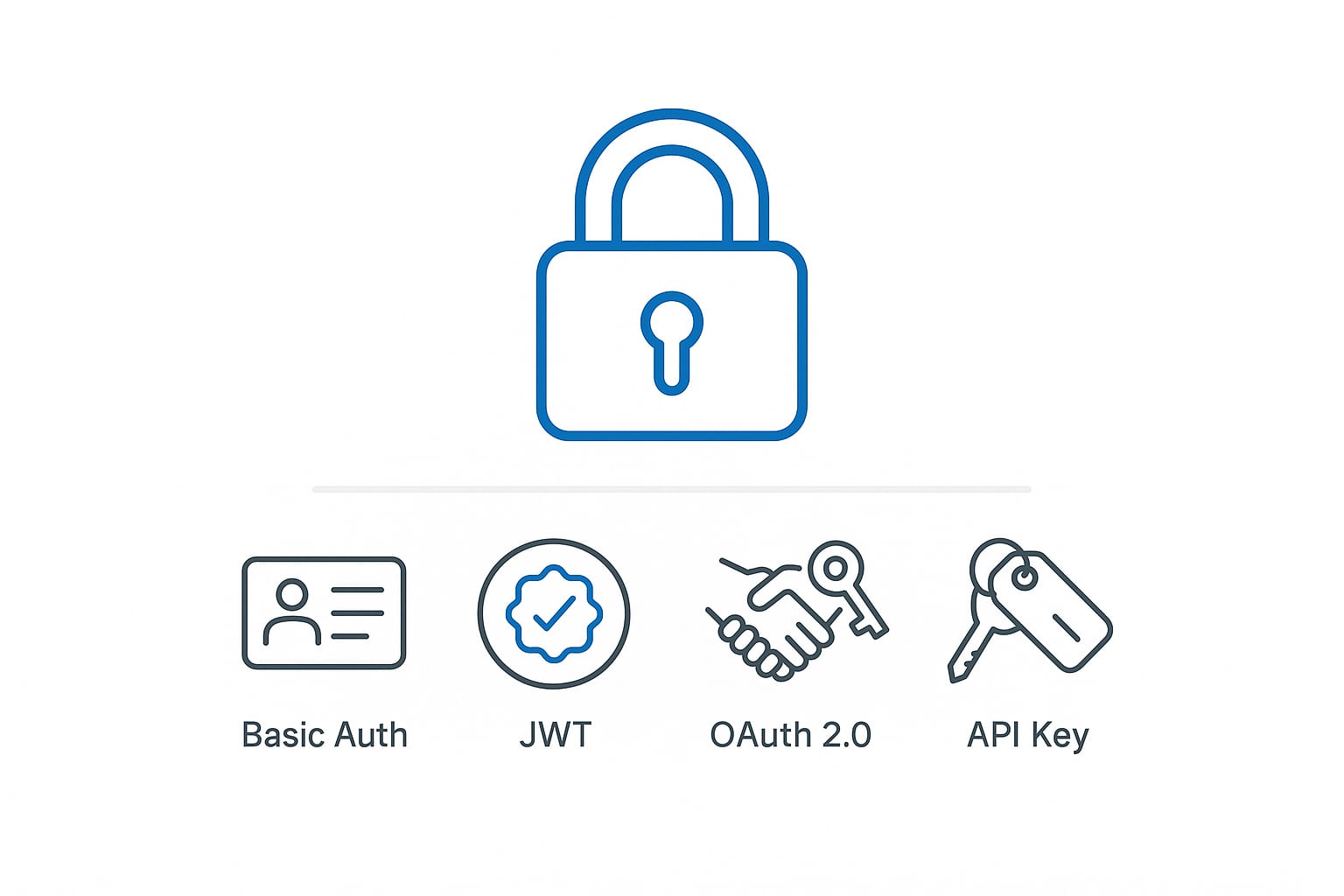
Securing your API endpoints isn't just good practice, it's essential survival. As cyber threats grow increasingly sophisticated, understanding the authentication mechanisms that protect your digital assets becomes a critical skill for developers and architects alike.
Having built authentication systems that protect millions of user accounts, I've seen firsthand how proper authentication can make or break an application's security posture. Here are the four fundamental REST API authentication methods every developer should master.
Why API Authentication Matters
Before we explore specific methods, let's understand what's at stake. REST APIs serve as the connective tissue of modern applications, enabling everything from mobile apps to IoT devices to access your systems. Without robust authentication:
- Unauthorized users could access sensitive data
- Attackers could manipulate your systems through API calls
- Your infrastructure could be vulnerable to abuse and rate-limiting bypasses
- Compliance requirements (GDPR, HIPAA, etc.) would be impossible to meet
Now, let's unlock the secrets of four essential authentication methods.
🧾 Basic Authentication: The Digital Equivalent of an ID Card
How It Works
Basic Authentication is exactly what it sounds like, basic. It involves transmitting a username and password with each request, encoded in base64 format, typically in the Authorization header:
Authorization: Basic dXNlcm5hbWU6cGFzc3dvcmQ=
The server decodes this string, separates the username and password, and verifies them against stored credentials.
Security Considerations
Here's where things get critical: base64 encoding is not encryption. It's merely encoding that can be easily reversed. This means Basic Authentication must always be used with HTTPS/TLS to prevent credential interception.
When to Use Basic Authentication
- Internal applications within secure networks
- Development environments
- Simple systems where implementation simplicity outweighs security concerns
- When paired with additional security layers (IP restrictions, VPNs)
When to Avoid It
- Public-facing APIs
- Mobile applications (storing credentials securely is challenging)
- High-security environments
- Any scenario where passwords might be intercepted
🔑 Token-Based Authentication (JWT): The Digital Passport
How It Works
JWT (JSON Web Token) authentication addresses many limitations of Basic Authentication by creating a signed token that confirms a user's identity without repeatedly transmitting credentials.
The process works in three steps:
- Authentication: User provides credentials once
- Token Generation: Server validates credentials and issues a signed JWT
- Authorization: Subsequent requests include the JWT instead of credentials
A JWT consists of three parts:
- Header: Contains token type and signing algorithm
- Payload: Contains claims (user ID, permissions, expiration)
- Signature: Verifies the token hasn't been tampered with
Security Advantages
- Credentials are transmitted only once
- Tokens can be scoped to specific permissions
- Tokens have expiration times, limiting damage from theft
- Stateless design improves scalability
Implementation Best Practices
- Set appropriate expiration times (balance security vs. user experience)
- Use refresh tokens for longer sessions
- Store tokens securely (HttpOnly cookies or secure local storage)
- Implement token revocation mechanisms for compromised tokens
- Never store sensitive data in the payload (it's encoded, not encrypted)
When to Use JWT
- Single page applications (SPAs)
- Mobile applications
- Microservices architectures
- When you need stateless authentication
- Cross-domain authentication scenarios
🛡️ OAuth 2.0: The Delegation Framework
How It Works
OAuth 2.0 isn't just an authentication method, it's a framework for authorized access. It enables third-party applications to access resources without exposing user credentials.
The core concept is delegation: users authorize applications to act on their behalf with limited scope.
Key OAuth Flows
Authorization Code Flow:
- User initiates login through third-party app
- User is redirected to authorization server
- User consents to specific permissions (scopes)
- Authorization server returns code to application
- Application exchanges code for access token
- Application uses token to access resources
Client Credentials Flow: Used for server-to-server communication where user consent isn't needed.
Implicit Flow: Simplified flow for browser-based applications (though less recommended now).
Resource Owner Password Credentials Flow: Allows direct credential exchange (used sparingly due to security concerns).
Security Considerations
- Implement proper redirect URI validation
- Use PKCE (Proof Key for Code Exchange) for public clients
- Enforce limited token scopes
- Implement proper token validation
- Set appropriate token lifetimes
When to Use OAuth 2.0
- Third-party integrations
- Social login features
- API ecosystem development
- Granular permission systems
- When you need user consent workflows
📬 API Key Authentication: The Simple Access Pass
How It Works
API keys are long, generated strings provided to developers or services that want to access your API. They're typically included in headers, query parameters, or sometimes in the request body:
Authorization: ApiKey your_api_key_here
X-API-Key: your_api_key_here
Implementation Approaches
- Header-based: Most secure, less exposed
- Query Parameter: Easier for simple integrations but visible in logs
- Mixed Authentication: Combining API keys with other methods for layered security
Security Considerations
- API keys typically don't expire automatically
- They're often shared across an entire application (lack of user-specific context)
- If compromised, they provide full access until revoked
- Key rotation mechanisms are essential
When to Use API Keys
- Public APIs with rate limiting needs
- Developer-focused services
- Internal service-to-service communication
- When simplicity of implementation is paramount
- For services where user context isn't necessary
Choosing the Right Authentication Method
The right authentication approach depends on your specific requirements. Here's a comparative framework:
| Factor | Basic Auth | JWT | OAuth 2.0 | API Keys |
|---|---|---|---|---|
| Implementation Complexity | Low | Medium | High | Low |
| Security Level | Low (without HTTPS) | Medium-High | High | Medium |
| User Experience | Poor (frequent logins) | Good | Good | N/A (backend) |
| Scalability | Poor | Excellent | Good | Good |
| Revocation | Difficult | Challenging | Easy | Moderate |
| Best For | Simple internal apps | Modern web/mobile apps | Delegated access | Service-to-service |
Beyond Authentication: Comprehensive API Security
Authentication is just one layer of API security. For truly robust protection:
- Implement Authorization: Authentication verifies identity; authorization controls what authenticated users can do
- Use Rate Limiting: Prevent abuse with request quantity restrictions
- Validate All Inputs: Prevent injection attacks
- Monitor and Log: Track suspicious activities and maintain audit trails
- Keep Dependencies Updated: Address vulnerabilities in your authentication libraries
- Use HTTPS Everywhere: Encrypt all API traffic
- Consider API Gateways: Centralize authentication and security policies
The Future of API Authentication
The authentication landscape continues to evolve. Watch for these emerging trends:
- Passwordless Authentication: Biometrics, magic links, and other alternatives
- Zero Trust Architecture: Never trust, always verify
- Continuous Authentication: Risk-based assessment beyond the initial authentication
- Decentralized Identity: Blockchain-based solutions that put users in control
Frequently Asked Questions
What is the most secure REST API authentication method?
It depends on who the caller is. For a third-party application acting on a user's behalf, OAuth 2.0, because it delegates scoped access without sharing credentials. For your own first-party clients, short-lived tokens issued after login. For service-to-service traffic, OAuth 2.0 client credentials or mutual TLS. Basic authentication is the weakest of the four and belongs only behind a trusted network boundary.
Are API keys secure enough?
For low-risk, server-to-server use with rate limiting and scoping, they are workable. Their weakness is structural: an API key is a long-lived bearer secret with no expiry and no user context, so anyone holding it is you until someone notices and rotates it. Leaked keys in public repositories remain one of the most common causes of cloud compromise.
JWT or session cookies for an API?
Sessions when a server renders your app and you want instant revocation. JWTs when you need stateless verification across services that do not share a session store. The cost of the stateless choice is that you cannot easily take a token back, which is why JWT designs pair short access-token lifetimes with a revocable refresh token.
How long should an access token live?
Short enough that a stolen one stops being useful quickly, typically minutes rather than hours, with a longer-lived refresh token held somewhere you can revoke it. The right number is a trade-off between blast radius and how much refresh traffic your token endpoint can absorb.
Do I still need HTTPS if my tokens are signed?
Yes. A signature proves a token was not altered. It does nothing to stop someone reading it off the wire and replaying it, because almost every scheme in common use is bearer-based: possession is authorisation. Transport encryption is what keeps the token from being observed in the first place.
What is the difference between authentication and authorization in an API?
Authentication establishes who is calling. Authorization decides whether that caller may perform this specific operation on this specific resource. Many API breaches are authorization failures rather than authentication ones: the caller was genuinely who they claimed, and the endpoint simply never checked that the record belonged to them.
Final Thoughts
API authentication isn't just about keeping bad actors out, it's about building trust with partners, customers, and other stakeholders who rely on your services. The method you choose sends a message about how seriously you take security.
In my experience building identity solutions at scale, the most successful approaches balance security with usability. Overly complex security measures often lead to workarounds that create vulnerabilities, while overly simple solutions leave your systems exposed.
Whether you're building a public API for thousands of developers or securing internal microservices, start with a clear understanding of your threat model, user needs, and development resources. The right authentication method will emerge naturally from these requirements.
Remember: in API security, you're only as strong as your weakest gate.
More like this
All Identity & CIAM- Identity & CIAMJWT vs Opaque Tokens: Choosing the Right API Token Strategy (2026)JWT versus opaque tokens for API authentication: statelessness versus revocation, latency at global scale, blast radius, and the hybrid…
- Identity & CIAMSecuring APIs in Identity and Access Management: A Comprehensive Guide for Modern OrganizationsDiscover API security strategies for Identity and Access Management systems. This expert guide covers authentication protocols,…
- Identity & CIAMPasswordless Authentication in 2026: 5 Methods Compared and How to Roll It OutPasswords are responsible for 80% of data breaches. Passwordless authentication eliminates the attack surface entirely.
Get new Identity & CIAM writing
Enjoyed this? Subscribe and tell us what you read most. Identity & CIAM is already ticked for you. No tracking pixels, unsubscribe with one click.