
Enterprise SSO: SAML vs OIDC, and How to Pick
Updated · 11 min read · By Deepak Gupta
On this page
Key takeaways
- SAML is the older XML-based protocol; OIDC is the modern JSON / OAuth 2.0-based protocol.
- Most enterprise IdPs (Okta, Entra, Ping, Google Workspace) support both; the customer's existing setup determines which you implement first.
- SAML still dominates enterprise install base; OIDC dominates new integrations.
- B2B SaaS should support both protocols at the per-Organization level, the customer picks.
- The CIAM choice matters: per-Org SSO connections with self-service IdP setup is the differentiator that turns SSO from a project into a configuration step.
What enterprise SSO is
The practical question for B2B SaaS isn't usually SAML versus OIDC philosophically, it's which the next contract requires first. The IT admin filling out the security questionnaire knows which protocol their IdP is configured for; the SaaS just needs to support both so it isn't the blocker.
SAML 2.0: the install base
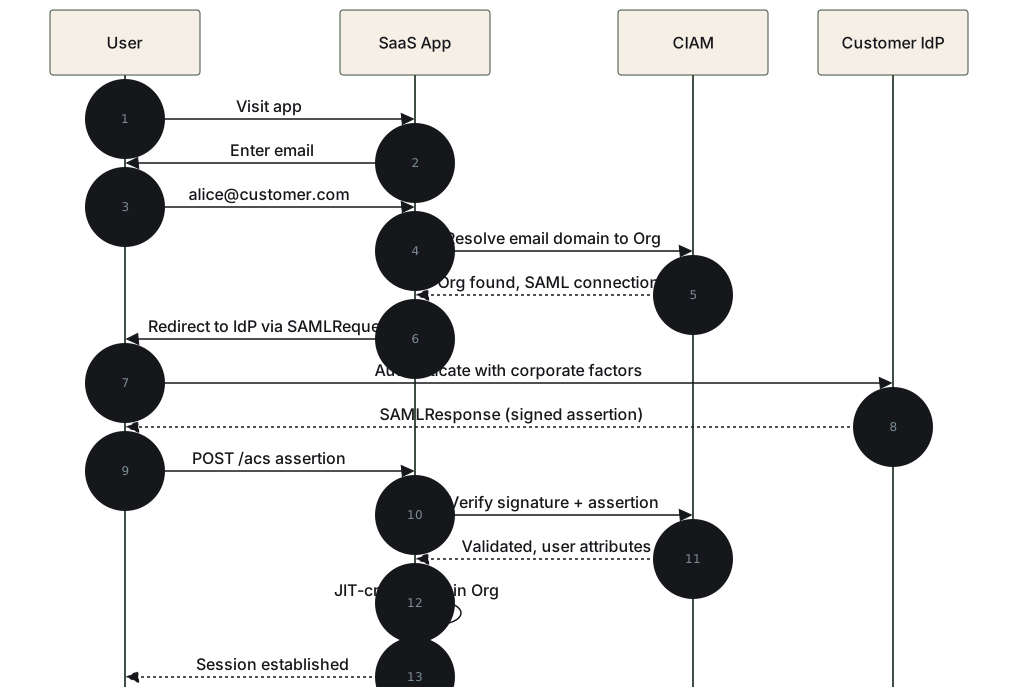
SAML (Security Assertion Markup Language) was standardized in 2005. It is XML-based, request-and-response oriented, and the protocol most enterprise IdPs default to for application SSO. The exchange:
- User clicks "Sign in with SAML" in the SaaS.
- SaaS redirects to the IdP with a SAML authentication request.
- IdP authenticates the user (password, MFA, etc.).
- IdP redirects back to the SaaS with a signed SAML assertion.
- SaaS verifies the assertion signature and creates / matches the user record.
SAML's strength is install-base coverage: every enterprise IdP supports it, every SAML-aware SaaS works with every other SAML-aware IdP, and procurement teams know what to ask for.
SAML's weakness is the developer experience: XML signing edge cases, attribute mapping ambiguity (emailaddress vs email vs mail), and the fact that the spec is dense enough that subtle bugs hide in many implementations. For new integrations, OIDC is materially less painful to debug.
OIDC: the modern integration
OIDC (OpenID Connect) is OAuth 2.0 with identity claims layered on top, JSON-based, well-understood by modern tooling, and easier to debug. The exchange:
- User clicks "Sign in with [IdP]" in the SaaS.
- SaaS redirects to the IdP's authorization endpoint with an OIDC request.
- IdP authenticates the user.
- IdP redirects back with an authorization code.
- SaaS exchanges the code at the IdP's token endpoint for an ID token (a signed JWT containing identity claims) plus an access token.
For SaaS-to-IdP federation, OIDC is the preferred protocol for new integrations. Discovery (.well-known/openid-configuration) makes IdP setup near-trivial: paste a discovery URL, the SaaS auto-configures.
The catch: many enterprise IdPs treat OIDC as their secondary protocol, and procurement teams sometimes ask for SAML by name even when OIDC would work. B2B SaaS that implements only OIDC will lose deals where the customer's procurement requires SAML in writing.
Per-Organization configuration
The architectural decision that makes Enterprise SSO scalable is per-Organization configuration. Each customer's Organization in your B2B SaaS has its own IdP connection, its own attribute mapping, its own signing key, its own claim transformations.
This is what the right CIAM ships as a primitive. The wrong CIAM either ships SSO at the global tenant level (one IdP for the whole SaaS, unworkable for B2B) or expects you to roll per-Org SSO yourself on top of generic SAML / OIDC libraries.
The vendors that handle per-Org SSO cleanly: WorkOS, Frontegg, Auth0 (Enterprise Connections + Organizations), SSOJet, Scalekit. For these, adding a new customer's IdP is a configuration step. For others, it's an engineering project.
Self-service IdP setup
The next-level differentiator: the customer's IT admin can configure their own IdP without involving your engineering team. This is an embedded UI where the admin uploads their SAML metadata XML (or pastes their OIDC discovery URL), maps attributes to user fields, tests the connection, and ships it.
WorkOS, Frontegg, Auth0 B2B Organizations, and MojoAuth all ship this UX. Without it, every new enterprise customer's SSO setup requires a back-and-forth between your engineering and their IT, a meaningful tax on enterprise sales velocity.
Just-in-time provisioning vs SCIM
SSO authenticates the user. Provisioning creates the user record. The two patterns:
- Just-in-time (JIT) provisioning, auto-create the user record on first SSO login, populated from the SAML or OIDC assertion attributes. The user clicks "Sign in with SSO" and gets a usable account.
- SCIM Directory Sync, the IdP pushes user records to your SaaS via SCIM API as employees are added, updated, and removed. Required for proper deprovisioning at scale.
Most B2B SaaS uses JIT for first-login convenience and SCIM for ongoing lifecycle, especially deprovisioning. SCIM is the harder feature; JIT comes free with proper SSO implementation.
Implementation choices
The CIAM that ship Enterprise SSO best, supporting both SAML and OIDC, per-Organization, with self-service setup, JIT, and SCIM, are the same products that ship strong B2B SaaS identity overall: WorkOS, Frontegg, Auth0, MojoAuth, with SSOJet, Scalekit, and Kinde as newer entrants in specific niches.
For self-hosted, Keycloak and WSO2 Identity Server handle SAML and OIDC well at the protocol level but require theming work for the self-service IdP setup UX.
Related guides
B2B SaaS Identity: Organizations, SSO, SCIM, and the Enterprise Sales Checklist
How to design B2B SaaS identity: Organizations, Enterprise SSO with SAML and OIDC, SCIM provisioning, audit logs, and the IT-admin features that close enterprise deals.
OAuth 2.1 Explained: What Changed and Why It Matters
OAuth 2.1 consolidates fifteen years of OAuth 2.0 practice into a single coherent specification. What it deprecates, what it requires, and how to migrate existing OAuth 2.0 code.
SAML 2.0 Explained: The Enterprise SSO Standard, 20 Years In
SAML 2.0 still dominates enterprise SSO install base in 2026. How the protocol actually works, the bindings, profiles, the metadata exchange, and the security pitfalls that keep biting implementers.
Related vendors
Auth0
Auth0 remains the safest mid-market default for B2C plus B2B Enterprise SSO when developer velocity matters more than long-run TCO. Auth0 for AI Agents (GA November 2025) and Auth for MCP (GA May 2026) make it the first major CIAM with a packaged agent-identity surface. Below 50k MAU it is still hard to beat. Above 500k MAU, cost and Actions-driven lock-in make FusionAuth, Cognito, or Stytch (Twilio) plus a passkey orchestrator the more honest shortlist.
Frontegg
Frontegg is the strongest B2B SaaS CIAM in 2026 by Admin Portal and self-service end-customer experience, the buyer is a SaaS engineering team that needs to ship enterprise-grade IT admin features without building them, and Frontegg delivers more of that out of the box than Auth0 or WorkOS. The trade-off is narrower B2C feature coverage and a smaller ecosystem than Auth0; for B2B-first SaaS the Admin Portal alone often justifies the choice.
MojoAuth
MojoAuth is a growing passwordless-native CIAM. Passkeys, magic links, and OTP are the product, not Flow blocks. Published MAU pricing scales through enterprise volume (free tier through a declining per-MAU table into the millions) without Auth0's invoice shape. Put it on the 2026 shortlist next to Stytch for passkeys, not next to Descope. Descope is orchestration. MojoAuth is passwordless. Community and FedRAMP still trail Auth0.
SSOJet
SSOJet is a 2026 enterprise-SSO pick for fast-growing B2B SaaS. Public pricing is connection-based and transparent (from $99/month on the public page, no MAU tax). That commercial shape is stronger for companies adding logos quickly than Auth0's MAU curve or a quote-only enterprise IdP. WorkOS remains the more mature Admin Portal. SSOJet is the pricing-transparency alternative. Not a B2C suite.
WorkOS
WorkOS is the strongest B2B-first CIAM in 2026 by deliberate scope choice: every product surface assumes the buyer is selling to enterprise IT, not to consumers. AuthKit's 1M MAU free tier makes it a credible Auth0 alternative for B2B SaaS that does not need adaptive risk or B2C consumer flows. In 2026 the company is also documenting MCP step-up patterns for agents; that is still a tutorial surface, not a packaged agent-identity product like Auth0 for AI Agents. For pure B2B SSO, SCIM, and audit logs, WorkOS is hard to beat at any price point.
Where to next
FAQ
- Which should I implement first, SAML or OIDC?
- Look at your customer pipeline. If the first enterprise customers are running Okta, Entra, or any modern IdP with both protocols available, OIDC is cleaner to implement and debug. If a specific customer's procurement team has already specified SAML in the security questionnaire, implement SAML first. In practice, B2B SaaS ends up supporting both.
- Is SAML deprecated?
- No, but new integrations skew OIDC. SAML remains the dominant protocol in enterprise install base, most existing enterprise SSO connections are SAML. Production B2B SaaS in 2026 supports both protocols and lets the customer pick during IdP configuration.
- Can a CIAM support OIDC for the application but SAML for the IdP?
- Yes, and this is a common pattern. The application talks to the CIAM via OIDC (the modern relying-party protocol), and the CIAM federates outbound to the customer's IdP via SAML. The application doesn't need to know whether the IdP is SAML or OIDC; the CIAM handles the protocol translation.
- What is JIT provisioning?
- Just-in-Time provisioning auto-creates a user record on first SSO login, populated from the SAML or OIDC assertion attributes. It avoids requiring the customer's admin to pre-provision users via SCIM for first-login access. Most B2B SaaS deployments combine JIT for first login with SCIM for ongoing lifecycle (deprovisioning especially).
Sources
- OASIS SAML 2.0 Core specification
- OpenID Connect Core 1.0
- Okta integration patterns