
Why Your AI Agents Are a Security Nightmare (And What to Do About It)
Most companies are creating massive security blind spots by forcing AI agents into human identity systems.
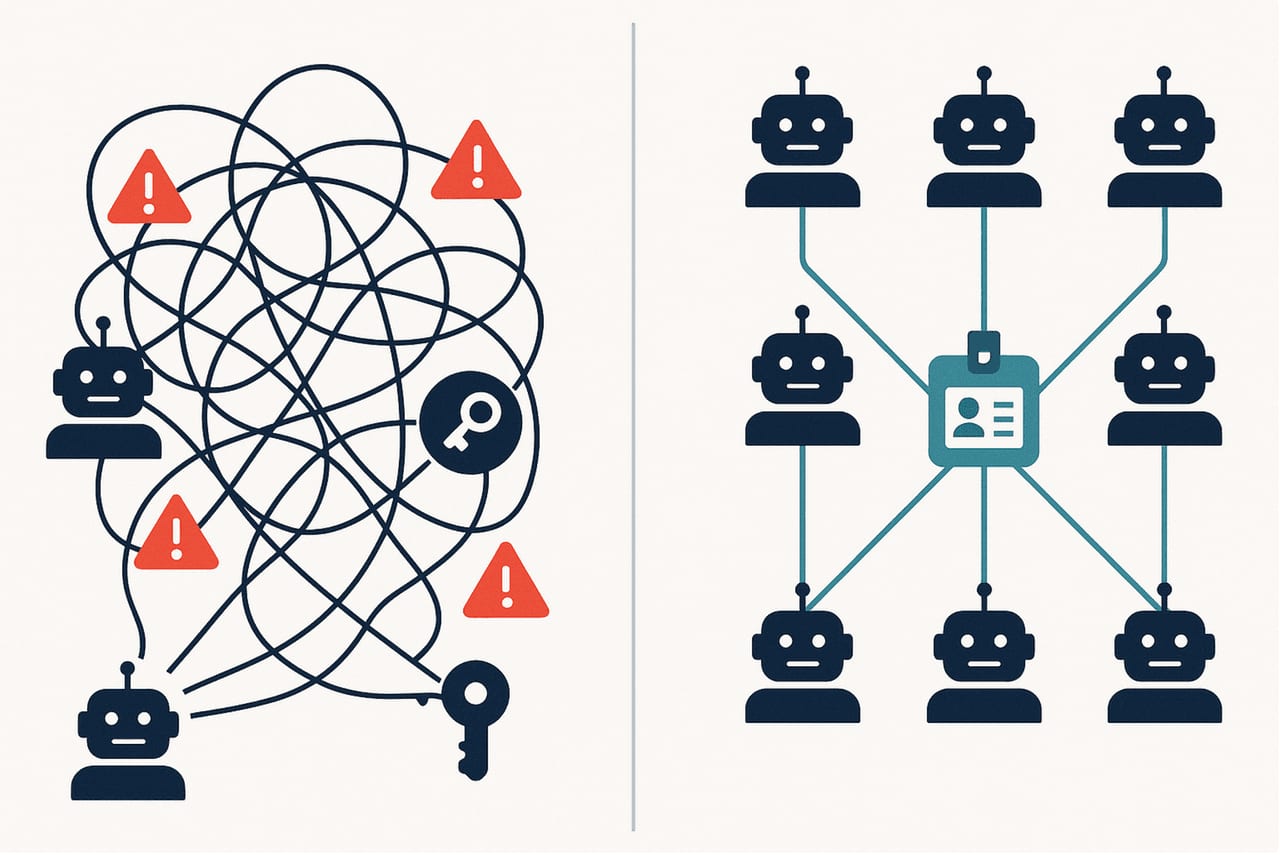
Most companies are rushing to deploy AI agents without realizing they're creating a massive security blind spot. The identity systems we use to manage human employees simply weren't designed for digital workers that never sleep, make thousands of API calls per hour, and need permissions that change by the minute.
If your organization is using shared service accounts for AI agents or trying to squeeze them into existing OAuth frameworks, you're not alone – but you are at risk.
The Problem Hidden in Plain Sight
This is coming in near future where a company has 500 human employees and 200 AI agents. The AI agents process customer support tickets, analyze financial data, generate reports, and monitor security systems. Each agent needs access to different databases, APIs, and internal tools to do its job.
But here's the thing – most organizations handle these AI agents like they're just another application, giving them shared passwords or cramming them into identity systems built for humans who log in once a day and call it quits at 5 PM.
This approach is like giving every robot in your factory the master key and hoping for the best.
I see this problem everywhere as I work with many organizations struggle with AI agent security as they scale their digital workforces - "The fundamental issue is that we're trying to manage artificial intelligence with frameworks designed for humans, an AI agent that processes customer data 24/7 has completely different security needs than a person who checks email a few times a day."
Why oauth and Current Systems Fall Short
OAuth 2.0 and openID Connect transformed how we handle human authentication. These protocols solved the problem of sharing passwords by letting applications access user resources through secure tokens instead. But they were built around several assumptions that just don't work for AI agents.
First, they assume a human is present to grant permissions. When you connect a new app to your google account, you see those consent screens asking what the app can access. AI agents can't click "Allow" or make judgment calls about what permissions make sense.
Second, these systems expect relatively predictable usage patterns. Humans log in occasionally, do some work, then log out. AI agents might authenticate thousands of times per hour as they process data, check multiple systems, and coordinate with other agents.
Third, current identity systems assume permissions stay fairly static. Your job role determines what you can access, and that doesn't change much day to day. AI agents need dynamic permissions that shift based on what they're working on, how confident they are in their decisions, and what's happening in the broader system.
Consider an AI agent responsible for fraud detection. Most of the time, it needs read-only access to transaction data and the ability to flag suspicious activities. But when it spots a potential fraud pattern, it might need immediate access to additional customer information, the ability to temporarily freeze accounts, and permission to start investigations.
Traditional identity systems can't handle this kind of rapid permission escalation without human approval workflows that defeat the purpose of automation.
The Security Risks Are Real
When organizations try to force AI agents into human-centric identity systems, they usually end up with one of several problematic approaches:
Shared Service Accounts: Multiple AI agents share the same login credentials, making it impossible to track which agent did what. If one agent gets compromised, the attacker potentially gains access to everything all the agents can do.
Over-Provisioned Permissions: Since it's hard to manage fine-grained permissions, agents get broad access to more resources than they actually need. This violates the basic security principle of least privilege.
Static Credentials: AI agents rely on API keys or passwords that rarely change because updating them is complicated. These credentials become attractive targets for attackers and create long-term security risks.
Poor Audit Trails: When multiple agents share accounts, you can't tell which agent performed specific actions. This makes security investigations difficult and creates compliance headaches.
The result? Organizations have digital workers with unclear permissions, shared credentials, and limited oversight – exactly the kind of security posture that would be unacceptable for human employees.
What AI Agent Identity Management Should Look Like
Purpose-built AI agent identity systems need to work differently than human identity management. Here's what actually matters:
Programmatic Operation: Everything has to work automatically without human intervention. AI agents need to authenticate, rotate credentials, and request permission changes without anyone clicking buttons or answering prompts.
Dynamic Authorization: Permissions should change based on context, not just job roles. An AI agent's access should depend on what task it's currently performing, how sensitive the data is, and what risk indicators are present.
AI-Specific Attributes: Instead of human attributes like names and email addresses, AI agents need identity information that reflects their artificial nature – model versions, training data, confidence thresholds, operational parameters.
Real-time Policy Evaluation: The system needs to make authorization decisions in milliseconds, not minutes, because AI agents can't wait around for approvals like humans can.
Behavioral Analytics: Security monitoring needs to understand AI agent behavior patterns, which are fundamentally different from human patterns.
The Business Case for Change
This isn't just a technical problem – it's a business risk that gets worse as organizations deploy more AI agents. Companies that don't address AI agent identity management face several problems:
Operational Risk: When AI agents fail due to authentication problems, business processes can stop immediately. Unlike humans who can work around login issues, AI agents typically just stop working when they can't authenticate.
Scalability Problems: Managing AI agent identities through ad-hoc approaches gets exponentially more complex as you add more agents. What works for 10 agents becomes unmanageable for 100.
Compliance Issues: Auditors are starting to ask hard questions about AI agent access controls and audit trails. Shared service accounts and unclear permission structures create compliance gaps that could have legal consequences.
Innovation Barriers: Organizations may avoid deploying sophisticated AI workflows because managing the required identities and permissions is too complex with current tools.
Practical Steps Forward
Organizations don't need to wait for perfect solutions to start improving their AI agent identity management:
Inventory Current AI Agents: Most organizations don't have a complete picture of their AI agents and how they currently authenticate. Start by documenting what you have.
Eliminate Shared Accounts: Give each AI agent its own identity, even if you're still using existing identity systems. This immediately improves audit trails and reduces blast radius from compromises.
Implement Automated Credential Rotation: AI agents should never rely on static passwords or API keys. Set up automated credential rotation even if it's basic.
Monitor AI Agent Behavior: Start collecting metrics on AI agent authentication patterns and access usage. This data will be crucial for both security monitoring and planning future improvements.
Plan for Purpose-Built Solutions: Start evaluating identity management solutions designed specifically for AI agents. The market is still developing, but early solutions are becoming available.
The Future Is Already Here
The transformation to AI-powered digital workforces is happening whether our security systems are ready or not. Organizations that address AI agent identity management proactively will be able to deploy AI more securely and scale their digital workforces more effectively.
Those that continue trying to manage AI agents with human-centric identity systems will find themselves increasingly constrained by security vulnerabilities and operational limitations.
The choice isn't whether to adopt AI agents – that decision has already been made by competitive pressure and technological capability. The choice is whether to manage them properly or accept the growing risks that come with inadequate identity controls.
"We're at a point where ignoring AI agent identity management isn't just a security risk – it's a business strategy risk. Companies that get this right will have a significant advantage in deploying and scaling AI solutions."
The time for makeshift solutions and workarounds has passed. AI agents are here to stay, and they need identity management systems built for their reality, not ours.
More like this
All AI Security & Agents- AI Security & AgentsClawdbot Is What Happens When AI Gets Root Access: A Security Expert's Take on Silicon Valley's Hottest AI AgentClawdbot is the viral AI assistant everyone's installing, but giving AI agents full system access raises critical security questions.
- AI Security & AgentsThe Identity Crisis No One's Talking About: How AI Agents and Vibe Coding Are Rewriting the Rules of Digital SecurityYour IAM strategy is obsolete. Organizations now manage 96 machine identities per human, AI agents make autonomous decisions at scale,…
- Identity & CIAMThe AI Agent Identity Crisis: Why Your IAM Strategy Needs a Machine-First RedesignWhile you perfected human identity management, machines quietly took over your infrastructure.
Get new AI Security & Agents writing
Enjoyed this? Subscribe and tell us what you read most. AI Security & Agents is already ticked for you. No tracking pixels, unsubscribe with one click.