
The Future of Continuous Access Control: OpenID CAEP
Most apps check user trust once during login, then ignore security changes for hours or days.
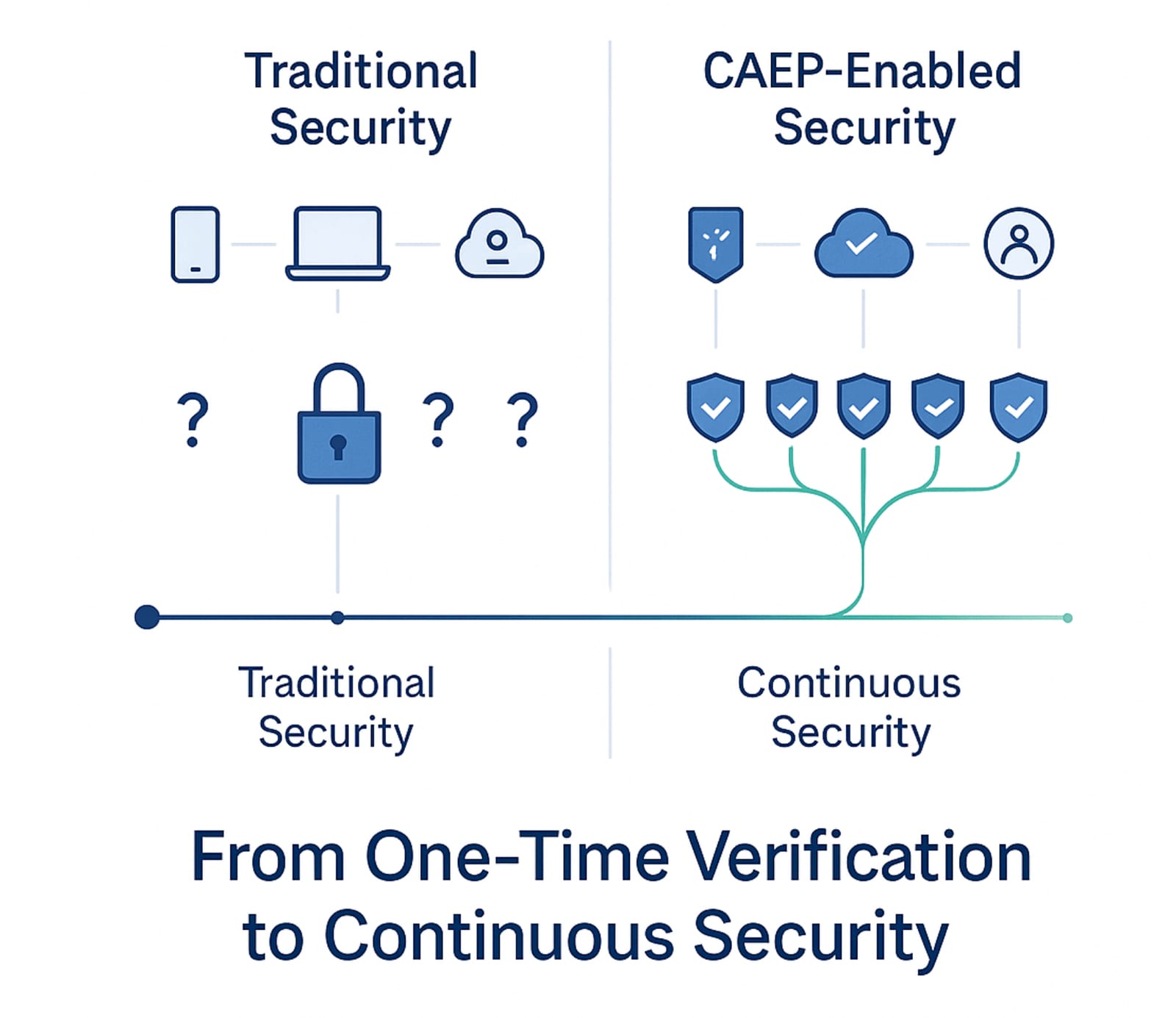
Modern security operates on a simple principle: trust, but verify. Yet most identity systems today verify trust only once, during login. What happens when that trust changes five minutes, five hours, or five days later?
This gap between initial authentication and ongoing access creates real security risks. A user logs into your system from their office in New York. Eight hours later, they're still logged in, but now someone is using their session from Moscow. Traditional systems can't detect this change until the next login cycle.
The OpenID Continuous Access Evaluation Profile (CAEP) changes this dynamic completely.
The Session Security Problem We All Face
Think about how web sessions work today. When users log into your application, they receive a token that grants access for hours or even days. During this time, critical security factors can change:
- The user moves from a trusted office network to an untrusted coffee shop
- An administrator revokes the user's permissions
- Security tools detect suspicious activity on the user's account
- The user's device falls out of compliance with company policies
Your application remains unaware of these changes. The user keeps accessing resources with stale permissions based on outdated context. This creates what security professionals call "privilege drift", the gap between what access someone should have versus what they actually have.
In identity platforms I have built, we encountered this challenge regularly. Customers wanted immediate session termination when employees left the company, but traditional federated systems couldn't communicate these changes effectively. Each application operated in isolation, unaware of security events happening elsewhere in the organization.
What CAEP Actually Does
CAEP solves this through continuous communication between security systems. Instead of checking trust once during login, CAEP enables ongoing conversations between identity providers, applications, and security services.
The protocol works like a security newsletter that everyone subscribes to. When something important happens, a user's location changes, their device becomes compromised, or an administrator revokes their access, the system broadcasts this information to all interested parties.
This isn't just theory. Microsoft has already implemented CAEP in their Entra platform. When a user violates a location-based policy, all Microsoft 365 applications receive the update and can respond immediately, not hours later.
The Technical Foundation
CAEP builds on the Shared Signals Framework (SSF), which provides the underlying messaging infrastructure. Think of SSF as the postal service and CAEP as the specific types of security letters it delivers.
The system uses Security Event Tokens (SETs) to communicate changes. These tokens are cryptographically signed JSON messages that describe what happened, when it happened, and who it affects.
The beauty lies in its simplicity. Applications don't need to poll for updates or maintain complex state. They simply listen for relevant events and respond accordingly.
Key Event Types That Matter
CAEP defines several critical event types that address real-world security scenarios:
- Session Revoked Events happen when administrators or automated systems determine a session should end immediately. This could result from detecting compromised credentials or policy violations.
- Credential Change Events notify applications when users modify their passwords, enable multi-factor authentication, or update other authentication factors. Applications can then require re-authentication for sensitive operations.
- Token Claims Change Events communicate when user attributes change, role modifications, group membership updates, or permission changes. Applications receive these updates and can adjust access controls accordingly.
- Assurance Level Change Events track when users step up or step down their authentication strength. Moving from password-only to multi-factor authentication triggers these events.
Each event type serves a specific security purpose, but together they create a comprehensive security communication system.
Real-World Business Impact
The business implications become clear when you consider typical enterprise scenarios:
An employee in your finance team logs into the ERP system Monday morning. Later that day, HR processes their termination. With traditional systems, the terminated employee could access financial data until their session expires, potentially days later.
CAEP changes this timeline from days to seconds. The HR system broadcasts a session revocation event. The ERP system receives this event and immediately terminates the user's access.
This same principle applies to device compliance. When mobile device management systems detect a compromised or non-compliant device, they can trigger immediate session termination across all applications the device accesses.
For SaaS companies, CAEP enables more sophisticated pricing models based on active usage rather than simple seat counts. Applications can track real-time user activity and adjust licensing accordingly.
Implementation Considerations
CAEP isn't a silver bullet that solves all access control problems. Implementation requires careful planning and consideration of several factors.
Event Volume Management becomes critical in large organizations. A single user action might trigger multiple events across different systems. Organizations need filtering and prioritization mechanisms to prevent event flooding.
Network Reliability affects CAEP's effectiveness. Applications must handle scenarios where events don't arrive due to network issues or system outages. Graceful degradation strategies are essential.
Privacy and Compliance considerations arise when sharing user activity data between systems. Organizations must ensure CAEP implementations comply with data protection regulations like GDPR and CCPA.
Legacy System Integration presents challenges. Not all applications can immediately support CAEP events. Organizations need bridge solutions and migration strategies for older systems.
The Interoperability Challenge
One of CAEP's most promising aspects is its focus on interoperability. The OpenID Foundation has developed an Interoperability Profile that ensures different vendor implementations work together.
This matters because enterprise environments typically include dozens of different applications from various vendors. Without interoperability, organizations end up with isolated security silos that can't communicate effectively.
The interoperability profile defines minimum requirements for CAEP implementations, including specific event types that must be supported and configuration metadata that must be provided.
Companies like Google, Microsoft, Okta, and Cisco have committed to supporting these interoperability requirements. This vendor alignment increases the likelihood of widespread adoption.
Current Adoption and Future Outlook
CAEP adoption is accelerating, but we're still in the early stages. Microsoft's implementation in Entra represents the largest production deployment to date. Other major identity providers are developing their own implementations.
The specification itself is progressing through the standardization process. The current draft (ID2) addresses feedback from early implementations and clarifies technical requirements.
Industry working groups are developing companion specifications. The Interoperability Profile for Secure Identity in the Enterprise (IPSIE) aims to align CAEP with other identity standards for comprehensive enterprise security.
Machine learning and AI will play increasingly important roles in CAEP implementations. Smart filtering systems will help organizations distinguish between normal user behavior changes and genuine security threats.
Getting Started with CAEP
Organizations interested in CAEP should start by understanding their current session management practices. Map out how long sessions last, what triggers session termination, and how quickly security changes need to propagate.
Evaluate existing identity infrastructure for CAEP readiness. Modern identity providers like Auth0, Okta, and Microsoft Entra are adding CAEP support. Applications built on these platforms can benefit from CAEP capabilities without extensive custom development.
Consider pilot implementations with high-value use cases. Session revocation for terminated employees and device compliance enforcement provide clear ROI and help build organizational confidence in the technology.
Engage with vendors about their CAEP roadmaps. Understanding implementation timelines helps with planning and budget allocation.
The Bigger Picture
CAEP represents more than just another security protocol. It embodies a fundamental shift toward continuous trust evaluation rather than point-in-time verification.
This shift aligns with zero trust security principles, where trust is never assumed and always verified. CAEP provides the communication infrastructure needed to implement zero trust effectively across complex enterprise environments.
The protocol also enables new business models and user experiences. Applications can provide smooth access while maintaining strong security through continuous context evaluation.
As remote work becomes permanent for many organizations, CAEP's ability to adapt to changing user contexts becomes even more valuable. Users work from different locations, devices, and networks throughout the day. CAEP helps security systems understand and respond to this dynamic environment.
Conclusion
CAEP addresses a fundamental gap in modern identity systems, the inability to respond quickly to changing security contexts. By enabling continuous communication between security systems, CAEP transforms static authentication into dynamic access evaluation.
The technical foundation is solid, vendor support is growing, and real-world implementations demonstrate practical value. Organizations that begin exploring CAEP now will be better positioned to take advantage of its capabilities as adoption accelerates.
Security is about managing risk in dynamic environments. CAEP gives us the tools to do this more effectively than ever before. The question isn't whether continuous access evaluation will become standard practice, it's how quickly organizations will adopt it to stay ahead of evolving security threats.
For technical teams building modern applications, understanding CAEP is becoming as important as understanding OAuth or SAML. The protocol will likely influence how we design and implement access control for years to come.
The future of identity security is continuous, contextual, and collaborative. CAEP is the standard that makes this future possible.
More like this
All Identity & CIAM- Identity & CIAMBeyond Human Access: Machine-to-Machine Authentication for Modern B2B SaaSMachines talk to machines without human intervention. But how do you ensure these automated conversations remain secure?
- Identity & CIAMSimplify User Access with Federated Identity ManagementDiscover the power of federated identity management for seamless SSO and enhanced user access. Improve security and streamline…
- Identity & CIAMSSO Deep Dive: SAML, OAuth, and SCIM in Enterprise Identity ManagementThis guide explores SAML, OAuth, and SCIM protocols central to enterprise single sign-on (SSO) systems.
Get new Identity & CIAM writing
Enjoyed this? Subscribe and tell us what you read most. Identity & CIAM is already ticked for you. No tracking pixels, unsubscribe with one click.