
Why AI Agents Are Killing Traditional Marketing Teams (And Supercharging Growth Teams Instead)
🤖 AI agents reached $5.4B market value in 2024, growing 45.8% annually. While traditional marketing teams plan quarterly campaigns, AI agents optimize in
I was in a meeting last month when our Head of Product made an observation that stopped me cold. "Your marketing team makes annual plans and runs huge campaigns," he said, "but we ship in sprints, measure everything, iterate constantly. Why can't marketing be more agile?"
His observation hit me like a lightning bolt. But then I realized something even more profound: AI agents are about to make this entire debate irrelevant.
While we've been arguing about whether marketing can be agile, AI agents have quietly started eating both traditional marketing workflows and revolutionizing what cross-functional growth teams can accomplish.
The AI Agent Reality Check
Here's what most people miss: AI agents aren't just fancy chatbots or marketing automation tools. They're autonomous software systems designed to perceive data, make decisions, and take actions without requiring constant human input.
The numbers tell the story: The AI agent market reached $5.4 billion in 2024 and is projected to grow at 45.8% annually through 2030. 84% of developers are using or planning to use AI tools in their development process, with 51% of professional developers using AI tools daily.
But here's the kicker - more than 78 percent of companies are now using gen AI in at least one business function (up from 55 percent a year earlier), yet roughly the same percentage report no material impact on earnings.
Why? Because they're still thinking in old paradigms.
Why Traditional Marketing Teams Are Getting Left Behind
Traditional marketing teams face a fundamental constraint problem, but it's not what you think. It's not about budget versus engineering hours anymore - it's about cognitive bandwidth and reaction speed.
Legacy marketing automation tools are built around rigid workflows: "If the user opens Email A, send Email B." But buyer behavior is not linear. Customers jump between channels, revisit content unpredictably, and make decisions based on dynamic inputs.
Think about your current marketing stack. You've got separate tools for email, social media, content creation, analytics, and customer service. Each tool has its own data, its own workflows, its own limitations. Your team spends half their time just managing the complexity of making these systems talk to each other.
Meanwhile, AI agents operate dynamically. They process signals as they arrive and adjust course immediately, ensuring that every action reflects the buyer's current state.
While marketing teams are still running quarterly planning sessions and monthly campaign reviews, AI agents are optimizing campaigns in real-time, personalizing content for each user, and identifying high-intent prospects the moment they show buying signals.
How AI Agents Are Transforming Product Development
Product teams have always been closer to agile principles, but AI agents are taking this to a completely new level.
Features that once took sprints can be prototyped in hours, and user feedback can be incorporated almost immediately. GitHub Copilot is evolving from an in-editor assistant to an agentic AI partner that can handle entire coding workflows asynchronously.
I've been watching this transformation firsthand. Claude Code stands out as the first truly capable AI software engineer, handling complete development projects from planning to deployment. It's not just writing code - it's debugging, testing, and deploying full applications.
But the real magic happens when AI agents start working together. Microsoft is bringing new capabilities to empower professional developers to orchestrate multiple specialized agents to handle complex tasks through their Azure AI Foundry platform.
The Cross-Functional AI Revolution
Here's where it gets really interesting. AI agents don't just make individual teams more efficient - they're fundamentally changing how cross-functional teams operate.
Cross-functional teams of animators, data scientists, and business strategists use AI insights to predict audience preferences and refine offerings. By combining creative and analytical perspectives, Disney ensures its content and experiences resonate globally.
The old model required humans to coordinate between departments, translate requirements, and manage handoffs. AI agents can now:
- Analyze user behavior data from product teams
- Generate personalized marketing content based on that analysis
- Optimize pricing models based on customer response patterns
- Coordinate with customer service to improve retention strategies
- Feed insights back to product development for feature prioritization
All automatically, with minimal human intervention.
The Real Growth Levers (AI Edition)
While building a CIAM platform, my job title said "CTO," and I made millions for shareholders – but none of my biggest wins came from marketing campaigns. We optimized onboarding flows, A/B tested customer service interactions, bundled products, tweaked pricing models.
Here's what's changed: AI agents can now run these optimization experiments continuously, across all touchpoints, simultaneously.
Take onboarding optimization. Traditional teams would:
- Identify a bottleneck (quarterly review)
- Design an experiment (2-week planning cycle)
- Build the test (engineering sprint)
- Run it for statistical significance (4-week minimum)
- Analyze results (another week)
- Implement changes (another sprint)
Total time: 2-3 months per optimization.
AI agents? They're running thousands of micro-experiments daily, adjusting copy, flow, timing, and personalization in real-time based on each user's behavior patterns.
AI agents can continuously monitor engagement signals across web visits, email clicks, content consumption, and third-party intent data. Instead of waiting for a form fill or a lead score to cross a threshold, the AI agent identifies when a lead is showing purchase intent, qualifies it, and moves it to the next stage instantly.
The Multi-Agent Growth Machine
The companies winning in 2025 aren't just using single AI agents - they're building multi-agent systems that coordinate across the entire growth funnel.
In 2026, organizations will deploy multi-agent systems to manage and optimize business processes. Agent orchestration platforms like OpenAI Agents SDK and Claude Agents will lead this trend, enabling businesses to deploy and manage multiple agents collaboratively.
Here's a real example from a B2B SaaS company I'm advising:
- Agent 1 (Prospect Intelligence): Monitors intent signals across the web, identifies companies showing buying behavior for cybersecurity solutions
- Agent 2 (Content Personalization): Creates customized landing pages, emails, and demos based on each prospect's specific use case and industry
- Agent 3 (Sales Enablement): Researches each prospect's company, identifies key decision makers, and prepares talking points for sales calls
- Agent 4 (Product Optimization): Analyzes how prospects interact with the product, identifies friction points, and suggests feature improvements
- Agent 5 (Revenue Operations): Tracks the entire customer journey, identifies which touchpoints drive conversions, and optimizes resource allocation
These agents don't just automate tasks - they coordinate with each other, share insights, and continuously optimize the entire growth system.
The Democratization Effect
Here's what gets me most excited: AI agents are democratizing capabilities that used to require entire specialized teams.
At GrackerAI, we're seeing small companies achieve what used to require massive marketing departments. A two-person startup can now run sophisticated growth experiments that would have required a team of 15 just two years ago.
24% of shoppers are comfortable letting AI tools shop for them, and this number jumps to 32% among younger shoppers (Gen Z). 37% of people actually like when AI creates content just for them.
We've moved from people tolerating automated messages to actually preferring personalized content from AI. That's not a trend - that's a fundamental shift in expectations.
The New Reality: Agile by Default
Traditional agile required discipline because resources were scarce. AI agents are making agile the natural state because they eliminate most of the coordination overhead that made traditional marketing slow.
Consider adapting the personal productivity "2-minute rule" for AI-enhanced teams: "If it takes less than 15 minutes to correctly prompt an AI agent to implement something, do it immediately rather than putting that task through the entire backlog/planning process."
Product teams are already adapting. AI agents can write unit tests for new code and help create end-to-end tests, improving quality guarantees. Development cycles that used to take weeks are now happening in days.
Marketing teams that embrace AI agents can finally match this velocity. No more waiting for quarterly reviews to optimize campaigns. No more monthly planning cycles to launch new experiments.
Making The Shift: The AI-First Growth Team
So how do you actually build this? Here's what I've learned works in 2025:
1. Start With High-Impact, Low-Risk AI Agents
Don't try to replace your entire marketing team overnight. Start with ad optimization - it typically delivers the fastest ROI for businesses and requires the least technical setup.
Pick one workflow that's currently manual and repetitive. Customer service responses, content personalization, or lead scoring are great starting points.
2. Build Multi-Agent Workflows, Not Single Tools
AI agents aren't chatbots, they're autonomous, task-driven systems trained to understand context, make decisions, and take action. The real power comes when multiple agents work together.
Start mapping your growth funnel to identify where different agents can collaborate. One agent identifies intent signals, another personalizes content, a third optimizes timing.
3. Focus on Continuous Learning, Not Campaign Planning
Traditional marketing campaigns rely on lagging metrics: you launch, wait, then review performance. Meanwhile, AI agents operate in a feedback loop: they observe how users react to campaigns, update their behavior models, and adjust strategy on the fly.
Your role shifts from planning campaigns to designing learning systems that get smarter over time.
4. Break Down the Data Silos
AI tools such as Slack, Microsoft Teams, and Zoom break down these barriers by enabling real-time collaboration, regardless of geography. The AI part of these tools can act as a single source of truth by integrating data from multiple sources to ensure everyone works with the same insights.
AI agents need access to everything - product usage data, customer service interactions, sales conversations, marketing engagement. The magic happens when they can see the complete picture.
The Competitive Advantage Window
By the end of 2025, 85% of enterprises will utilize AI agents, and those that start now will have a significant competitive advantage.
But here's the thing - most companies are still treating AI agents like fancy automation tools. They're missing the bigger picture.
The real opportunity isn't just about automating what you're already doing. It's about fundamentally reimagining how growth happens when AI agents can coordinate across every touchpoint, learn from every interaction, and optimize every decision in real-time.
"AI is beginning to move beyond solving one-off tasks. In 2026, we'll start to see AI tackle repetitive workflows, like competitor analysis or audience segmentation, that used to require entire teams."
What This Means For Your Organization
If you're a marketing leader, stop asking for more budget and start asking for AI agent development resources. The constraint isn't money anymore - it's how quickly you can deploy intelligent automation.
If you're a founder or CEO, consider building AI-first growth teams that blend human strategy with agent execution. The companies that figure this out first will have an almost unfair advantage.
If you're in product or engineering, pay attention to how AI agents can accelerate your development cycles. We're moving toward continuous creation where the limiting factor isn't coding but decision-making.
The Bottom Line
We've spent years debating whether marketing teams can be agile. Meanwhile, AI agents have made agility the default state for teams smart enough to embrace them.
The question isn't whether your marketing team can be more agile anymore. The question is whether you're ready to build AI-powered growth engines that make traditional department boundaries irrelevant.
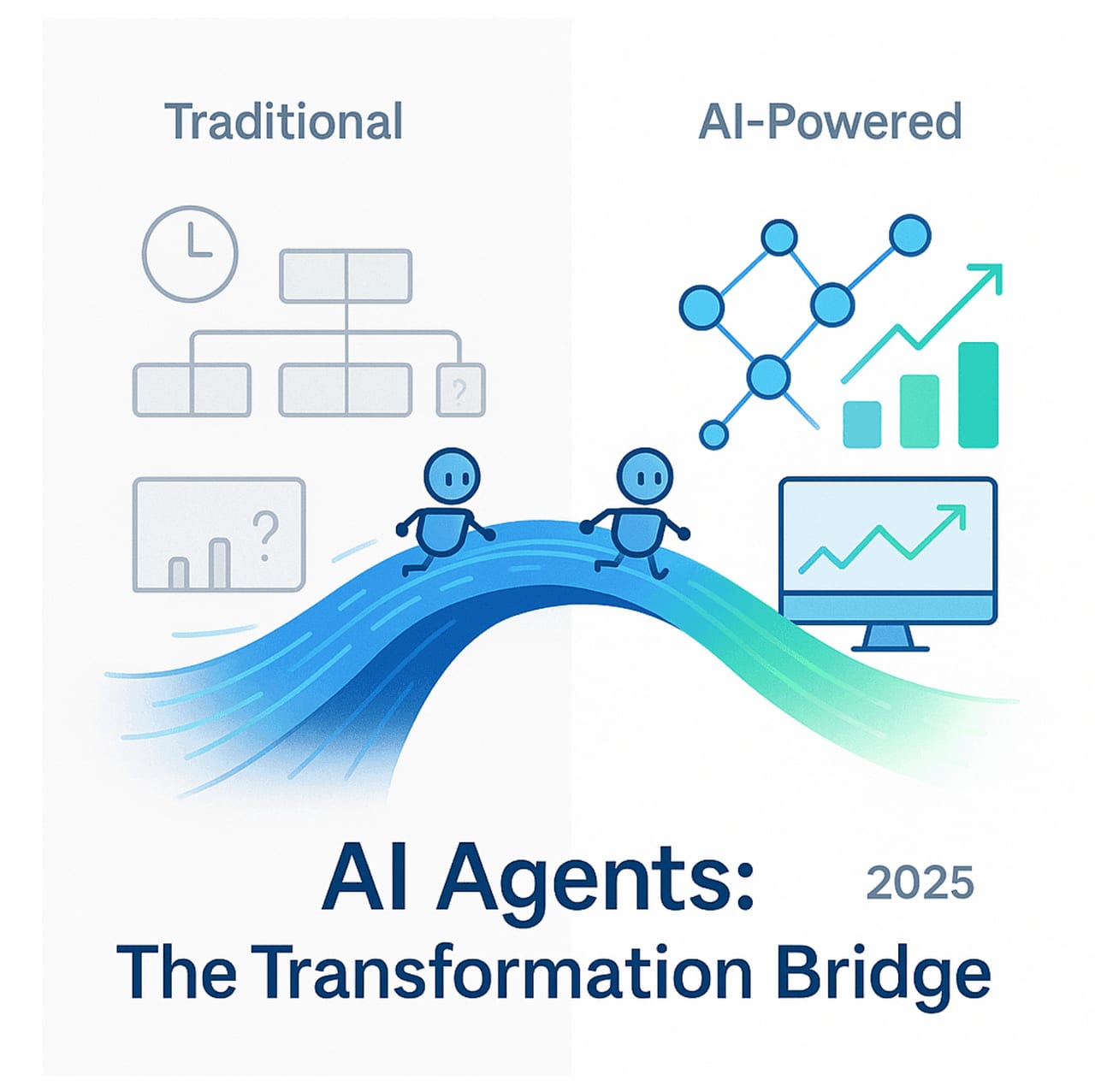
Traditional marketing teams plan campaigns. AI-powered growth teams deploy autonomous agents that continuously optimize the entire customer experience.
Which future are you building toward?
More like this
All AI Security & Agents- GEO & AI SearchProgrammatic SEO: The #1 Growth Hack That Transforms Businesses from Content Creators to Market LeadersSaaS companies are abandoning traditional content marketing for programmatic SEO, the automated growth strategy that generates 100K+…
- GEO & AI SearchWhy Gated Whitepapers Are Killing Your AI Visibility (And What Cybersecurity Marketers Should Do Instead)The cybersecurity industry's reliance on gated PDFs and MQL-driven content is actively destroying future pipeline by making the best…
- Founders & GrowthThe Early Stage Growth Trap: How Smart Startups Escape the Marketing Catch-22Early stage startups face a brutal dilemma: you need marketing expertise and budget to grow, but lack both.
Get new AI Security & Agents writing
Enjoyed this? Subscribe and tell us what you read most. AI Security & Agents is already ticked for you. No tracking pixels, unsubscribe with one click.