
What Is Grok AI? xAI's Chatbot Explained (2026 Guide)
Elon Musk's Grok AI isn't just another chatbot, it accesses real-time data from X, and uses massive computational power to challenge ChatGPT.
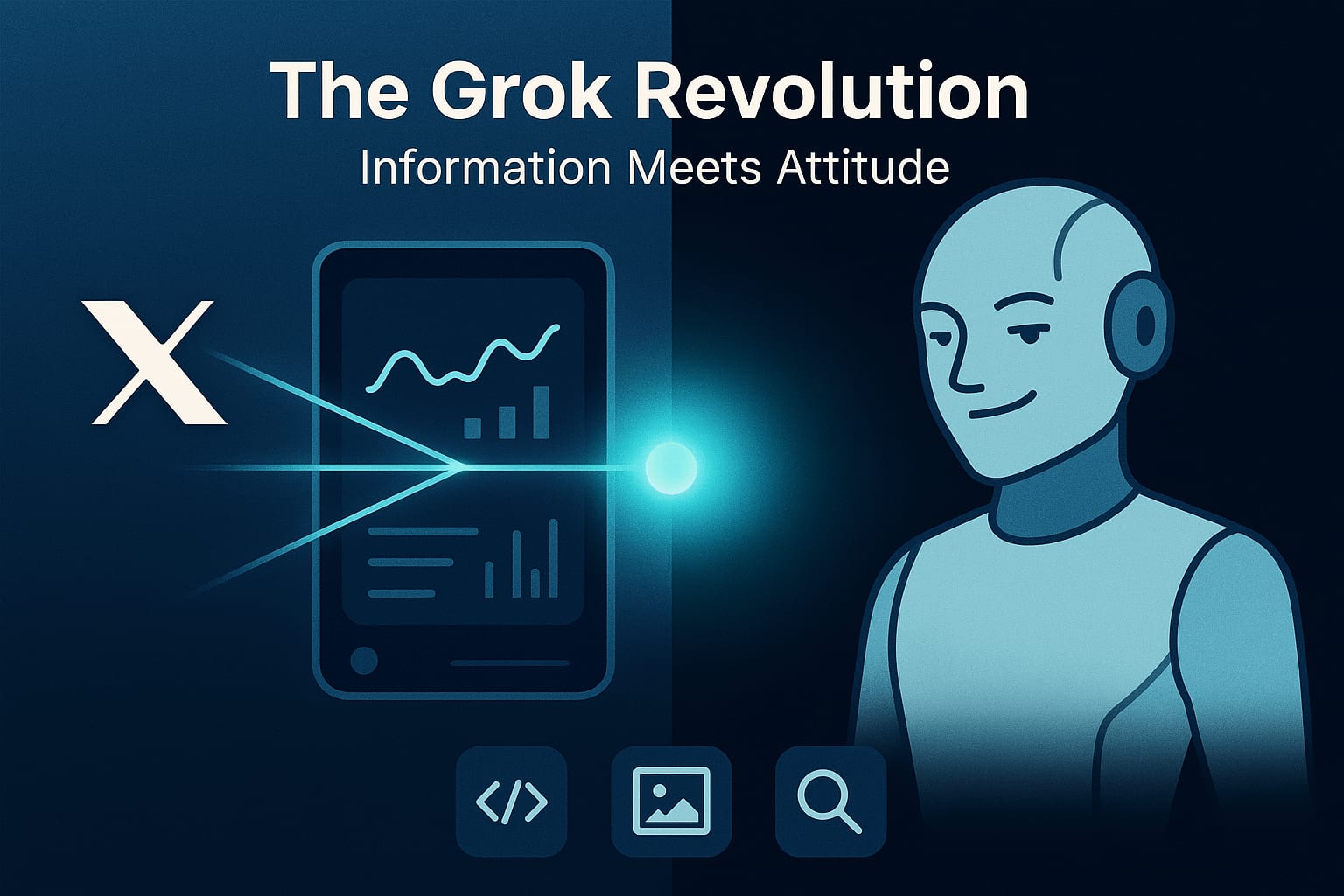
Grok AI is a conversational AI chatbot built by xAI, Elon Musk's artificial intelligence company. It pulls real-time information from X and the broader web instead of relying only on a static training cutoff, then pairs that live search with a more direct, less filtered personality than most chatbots offer. This guide explains what Grok is, how it has evolved through 2026, how it compares to ChatGPT and Gemini, and where it fits in the broader AI landscape. For a deeper breakdown of every Grok model and feature, see the Grok AI hub.
What is Grok AI?
Grok AI is an artificial intelligence chatbot created by xAI, Elon Musk's AI company. Think of it as Musk's answer to ChatGPT, but with some key differences that make it stand out in the increasingly crowded AI assistant market.
The name "Grok" comes from Robert Heinlein's 1961 science fiction novel "Stranger in a Strange Land," where it means to understand something so deeply that it becomes part of you. This name wasn't chosen randomly – it reflects xAI's vision for their AI to develop a profound understanding of human communication and behavior, not just process data.
What Makes Grok Special?
Real-Time Information Access
Unlike most AI chatbots that have knowledge cutoff dates, Grok has direct access to X (formerly Twitter). This means it can provide you with up-to-date information about current events, trending topics, and breaking news. When you ask Grok about something happening right now, it can actually check X to find the latest information rather than saying "I don't have information after my training cutoff date."
Grok also has a feature called "DeepSearch" that extends its search capabilities beyond X to the broader internet, allowing it to give you more comprehensive answers.
A Personality with Attitude
Most AI assistants are designed to be neutral and professional. Grok, however, has been intentionally designed with humor and what Musk calls a "rebellious attitude." It can be sarcastic and isn't afraid to tackle edgy or provocative questions.
Grok offers two interaction modes:
- Regular Mode: For straightforward, factual answers
- Fun Mode: Described by Musk as "unhinged fun mode," which brings out Grok's personality and humor
This personality-driven approach aims to make interactions more engaging and human-like, though it has also raised concerns about the potential for generating inappropriate content.
Visual and Coding Capabilities
Grok can generate images through its Aurora model, turning your text descriptions into visual content. It can also help developers by generating and debugging code, with its capabilities improving significantly with each new model, most recently Grok 4.6.
The Technology Behind Grok
The Evolution: Grok-1 to Grok 4.6
Grok has evolved rapidly since its introduction:
Grok-1 (2023):
- Open-source language model with 314 billion parameters
- Uses a "Mixture of Experts" architecture that combines multiple specialized models
- Released to the public under Apache 2.0 license, allowing researchers and developers to study and build upon it
Grok-2 (August 2024):
- Enhanced performance, processing speed, and multilingual capabilities
- Better at following instructions
Grok-3 (Early 2025):
- Powered by hundreds of thousands of Nvidia H100 GPUs
- Expanded context window of 128,000 tokens (allowing it to process and remember more information)
- Trained on 12.8 trillion tokens
- Features advanced reasoning capabilities through special modes:
- "Think Mode" for complex problem-solving
- "Big Brain Mode" for particularly demanding tasks
Grok 4 and Grok 4.5 (2025 to mid-2026):
- Grok 4 arrived in 2025 with stronger reasoning and expanded multimodal support beyond Grok 3
- Grok 4.5 followed on July 8, 2026, forming the architecture that Grok 4.6 builds on
Grok 4.6 (August 12, 2026):
- xAI's current flagship model as of this writing
- Supports a 500,000-token context window, nearly four times Grok 3's 128,000 tokens
- Accepts both text and image input
- Available through xAI's API at $2 per million input tokens and $6 per million output tokens for prompts under 200,000 tokens, with higher rates above that threshold
Computational Power
Grok is built on substantial computational infrastructure, including the "Colossus" supercomputer in Memphis, Tennessee. For Grok 3's training alone, xAI used 100,000 high-performance Nvidia GPUs, resulting in 200 million GPU hours of computation.
This massive investment in hardware reflects xAI's commitment to competing at the highest level in the AI space and pursuing artificial general intelligence (AGI).
How People Are Using Grok
Personal Assistant and Productivity
Like other AI assistants, Grok can help with daily tasks such as:
- Drafting emails and messages
- Summarizing long documents
- Creating to-do lists and reminders
- Planning travel itineraries
- Generating creative ideas
Its real-time information access gives it an edge when you need the latest information for your tasks.
Content Creation and Marketing
For content creators and marketers, Grok offers:
- Help with brainstorming ideas
- Generation of social media content
- Creation of blog posts and articles
- Image generation for visual content
- SEO optimization suggestions
- Creation of engaging social media captions
Business Applications
Businesses can leverage Grok for:
- Automating responses to common customer questions
- Analyzing large datasets to identify trends
- Integrating with CRM and ERP systems
- Generating real-time market analyses
- Creating research reports
Education and Research
Students and researchers benefit from Grok's:
- Ability to explain complex concepts in multiple ways
- Deep search capabilities for summarizing large volumes of information
- Advanced reasoning to help solve complex problems
- Up-to-date information on evolving fields
How Grok Compares to Other AI Assistants
Grok vs. ChatGPT
| Feature | Grok AI | ChatGPT |
|---|---|---|
| Real-time Data | Yes, through X integration | Limited (only in paid versions) |
| Personality | Humorous, rebellious, sometimes sarcastic | Generally neutral and professional |
| Open Source | Grok-1 is open source | No |
| Technical Reasoning | Strong in math and coding | Strong in general problem-solving |
| Pricing | Paid tiers available (X Premium+, SuperGrok) | Free version available, Plus ($20/month) |
While ChatGPT is generally considered more mature with wider accessibility, Grok's real-time information access and distinctive personality create a unique experience.
Grok vs. Google Gemini
| Feature | Grok AI | Google Gemini |
|---|---|---|
| Real-time Data | Via X and DeepSearch | Via Google Search |
| Multimodal Capabilities | Text, images, code | Text, images, code, audio, video |
| Integration | Primarily with X | Across Google's ecosystem |
| Specialized Features | Think Mode, Big Brain Mode | Flash Thinking, Google Workspace integration |
Gemini benefits from Google's extensive search capabilities and broader ecosystem integration, but Grok has shown strong performance in technical reasoning tasks. For a deeper, feature-by-feature breakdown against GPT-4, Claude, and other leading LLMs, see this comprehensive comparison.
Concerns and Limitations
Bias and Misinformation
Because Grok pulls real-time information from X, it can sometimes spread misinformation or conspiracy theories that are circulating on the platform. This reliance on social media data without robust fact-checking mechanisms raises concerns about the accuracy of information Grok provides.
Privacy and Data Security
Grok collects various types of user data, including:
- Personal information (if provided)
- Conversation logs
- User behavior patterns
- Social interactions from X
The Irish Data Protection Commission has launched an investigation into how X uses European users' personal data to train Grok, highlighting regulatory concerns about data privacy.
Ethical Boundaries
Grok's "no filters" approach has sparked controversy. While it aims to provide more engaging and direct communication, it can potentially generate inappropriate or offensive content. Past versions of Grok have demonstrated the ability to generate explicit content, raising questions about safety guardrails and responsible AI development that carry into each new release.
Technical Limitations
Despite its advanced capabilities, Grok still faces challenges:
- Occasional inaccuracies, especially with rapidly changing information
- Earlier versions had weaker reasoning capabilities compared to competitors
- Inconsistent quality in image generation
- Difficulty verifying the reliability of information pulled from X
Where Grok Stands in 2026
As of August 2026, Grok 4.6 is xAI's current flagship model, released August 12, 2026 on top of the Grok 4.5 architecture from earlier that summer. The jump from Grok 3 to Grok 4.6 shows how fast the product has moved: the context window nearly quadrupled to 500,000 tokens, and the model now takes image input alongside text.
xAI has kept up a rapid release cadence since its $6 billion Series C funding round in December 2024, using that capital to expand the Colossus supercomputer and ship new model versions every few months. Expect that pace to continue, with further reasoning, multimodal, and integration improvements layered onto the Grok 4.x line.
Quick comparison: Grok 4.6 vs ChatGPT vs Claude
| Feature | Grok 4.6 | GPT-4o | Claude 3.7 |
|---|---|---|---|
| Real-time web data | Yes (X/Twitter) | Yes (Bing) | Limited |
| Image generation | Aurora (native) | DALL-E 3 | No |
| Deep research mode | DeepSearch | Deep Research | Extended thinking |
| Context window | 500K | 128K | 200K |
| Free tier | Yes | Yes | Yes |
The Bottom Line
Grok AI represents a distinctive approach to AI assistants, emphasizing real-time information access, personality, and technical reasoning capabilities. Its integration with X and unique design philosophy set it apart in an increasingly crowded field, one piece of the broader story of how AI is reshaping humanity's future.
While it offers exciting capabilities and potential applications across various domains, users should be aware of concerns regarding data privacy, content moderation, and information accuracy. As xAI continues to develop and refine Grok, addressing these concerns will be crucial for its long-term success and responsible deployment.
Whether Grok will ultimately achieve xAI's ambitious goal of moving toward artificial general intelligence remains to be seen, but its rapid development and significant investment suggest that it will remain a noteworthy player in the AI assistant space for the foreseeable future.
More like this
All AI Security & Agents- AI Security & AgentsThe Comprehensive Guide to Understanding Grok AI: Architecture, Applications, and ImplicationsHow Grok 4.6 actually works: xAI's server infrastructure, 500K-token context window, real-time X data pipeline, and privacy architecture…
- AI Security & AgentsClaude Code and the Future of Programming: A Paradigm Shift in How We Build SoftwareAfter analyzing months of developer experiences with AI Coding, one thing is clear: we're witnessing a fundamental shift in programming.
- AI Security & AgentsThe Evolution of Software Development: From Machine Code to AI OrchestrationMajor tech companies now generate 30% of code with AI. Explore the dramatic shift from manual coding to AI orchestration, and why the…
Get new AI Security & Agents writing
Enjoyed this? Subscribe and tell us what you read most. AI Security & Agents is already ticked for you. No tracking pixels, unsubscribe with one click.