
OpenAI Just Changed Everything: Why GPT OSS Could Be the Most Important AI Release You've Never Heard Of
OpenAI just released GPT OSS - their first open-source AI models since 2019. These aren't just free downloads; they're transparent, powerful systems that
Remember when OpenAI used to share their AI models with everyone? That was back in 2019, when they released GPT-2 and the whole tech community could download it, tinker with it, and build amazing things. Then something changed. OpenAI went quiet on the open source front, keeping their best models locked behind paywalls and APIs.
Well, they're back, and this time, they brought something special.
What Exactly Did OpenAI Just Release?
Today OpenAI dropped two new AI models called GPT OSS. Think of these as the "open recipe" versions of their smart AI systems. Anyone can download them, run them on their own computers, and even peek inside to see exactly how they think.
The two models are gpt-oss-120b and gpt-oss-20b. Those numbers? They roughly tell you how "smart" each model is, 120 billion parameters for the big one, 21 billion for the smaller one. But here's where it gets interesting: despite having 120 billion parameters, the larger model only uses about 5 billion at a time. It's like having a massive toolkit but only picking the exact tools you need for each job.
This matters because these models can actually run on regular business hardware, not just the massive server farms that usually power AI. The smaller model? It'll run on a good gaming computer.
Breaking Down the Technical Magic
GPT OSS does with something called Mixture-of-Experts architecture. Traditional AI models are like turning on every light in a house to read one book. GPT OSS is like having smart switches that only turn on the lights in the room you're using.
This approach brings two huge benefits. First, it runs much faster because it's not wasting energy on unused parts. Second, it needs way less computer memory to operate. The 120-billion parameter model runs on a single high-end GPU that costs around $30,000, expensive for you and me, but affordable for most businesses.
But there's another trick up GPT OSS's sleeve: something called "configurable reasoning effort." Think of it like asking someone to solve a problem, but you can choose whether you want a quick answer or a really thorough explanation.
Set it to "low effort" and the model gives you fast, straightforward responses. Crank it up to "high effort" and it shows you its complete thought process, every step, every consideration, every decision point. It's like having a tutor who can either give you the answer quickly or walk you through the entire problem-solving process.
Why This Transparency Thing Is Actually Revolutionary
Most AI systems are black boxes. You ask a question, get an answer, but have no idea how the AI arrived at that conclusion. GPT OSS changes this completely.
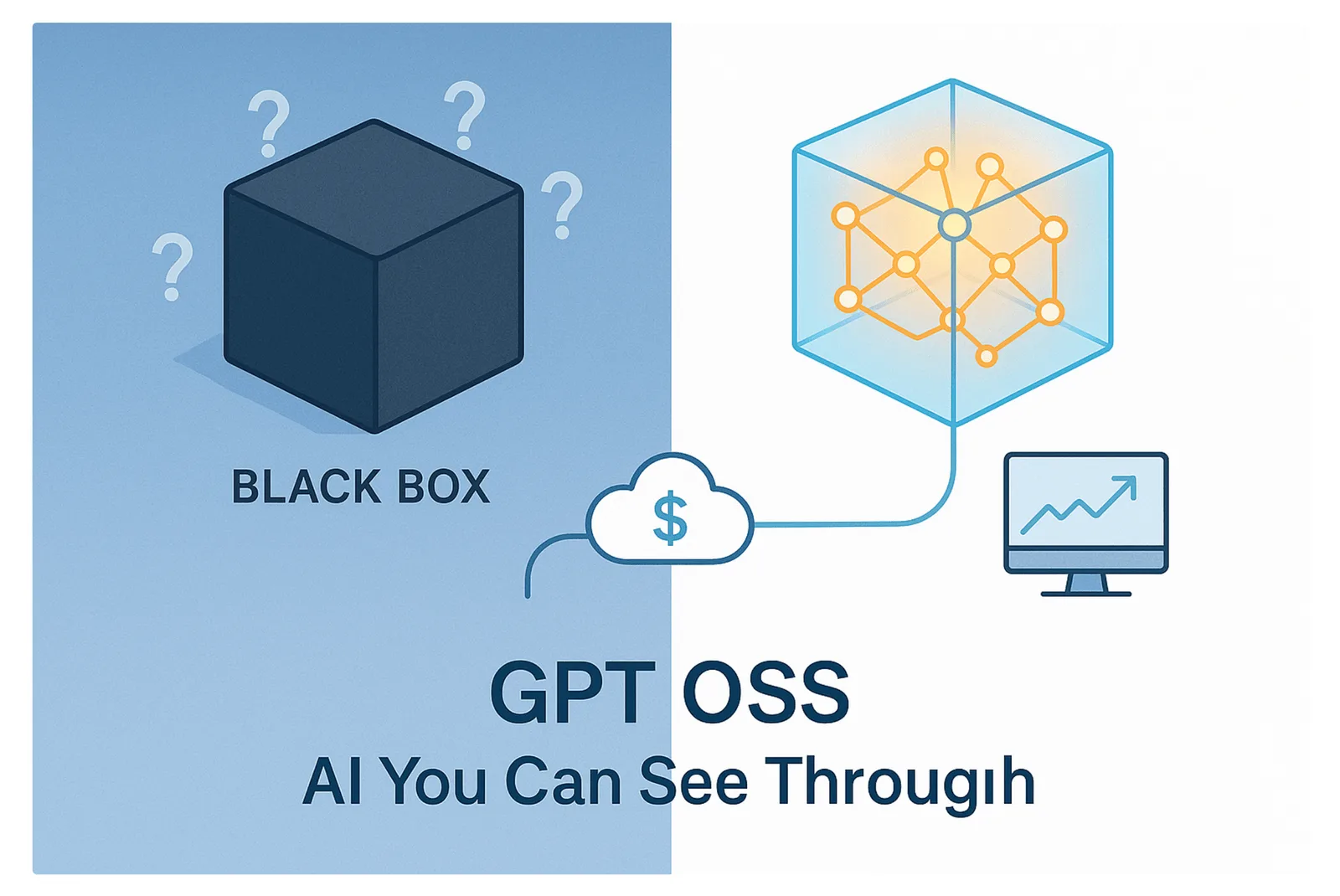
When you use these models, you can actually watch them think. They show you their reasoning process in real-time. If the AI is solving a math problem, you see each step. If it's writing code, you see how it approaches the problem and builds the solution.
This transparency isn't just cool, it's practical. Imagine you're a doctor using AI to help diagnose patients, or a financial advisor using AI to recommend investments. Wouldn't you want to understand exactly how the AI reached its conclusions?
The Timing Isn't Coincidental
OpenAI didn't release these models just because they felt generous. There's some serious competition heating up, and most of it is coming from China.
Companies like DeepSeek, Alibaba's Qwen team, and others have been releasing incredibly capable open-source AI models. DeepSeek's recent model reportedly achieved GPT-4-level performance while costing just $6 million to train, compared to OpenAI's estimated $100+ million investment in GPT-4.
Sam Altman, OpenAI's CEO, recently admitted they had been "on the wrong side of history" when it came to open-source AI. This release feels like their attempt to get back in the game.
The political context matters too. The current U.S. administration has been encouraging American AI companies to open-source more technology, partly as a response to China's growing influence in AI development. GPT OSS positions OpenAI as the American alternative to Chinese open-source dominance.
What Makes GPT OSS Different From Everything Else Out There
Most open-source AI models come with strings attached. Meta's Llama models, for example, restrict usage for companies with more than 700 million monthly users. It's like buying a car but being told you can't drive it on certain roads.
GPT OSS uses the Apache 2.0 license, basically the "do whatever you want" license of the software world. Want to modify it? Go ahead. Want to use it commercially? No problem. Want to integrate it into your product? Have at it.
The models also include built-in capabilities that usually require separate tools. They can browse the web, run Python code, and generate structured outputs. It's like getting a Swiss Army knife instead of individual tools.
The Safety Question Everyone's Asking
Releasing powerful AI models openly always raises safety concerns. What if someone uses them for harmful purposes?
OpenAI took this seriously. They put GPT OSS through extensive testing with three independent expert groups. They even tried to train malicious versions of the models to see if bad actors could weaponize them. According to their testing, even when specifically trained for harmful purposes, the models couldn't reach dangerous capability levels.
The transparency feature actually helps with safety too. Since you can see exactly how the model thinks, it's easier to spot potential problems before they become actual issues.
OpenAI also launched a $500,000 challenge, asking security researchers to find ways to misuse the models. This kind of crowdsourced testing often reveals issues that internal teams miss.
What This Means for Regular People and Businesses
For individual developers and small companies, GPT OSS democratizes access to advanced AI. You no longer need a massive budget to experiment with frontier AI capabilities. A startup can download these models, run them locally, and build sophisticated AI features without ongoing API costs.
For larger organizations, the implications are even bigger. They can fine-tune the models for specific use cases, ensure complete data privacy by running everything internally, and have full control over their AI infrastructure.
Educational institutions can use these models for research without worrying about usage limits or costs. Scientists can integrate advanced AI reasoning into their research workflows. The possibilities multiply when you remove the barriers.
The Bigger Picture: What This Says About AI's Future
GPT OSS represents more than just new models, it signals a fundamental shift in how AI development might work going forward.
For years, the narrative has been that only a few big companies with enormous resources could develop truly advanced AI. GPT OSS challenges this assumption. It suggests that open development might be not just viable, but potentially superior for many applications.
This doesn't mean proprietary AI development will disappear. OpenAI still keeps their most advanced models (like GPT-4o and o1) behind closed doors. But it does mean the gap between open and closed AI systems is narrowing rapidly. See our OpenAI model reference for current specs and pricing across the full closed and open lineup.
Some Limitations Worth Mentioning
GPT OSS isn't perfect. The models, while impressive, don't quite match OpenAI's very best proprietary systems. They're more like the "pretty great" versions rather than the "absolutely cutting-edge" ones.
Running these models still requires decent hardware. While the smaller model can run on consumer hardware, you'll need a computer with significant memory and processing power. It's not quite "runs on your phone" level yet.
The models also inherit some of the usual AI limitations: they can sometimes generate incorrect information, they have knowledge cutoffs, and they can exhibit biases present in their training data.
Looking Forward: What Happens Next?
The release of GPT OSS sets up an interesting dynamic. Will other major AI companies follow suit with their own open releases? Will the open-source community build on these models to create even more capable systems?
One thing seems certain: the balance between open and closed AI development is shifting. Companies that rely entirely on keeping their AI locked up might find themselves at a disadvantage as open alternatives become increasingly capable.
For OpenAI, this represents a return to their original mission of ensuring AI benefits everyone. Whether they can maintain this balance between open collaboration and business sustainability remains to be seen.
But for now, GPT OSS gives us a glimpse into a future where advanced AI isn't controlled by just a few companies, where anyone with good ideas and decent hardware can build sophisticated AI applications.
That's a future worth paying attention to.
The GPT OSS models are available for download through major platforms like Hugging Face, with comprehensive documentation and examples to help developers get started. For most people, the real impact will come through applications and services built on these models rather than direct usage, but knowing these open alternatives exist helps ensure AI development remains diverse and competitive.
More like this
All AI Security & Agents- AI Security & AgentsOpenAI vs. DeepSeek: Navigating the AI Trust Paradox in an Era of Geopolitical TensionsAs geopolitical tensions reshape AI adoption, enterprises struggle to balance OpenAI's compliance frameworks against DeepSeek's cost…
- AI Security & AgentsDeepSeek: Revolutionizing AI with Efficiency, Innovation, and AffordabilityDeepSeek redefines AI with cutting-edge innovations: MoE architecture activates only 37B parameters/token, FP8 training slashes costs,…
- AI Security & AgentsAnthropic Finally Answered the Open Weights Letter. A Chinese Lab Answered It Louder.Amodei says Anthropic never wanted a ban. His real objection is irreversibility. Days earlier, a Chinese lab shipped 2.8 trillion open…
Get new AI Security & Agents writing
Enjoyed this? Subscribe and tell us what you read most. AI Security & Agents is already ticked for you. No tracking pixels, unsubscribe with one click.