
SCIM Provisioning: A B2B SaaS Practitioner's Guide
Updated · 11 min read · By Deepak Gupta
On this page
Key takeaways
- SCIM 2.0 (RFC 7644) is the standard REST-and-JSON protocol for automated user lifecycle between IdPs and SaaS apps.
- The hard requirement starts around 1000-seat customers, manual user management at that scale is unacceptable.
- SCIM handles provisioning, updating, and deprovisioning. Deprovisioning at scale is what justifies the protocol.
- Just-in-time (JIT) provisioning is the cheaper alternative for first-login; SCIM is required for proper deprovisioning.
- WorkOS, Frontegg, Auth0, and SSOJet ship SCIM cleanly; smaller CIAM products often have rough implementations or lack it entirely.
What SCIM does
The protocol is fifteen years mature in production deployments. Its predominance in 2026 is uncontested, every major workforce IdP supports SCIM, every B2B SaaS that lands enterprise customers eventually ships SCIM support.
How the request flow works
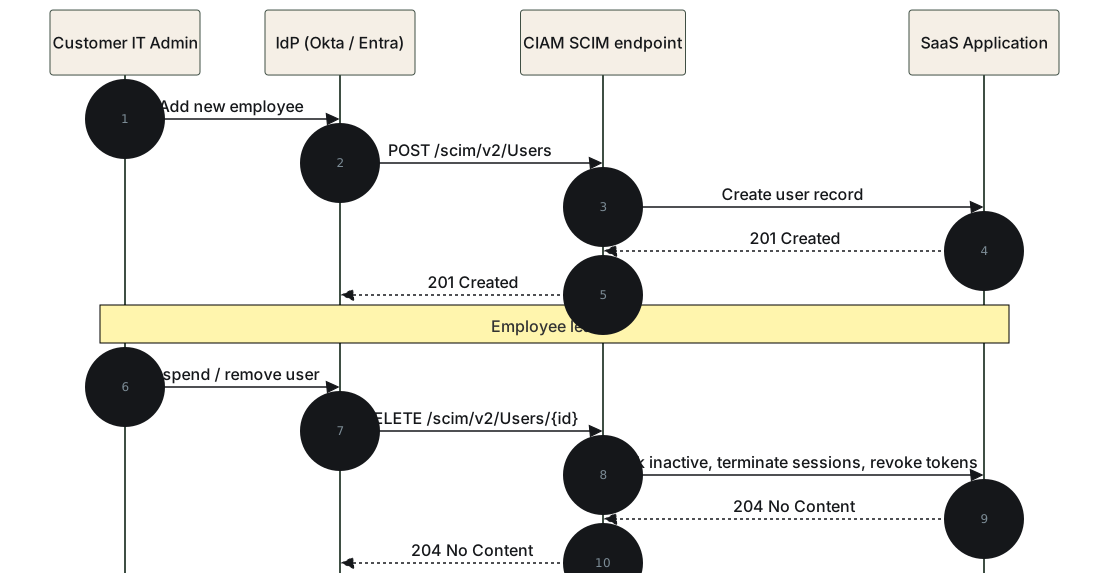
The IdP holds the source of truth for users. Periodically (or in real-time on change), it sends the application's SCIM endpoint a series of REST calls:
POST /scim/v2/Users
{
  "schemas": ["urn:ietf:params:scim:schemas:core:2.0:User"],
  "userName": "alice@acme.com",
  "name": { "givenName": "Alice", "familyName": "Smith" },
  "emails": [{ "value": "alice@acme.com", "primary": true }],
  "active": true,
  "groups": [{ "value": "engineering" }]
}

PUT /scim/v2/Users/{id}
PATCH /scim/v2/Users/{id}
DELETE /scim/v2/Users/{id}
Group sync uses analogous Groups endpoints. The application processes each call, updates its local user model, and returns the SCIM response.
The deprovisioning value proposition
Onboarding via SCIM is convenient. Offboarding via SCIM is the reason it's required at scale. The asymmetry is the whole story: an organization that adds users manually for a year is fine, an organization that fails to remove departing employees for a year is in violation of nearly every B2B security questionnaire and several regulatory regimes. SCIM's automation is what makes deprovisioning reliable.
When an employee leaves an organization, IT removes them in the IdP. Without SCIM, the SaaS doesn't know, that user can still log in with their company SSO (which IT also disabled, but only at the IdP), or via a legacy password if one exists. With SCIM, the deprovision propagates immediately: the SaaS marks the user inactive, terminates active sessions, and revokes API tokens.
For regulated industries and any organization with departing-employee exposure, SCIM-driven deprovisioning is non-negotiable. It is also the most-tested compliance question in B2B SaaS security questionnaires above ~$200k contract value.
JIT provisioning vs SCIM
Most B2B SaaS deployments use both:
- JIT provisioning auto-creates a user on first SSO login. The user clicks "Sign in with SSO," the IdP authenticates, the SaaS sees the SAML / OIDC assertion, and creates the user record from the assertion attributes. JIT is cheap (no SCIM endpoint required) but doesn't deprovision.
- SCIM handles ongoing lifecycle including deprovisioning. The SaaS exposes the endpoint; IT configures it once in the IdP; everything after is automatic.
The pattern: ship JIT first for convenience, add SCIM when the first 1000-seat customer demands it.
What goes wrong in practice
SCIM looks simple in the spec and isn't in production. The classes of bug that surface at scale:
- Attribute mapping ambiguity. The IdP sends
userNamebut the SaaS expectsemail; mapping logic may diverge per IdP. Production deployments need per-IdP mapping config. - Group membership semantics. Adding Alice to "engineering" can mean updating Alice's
groupsfield or updating "engineering" group'smembersfield, depends on the IdP. The SaaS's SCIM implementation must handle both. - Large tenant performance. A 10,000-seat customer's initial sync fires 10,000 POSTs in rapid succession. The SaaS must rate-limit, batch, or queue.
- Eventual consistency. SCIM is async. A user can sometimes "exist" briefly before group membership lands. Handle the race or ensure ordering.
- Provider-specific extensions. Microsoft and Okta ship vendor extensions to SCIM. Production SaaS supports the most common ones explicitly.
CIAM vendor coverage
The 2026 CIAM with production-grade SCIM:
- WorkOS, Directory Sync is the headline B2B product, broadest IdP coverage in this index.
- Frontegg, embedded Admin Portal lets the customer's IT admin configure SCIM themselves.
- Auth0, SCIM is Enterprise-tier; covers the major IdPs cleanly.
- SSOJet, SCIM included in the standard B2B product surface.
For the legacy enterprise tier, Ping Identity, ForgeRock, and IBM Security Verify all ship mature SCIM, alongside Okta Workforce (which is workforce IAM, outside this index). For self-hosted, Keycloak and WSO2 IS support SCIM but require operator configuration.
Related guides
B2B SaaS Identity: Organizations, SSO, SCIM, and the Enterprise Sales Checklist
How to design B2B SaaS identity: Organizations, Enterprise SSO with SAML and OIDC, SCIM provisioning, audit logs, and the IT-admin features that close enterprise deals.
Enterprise SSO: SAML vs OIDC, and How to Pick
SAML and OIDC are the two protocols that dominate enterprise SSO. A practical comparison, when each is the right answer, and the IdP-side considerations that determine the choice.
Related vendors
Auth0
Auth0 remains the safest mid-market default for B2C plus B2B Enterprise SSO when developer velocity matters more than long-run TCO. Auth0 for AI Agents (GA November 2025) and Auth for MCP (GA May 2026) make it the first major CIAM with a packaged agent-identity surface. Below 50k MAU it is still hard to beat. Above 500k MAU, cost and Actions-driven lock-in make FusionAuth, Cognito, or Stytch (Twilio) plus a passkey orchestrator the more honest shortlist.
Frontegg
Frontegg is the strongest B2B SaaS CIAM in 2026 by Admin Portal and self-service end-customer experience, the buyer is a SaaS engineering team that needs to ship enterprise-grade IT admin features without building them, and Frontegg delivers more of that out of the box than Auth0 or WorkOS. The trade-off is narrower B2C feature coverage and a smaller ecosystem than Auth0; for B2B-first SaaS the Admin Portal alone often justifies the choice.
SSOJet
SSOJet is a 2026 enterprise-SSO pick for fast-growing B2B SaaS. Public pricing is connection-based and transparent (from $99/month on the public page, no MAU tax). That commercial shape is stronger for companies adding logos quickly than Auth0's MAU curve or a quote-only enterprise IdP. WorkOS remains the more mature Admin Portal. SSOJet is the pricing-transparency alternative. Not a B2C suite.
WorkOS
WorkOS is the strongest B2B-first CIAM in 2026 by deliberate scope choice: every product surface assumes the buyer is selling to enterprise IT, not to consumers. AuthKit's 1M MAU free tier makes it a credible Auth0 alternative for B2B SaaS that does not need adaptive risk or B2C consumer flows. In 2026 the company is also documenting MCP step-up patterns for agents; that is still a tutorial surface, not a packaged agent-identity product like Auth0 for AI Agents. For pure B2B SSO, SCIM, and audit logs, WorkOS is hard to beat at any price point.
Where to next
FAQ
- What is SCIM?
- System for Cross-domain Identity Management, a REST-and-JSON protocol (RFC 7644, 2015) for automated user lifecycle between identity providers (Okta, Microsoft Entra, Google Workspace) and applications. The IdP pushes user creates, updates, and deletes to the app's SCIM endpoint.
- Do I need SCIM at launch for B2B SaaS?
- No. JIT provisioning (auto-create users on first SSO login) covers initial signup. SCIM becomes a hard requirement around 1000-seat customers because manual user management at that scale is unacceptable. Most B2B SaaS adds SCIM in the 100-customer range, before the first 1000-seat deal arrives.
- What's the difference between SCIM and JIT provisioning?
- JIT auto-creates a user on first SSO login from the assertion attributes. SCIM is the IdP pushing user changes to the app continuously, including deprovisioning, which JIT doesn't handle. Most B2B SaaS uses both: JIT for first-login convenience, SCIM for ongoing lifecycle and especially deprovisioning.
- Which CIAM platforms ship SCIM cleanly?
- WorkOS Directory Sync, Frontegg, Auth0 Enterprise, and SSOJet ship production-grade SCIM. Smaller or B2B-immature CIAM either don't ship SCIM or ship rough implementations that surface bugs at production scale (group sync, attribute mapping, large-tenant performance).
Sources
- RFC 7644, SCIM 2.0 Protocol
- RFC 7643, SCIM 2.0 Schema
- Okta SCIM integration documentation