
OAuth 2.1 Explained: What Changed and Why It Matters
Updated · 11 min read · By Deepak Gupta
On this page
Key takeaways
- OAuth 2.1 is a consolidation of OAuth 2.0 plus security best-practice RFCs into a single coherent specification.
- PKCE is now mandatory for all clients (public and confidential), not just public clients.
- The Implicit grant and Resource Owner Password Credentials grant are deprecated and removed.
- Refresh tokens must be either sender-constrained or single-use rotating; bearer refresh tokens without rotation are deprecated.
- Most modern CIAM and OAuth 2.0 deployments are already OAuth 2.1-compliant by default; the migration is mostly the deprecations.
What changed
The motivation for OAuth 2.1 was that the 2012 OAuth 2.0 spec had accumulated enough best-practice modifications via separate RFCs that practitioners couldn't be sure what "OAuth 2.0" actually meant in 2024. OAuth 2.1 is the answer: one document, current best practice, deprecated patterns explicitly removed.
What's deprecated
Implicit flow
The Implicit grant returned the access token directly to the browser in the URL fragment. It was designed for public clients (SPAs) before PKCE existed. PKCE plus the Authorization Code flow now handle the same client model without the URL-fragment leak surface.
What to do: SPAs that still use Implicit should migrate to Authorization Code with PKCE. Most modern OAuth libraries default to PKCE; the migration is mostly configuration.
Resource Owner Password Credentials (ROPC) grant
ROPC let the client collect the user's password and POST it to the token endpoint. It was designed for legacy migration scenarios and trusted first-party clients. In practice, ROPC was misused by clients that should never have seen the password and undermined the entire phishing-resistance story of OAuth.
What to do: ROPC clients need to migrate to Authorization Code (browser-redirect flow) or Device Authorization (for input-constrained devices like CLIs). For legacy database migrations, most CIAM ship import tools that don't require ROPC.
Bearer refresh tokens without rotation
OAuth 2.0 allowed long-lived refresh tokens that the client could replay forever. If a refresh token leaked, the attacker had access until manual revocation.
OAuth 2.1 requires refresh tokens to be either sender-constrained (DPoP or mTLS) or single-use rotating (each refresh issues a new refresh token, the old one is revoked).
What to do: enable refresh token rotation in your CIAM. Every modern CIAM supports it; many had it default-on already.
What's now required
PKCE for all clients
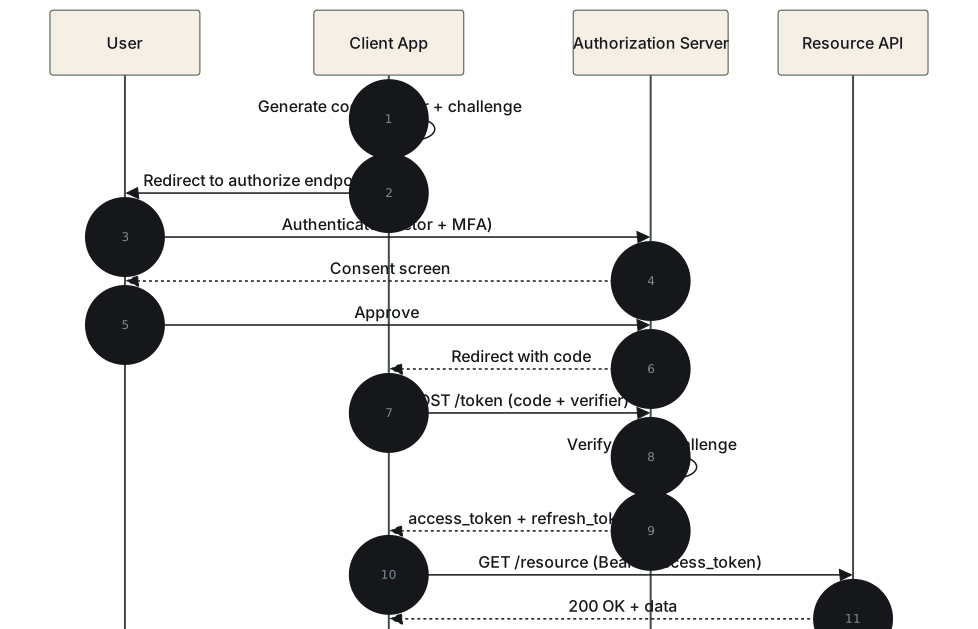
PKCE was originally designed for public clients (no client secret, can't be trusted to keep secrets). OAuth Security BCP recommended PKCE for confidential clients too because confidential client secrets are often less protected than the design assumes. OAuth 2.1 makes PKCE universal.
The code change is small: every authorization request includes a code_challenge, every token exchange includes the matching code_verifier. Most CIAM SDKs handle this automatically.
Redirect URI exact-match
OAuth 2.0 allowed redirect URI matching by prefix or other patterns. This caused real vulnerabilities where attackers exploited redirect URI parsing differences.
OAuth 2.1 requires exact-match comparison. Pre-register every redirect URI; no wildcards, no prefix matches.
No bearer tokens in URLs
Bearer tokens in URL query parameters leak via browser history, server logs, referrer headers, and bookmarks. OAuth 2.1 forbids this, bearer tokens must travel in the Authorization header (preferred) or POST body, never in URLs.
Pushed Authorization Requests (PAR) recommended
PAR moves the authorization request from URL parameters to a backend POST, returning a one-time request_uri the client uses in the redirect. It eliminates the URL-tampering attack surface and keeps sensitive parameters off the wire visibility.
Not strictly required by OAuth 2.1 but strongly recommended. Required by FAPI (Financial-grade API) profiles for banking and high-security scenarios.
How CIAM uses OAuth
OAuth shows up in three places in a CIAM architecture:
- Your apps sign customers in. Web, mobile, and single-page apps redirect to the CIAM using the authorization code flow with PKCE and receive tokens back. OIDC adds the identity layer.
- Your APIs trust the tokens. Each API validates the access token's signature, issuer, audience, expiry, and scopes before serving the request. See API authorization patterns.
- The CIAM is itself a client. When a customer chooses "Sign in with Google" or Apple, the CIAM runs an OAuth or OIDC flow against that provider, then issues its own tokens to your app. See social login.
When comparing CIAM platforms on OAuth, check support for OAuth 2.1 defaults (PKCE everywhere, exact redirect matching, refresh token rotation), custom scopes and API audiences, token exchange, sender-constrained tokens (DPoP or mTLS), and per-application token lifetimes.
OAuth grant types: which one to use when
Pick the grant by who is present and what kind of client is asking. If a person signs in, use authorization code with PKCE, whatever the app type. If no person is present, use client credentials. Devices without a keyboard use device authorization, and delegation uses token exchange. OAuth 2.1 removes the implicit and password grants entirely.
| Grant type | Use it for | OAuth 2.1 status |
|---|---|---|
| Authorization code + PKCE | Any app a person signs in to: web, SPA, mobile, desktop | Required default |
| Client credentials | Machine-to-machine calls with no user present | Kept |
| Device authorization (RFC 8628) | TVs, consoles, CLIs, and other input-constrained devices | Kept (separate RFC) |
| Refresh token | Renewing access without a new login | Kept, with rotation or sender-constraint |
| Token exchange (RFC 8693) | Delegation: a service or AI agent acting on a user's behalf | Kept (separate RFC) |
| Implicit | Legacy single-page apps | Removed |
| Resource owner password (ROPC) | Legacy apps collecting passwords directly | Removed |
For AI agents, token exchange with narrowed scopes is the pattern to reach for. The token management for AI agents guide covers it.
Migration path for existing OAuth 2.0 deployments
The migration is mostly configuration, not code:
- Enable PKCE for all clients, most CIAM expose this as a per-client setting, default-on for new clients.
- Disable Implicit grant, remove Implicit-flow SPAs from production; migrate to Authorization Code with PKCE.
- Disable ROPC grant, remove any ROPC clients; migrate database-import scenarios to CIAM bulk-import tooling.
- Enable refresh token rotation, most CIAM expose this per-client; default-on for modern CIAM.
- Tighten redirect URI registration, replace wildcard or prefix matches with exact-match URIs.
- Audit token-in-URL patterns, replace any
?access_token=...patterns with Authorization headers. - Consider PAR, required for FAPI scenarios, recommended for any high-security deployment.
Most of these are settings the CIAM exposes; the migration is hours-to-days of cleanup, not a refactor.
Vendor support snapshot
OAuth 2.1 compliance is broadly the 2026 baseline. The CIAM in this index that ship strict OAuth 2.1 (no Implicit, no ROPC, PKCE mandatory, refresh rotation default): Auth0, Curity, Ory, Descope, Zitadel, Stytch. Most other CIAM ship OAuth 2.1 by default for new clients but retain backwards compatibility for legacy clients still on OAuth 2.0 patterns.
For agent identity (where OAuth 2.1 plus Dynamic Client Registration is the foundation), see the AI agent identity guide.
Related guides
Related vendors
Auth0
Auth0 remains the safest mid-market default for B2C plus B2B Enterprise SSO when developer velocity matters more than long-run TCO. Auth0 for AI Agents (GA November 2025) and Auth for MCP (GA May 2026) make it the first major CIAM with a packaged agent-identity surface. Below 50k MAU it is still hard to beat. Above 500k MAU, cost and Actions-driven lock-in make FusionAuth, Cognito, or Stytch (Twilio) plus a passkey orchestrator the more honest shortlist.
Curity
Curity is the standards-purist enterprise CIAM in 2026, among the most spec-correct OAuth 2.0 / OIDC implementations available, with strong FAPI and Open Banking support that suits financial services and regulated workloads. The configuration-as-code model treats identity like infrastructure-as-code, which appeals to engineering-mature enterprises. Outside the standards-correctness or FAPI use cases, the enterprise pricing and learning curve make broader-scope CIAM (Auth0, Ping) more practical.
Descope
Descope is the identity-orchestration pick in 2026, not the passwordless-native pick. Flows is the strongest visual auth designer in this index. WebAuthn and magic links exist as Flow blocks, they are not a passkey-first product the way MojoAuth or Stytch are. Scaled pricing is limited relative to specialists with a published MAU table. Pick Descope to author journeys. Pick MojoAuth or Stytch to enroll passkeys. Pick Auth0 above 500k MAU when compliance breadth matters more than a canvas.
Ory
Ory is the most architecturally modern open-source CIAM in 2026, Go-based, Kubernetes-native, composable components, strict Apache 2.0, with native Zanzibar-style FGA via Keto that no other full-platform vendor in this index ships natively. The trade-off is operational scope: running four composable services rather than one binary suits Kubernetes-native teams and frustrates everyone else. For teams that want OSS plus FGA from one vendor, Ory is the singular pick.
Where to next
FAQ
- How does CIAM use OAuth?
- A CIAM platform acts as the OAuth authorization server for your applications. It signs customers in, then issues access tokens that your APIs validate and refresh tokens that keep sessions alive. OpenID Connect runs on top to tell apps who the customer is, and the CIAM also acts as an OAuth client when customers use social login.
- Which OAuth grant type should I use?
- Use authorization code with PKCE for any app a person signs in to: web, single-page, and mobile. Use client credentials for machine-to-machine calls, device authorization for TVs and command-line tools, and refresh tokens to renew access. Token exchange covers delegation, such as an AI agent acting for a user. Implicit and password grants are removed in OAuth 2.1.
- Is OAuth 2.1 a different protocol from OAuth 2.0?
- No, OAuth 2.1 is a consolidation, not a replacement. It collects OAuth 2.0 (RFC 6749) plus the security-best-practice RFCs (PKCE in RFC 7636, Bearer Token Usage RFC 6750, Token Revocation RFC 7009) plus the OAuth Security BCP into a single document, removes the deprecated grants, and tightens defaults.
- Do I need to migrate existing OAuth 2.0 code?
- Probably not, if you're following modern best practice. If you've already adopted PKCE for public clients, used Authorization Code flow with PKCE for SPAs (not Implicit), and used refresh token rotation, you're already OAuth 2.1-compliant. The deprecations matter only if you have existing Implicit-flow or ROPC-flow code; those need rewriting.
- What is PKCE and why is it mandatory now?
- PKCE (Proof Key for Code Exchange, RFC 7636) is a mechanism that protects authorization code flows from interception attacks. The client generates a random code_verifier, hashes it to a code_challenge, sends the challenge with the authorization request, and presents the verifier on the token exchange. PKCE was originally designed for public clients (mobile apps, SPAs) but proved valuable for confidential clients too; OAuth 2.1 makes it universal.
- Why was the Implicit grant removed?
- Because it returns the access token in the URL fragment, where it can leak via browser history, referrer headers, and logging. The Authorization Code flow with PKCE provides the same client model (browser-only public clients) without the leak surface. Modern SPAs and mobile apps should use Authorization Code with PKCE; Implicit is deprecated.
Sources
- OAuth 2.1 specification (IETF draft)
- RFC 7636, PKCE
- OAuth 2.0 Security Best Current Practice
- RFC 6749, OAuth 2.0