
Implementation blueprint
Agentic, non-human, and API identity
For: Teams giving AI agents, workloads, and services access to APIs on behalf of users, safely and revocably.
Updated 2026-07-19
Problem context
AI agents and automations increasingly call APIs on a user's behalf. If they reuse the human's session or a shared long-lived API key, you lose least privilege, revocability, and any ability to attribute actions. Non-human identity becomes the weakest link.
Treat each agent or workload as a first-class identity. Issue short-lived, scoped tokens; capture explicit on-behalf-of delegation and consent; enforce fine-grained authorization at the API or MCP server; and make every agent action revocable and auditable.
Reference architecture

Core flows
Scoped, short-lived agent token issuance
An agent exchanges its own credential (or an on-behalf-of grant) for a short-lived token scoped to exactly the actions it needs, never the human's full session.
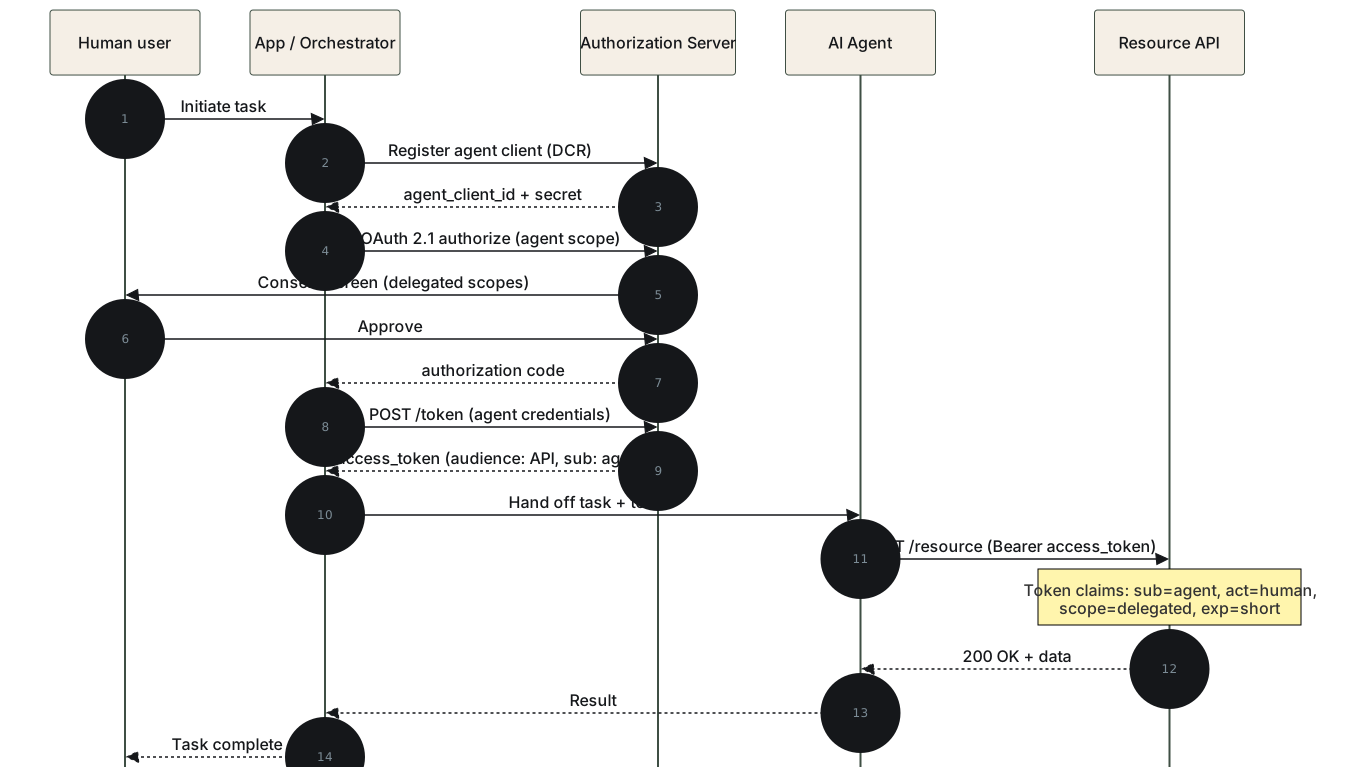
Fine-grained authorization at the API
The protected API or MCP server verifies scope and on-behalf-of context on every call, applying relationship-based checks rather than coarse roles.

Data objects & boundaries
- Agent / workload identity
- A first-class, non-human identity distinct from any human user.
- Delegation grant
- Explicit, consented on-behalf-of authority with a defined scope and lifetime.
- Scoped token
- Short-lived credential limited to specific actions; never the human's full session token.
- Authorization policy
- Fine-grained, relationship-based rules enforced at the API.
- Agent audit event
- Revocable, traceable record of every action an agent takes.
Required standards & protocols
- OAuth 2.1 with scoped, short-lived access tokens
- Token exchange (RFC 8693) for on-behalf-of delegation
- OAuth client credentials or workload identity (mTLS / SPIFFE) for machine auth
- Fine-grained / relationship-based authorization (ReBAC) at the API
Build-vs-buy decisions
| Decision | Build if | Buy if |
|---|---|---|
| Agent / workload identity | You have deep OAuth and workload-identity expertise. | You want per-agent identity and rotation without building the issuance and lifecycle. |
| Fine-grained authorization | Your authz maps cleanly to simple scopes. | You need relationship-based, revocable, per-action authorization for agents. |
| Delegation / consent for on-behalf-of | Rarely worth building; the flows are subtle. | You want a supported on-behalf-of model with explicit, revocable consent. |
Weigh the whole picture with the build-vs-buy worksheet.
Anti-patterns
Agents reusing the human's session
An agent with the user's full session has far more access than it needs and cannot be revoked independently.
Shared, long-lived API keys
Shared keys break least privilege, rotation, and attribution; issue per-agent, short-lived tokens instead.
No revocation path for a rogue agent
If you cannot revoke a single agent's access instantly, one compromised agent is a standing breach.
Coarse scopes for fine-grained needs
Broad scopes over-grant; use relationship-based authorization enforced per action.
Implementation checklist
- Give every agent and workload its own identity, never a shared key
- Issue short-lived, narrowly-scoped tokens
- Capture explicit, revocable on-behalf-of delegation and consent
- Enforce fine-grained authorization at the API or MCP server
- Make every agent action revocable independently of the user
- Audit all agent actions with full traceability
- Rotate machine credentials automatically
What to require of a platform
- Per-agent / per-workload identity issuance
- Short-lived, scoped tokens with token exchange (on-behalf-of)
- Workload identity (mTLS / SPIFFE) or scoped agent tokens
- Fine-grained / relationship-based authorization
- Instant, per-agent revocation
- Full agent audit trail
Related guides
Head-to-head comparisons
Compliance
FAQ
- Can an AI agent just use the user's session?
- No. An agent with the user's full session has far more access than it needs and cannot be revoked independently. Give each agent its own identity and short-lived, scoped tokens via on-behalf-of delegation.
- How do I revoke a single misbehaving agent?
- Issue per-agent identities and short-lived tokens so you can revoke one agent instantly without affecting the user or other agents. If you cannot revoke a single agent, a compromised one is a standing breach.