
AI Agent Observability, Evaluation & Governance: The 2026 Market Reality Check
57% of organizations now run AI agents in production, yet observability remains the lowest-rated part of the AI stack.
Why This Research Matters
Here's something that caught my attention while analyzing the AI infrastructure landscape: everyone's building AI agents, but almost nobody knows if they're actually working as intended.
After spending years scaling identity systems to serve over a billion users at CIAM Platform, I learned a fundamental truth: you can't improve what you can't measure. The same principle applies to AI agents, but the measurement tools are nowhere near ready for what's coming.
The numbers tell the story: 57% of organizations now have AI agents in production, yet observability and evaluation remain the lowest-rated parts of the AI stack. Only one-third of teams are satisfied with their current solutions. That's not just a gap, it's a chasm that represents both a massive risk and an equally massive opportunity.
This research analyzes 90+ companies building in this space, identifies five critical market gaps, and outlines what needs to happen for AI agents to scale safely across enterprises. If you're building, investing in, or deploying AI agents, understanding this landscape isn't optional anymore.
Key Takeaways
- 57% of organizations now run AI agents in production, but observability and evaluation remain the lowest-rated parts of the AI stack, with fewer than one in three teams satisfied with their current tooling.
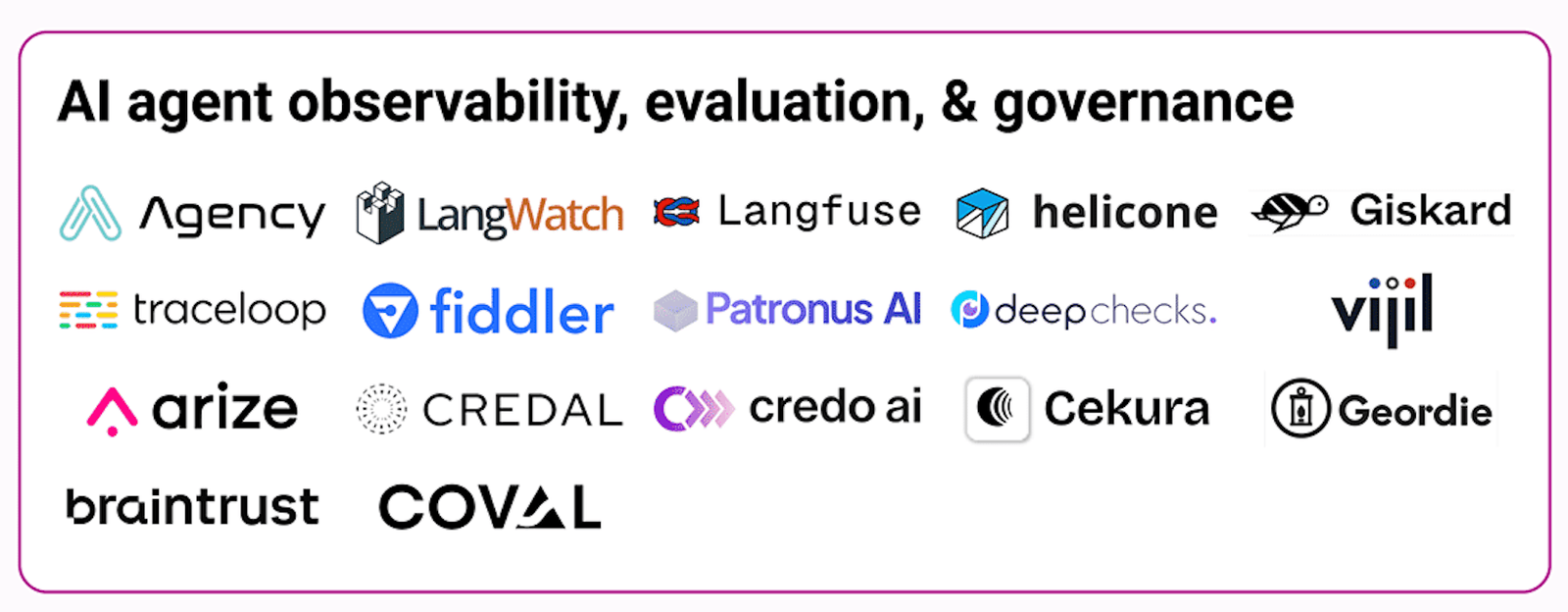
- The market splits into three tiers: open-source observability tools (Langfuse, Arize/Phoenix, Traceloop), evaluation and testing platforms (Patronus AI, Braintrust, Galileo), and governance/compliance platforms (Credo AI, Fiddler AI, Holistic AI), plus APM incumbents like Datadog and Dynatrace extending into AI.
- Five tooling gaps dominate the market: multi-agent system observability, real-time online evaluation, human-in-the-loop workflows, cross-platform governance, and automated compliance reporting.
- Regulation is already binding, not hypothetical. The EU AI Act's prohibited-practices rules took effect in February 2025 and general-purpose model obligations followed in August 2025, with penalties up to €35M or 7% of global turnover.
- Expect consolidation: APM vendors, cloud providers, and security companies are the most likely acquirers of observability and governance startups between now and 2027.
The Market Context: Why Now?
Three forces are converging to make AI agent observability mission-critical, and they're all accelerating faster than most people realize.
Regulatory Reality
The EU AI Act isn't coming, it's here. Prohibited AI practices became enforceable in February 2025. General-purpose AI model obligations kicked in August 2025. The penalties are real: up to €35M or 7% of global turnover, whichever is higher.
After navigating data residency requirements across dozens of countries while building CIAM platform, I can tell you that compliance isn't something you bolt on later. The companies treating governance as an afterthought are building technical debt that will cost them exponentially more to fix later, a pattern I've documented in the shadow AI governance crisis, where most large enterprises can't even inventory the AI systems already running inside them.
Production Deployment Surge
The shift from demos to production is happening faster than the infrastructure can handle, according to LangChain's State of AI Agents Report 2025:
- 57% of organizations have agents in production (up from 51% just last year)
- 72% of enterprise AI projects involve multi-agent architectures (up from 23% in 2024)
- 49% of enterprises have 10+ agents running in production
- Financial services alone is spending $80B+ on AI in 2025, per Bain's Technology Report 2025
Think about that progression. We went from 23% to 72% multi-agent adoption in a single year. The tooling to observe, evaluate, and govern these systems isn't evolving at the same pace.
The Trust Problem
Here's the catch: despite all this deployment, trust remains the bottleneck, according to Cleanlab's AI Agents in Production Survey 2025:
- 69% of AI-powered decisions still require human verification
- 32% cite quality as the top barrier to production deployment
- Only 34% have achieved full agentic AI deployment despite significant budgets
The real story is that we're deploying systems we don't fully trust, at a scale we can't fully monitor, with compliance requirements we're barely meeting. That's not sustainable.
Market Landscape: Who's Building What
The market has fragmented into distinct categories, each addressing different parts of the observability problem. Here's how the key players stack up. If you're running this comparison internally, the same due-diligence discipline I outline in how to compare SaaS tools when every G2 review is paid applies directly to evaluating these vendors.
Observability-Focused Platforms
| Company | Focus | Key Differentiator |
|---|---|---|
| Langfuse | LLM Tracing & Prompt Management | Open-source (MIT), 19K+ GitHub stars, production-ready |
| LangSmith | LangChain Ecosystem Observability | Native integration for LangChain/LangGraph users |
| Arize AI / Phoenix | ML + LLM Observability | OpenTelemetry-native, enterprise Arize AX platform |
| Helicone | LLM Gateway & Cost Tracking | 2-minute setup, 100+ model support, automatic cost tracking |
| LangWatch | LLM Evaluation & Monitoring | Agentic AI testing focus, ISO 27001/SOC2 |
| Traceloop | OpenTelemetry-based Tracing | SOC2 compliant, free tier (50K spans/month) |
| Datadog LLM Observability | Enterprise APM Extension | Full-stack integration, security scanning |
Evaluation & Testing Platforms
| Company | Focus | Key Differentiator |
|---|---|---|
| Giskard | AI Red Teaming & Security | Open-source library + Hub, DeepLearning.AI course |
| Patronus AI | Hallucination Detection & Safety | HaluBench benchmark for faithfulness |
| Braintrust | Evals + CI/CD Integration | Production traces → eval datasets workflow |
| Galileo | GenAI Evaluation Platform | Luna-2 models for real-time guardrails |
| Opik (Comet) | Agent Reliability & Monitoring | Open-source, comprehensive agent evaluation |
| Maxim AI | Agent Simulation & Testing | AI-generated test scenarios at scale |
Governance & Compliance Platforms
| Company | Focus | Key Differentiator |
|---|---|---|
| Vijil | AI Agent Trust Layer | Gartner Cool Vendor 2025, $17M raised |
| Credal AI | Secure Enterprise AI Agents | Y Combinator, enterprise access controls |
| Fiddler AI | ML + LLM Governance | Explainability, regulatory compliance focus |
| Credo AI | AI Governance Platform | Policy-to-proof management |
| Arthur AI | Model Performance & Governance | Open-source Arthur Engine for real-time eval |
| Monitaur | Lifecycle Compliance | Strong in insurance/financial services |
| Holistic AI | End-to-End AI Governance | Risk management, compliance tracking |
Enterprise APM Players Expanding into AI
The established monitoring companies are making their move:
| Company | Approach | Pricing Signal |
|---|---|---|
| Datadog | Dedicated LLM Observability module | $20-100K+/year |
| Dynatrace | AI-powered observability | Usage-based pricing |
| New Relic | AI monitoring integration | Enterprise tier |
| Splunk | Resolve AI spinoff | $1B valuation |
The Five Critical Gaps (And Why They Matter)
Through analysis of industry reports, customer surveys, and competitive positioning, five significant gaps emerge. These aren't just product opportunities, they're the infrastructure requirements that will determine which agent use cases actually scale.
Gap 1: Multi-Agent System Observability
The Reality: Current observability tools were built for single-agent or simple chain architectures. But 72% of enterprise AI projects now use multi-agent systems, and these systems fail in fundamentally different ways.
The data is stark:
- Multi-agent systems have 14 distinct failure modes across three categories: system design failures (44.2%), inter-agent misalignment (32.3%), and task verification problems (23.5%)
- 43% of product teams report inter-agent communication as the largest source of latency
- Debugging multi-agent systems without proper observability is "exponentially harder" than single-agent debugging
What's Actually Missing:
When an agent makes a decision based on information from three other agents, and that decision cascades to five more agents, how do you trace the decision path? How do you identify which agent introduced the error? How do you detect coordination bottlenecks before they become critical?
Current tools don't answer these questions well because they weren't designed for multi-agent complexity. They show you individual agent traces, but not the interaction patterns that create emergent behaviors. Those blind spots are exactly what attackers exploit once agents start chaining actions across systems, a risk I break down in AI vulnerability chaining.
The Technical Gap:
- Graph-based visualization of agent decision paths across multiple agents
- End-to-end tracing of inter-agent message flows with timing breakdowns
- Coordination bottleneck detection and analysis
- Cascading failure impact assessment
Market Signal: Microsoft has published a comprehensive Multi-Agent Reference Architecture with observability guidelines, but the tooling implementations lag significantly behind the framework guidance.
Gap 2: Real-Time Online Evaluation
The Reality: 52% of organizations run offline evaluations on test sets. Only 37% run online (production) evaluations, a split LangChain's State of AI Agents Report 2025 also documents. This 15-percentage-point gap represents a fundamental challenge: teams can't assess quality in real-time without adding unacceptable latency.
Here's what I learned from scaling large scale infra: the bugs that matter most only show up in production, under real load, with real data. The same is true for AI agents. Your test data never perfectly represents production behavior.
The Production Challenge:
- Latency is the second-biggest production challenge (20% of respondents cite it)
- For enterprises with 10K+ employees, hallucinations and output consistency are the top quality issues
- Evaluation practices mature once agents reach production, "not evaluating" drops from 29.5% to 22.8%
What's Actually Missing:
The problem isn't just running evals, it's running them fast enough to matter. If your evaluation takes 500ms and your agent needs to respond in 200ms, you can't evaluate in the critical path. You're forced to evaluate asynchronously, which means you're catching problems after they've already impacted users.
The Technical Gap:
- Sub-100ms guardrail evaluation that can run inline
- Progressive quality degradation detection (catching slow trends, not just sudden failures)
- Real-time drift monitoring without performance impact
- Automated production-to-eval feedback loops
Market Signal: Galileo's Luna-2 models offer real-time guardrails, but most platforms still treat evaluation as a pre-deployment activity rather than a continuous production necessity.
Gap 3: Human-in-the-Loop Integration
The Reality: HITL is mentioned everywhere as a feature, but almost no platform provides comprehensive guidance on actually implementing effective human oversight at scale. Most annotation and approval workflows are custom-built by each organization.
The numbers tell the story:
- 66.5% of organizations say employees need additional skills training to manage AI agents
- Regulated enterprises are leading adoption of manager features (approvals, review controls)
- Human oversight is being "embedded directly into workflows rather than treated as an afterthought"
What's Actually Missing:
Think about what "human-in-the-loop" actually means in production. It's not just about having a button that lets someone approve or reject. It's about:
- Routing the right decisions to the right humans at the right time
- Providing enough context for humans to make informed decisions quickly
- Learning from human feedback to improve future autonomous decisions
- Managing escalation paths when confidence is low
- Training humans to oversee AI effectively
None of the major platforms make this easy. You're building most of this yourself.
The Technical Gap:
- Native annotation queues and review dashboards
- Configurable approval workflows based on confidence/risk scoring
- Escalation path management with role-based routing
- Structured human feedback → model improvement pipelines
- Training and calibration tools for human reviewers
Market Signal: LangGraph and similar frameworks let you "bake in human approval and moderation steps," but the tooling layer for managing these interactions at enterprise scale is severely underdeveloped.
Gap 4: Cross-Platform Governance
The Reality: Organizations are experiencing "agent sprawl", too many agents scattered across teams, tools, and workflows without coordination. According to IDC's AI Agent Adoption Study, 97% haven't figured out how to scale agents across their organization.
I've seen this pattern before with identity systems. When every team builds their own authentication, you end up with dozens of incompatible identity solutions, each with its own security model, audit trail, and compliance gaps. The same thing is happening with AI agents.
The Sprawl Problem:
- 63% of executives cite "platform sprawl" as a growing concern
- Regulated enterprises rebuild their AI agent stack every 3 months or faster
- No dominant standard for governance across LangChain, CrewAI, AutoGen, Google ADK, OpenAI Agents SDK, etc.
What's Actually Missing:
When you have agents built on five different frameworks, each with its own tracing format, its own evaluation approach, its own access control model, how do you govern that? How do you ensure consistent security policies? How do you even inventory what agents exist?
The Technical Gap:
- Unified agent registry and inventory across frameworks
- Cross-platform policy enforcement (apply the same security policy to LangChain and AutoGen agents)
- Centralized permission and access management
- Framework-agnostic governance dashboards
Market Signal: OpenTelemetry provides a foundation for standardized tracing, but LLM and agent-specific semantic conventions are still emerging. Each framework is building its own observability patterns.
Gap 5: Automated Compliance
The Reality: Regulatory requirements are accelerating faster than compliance tooling can handle. Only 28% test for bias. Only 22% test for interpretability. These aren't nice-to-haves anymore, they're legal requirements.
Having navigated GDPR, CCPA, and data residency requirements across dozens of countries while building CIAM platform, I can tell you that manual compliance doesn't scale. You need automated systems that can:
The Compliance Challenge:
- EU AI Act requires documentation, transparency, and risk assessments for high-risk systems
- PII scrubbing, tenancy isolation, and audit logs are "still on the roadmap" for many platforms
- Compliance gaps "only emerge under realistic workloads and data flows"
- Many platforms lack built-in GDPR workflows and data retention management
What's Actually Missing:
Compliance isn't just about generating a report. It's about continuous monitoring, automated risk assessment, and audit-ready documentation that's generated as a byproduct of normal operations, not as a separate manual process.
The Technical Gap:
- Automated EU AI Act compliance reporting with evidence trails
- Continuous bias and fairness monitoring across demographic segments
- Audit-ready documentation generation (automatic, not manual)
- NIST AI RMF and ISO 42001 alignment tracking
- Regulatory change management (automatically adapting to new requirements)
Market Signal: Platforms like Monitaur and Holistic AI focus on compliance but lack deep integration with observability and evaluation workflows. You end up with separate systems that don't talk to each other.
The Strategic Opportunities
Based on these gaps, five high-potential opportunities emerge for both founders and enterprises. These aren't just product ideas, they're infrastructure categories that need to exist for AI agents to scale safely.
Opportunity 1: Guardian Agents
Gartner predicts Guardian Agents, specialized AI agents that oversee and manage other agents, will capture 10-15% of the agentic AI market by 2030. This is a greenfield category with almost no established players.
What Guardian Agents Actually Do:
Think of them as the security team for your AI infrastructure. They leverage agentic AI capabilities combined with deterministic evaluations to:
- Monitor other agents in real-time
- Balance runtime decision-making with risk management
- Enforce guardrails dynamically based on context
- Provide automated trust, risk, and security controls
- Intervene when agents start behaving unexpectedly
Why This Matters Now:
As Gartner notes, "Agentic AI will lead to unwanted outcomes if it is not controlled with the right guardrails." As agent autonomy increases, so does the blast radius of mistakes. A Guardian Agent can catch problems before they cascade.
The Market Opportunity:
If the agentic AI market reaches even conservative projections ($7.9B in 2025 → $199B by 2035), a 10-15% slice of that represents a $20-30B opportunity by 2035. The platforms that establish themselves as the trusted oversight layer will capture significant value.
Entry Strategy: Build on existing guardrail frameworks (NeMo Guardrails, Guardrails AI) but add agentic capabilities for dynamic adaptation and autonomous decision-making about when to intervene.
Opportunity 2: Vertical-Specific Solutions
Horizontal platforms struggle to address the unique compliance and workflow requirements of regulated industries. Purpose-built solutions can command premium pricing because they solve problems that generalized tools can't.
High-Value Verticals:
| Vertical | Compliance Requirements | Market Signal | Specific Needs |
|---|---|---|---|
| Financial Services | SOX, Basel III, AML/KYC | $80B+ AI spend in 2025 | Transaction monitoring, model risk management |
| Healthcare | HIPAA, FDA guidance | Stanford Cancer Center deploying agents | PHI protection, clinical validation |
| Legal | Attorney-client privilege, eDiscovery | Harvey raised $300M Series D | Document confidentiality, audit trails |
| Government | FedRAMP, NIST RMF | EU AI Act public sector focus | Security clearances, transparency requirements |
Why Verticals Win:
From my experience with CIAM platform serving financial services and healthcare customers, I learned that compliance isn't just about checking boxes, it's about understanding the operational workflows, the regulatory nuances, and the risk tolerance of each industry. A banking compliance officer and a hospital CISO have fundamentally different priorities.
Entry Strategy: Start with one vertical. Build deep compliance expertise. Establish credibility through partnerships with industry associations and regulatory consultants. Expand horizontally once you're the trusted solution in one space.
Opportunity 3: Open-Source Enterprise Bridge
The market shows clear bifurcation that creates an opportunity for platforms that can bridge both worlds:
Open-Source Tools:
- Langfuse (MIT license), Phoenix, TruLens
- Free to use, full data control
- Requires infrastructure management expertise
- Strong developer community
Enterprise Platforms:
- Datadog, Arize AX, Dynatrace
- $50-100K+/year pricing
- Turnkey deployment, managed infrastructure
- Limited flexibility, vendor lock-in concerns
The Gap: Engineering teams want data control and vendor independence while still needing enterprise-grade capabilities. The platforms that bridge this gap can capture both ends of the market.
The Winning Formula:
Having built both open-source libraries and commercial SaaS for IAM industry, here's what works:
- Open-source core with MIT or Apache 2.0 licensing (not AGPL)
- Generous free tier that's actually useful, not just a marketing gimmick
- Easy self-hosting with excellent documentation and Docker/Kubernetes support
- Progressive enterprise features (SSO, RBAC, compliance, multi-tenancy) that justify commercial pricing
- Transparent upgrade path with clear differentiation between open-source and commercial features
Success Example: Langfuse has executed this well, MIT licensing, cloud and self-hosted options, clear documentation, and a transparent enterprise tier. They're not trying to upsell you on day one, which builds trust.
Opportunity 4: Multi-Agent Orchestration Observability
As orchestration frameworks proliferate (LangGraph, CrewAI, AutoGen, Google ADK, OpenAI Agents SDK), there's a clear need for framework-agnostic observability that works across patterns.
The Challenge:
Each framework has its own way of structuring agent interactions. LangGraph uses state graphs. CrewAI uses crew hierarchies. AutoGen uses conversational patterns. How do you build observability that works across all of them without requiring different instrumentation for each?
Technical Requirements:
- OpenTelemetry-native with LLM-specific semantic conventions
- Graph visualization of agent decision paths that works regardless of framework
- Cross-framework tracing with unified span structure
- Multi-agent coordination metrics (latency between agents, message passing patterns, bottleneck detection)
The Competitive Moat:
The platform that becomes the de facto standard for multi-agent tracing captures significant switching costs. Once teams instrument their code with your SDK and build dashboards on your platform, they're sticky. Observability data has high lock-in potential.
Entry Strategy: Build excellent open-source instrumentation libraries first for each major framework. Make them ridiculously easy to integrate. Then monetize the visualization, analysis, and alerting layer. Give away the data collection, sell the insights.
Opportunity 5: Continuous Evaluation Platform
The gap between offline evals (52% adoption) and online evals (37% adoption) represents a significant product opportunity. The vision is to seamlessly connect development testing with production monitoring.
What This Looks Like in Practice:
Imagine a workflow where:
- Agent fails in production with a specific input
- System automatically captures that failure as a test case
- Engineering team reproduces the failure in development
- Fix is implemented and validated against the new test case
- Eval suite now includes this regression test
- Similar failures are prevented automatically
That's continuous evaluation. It's not just about running evals, it's about closing the loop from production failures to development improvements to automated regression prevention.
Key Features:
- Production trace → evaluation dataset with one click
- Eval results surfaced in CI/CD (show eval failures directly in pull requests)
- Automatic regression detection when new changes degrade quality on historical test cases
- Shared workspace for engineers, PMs, and domain experts to collaborate on evals
Competitive Landscape: Braintrust is executing on this vision with their production traces to eval datasets workflow. But the market can support multiple winners given the complexity of requirements across different agent architectures and use cases.
Market Projections: What's Coming
Size and Growth
The figures below combine estimates from CB Insights' Agentic Commerce Market Map and Bain's Technology Report 2025:
| Metric | 2025 | 2030 | 2035 |
|---|---|---|---|
| Enterprise AI Governance Market | $2.2B | $4.9B | $9.5B |
| Governance Platforms Market Share | 48% | , | , |
| Autonomous AI Agent Market | $7.9B | , | $199B |
| Agentic AI GDP Contribution | , | $2.6-4.4T | , |
The numbers are staggering, but here's what matters: the governance market is growing at 16-17% CAGR while the overall agent market is growing at 40%+ CAGR. That delta represents the infrastructure gap, agents are being deployed faster than governance tools can handle.
Technology Evolution Timeline
2025-2026: Foundation Building
- Observability becomes table stakes (you can't deploy agents without it)
- Basic guardrails and compliance tooling reach production-ready maturity
- OpenTelemetry adoption accelerates as the de facto standard for agent tracing
- First wave of consolidation begins
2026-2027: Guardian Agent Emergence
- Specialized oversight agents enter production at scale
- Autonomous governance systems emerge (agents monitoring agents)
- Multi-agent debugging tools mature beyond simple trace visualization
- Vertical-specific compliance platforms gain traction
2027-2028: Multi-Modal Expansion
- Vision, audio, and document agent observability become standard
- Cross-modal tracing and evaluation (agent orchestrating across modalities)
- Embodied AI governance frameworks for physical-world agents
- Real-time safety guarantees for high-stakes applications
2028-2030: Self-Healing Systems
- Agents that automatically improve from production feedback without human intervention
- Continuous learning with governance constraints
- Autonomous compliance adaptation to new regulations
- Human-in-the-loop becomes exception-based rather than default
Consolidation Predictions
The market is primed for consolidation, and we're already seeing signals.
Recent M&A Activity (also tracked in CB Insights' Agentic Commerce Market Map):
- Palo Alto Networks acquired Chronosphere (data observability) for $3.35B
- Resolve AI (founded by ex-Splunk team) reached $1B valuation at Series A
- Major enterprise funding continues ($40B to OpenAI, $13B to Anthropic)
Expected Acquirers:
APM Vendors: Datadog, Dynatrace, New Relic are seeking AI observability capabilities to prevent customer attrition. If your customers are deploying AI agents and you don't have observability for them, they'll switch to a platform that does.
Cloud Providers: AWS, Azure, GCP are building integrated agent platforms. They'll acquire rather than build specialized capabilities that give them governance credibility.
Security Companies: Palo Alto, CrowdStrike, Zscaler are expanding from network/endpoint security into AI governance. They have budget, distribution, and trust. They're looking for technology and talent.
Likely Acquisition Targets:
- Open-source leaders with strong enterprise traction (Langfuse, Phoenix)
- Vertical-specific governance platforms with proven compliance capabilities
- Guardian Agent pioneers with working production deployments
Timeline Prediction: Major acquisitions (9-figure+) will happen between Q3 2026 and Q1 2027 as enterprises demand integrated solutions and acquirers realize they can't build fast enough internally.
Investment Thesis: For Founders and Investors
For Founders: Where to Build
High-Potential Areas:
- Multi-agent system observability with graph-based debugging that actually works at scale
- Guardian Agent platforms for runtime oversight with autonomous intervention capabilities
- Vertical-specific compliance automation (finserv, healthcare, legal) with deep regulatory expertise
- Framework-agnostic instrumentation and tracing that becomes the standard across orchestration platforms
- Continuous evaluation platforms with production-to-dev feedback loops and automated regression prevention
Avoid These Crowded Areas:
- General-purpose LLM observability - Langfuse has significant momentum and network effects
- Basic prompt management - Commoditizing rapidly, low differentiation
- Simple cost tracking - Table stakes feature, not a platform
Go-to-Market Strategy:
Start with one well-defined customer persona. If you're building for "anyone using AI agents," you're building for no one. Pick:
- Enterprise AI teams at Fortune 500s
- AI-native startups deploying agents
- Regulated industry practitioners (finserv, healthcare)
- Individual developers building agent applications
Build something that 10 people love before building something that 1,000 people tolerate.
For Investors: Bull and Bear Cases
Bull Case:
The market signals are unambiguous:
- 62% of teams plan observability improvements in the next year, that's massive demand
- Regulatory tailwinds (EU AI Act enforcement) create compliance urgency
- 89% observability adoption but low satisfaction (fewer than 33% happy) = replacement opportunity
- Multi-agent complexity creates new tooling requirements that existing APM tools can't handle
The infrastructure layer that enables safe AI agent deployment at scale will capture enormous value. The winners in this category will be as foundational as Datadog, Splunk, and New Relic were for traditional infrastructure.
Bear Case:
The risks are real:
- Cloud provider lock-in: AWS, Azure, GCP building native capabilities could commoditize the market
- Open-source commoditization: If Langfuse and Phoenix solve 80% of problems for free, commercial opportunities shrink
- Market fragmentation: Too many frameworks, too much heterogeneity, hard to build platform solutions
- Enterprise budget uncertainty: If AI ROI doesn't materialize, budgets will contract fast
My Take:
Having built enterprise SaaS through the cloud transition, I've seen this pattern before. The bear case arguments are valid, but they underestimate the complexity of what enterprises actually need. Cloud providers will build basic capabilities, but they won't build vertical-specific compliance tools. Open source will solve data collection, but enterprises will pay for insights, automation, and guarantees.
The question isn't whether there's a market, it's which specific problem you're solving and for whom.
Key Metrics to Track:
For due diligence, watch these leading indicators:
- Production agent count growth at enterprises (not just POCs)
- EU AI Act enforcement actions (first major fines will accelerate compliance spend)
- Multi-agent architecture adoption rates in your target segment
- Open-source star velocity (Langfuse, Phoenix, Opik growth rates)
- Customer concentration (diversified vs. single-vertical)
Conclusion: The Infrastructure Opportunity
The AI Agent Observability, Evaluation & Governance market is at a genuine inflection point. Three forces are converging:
- Regulatory requirements that are already in force (EU AI Act)
- Accelerating adoption with 57% of organizations running agents in production
- Critical tooling gaps in multi-agent, online evals, HITL, and compliance
This creates a once-in-a-generation infrastructure opportunity.
The winners will be platforms that:
- Provide end-to-end visibility into multi-agent systems that scales with complexity
- Seamlessly bridge development evaluation and production monitoring
- Automate compliance for regulated industries with audit-ready evidence
- Offer open-source foundations with clear paths to enterprise capabilities
- Become the trusted governance layer for autonomous AI
The Real Story:
Trust, governance, and transparency will determine which agent use cases scale and which get shut down by regulators, customers, or internal compliance teams. The infrastructure to deliver that trust is still being built.
After scaling identity infrastructure to serve over a billion users, I learned that the most valuable infrastructure isn't the most technically impressive, it's the most trusted. The companies that solve for trust at scale will capture disproportionate value.
The opportunity is now. The infrastructure that enables safe AI agent deployment at scale will be as foundational as the agents themselves.
Frequently Asked Questions
What is AI agent observability?
AI agent observability is the practice of tracing, monitoring, and analyzing how an AI agent reaches its outputs, not just what it outputs. Tools like Langfuse, LangSmith, and Arize AI/Phoenix capture an agent's full trace, its reasoning steps, tool calls, and decisions, so teams can debug failures and track cost and latency once the agent is live.
How is AI agent observability different from LLM observability?
LLM observability typically tracks a single model call: a prompt in, a completion out. AI agent observability has to account for multi-step reasoning, tool use, and, increasingly, multiple agents coordinating with each other. That gap is the biggest unmet need in this market: 72% of enterprise AI projects now involve multi-agent architectures, but most current tools were built for single-agent or simple chain use cases. They show individual agent traces without the interaction patterns, message flows, or coordination bottlenecks that cause multi-agent systems to fail.
What's the difference between observability, evaluation, and governance tools?
Observability platforms (Langfuse, LangSmith, Arize AI/Phoenix, Datadog LLM Observability) trace what an agent did. Evaluation and testing platforms (Patronus AI, Braintrust, Galileo, Giskard) score whether that output was correct, safe, or aligned with policy. Governance and compliance platforms (Credo AI, Fiddler AI, Arthur AI, Holistic AI, Monitaur) turn those signals into audit-ready documentation and policy enforcement. Most vendors specialize in one tier; few cover all three well.
What tools exist for AI agent governance?
The governance and compliance tier includes Vijil (AI agent trust layer, Gartner Cool Vendor 2025), Credal AI (secure enterprise agent access controls), Fiddler AI (explainability and regulatory compliance), Credo AI (policy-to-proof management), Arthur AI (open-source real-time evaluation engine), Monitaur (lifecycle compliance for insurance and financial services), and Holistic AI (end-to-end risk management). None of them yet integrate deeply with the observability and evaluation layers, which is why teams often end up stitching together separate systems that don't talk to each other.
Why do so few teams run real-time (online) evaluations?
Because evaluation adds latency, and most agents can't absorb that cost in the critical path. Only 37% of organizations run online evaluations versus 52% that run offline evaluations on test sets. If an eval takes 500ms and the agent needs to respond in 200ms, teams are forced to evaluate asynchronously, which means they catch problems after users have already been affected.
What's driving consolidation in this market?
Three types of acquirers are active: APM vendors (Datadog, Dynatrace, New Relic) that need AI observability to prevent customer attrition, cloud providers (AWS, Azure, GCP) that would rather acquire governance credibility than build it from scratch, and security companies (Palo Alto Networks, CrowdStrike, Zscaler) expanding from network and endpoint security into AI governance. Recent moves, including Palo Alto Networks' $3.35B acquisition of Chronosphere and Resolve AI's $1B valuation at Series A, point toward major acquisitions landing between Q3 2026 and Q1 2027.
For more vendor landscape research like this, browse the Analysis hub.
Research Methodology
This analysis synthesized data from:
- LangChain State of AI Agents Report 2025
- Cleanlab AI Agents in Production Survey 2025
- IDC AI Agent Adoption Study
- Gartner AI Predictions 2025-2030
- Bain Technology Report 2025
- CB Insights Agentic Commerce Market Map
- Analysis of 90+ companies across observability, evaluation, and governance categories
- Primary research through vendor documentation and product analysis
About This Research
This Research Data Sheet is part of an ongoing series analyzing the infrastructure requirements for enterprise AI deployment. Future topics will include machine identity management, AI agent security architecture, and compliance automation frameworks.
For questions, corrections, or collaboration inquiries, connect with me on LinkedIn.
Disclaimer: This research is provided for informational purposes only and should not be considered investment advice. Market projections are based on available data and analyst reports but are inherently uncertain. Always conduct your own due diligence before making investment or business decisions.
More from Deepak Gupta
Every page on guptadeepak.com is hand-curated by Deepak Gupta. Pick a thread:
- About Deepak Gupta Founder, cybersecurity architect, and writer at guptadeepak.com.
- My journey From LoginRadius (2013, 1B+ users) to GrackerAI, in milestones.
- Publications & patents Books, free e-books, a journal special issue, and five granted patents.
- Research Hub Curated research, buyer's guides, vendor comparisons, and technical deep-dives.
Get the newsletter
New writing on identity, AI security, and building software, delivered when it ships. No tracking pixels, no funnels, unsubscribe with one click.