
IAM vs CIAM vs IDaaS: What's the Difference and Which Do You Need?
IAM is for employees, CIAM is for customers, and IDaaS is how either is delivered. Here is how they differ and which one you need.
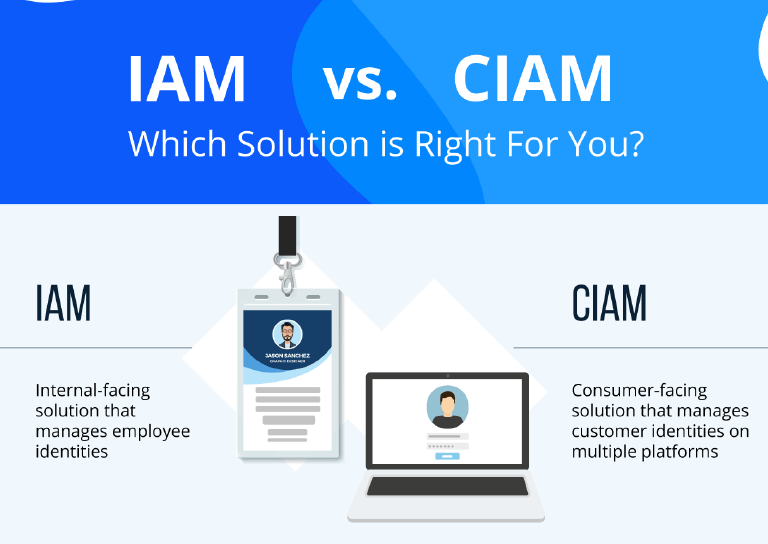
If you are trying to work out whether you need IAM, CIAM, or an IDaaS product, the confusion is not your fault. Vendors use the three terms interchangeably, and the biggest identity companies now sell all of them. Picking the wrong one means forcing an employee-directory tool onto millions of customers, or paying for customer-scale tooling to manage 200 staff.
The short answer: IAM (in everyday use, workforce IAM) secures your employees and contractors. CIAM secures your customers and partners at consumer scale. IDaaS is not a third category; it is the cloud delivery model, and it can deliver either one. Choose IAM for staff, CIAM for anyone who signs up for your product, and decide separately whether you want it as a cloud service (IDaaS) or self-hosted.
This comparison is written from a practitioner's vantage: Deepak Gupta founded LoginRadius, a CIAM platform he scaled to serve over a billion users, and has worked in digital identity for more than 15 years.
Last verified: September 2026. Vendor product lines, ownership changes, and standards references were rechecked this month. See How we evaluated.
Key Takeaways
- IAM is the umbrella discipline; in buying conversations it usually means workforce identity for employees and contractors.
- CIAM is identity for external users: self-service registration, consumer-grade UX, consent management, and scale to millions.
- IDaaS describes how identity is delivered (cloud, subscription, vendor-operated), not who it serves. Most modern CIAM is IDaaS by default.
- The categories blur because Okta, Microsoft, Ping, and IBM sell both workforce and customer identity, but the architectures still differ.
- Most organizations need both workforce IAM and CIAM, usually as separate platforms even when one vendor supplies both.
The Three Terms, Defined
- IAM (Identity and Access Management): the discipline of making sure the right people have the right access to the right resources. It predates the customer-versus-workforce split.
- Workforce IAM: IAM for employees, contractors, and internal partners. The buyer is IT and security, the source of truth is the HR system, and users number in the thousands.
- CIAM (Customer Identity and Access Management): IAM for customers, consumers, partners, and B2B SaaS tenants. The buyer is usually engineering, product, or digital. Users register themselves and number in the millions. See What is CIAM for the full explainer.
- IDaaS (Identity as a Service): identity capabilities delivered as a cloud-hosted, multi-tenant subscription service rather than software you install and run. It can deliver workforce IAM, CIAM, or both.
IAM vs CIAM vs IDaaS: Comparison Table
| Dimension | Workforce IAM | CIAM | IDaaS |
|---|---|---|---|
| What it is | Identity category for internal users | Identity category for external users | Delivery model (cloud service) |
| Users | Employees, contractors | Customers, consumers, partners, B2B tenants | Either, depending on the product |
| Scale | Hundreds to tens of thousands | Hundreds of thousands to billions | Scales elastically with the service |
| Provisioning | Admin-driven, SCIM from HR | Self-service registration, social login | Whatever the delivered product supports |
| UX priority | Functional; friction tolerated | Conversion-critical | Not defined by the model |
| Compliance focus | Internal policy, access reviews, SOX | Consumer privacy: GDPR, CCPA, consent | Vendor certifications, data residency |
| Integrations | Enterprise apps, directories, HR systems | Customer apps, CRM, marketing, e-commerce | REST APIs and standard protocols (SAML, OAuth, OIDC) |
| Cost model | Per employee per month | Per monthly active user, per connection | Subscription (opex) instead of licenses and servers (capex) |
| Main risk | Insider threat, privilege abuse | Account takeover, credential stuffing, fake accounts | Vendor dependency, outage blast radius |
IAM: Workforce Identity
IAM started as the original identity discipline, built to manage employees and internal users. Think of it as the digital version of office keycards and badges. When someone in finance needs access to payroll, IAM handles the request. When an engineer needs admin rights on production, IAM manages that too, ideally with approval and an expiry.
Workforce IAM typically includes:
- Directory services that store users, groups, and credentials
- Single sign-on so employees reach every app with one login, often through federated SSO
- Lifecycle automation so joiners, movers, and leavers trigger access changes everywhere, usually via SCIM from the HR system
- Role-based access control that assigns permissions by job function
- Governance and certification: access reviews, role mining, and segregation of duties
- Privileged access management for admin and service accounts
- Conditional access based on device posture, location, and risk
Workforce IAM once assumed users sat inside a trusted corporate network. Zero Trust has replaced that assumption, but the design priorities remain control, least privilege, and auditability. Employees accept some friction because login is part of the job.
Common workforce platforms include Okta Workforce Identity, Microsoft Entra ID, Ping Identity, JumpCloud, and OneLogin. For a ranked view, see top IAM solutions. For the wider landscape, The Identity Map lays out access management vendors.
CIAM: Customer Identity
CIAM emerged when companies realized customers need a different approach. They arrive unannounced, register themselves, expect consumer-app convenience, and leave when registration or login gets in the way.
CIAM is shaped by five requirements that workforce IAM was not built for:
- Authentication: social login, passkeys, magic links, and adaptive MFA that challenges only risky logins.
- Scalability: millions of identities and traffic spikes during launches and sales events.
- Privacy and data regulation: explicit, granular, revocable consent, plus the ability for users to view, change, export, and delete their data under GDPR and CCPA.
- User experience: progressive profiling instead of long forms, branded flows, and self-service recovery.
- Integrations: CRM, marketing automation, analytics, and e-commerce, feeding a single customer view.
Security assumptions differ too. CIAM must assume customer devices and networks may be compromised, and it faces credential stuffing and bot attacks at a volume internal systems rarely see. For B2B SaaS, CIAM adds organizations: each customer has its own admins, its own SSO connection, and its own SCIM feed.
If you are choosing a CIAM vendor, start with the top 10 CIAM solutions ranking, then compare 30+ vendors in the CIAM providers directory. Our CIAM Compass knowledge portal scores vendors on one matrix at CIAM Compass vendors.
IDaaS: The Delivery Model
IDaaS describes how identity is delivered, not what it does. Instead of buying servers, installing software, and patching it, you subscribe to a cloud service. The term is older than CIAM as a category: it first described cloud workforce identity, the model Okta was founded on in 2009. Today it applies equally to customer identity.
What IDaaS changes:
- Operations: the vendor handles updates, security patches, and scaling, and distributes the service across regions.
- Cost structure: subscription fees replace upfront licenses and hardware, moving identity from capital to operating expense.
- Integration: REST APIs and standard protocols such as SAML, OAuth 2.0, and OpenID Connect suit cloud-native apps and microservices.
- Skills needed: less in-house expertise to deploy and run, though you still own configuration and policy.
Most modern CIAM is IDaaS by default. Self-hosted identity (Keycloak, Ory, self-hosted FusionAuth) is the exception, chosen for data sovereignty, on-premises mandates, or deep customization. The trade-off is the same as any managed-versus-self-hosted decision: total cost, operating capacity, data residency, and how far you need to customize beyond what the vendor exposes. On-premises can cost less over time for stable deployments, but it needs dedicated staff.
Where the Categories Blur
The largest identity vendors sell both workforce and customer identity:
- Okta: Okta Workforce Identity plus Auth0 for customer identity. Okta branded Auth0 as Customer Identity Cloud for a period, then returned to the Auth0 name.
- Microsoft: Entra ID for workforce and Entra External ID for customers. Azure AD B2C stopped being sold to new customers on 1 May 2025.
- Ping Identity: PingOne and ForgeRock, combined since Thoma Bravo completed the ForgeRock acquisition in August 2023, cover both segments.
- IBM: IBM Verify (formerly IBM Security Verify) handles customer and workforce identity in one platform.
CyberArk, long cited as a vendor spanning both, is now part of Palo Alto Networks, which completed the acquisition in February 2026. Its identity offering now centers on workforce, privileged, machine, and AI-agent identity rather than customer identity, so confirm current CIAM coverage directly before shortlisting it.
Convergence matters when you want consistent risk decisions, shared MFA policy, unified audit, or PAM coordination across employees and customers. For most B2B SaaS companies, the simpler answer still holds: pick a CIAM for your product, and let each customer organization run its own workforce IAM.
Architectural Differences That Still Matter
- Data model: CIAM revolves around users and, for B2B, organizations as containers. Workforce IAM revolves around groups, roles, and entitlements drawn from HR.
- Authentication UX: CIAM optimizes for first-time sign-up with social login, passkeys, or magic links. Workforce IAM optimizes for daily SSO, with assurance settled at hire.
- Administration: CIAM admins manage configuration and support cases; workforce IAM admins manage entire identity lifecycles.
- Audit: CIAM audits per-customer activity, often for the customer's own security team. Workforce IAM audits employee access for governance and SOX.
A CIAM repurposed as workforce IAM, or the reverse, usually feels wrong on both sides. The cleaner pattern is one platform per use case, even when one vendor sells both.
The Five Features to Compare
When you weigh IAM against CIAM for a use case, compare all five, not just authentication:
- Authentication: standardized corporate credentials and SSO (IAM) versus a menu of social, passwordless, and adaptive options (CIAM).
- Scalability: predictable headcount growth (IAM) versus spiky, unpredictable consumer traffic (CIAM).
- Privacy and data regulation: internal data governance (IAM) versus consumer consent and data subject rights (CIAM).
- User experience: functional and mandatory (IAM) versus conversion-critical (CIAM).
- Integrations: internal business applications (IAM) versus customer-facing apps and marketing tools (CIAM).
Identity Management vs Access Management (IdM vs IAM)
Identity management (IdM) decides who someone is in your systems. Access management (AM) decides what that identity may do. Identity and access management (IAM) is the umbrella term for both working together. The difference between IdM and IAM is scope: IdM is one half of IAM.
| Identity management (IdM) | Access management (AM) | |
|---|---|---|
| Question it answers | Who is this, and what do we know about them? | Should this identity be allowed to do this, right now? |
| Core jobs | Creating, updating, and removing identities; attributes; directories; provisioning and deprovisioning | Authentication, MFA, single sign-on, sessions, authorization policy |
| When it runs | Across the identity lifecycle: joiner, mover, leaver | At every sign-in and every protected request |
| Typical tools | Directories, HR-driven provisioning, SCIM, identity governance | Identity providers, SSO, MFA, policy engines |
| Failure looks like | Orphaned accounts and stale permissions after someone leaves | A valid user reaching data they should not see |
The two depend on each other. Access decisions are only as good as the identity data behind them, and clean identity data is wasted if access rules are loose. For customer-facing systems the same split applies inside CIAM, where self-registration replaces HR-driven provisioning.
Choosing the Right Approach
- Managing employee access? Choose workforce IAM, delivered as IDaaS or on-premises.
- Building customer-facing applications? Choose CIAM. Scale, UX, and privacy requirements make specialized customer identity necessary.
- Both? Most organizations need both. Some vendors cover both use cases; others specialize and integrate.
- Cloud or self-hosted? Decide on budget, in-house skills, and data residency. Some regulations require data to stay within a region, which narrows your cloud options or favors self-hosting.
Implementation Considerations
- Inventory user types. List every population that needs access (employees, contractors, customers, partners, AI agents) and the applications and data each needs.
- Match security to sensitivity. A payments app needs stronger authentication than a marketing site. Customer-facing apps must balance security with conversion.
- Plan integrations. Standard protocols simplify most connections, but legacy applications may need custom work.
- Plan the migration. Accounts, credentials, and permissions must move without disrupting users. Keep password hashes where the target supports them.
- Manage the change. Train employees on new login processes, and tell customers in advance about account changes.
The Future of Identity Management
- Passwordless by default: NIST SP 800-63-4 (final, July 2025) accepts synced passkeys at AAL2, and several central banks have retired SMS one-time codes for financial services.
- Zero Trust: no user or device is trusted by default, which raises the importance of strong identity verification and continuous monitoring for employees and customers alike.
- AI in both directions: attackers automate phishing and credential stuffing; defenders use behavioral analytics and anomaly detection.
- AI agents as a new identity type: both workforce and customer identity now need to authenticate agents acting on someone's behalf. See identity for AI agents.
- More privacy law: privacy regulation keeps expanding globally, and EU Digital Identity Wallets arrive under eIDAS 2.0 by 24 December 2026.
The IAM, CIAM, and IDaaS distinctions will stay useful because each answers a different question: who the identity belongs to, and how the service is delivered.
How We Evaluated
Last verified: September 2026. This page merges and replaces earlier guptadeepak.com explainers on IAM, CIAM, and IDaaS. We checked vendor product lines and ownership against company announcements and documentation (Auth0's branding, Microsoft's Azure AD B2C end of sale, Ping and ForgeRock, IBM Verify, and Palo Alto Networks' CyberArk acquisition) and standards references against NIST's published text. This is a conceptual comparison, not a vendor test; rankings live in the top 10 CIAM solutions.
Frequently Asked Questions
What is the core difference between IAM and CIAM?
Workforce IAM manages known internal users, provisioning accounts from HR, enforcing least privilege, and supporting audits for a workforce of thousands. CIAM manages external users who register themselves, scaling to millions while handling consent, privacy regulation, consumer UX, and integrations with customer-facing systems.
Is IDaaS the same as IAM or CIAM?
Neither. IDaaS is a delivery model: identity delivered as a cloud subscription service. An IDaaS product can provide workforce IAM, CIAM, or both. Okta's workforce product and Auth0 are both IDaaS, but they serve different users.
Can an IAM system be used to manage customer identities?
Technically you can stretch workforce IAM to cover customers, but it was not built for it. It lacks self-service registration, consumer consent management, and pricing and scaling tuned for millions of users. That gap is exactly what CIAM fills.
When should a business choose IAM, and when CIAM?
Choose IAM for employee-facing identity: provisioning, access rights, compliance reporting, and SSO for staff. Choose CIAM when people sign up for your product, and you need customer authentication, privacy compliance, a low-friction experience, and integrations with customer systems. Most businesses with a digital product need both.
Should one platform handle both customer and workforce identity?
Sometimes. Okta, Microsoft, Ping, and IBM sell both, which helps when you want shared risk policy and unified audit. Even then, most organizations run them as separate deployments because the data models and UX differ. B2B SaaS startups usually pick a CIAM and leave workforce IAM to each customer.
What features should you compare when choosing between IAM and CIAM?
Compare five: authentication, scalability, privacy and data regulation, user experience, and integrations. Weighing all five, rather than authentication alone, shows which category fits your use case.
What is the difference between IdM and IAM?
Identity management (IdM) covers creating and maintaining identities: accounts, attributes, and provisioning. Identity and access management (IAM) includes IdM plus access management, which covers authentication, single sign-on, MFA, and authorization. Every IAM program contains identity management, but identity management alone does not control access.
What is the difference between identity management and access management?
Identity management establishes who a user is and keeps their account and attributes accurate across the lifecycle. Access management uses that identity at the moment of a request to authenticate the user and decide what they are allowed to reach. One manages the record; the other enforces the rules.
What is EIAM, and how is it different from CIAM?
EIAM, or enterprise identity and access management, is another name for workforce IAM: identity for employees, contractors, and partners accessing internal systems. CIAM serves customers using your products. EIAM optimizes for control, audit, and HR-driven lifecycle; CIAM optimizes for self-registration, conversion, consent, and scale.
What are examples of IAM and CIAM use cases?
IAM use cases include employee single sign-on to SaaS tools, onboarding and offboarding staff, privileged access for administrators, and access reviews for auditors. CIAM use cases include customer sign-up and login for a shopping app, passkeys for a banking app, social login for a media site, and per-organization SSO for a B2B SaaS product.
What to Read Next
- What Is CIAM? A Complete Guide: capabilities, architecture, build vs buy, and 2026 trends
- Top 10 CIAM Solutions: the ranked shortlist
- CIAM Providers Directory: 30+ vendors side by side
- Top IAM Solutions: the workforce side
- What Is Federated SSO: how single sign-on spans organizations
More like this
All Identity & CIAM- Identity & CIAMWhy LoginRadius Became a Leading IDaaS ProviderHow I built LoginRadius into an IDaaS platform that handles hybrid environments, SSO, MFA, and compliance at scale.
- Identity & CIAMFederated Identity Management vs. SSO: What's The Difference?Enterprises need to use methods to maximize the use of digital identities for multiple users.
- Identity & CIAM8 Key Components of a Perfect CIAM PlatformMore than just individuals, a perfect CIAM platform needs to be able to incorporate. There are plenty of business processes and…
Get new Identity & CIAM writing
Enjoyed this? Subscribe and tell us what you read most. Identity & CIAM is already ticked for you. No tracking pixels, unsubscribe with one click.